
- Atomic number
- 37
- Atomic mass
- 85.47
- Shells
- 2, 8, 18, 8, 1
- Configuration
- 1s² 2s² 2p⁶ 3s² 3p⁶ 4s² 3d¹⁰ 4p⁶ 5s¹
- In the table
- period 5, group 1 (IA), s-block
- Kind
- Alkali metal
- Valency
- 1 (Rb⁺, as in RbCl and RbOH)
- State at 25 °C
- solid
- Melts · boils
- 39 °C · 688 °C
- Density
- 1.5 × as heavy as water
- Known since
- 1861
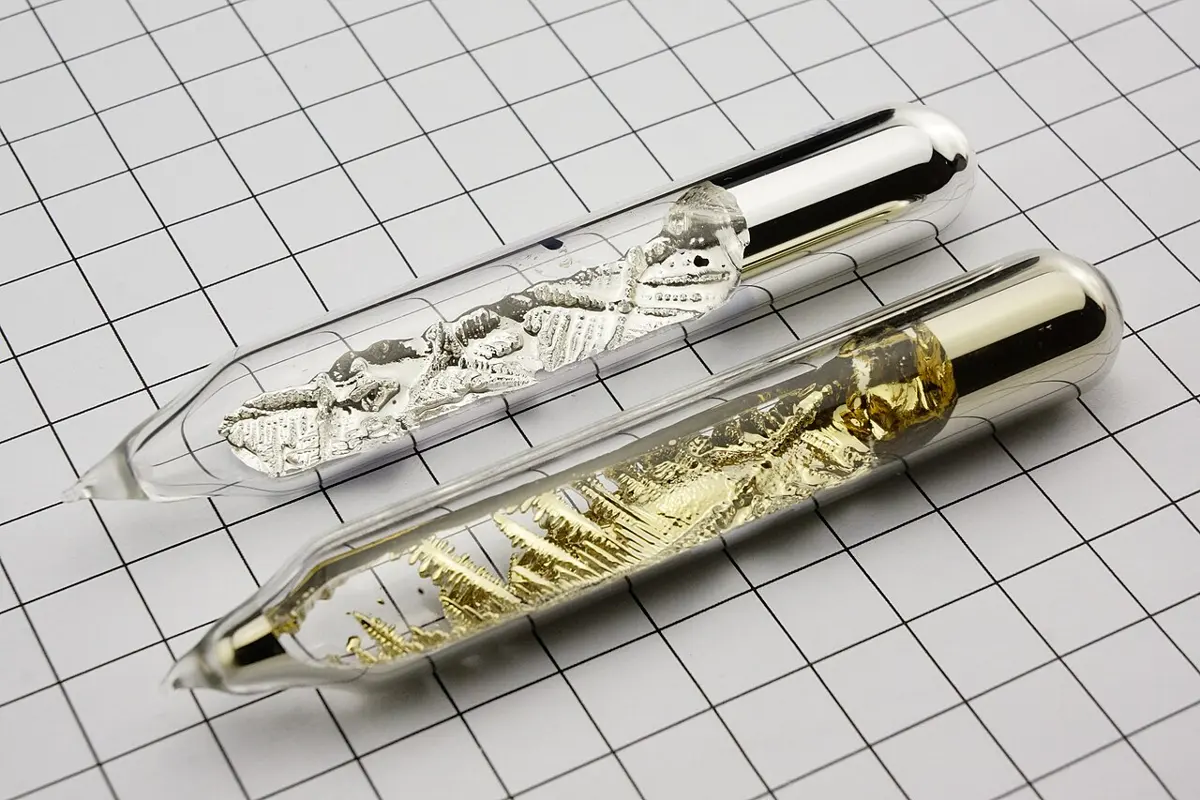
When the map on a phone shows exactly where you are, in Kathmandu or on a trek in Mustang, it works by timing signals from satellites. A difference of a millionth of a second would put you about 300 meters out. So each satellite carries atomic clocks so steady that they would take many thousands of years to drift by a second, and many of them keep time by the atoms of rubidium.
Rubidium is a soft, silvery metal that would melt on a hot summer day in the Terai, and bursts into flame if air reaches it. Here is its story.
The rubidium atom
Every rubidium atom has 37 protons, so rubidium’s atomic number is 37, and a neutral atom has 37 electrons. Natural rubidium has two isotopes; the commoner one has 48 neutrons, mass number 37 + 48 = 85.
Its shells and subshells
By the 2n² rule Grade 8: Bohr and Bury’s rule, the K, L and M shells fill as 2, 8, 18. The N shell could hold 32, but it never gets more than 8 before the next shell begins (an outer shell holds at most 8). So the 37th electron starts a fifth shell, O: 2, 8, 18, 8, 1.
Subshells explain why Grade 10: The Aufbau principle. After 4s, 3d and 4p are full (that is krypton, element 36), the next subshell in order of energy is 5s, which is lower than 4d. So:
1s² 2s² 2p⁶ 3s² 3p⁶ 4s² 3d¹⁰ 4p⁶ 5s¹
Rubidium is krypton plus one electron, in a new shell, just as potassium is argon plus one, and sodium is neon plus one.
Its place in the periodic table
- Period 5, because its electrons are in five shells.
- Group 1, called IA in the older naming: lithium, sodium, potassium, rubidium, cesium and francium, the alkali metals (hydrogen sits at the top of the column but is not one of them).
- s-block, because its last electron goes into an s subshell.
Its one outer electron is far from the nucleus and shielded by 36 others, so it is lost very easily. Rubidium becomes the ion Rb⁺ Grade 9: Positively charged ions, and its valency is 1, as in rubidium chloride, RbCl.
A rubidium atom loses one electron. What does it become?
Pick an answer to see why.
How rubidium was found and named
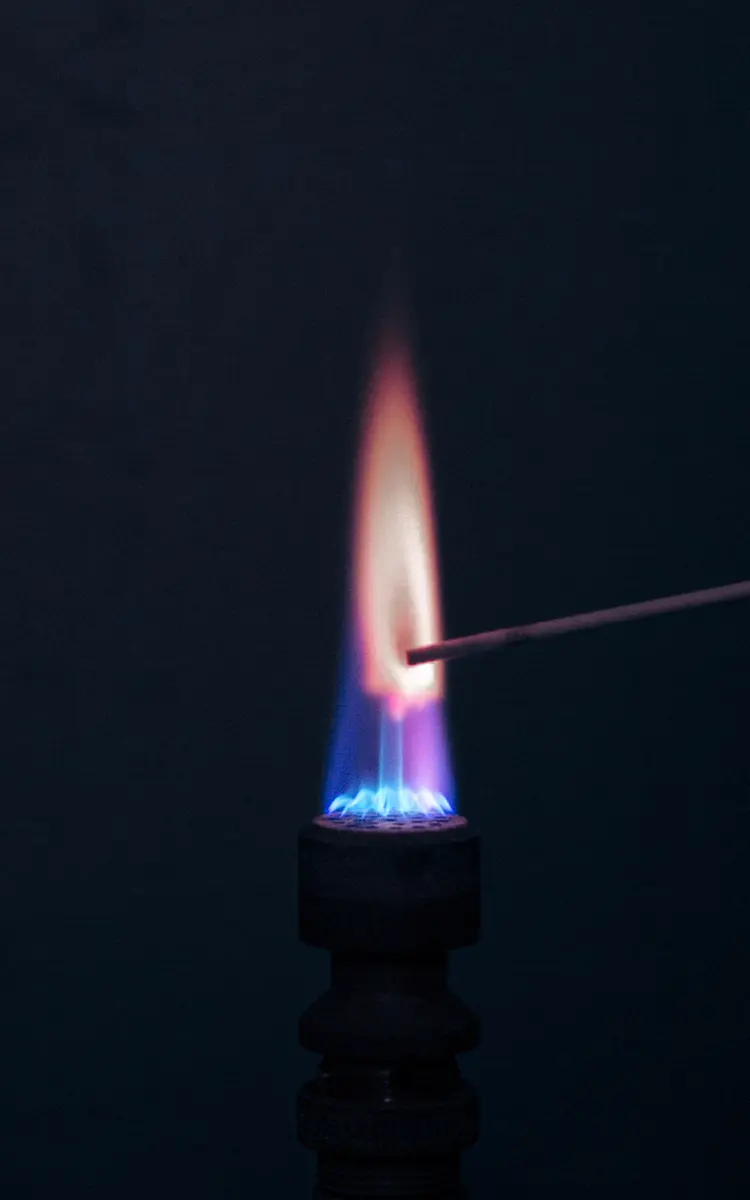
In 1859 Robert Bunsen and Gustav Kirchhoff, at Heidelberg in Germany, built the first spectroscope: a prism that spreads the light of a flame into its colors. Each element, heated in a flame, gives its own pattern of bright lines, like a barcode (Why each element has its own lines).
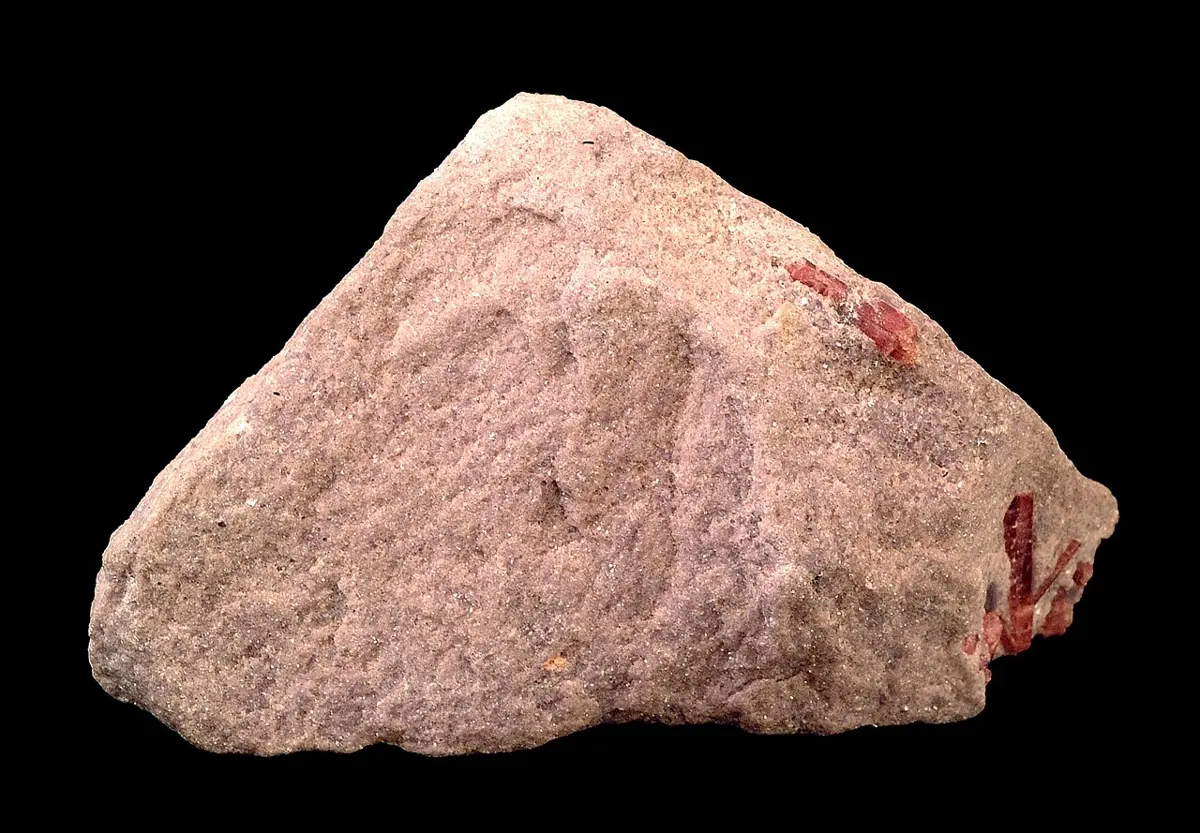
In 1860 two blue lines in the light from a mineral water led them to a new element, cesium. In 1861 they looked at lepidolite, a pink mineral of lithium and potassium, and saw two lines that belonged to no known element, deep red, near the edge of what eyes can see. They named the element after them, from the Latin rubidus, “deep red”: hence the symbol Rb. Two years later Bunsen made a little of the metal itself, and measured its density and melting point, close to today’s values. In Nepali it is simply रुबिडियम.
Where rubidium is found
In the universe. Rubidium was made in aging giant stars and in exploding and colliding stars, as lighter atoms caught neutrons (Heavier than iron).
In the Earth’s crust. Rubidium is not rare: there are about 90 grams in every tonne of rock, more than copper or zinc. But it has no ore of its own. Its ions are like potassium’s, only a little bigger, so they take the place of a few potassium ions in many minerals, spread thinly everywhere. It is collected as a by-product of mining lithium (from lepidolite) and cesium. So little is used, probably a few tonnes a year, that no country reports how much is made; in 2025 the world’s rubidium came from old stockpiles of ore (USGS, 2026).
In the sea and in you. Sea water holds about 0.12 milligrams in every liter. Because your body treats rubidium like potassium, you take it in with your food and keep it inside your cells: a person holds roughly a third to half a gram of it, though it has no known use in the body.
What rubidium is like
- A soft, silvery-white metal, soft enough to cut with a knife.
- Melts at 39.3 °C, just above body temperature: it would melt in a hot hand, if it were safe to hold, and on a summer day in the Terai, which often passes 40 °C Grade 9: Melting point. It boils at 688 °C.
- Density 1.53 g/cm³: unlike lithium, sodium and potassium, it is denser than water, so it sinks in water (while it reacts).
- Very reactive, more so than potassium: so it is kept sealed in glass with no air, or under oil.
Why do the alkali metals melt so easily, and more easily going down the group? Each atom gives only one electron to the “sea” of free electrons that holds a metal together Grade 9: What is inside a metal, and the atoms get bigger down the group, so that one electron holds them less and less tightly. In iron, each atom gives more electrons and the atoms are smaller; iron melts at 1,538 °C.
How rubidium reacts
Like all alkali metals, rubidium reacts by losing its outer electron, and it loses it more easily than potassium does, because it is farther from the nucleus. So it is more reactive than potassium Grade 10: Chemical reactivity.
- Air. It tarnishes at once, and a piece left in air soon catches fire by itself, forming oxides.
- Water. It reacts violently, even explosively, giving rubidium hydroxide, a strong alkali, and hydrogen gas, which catches fire Grade 9: Very reactive metals and water:
2Rb + 2H₂O → 2RbOH + H₂
- Chlorine. It burns in chlorine to form rubidium chloride, a white salt very like common salt:
2Rb + Cl₂ → 2RbCl
Potassium, rubidium and cesium are dropped into water. Which reacts most violently?
Pick an answer to see why.
Rubidium in daily life
Atomic clocks
Every atom of rubidium-87 can absorb microwaves of one exact frequency: 6,834,682,611 waves a second. That number is the same for every rubidium atom, anywhere, and it never wears out or drifts the way a swinging pendulum or a vibrating quartz crystal does. A rubidium clock keeps a quartz oscillator in step with those atoms.
Rubidium clocks are small, sturdy and fairly cheap, so they are the workhorses of atomic time: in mobile phone networks, and in navigation satellites. Most GPS satellites, Europe’s Galileo and India’s NavIC satellites all carry rubidium clocks Grade 9: GPS.

The coldest atoms
In 1995, in the USA, Eric Cornell and Carl Wieman cooled a cloud of rubidium-87 atoms with lasers and magnets to less than a millionth of a degree above absolute zero, the lowest temperature possible. The atoms merged into a strange new state of matter, a Bose–Einstein condensate, in which thousands of atoms behave as one. It won them a share of the Nobel Prize in Physics in 2001. Rubidium is a favorite of such experiments because cheap lasers, like those once used in CD players, give exactly the light its atoms absorb.
Other uses
- Heart scans. Radioactive rubidium-82, with a half-life of only 76 seconds, is made in the hospital from strontium-82. Injected into a vein, it is taken up by heart muscle like potassium, and a PET scanner shows which parts of the heart get too little blood.
- Special glass, for example in optical fibers, and fireworks with a purple color.
- Photocells: like cesium, rubidium gives off electrons easily when light falls on it.
Isotopes of rubidium
Natural rubidium is a mixture of rubidium-85 (72%) and rubidium-87 (28%).
Rubidium-87 is radioactive, but only just: its half-life is about 49 billion years, more than three times the age of the universe. Each atom that decays turns into an atom of strontium-87. In a rock, rubidium-87 slowly builds up strontium-87, so by measuring both, geologists can find how long ago the rock formed. This rubidium–strontium dating has measured the ages of the oldest rocks and of meteorites (A clock inside the atom).
Rubidium and your health
Rubidium has no known job in the body, and its compounds are not very poisonous; there are no known health problems from the rubidium in food and water (USGS, 2026). The metal is another matter.
Surprising facts and records
- Seen before it was held. Rubidium was found only from its light, before anyone had seen the element itself: the second element, after cesium, found with a spectroscope.
- More common than copper. There is more rubidium in the Earth’s crust than copper, zinc or lead, yet most people have never heard of it, because it never gathers into an ore.
- A clock in your pocket. The smallest rubidium clocks sold today are about the size of a matchbox.
In your science books
- Grade 8: the 2n² rule and groups in the periodic table.
- Grade 9: ions, very reactive metals and water, atomic mass and GPS.
- Grade 10: electronic configuration, metals and reactivity down a group.
- Going further: what stars are made of (Bunsen, Kirchhoff and the spectroscope), how old the Earth is and where the atoms in your body came from.
More to explore
- Nobel Prizes with rubidium in them: laser cooling (1997, rubidium is a favorite atom to cool), the coldest stuff in the universe (2001, the first Bose–Einstein condensate was rubidium) and holding one atom, counting one photon (2012, giant rubidium atoms used as spies on light).
- Elements next door: potassium above it, strontium beside it, and lithium and sodium, the rest of its family.
- Play: find rubidium in Guess the Element and the Periodic Table Jigsaw.
- Read more: rubidium at the Royal Society of Chemistry and at PubChem.