
- Atomic number
- 83
- Atomic mass
- 208.98
- Shells
- 2, 8, 18, 32, 18, 5
- Configuration
- 1s² 2s² 2p⁶ 3s² 3p⁶ 4s² 3d¹⁰ 4p⁶ 5s² 4d¹⁰ 5p⁶ 6s² 4f¹⁴ 5d¹⁰ 6p³
- In the table
- period 6, group 15 (VA), p-block
- Kind
- Other metal
- Valency
- 3, sometimes 5 (Bi³⁺)
- State at 25 °C
- solid
- Melts · boils
- 271 °C · 1,564 °C
- Density
- 9.8 × as heavy as water
- Known since
- 1753
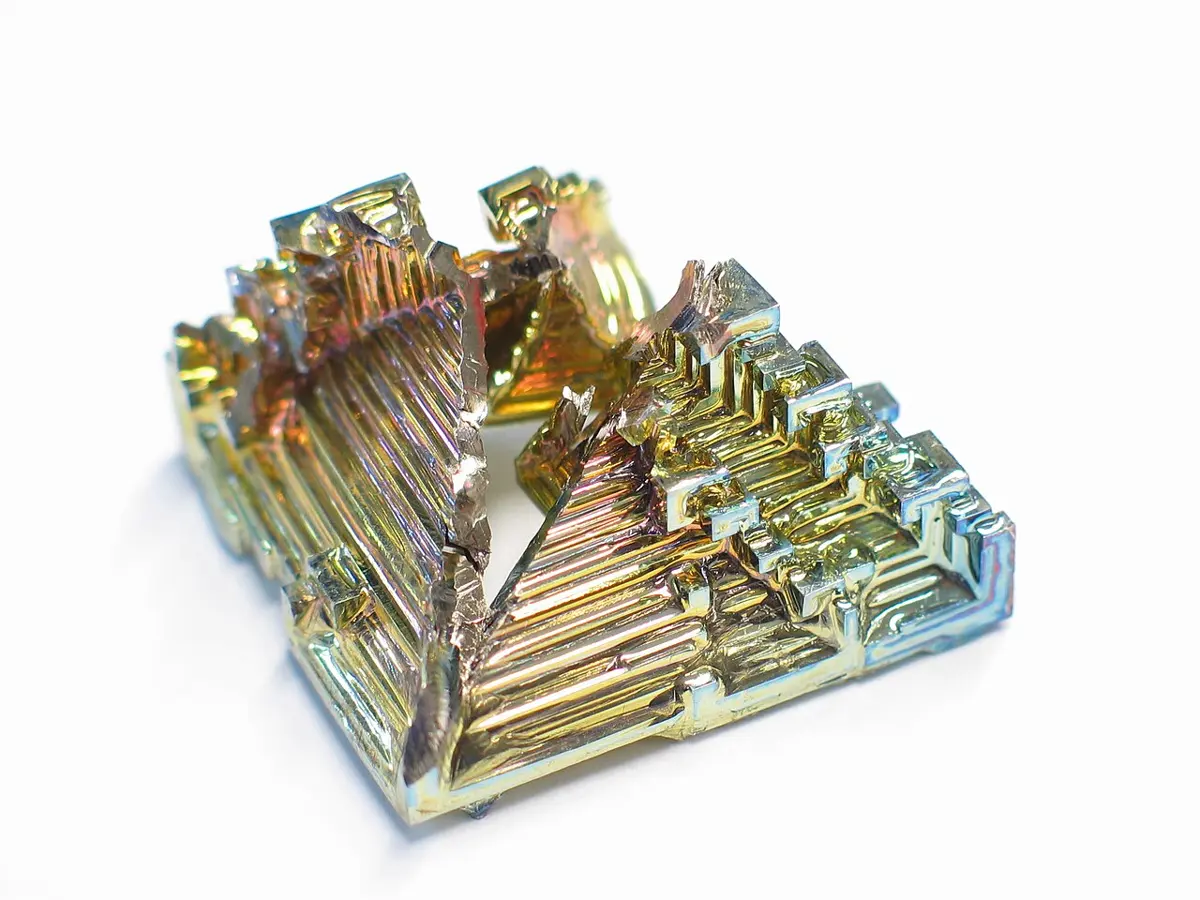
Some of the most beautiful objects in a science shop are crystals of bismuth: little staircases of squares inside squares, shining gold, pink, purple and blue. They look like jewelry from another planet, yet they are made simply by melting bismuth and letting it cool.
Bismuth is also the metal in some pink stomach medicines, a metal that swells when it freezes as water does, and the heaviest element whose atoms are very nearly everlasting. Here is its story.
The bismuth atom
A bismuth atom has 83 protons, so bismuth’s atomic number is 83, and a neutral atom has 83 electrons. Natural bismuth is all one isotope, bismuth-209, with 126 neutrons: 83 + 126 = 209.
The electrons fill six shells: 2, 8, 18, 32, 18, 5 Grade 8: Bohr and Bury’s rule. In subshells, in the order they fill Grade 10: The Aufbau principle, it ends:
… 6s² 4f¹⁴ 5d¹⁰ 6p³
Its place in the periodic table
- Period 6, because its electrons are in six shells.
- Group 15, called VA in the older naming, because it has five outer electrons.
- p-block, because its last electrons go into a p subshell (6p).
Bismuth is at the bottom of the nitrogen family: nitrogen, phosphorus, arsenic, antimony and bismuth. Going down the group, the atoms get bigger and lose electrons more easily, so the family changes from non-metals (nitrogen and phosphorus) through metalloids (arsenic and antimony) to a metal, bismuth Grade 10: How properties change down groups.
Its valency
Nitrogen at the top of the group usually has valency 3, sharing electrons. Bismuth also has valency 3, but as a metal it gives its three 6p electrons away, becoming the ion Bi³⁺, as in bismuth oxide, Bi₂O₃, and bismuth chloride, BiCl₃ Grade 9: Valency. Using all five outer electrons, valency 5, is rare for bismuth, because, as in its neighbors thallium and lead, the 6s pair is held tightly.
How many electrons are in the outermost shell of a bismuth atom?
Pick an answer to see why.
How bismuth was found and named
Nobody knows who first made bismuth. Lumps of the pure metal are sometimes found in the ground, and it melts easily, so people used it long before they knew it was an element. The Inca of South America put about 18% bismuth into the bronze of a knife found at Machu Picchu, about 500 years ago, perhaps to make it easier to cast.
In Europe, German miners knew it by the 1400s, but for centuries it was confused with lead and tin, two other soft, heavy, easily melted metals. In 1753 the French chemist Claude François Geoffroy showed that it was a separate metal of its own.
The name comes from the old German wismut, perhaps from weisse Masse, “white mass”, though no one is sure; a German scholar turned it into the Latin bisemutum in the 1500s. The symbol is Bi.
Where bismuth is found
In the universe. Bismuth was made inside old giant stars, which build up heavy atoms by adding neutrons one at a time (Slowly, in giant stars). Bismuth is where that slow road ends. Add one more neutron to bismuth-209 and it becomes radioactive bismuth-210, which turns into polonium, which breaks down into lead. The atoms go round in a loop and never climb higher. Every heavier element had to be made in a violent flash, when dead stars collided.
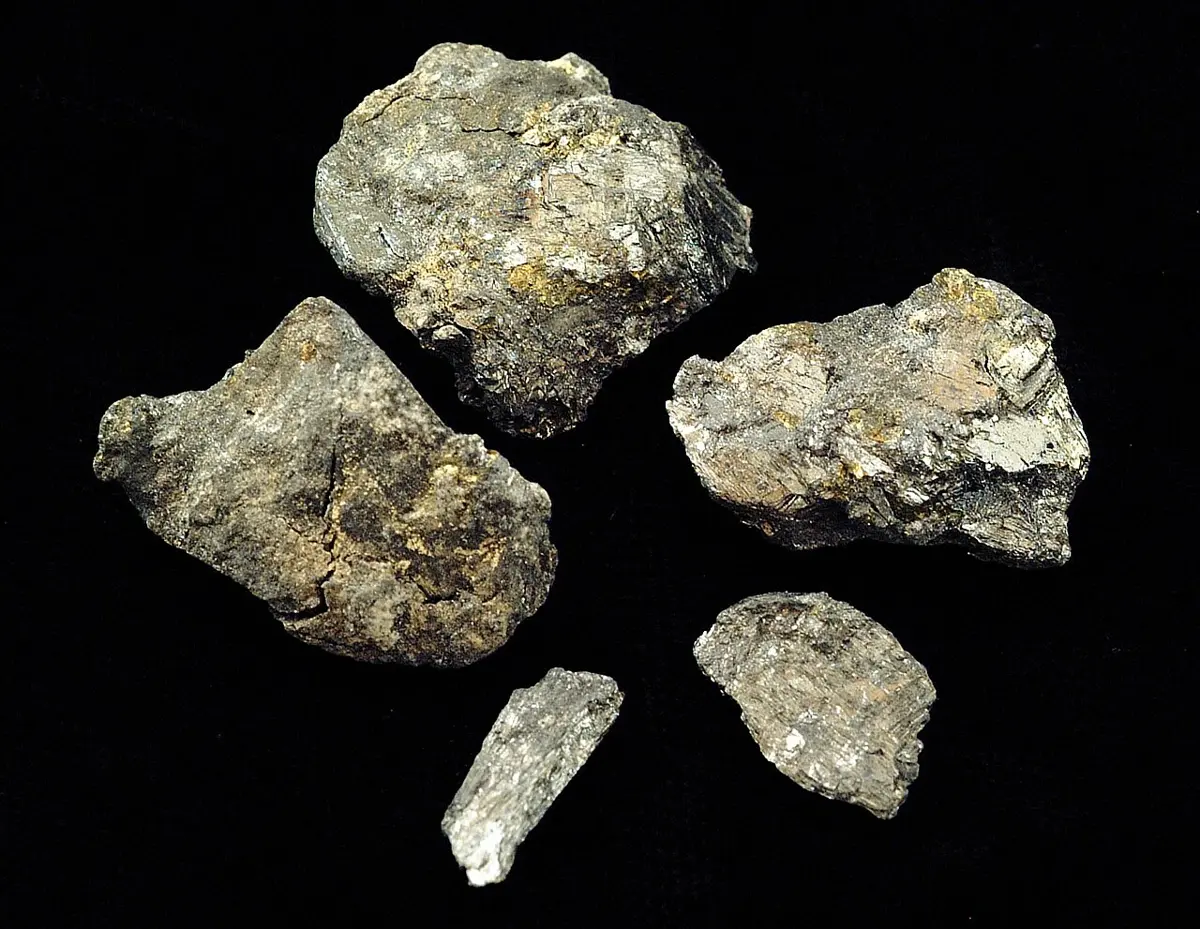
In the Earth’s crust. Bismuth is rare: well under a gram in a tonne of ordinary rock. Its main ore is bismuthinite, bismuth sulphide (Bi₂S₃), but very little is mined for itself. Most of it is collected as a by-product when ores of lead, tungsten and zinc are refined. In 2024 the world produced about 16,000 tonnes of bismuth, 13,000 of them in China (USGS, 2025).
In your body. Bismuth does nothing useful in the body.
What bismuth is like
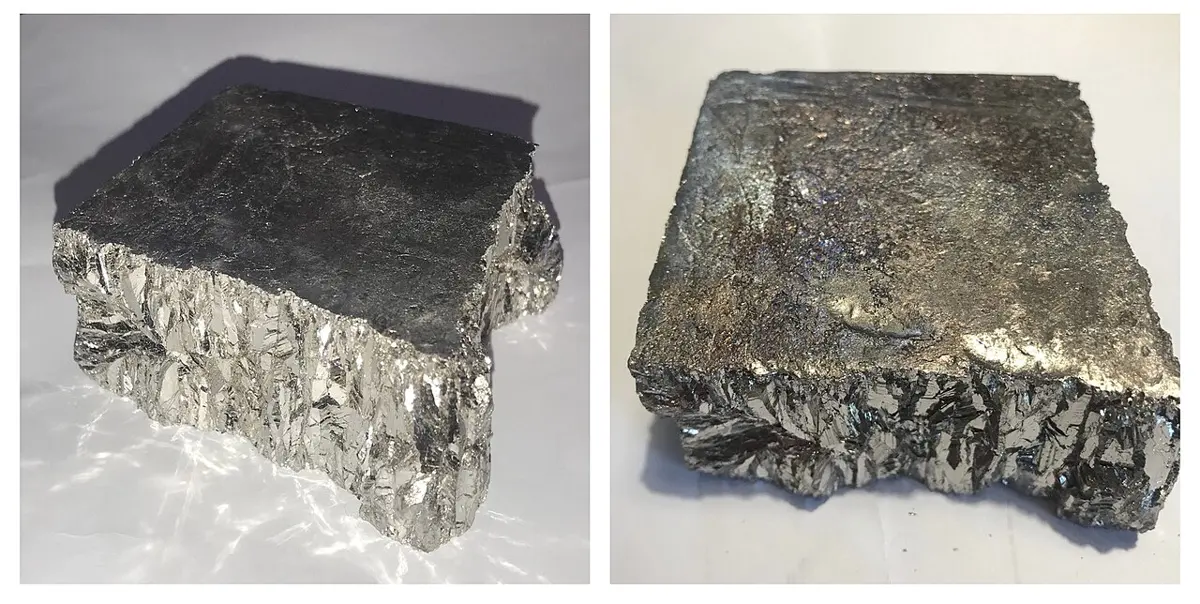
- Silvery with a pink tinge. A fresh surface is white like silver but faintly pinkish.
- Heavy: its density is 9.8 g/cm³, a little less than lead’s 11.3.
- Brittle. Unlike most metals, it is not malleable: hit it with a hammer and it shatters into shiny, crystal-faced pieces Grade 9: Malleable.
- Melts at 271 °C, low enough for a kitchen stove.
- A poor conductor. Of all metals, only mercury conducts heat worse, and it conducts electricity poorly too.
- Pushed away by magnets. Most things are not affected by a magnet at all, and iron is strongly pulled. Bismuth is weakly repelled, more than any other metal: a small strong magnet can even float between two blocks of bismuth.
A metal that swells when it freezes
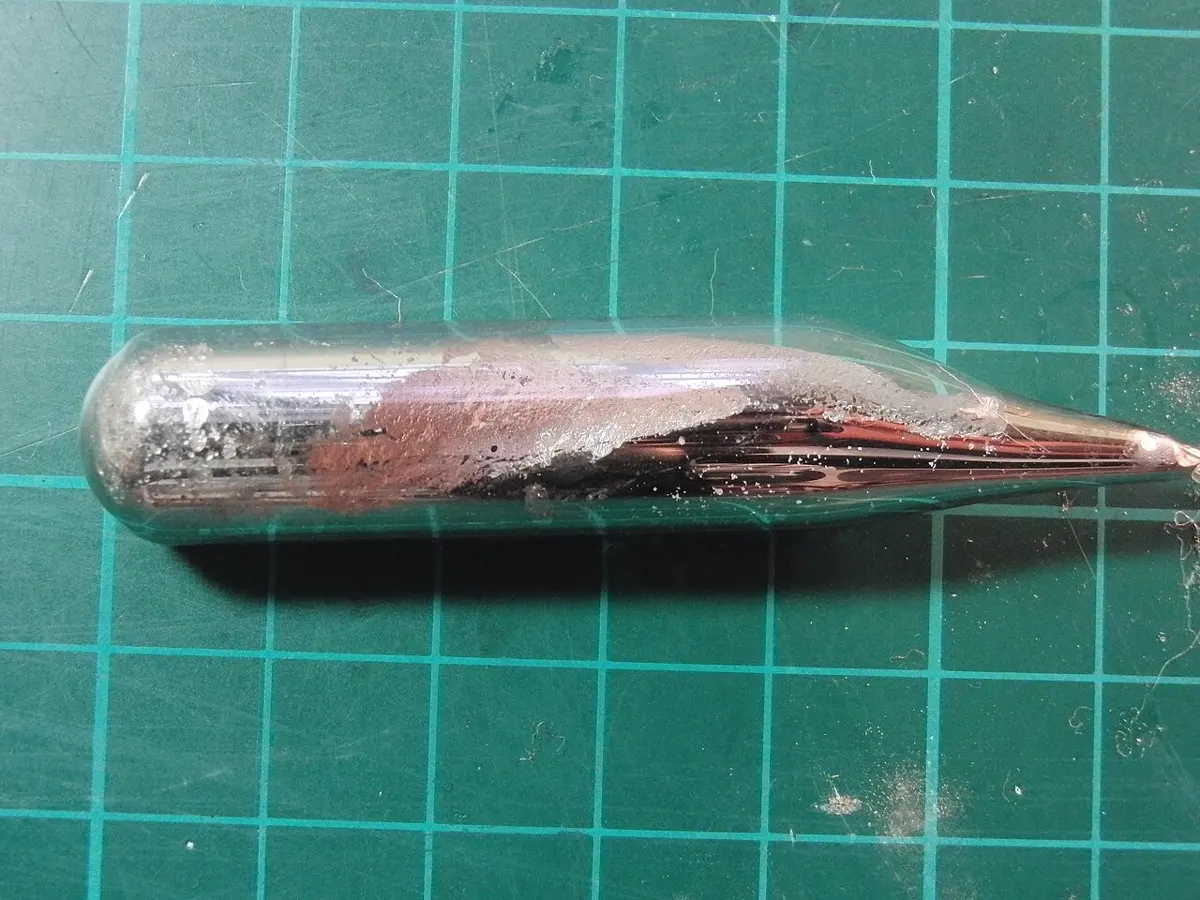
Almost every liquid shrinks as it freezes, so its solid sinks in its own liquid. Water is the famous exception: ice is less dense than water and floats, and a bottle of water left in a freezer cracks. Bismuth does the same: it grows by about 3.3% as it becomes solid, so solid bismuth floats on liquid bismuth. This is useful: bismuth alloys poured into a mold swell slightly as they freeze and fill every corner sharply.
Rainbow staircases
When liquid bismuth cools slowly, its crystals grow as cubes. But the edges and corners of a growing crystal stick out into the liquid and grow faster than the middles of its faces. Each face is left behind as a hollow of square steps, a hopper crystal.
The colors are not paint. As the hot crystal meets the air, it gets a very thin coat of oxide, much thinner than a ten-thousandth of a millimeter. Light bouncing off the top of that coat meets light bouncing off the metal underneath, and some colors cancel out. A thin coat looks gold, a thicker one purple, then blue: the same effect that colors a soap bubble or a film of oil on a wet road.
Why does a bismuth crystal shine in rainbow colors?
Pick an answer to see why.
How bismuth reacts
Bismuth is not very reactive. It is below hydrogen in the reactivity series, near copper, so it does not react with water or with dilute hydrochloric acid Grade 9: The reactivity series.
With air. Heated strongly, bismuth burns with a bluish flame, giving yellow bismuth oxide Grade 9: Metals react with oxygen:
4Bi + 3O₂ → 2Bi₂O₃
With water, a white surprise. Bismuth chloride dissolves in a little hydrochloric acid, but pour the solution into plenty of water and a white solid, bismuth oxychloride, appears:
BiCl₃ + H₂O → BiOCl↓ + 2HCl
Add more hydrochloric acid and it dissolves again: the reaction can go both ways. Bismuth oxychloride gives a pearly shine to some lipsticks, nail polish and eye shadows.
With sulphur. Bismuth and sulphur compounds make bismuth sulphide, Bi₂S₃, which is black. That explains a strange side effect of bismuth stomach medicine (below).
Bismuth in daily life
Stomach medicine. The best-known bismuth compound is bismuth subsalicylate, the medicine in some pink liquids and tablets for upset stomachs and diarrhea. Bismuth compounds coat the lining of the stomach and gut and kill some germs. Doctors also use bismuth, together with antibiotics, against Helicobacter pylori, the bacterium that causes most stomach ulcers (The germ behind stomach ulcers).
Metals that melt in hot water. Mixed with tin, lead, indium or cadmium, bismuth makes fusible alloys that melt at very low temperatures. Wood’s metal, half bismuth, melts at about 70 °C, below the boiling point of water. Such alloys are used where something must give way at a set temperature: plugs in some fire sprinklers that melt and let the water out when a room gets hot, safety plugs in boilers, and fuses (Fuse, Alloys).
Instead of lead. Bismuth is heavy like lead but far less poisonous, so it is replacing lead in solder for electronics, in brass for drinking-water taps and pipes, and in fishing weights and shot.
Colors. Bismuth vanadate is a bright, safe yellow pigment for paints and plastics, used instead of yellows made with lead or cadmium.
Isotopes of bismuth: nearly forever
All natural bismuth is bismuth-209. For a long time it was thought to be stable, the heaviest stable atom of all. But in 2003, French scientists, cooling a crystal of bismuth to almost absolute zero, caught its atoms in the act of decay: bismuth-209 gives out an alpha particle and becomes thallium-205 (Alpha decay).
Its half-life, the time for half of its atoms to decay Grade 9: Radioactive elements, is about 2 × 10¹⁹ years: 20 billion billion years, more than a billion times the age of the universe.
So lead-208, just before bismuth, is now the heaviest atom that has never been seen to decay Grade 9: Nuclear stability.
Bismuth also has a job in nuclear reactors: hit with neutrons, bismuth-209 becomes bismuth-210, which decays within days into polonium-210. That is how almost all the world’s polonium is made (see polonium).
Bismuth and your health
Bismuth has no use in the body, but for a heavy metal it is remarkably safe, much safer than its neighbors lead, thallium and polonium. That is why it can be a medicine. Still, taking bismuth medicines in large amounts for months has caused confusion and other problems of the brain, which went away when the medicine stopped.
Surprising facts and records
- The most diamagnetic metal. “Diamagnetic” means pushed away by a magnet; bismuth shows it more strongly than any other metal.
- Nearly stable. Its half-life is the longest ever measured for alpha decay.
- Grow your own. Bismuth melts at such a low temperature that people grow its staircase crystals in a pan, by melting it, letting it cool slowly and pouring off the liquid when crystals have formed (an adult’s job: molten metal burns).
- Color from no color. One silvery metal gives gold, pink, purple, blue and green, without a single dye.
In your science books
- Grade 8: the 2n² rule, alloys and the fuse.
- Grade 9: valency, radioactive elements, nuclear stability, malleability, metals and oxygen and the reactivity series.
- Grade 10: electronic configuration and properties down a group.
- Going further: alpha decay and how giant stars build heavy atoms.
More to explore
- Nobel Prizes: the germ behind stomach ulcers (2005; bismuth is part of the cure).
- Its neighbors: lead, antimony above it in group 15, and polonium, made from bismuth.
- Play: find bismuth in Guess the Element and the Periodic Table Jigsaw.
- Read more: bismuth at the Royal Society of Chemistry and at PubChem.