
- Atomic number
- 101
- Atomic mass
- 258.1
- Shells
- 2, 8, 18, 32, 31, 8, 2
- Configuration
- 1s² 2s² 2p⁶ 3s² 3p⁶ 4s² 3d¹⁰ 4p⁶ 5s² 4d¹⁰ 5p⁶ 6s² 4f¹⁴ 5d¹⁰ 6p⁶ 7s² 5f¹³
- In the table
- period 7, group none (f-block), f-block
- Kind
- Actinide
- Valency
- 3 (Md³⁺), and 2 (Md²⁺)
- State at 25 °C
- solid
- Melts · boils
- 827 °C · not known
- Known since
- 1955
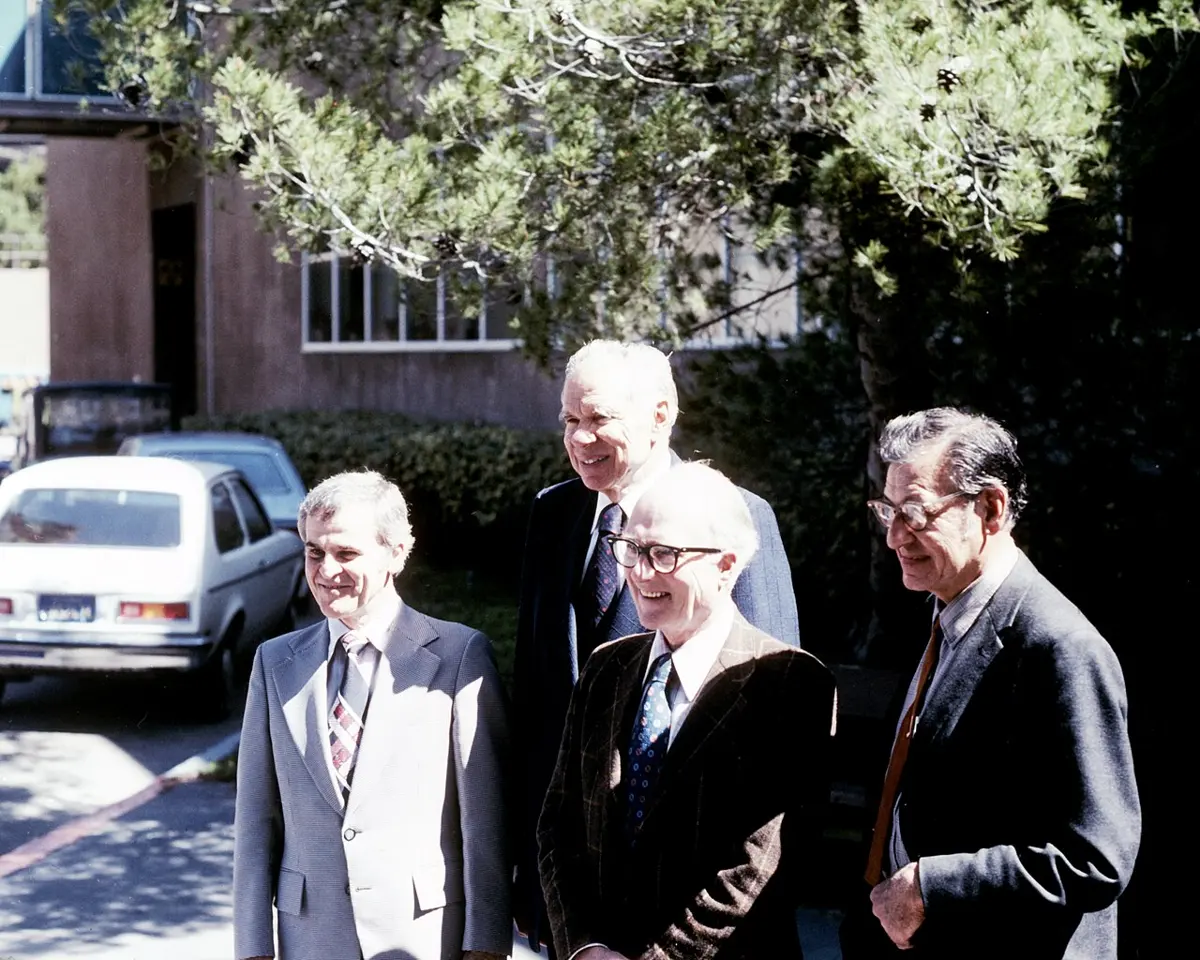
In one night in February 1955, a team of scientists in Berkeley, California, made a new element and caught its atoms one at a time. In all they found 17 atoms of it. No element had ever been made and identified a single atom at a time before. They named it after the man who first used the periodic table to predict elements no one had yet found: Dmitri Mendeleev.
The mendelevium atom
A mendelevium atom has 101 protons (atomic number 101) and 101 electrons. Its longest-lasting kind, mendelevium-258, has 258 − 101 = 157 neutrons. By shells, the electrons are 2, 8, 18, 32, 31, 8, 2, and in subshells Grade 10: The Aufbau principle:
… 6p⁶ 7s² 5f¹³
Mendelevium is in period 7, the thirteenth of the actinides in the f-block Grade 10: Features of the modern periodic table, right under thulium. In water it usually forms Md³⁺, like most actinides, but it can also be turned into Md²⁺ quite easily.
How many electrons does a mendelevium atom have in its 5f subshell?
Pick an answer to see why.
Why a nuclear reactor cannot make it
Every element up to fermium, element 100, can be made in a reactor, where nuclei catch neutrons one by one and now and then turn a neutron into a proton. The road stops at fermium: the next step, fermium-258, splits in two almost at once. So element 101 had to be made another way: by firing one nucleus at another in an accelerator.
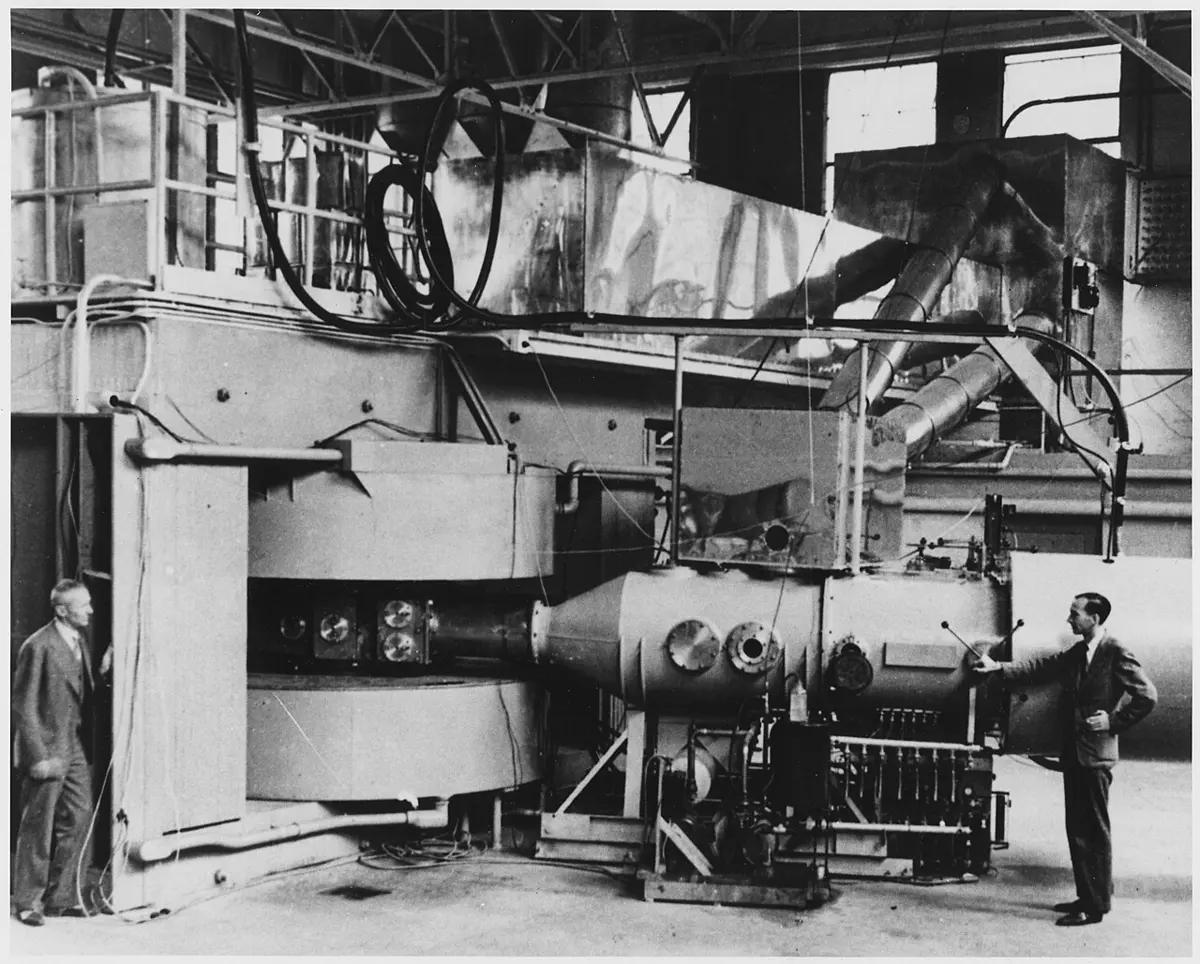
The Berkeley team took a tiny amount of einsteinium-253 (99 protons), far too little to see, and fired alpha particles at it from a cyclotron. An alpha particle is a helium nucleus, with 2 protons and 2 neutrons. Now and then one joined an einsteinium nucleus: 99 + 2 = 101 protons.
²⁵³Es + ⁴He → ²⁵⁶Md + ¹n
Check the mass numbers: 253 + 4 = 257 on the left, and 256 + 1 = 257 on the right.
One night, seventeen atoms
The team had a clever way to catch their atoms. The einsteinium sat on the back of a thin gold foil. When an alpha particle joined an einsteinium nucleus, the new atom was knocked forward, right out of the foil, and landed on a second catcher foil behind it. The precious einsteinium stayed where it was, ready to be used again.
On the night of 19 February 1955, the team ran the cyclotron, dissolved the catcher foils, and separated the elements in them by passing the liquid slowly through a column of resin, collecting it drop by drop. Each element comes out of such a column at its own time, in an order the periodic table predicts. The drops where element 101 should be were dried and put in front of counters.
Mendelevium-256 has a half-life of about 77 minutes: after 77 minutes, half of its atoms have decayed (half-life). Most of its atoms do it by electron capture: the nucleus pulls in one of the atom’s own innermost electrons, which joins a proton to make a neutron. So the 101 protons become 100, and the atom becomes fermium-256. Fermium-256 then splits in two (fission), giving a big pulse in the counter that nothing else in the drops could give. Each pulse meant one atom of element 101. In that night and the experiments after it, the team counted 17.
The team was Albert Ghiorso, Bernard Harvey, Gregory Choppin, Stanley Thompson and Glenn Seaborg.
Named after Mendeleev
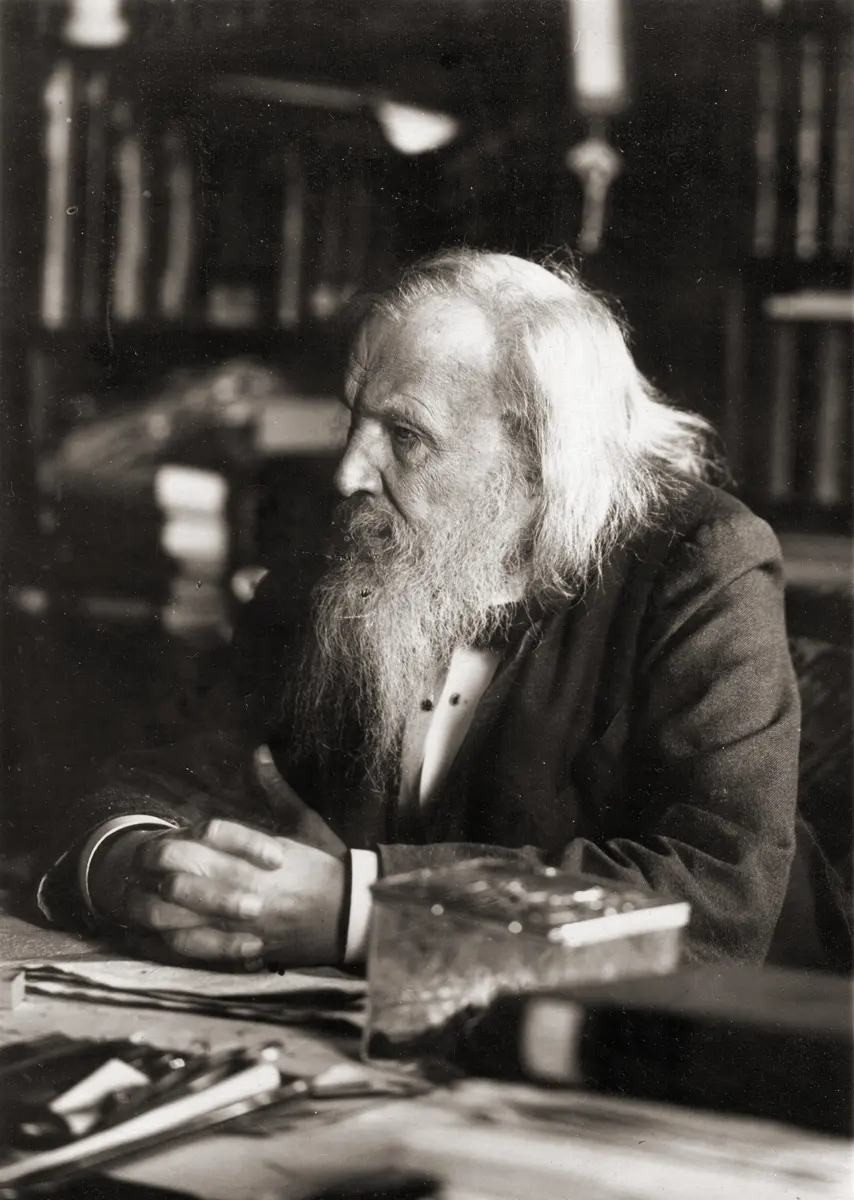
In 1869 the Russian chemist Dmitri Mendeleev arranged the known elements by atomic weight and saw their properties repeat Grade 10: Mendeleev’s periodic table. Where an element seemed to be missing, he left a gap and predicted what the missing element would be like. When gallium and germanium were found, they matched his predictions.
The Berkeley team had used that same idea to find their element: they knew where element 101 should come out of the column because the periodic table told them. In their paper, they suggested the name mendelevium “in recognition of the pioneering role of the great Russian chemist, Dmitri Mendeleev, who was the first to use the periodic system of the elements to predict the chemical properties of undiscovered elements”. It was the middle of the Cold War between the United States and the Soviet Union, and an American team named its new element after a Russian. Its symbol is Md.
What is known, and what is only predicted
Today, a few millionths of a gram of einsteinium can make millions of mendelevium atoms at a time. That sounds a lot, but a million atoms of mendelevium weigh less than a millionth of a billionth of a gram. No one has ever had enough to see or weigh.
What has been measured, with single atoms or tiny traces in water:
- In water it forms Md³⁺, and can be changed to Md²⁺.
- Its longest-lasting kind, mendelevium-258, has a half-life of about 51 days: the last element with any kind of atom that lasts longer than a day.
- In 2018, a team in Japan measured how much energy it takes to pull one electron off an atom of mendelevium, one atom at a time, and did the same for fermium, nobelium and lawrencium (see lawrencium).
What is only predicted: that mendelevium is a solid metal, and its melting point. The facts card’s 827 °C is an estimate, not a measurement (another estimate is about 800 °C). Its density and boiling point are unknown.
The body has no use for mendelevium, and it is far too rare to harm anyone outside the few laboratories that make it.
In your science books
- Grade 9: radioactive elements, nuclear fission and shells and their energy.
- Grade 10: Mendeleev’s periodic table, the actinides and the Aufbau principle.
- Going further: alpha decay, fission and half-life.
More to explore
- Nobel Prizes: Seaborg and McMillan’s prize (1951) for the elements beyond uranium.
- Its neighbors: einsteinium, from which it was made, fermium, the last element a reactor can make, nobelium, next in the table, and thulium, the element above it.
- Play: find mendelevium in Guess the Element and the Periodic Table Jigsaw.
- Read more: mendelevium at the Royal Society of Chemistry and at PubChem.