
- Atomic number
- 82
- Atomic mass
- 207.2
- Shells
- 2, 8, 18, 32, 18, 4
- Configuration
- 1s² 2s² 2p⁶ 3s² 3p⁶ 4s² 3d¹⁰ 4p⁶ 5s² 4d¹⁰ 5p⁶ 6s² 4f¹⁴ 5d¹⁰ 6p²
- In the table
- period 6, group 14 (IVA), p-block
- Kind
- Other metal
- Valency
- 2 and 4 (plumbous Pb²⁺, plumbic Pb⁴⁺)
- State at 25 °C
- solid
- Melts · boils
- 327 °C · 1,749 °C
- Density
- 11.3 × as heavy as water
- Known since
- ancient times
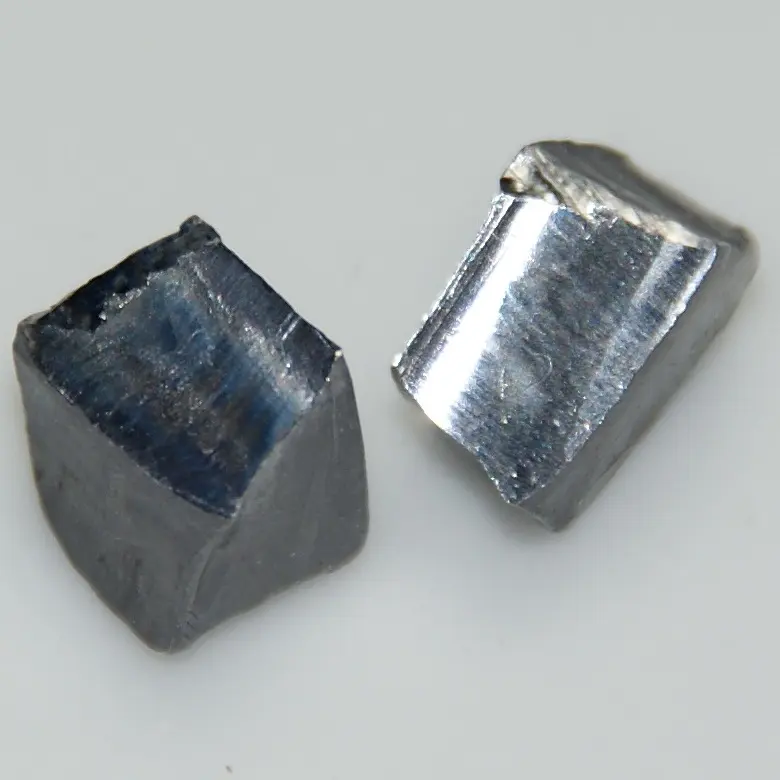
Start a motorbike or a car, and the first push of electricity comes from a box of lead plates in acid. Have an X-ray at the dentist, and a heavy apron of lead protects the rest of your body. Lead is soft, heavy and easy to shape, and people have used it for over 6,000 years: for water pipes, paint, bullets and fishing weights.
It is also a poison that harms almost every part of the body, above all a child’s growing brain. Nepali calls it सिसा. Here is the story of a useful metal we have learned to fear.
The lead atom
A lead atom has 82 protons, so lead’s atomic number is 82, and a neutral atom has 82 electrons. The most common kind of lead atom has 126 neutrons, so its mass number is 82 + 126 = 208.
The electrons fill six shells: 2, 8, 18, 32, 18, 4. The first four shells are full, holding their 2n² Grade 8: Bohr and Bury’s rule; the fifth has 18 and the sixth, the outermost, has 4. In subshells, in the order they fill Grade 10: The Aufbau principle:
1s² 2s² 2p⁶ 3s² 3p⁶ 4s² 3d¹⁰ 4p⁶ 5s² 4d¹⁰ 5p⁶ 6s² 4f¹⁴ 5d¹⁰ 6p²
Its place in the periodic table
- Period 6, because its electrons are in six shells.
- Group 14, called IVA in the older naming, because it has four outer electrons.
- p-block, because its last electrons go into a p subshell (6p).
Lead is at the bottom of the carbon family: carbon, silicon, germanium, tin and lead. All have four outer electrons, but going down the group the atoms get bigger and lose electrons more easily, so the elements turn from a non-metal (carbon) through metalloids (silicon, germanium) to metals (tin and lead) Grade 10: How properties change down groups.
Its valency
Lead has two valencies Grade 9: Variable valency:
- 2, in plumbous compounds, the common ones: lead oxide (PbO), lead nitrate (Pb(NO₃)₂), lead sulphide (PbS). The atom gives up its two 6p electrons.
- 4, in plumbic compounds, such as lead dioxide (PbO₂). The atom must also give up its 6s pair, which it holds tightly, so these are fewer and less stable.
Carbon at the top of the group almost always has valency 4; lead at the bottom usually has 2. This change down a group is one of the patterns of the periodic table.
A pencil’s “lead” is made of what?
Pick an answer to see why.
How lead was found and named
Lead is one of the metals people learned to use first. Its ore gives up the metal at a low temperature in an ordinary fire, so lead has been smelted for more than 6,000 years; some of the oldest lead objects come from what are now Turkey and Egypt.
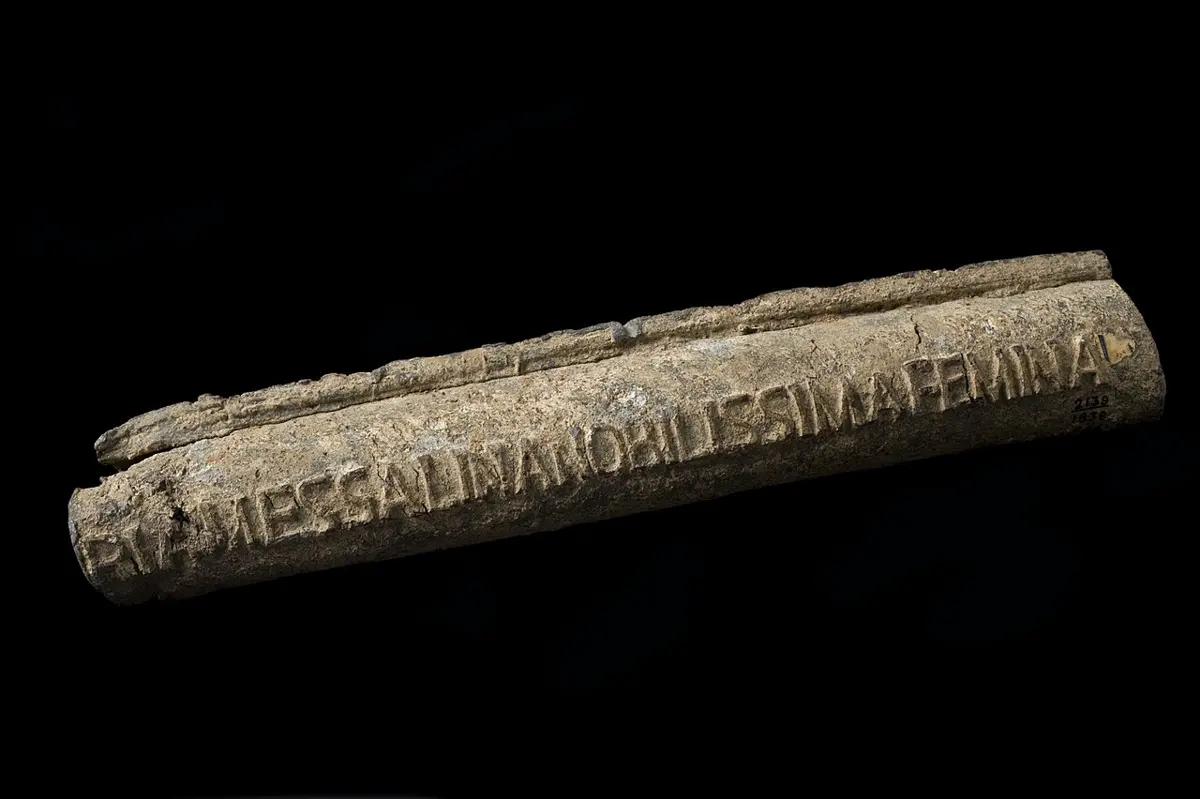
The Romans used lead on an enormous scale: for water pipes, roofs, coffins and cooking pots. The smoke of their furnaces drifted round the world: layers of ice in Greenland, laid down year by year, hold a record of lead pollution that rises and falls with the Roman Empire’s fortunes 2,000 years ago.
The names. The Latin word for lead was plumbum, which gives its symbol, Pb Grade 8: Symbols from Latin names. Because Roman water pipes were lead, a person who works on pipes is still called a plumber, and a weight on a string that hangs straight down is a plumb line. The English word “lead” is Old English. Nepali’s सिसा is one of the eight metals of the old अष्टधातु, with gold, silver, copper, tin, zinc, iron and brass.
Where lead is found
In the universe. Like all elements heavier than iron, lead was made when atoms caught neutrons inside giant stars and when dead stars collided (Heavier than iron: catching neutrons). But lead is also still being made, slowly, here on Earth: uranium and thorium in rocks decay, step by step, until they become lead, and stop (From uranium to lead).
In the Earth’s crust. Lead is not common, about 10 to 15 grams in a tonne of ordinary rock, but it is concentrated in ores. The main ore is galena, lead sulphide (PbS): heavy, silvery-gray cubes that look metallic Grade 8: Metallic minerals. Galena often holds a little silver too, and much of the world’s silver once came from it.
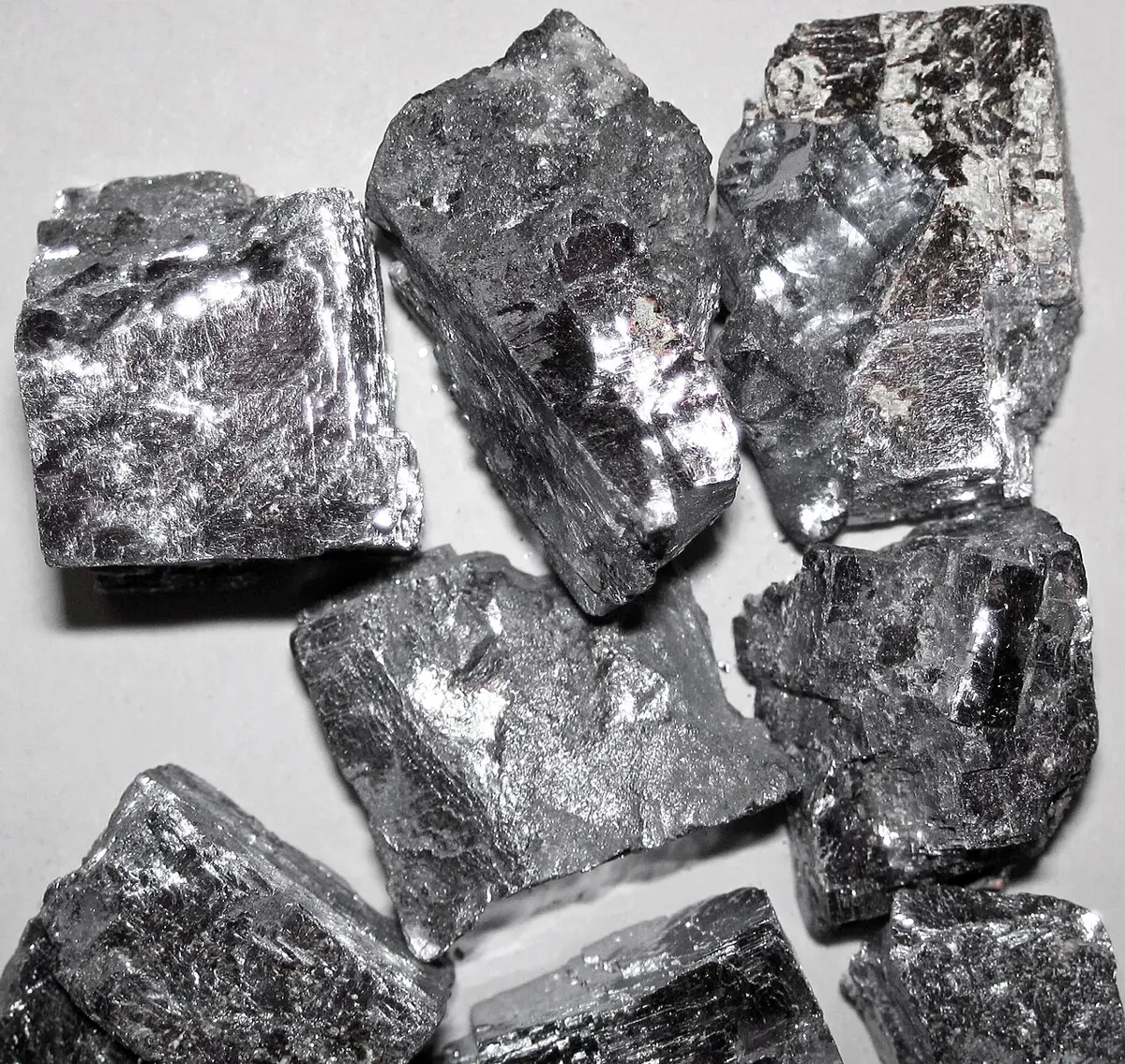
In 2024 the world’s mines produced about 4.3 million tonnes of lead, 1.9 million of it in China, followed by Australia, the USA, Peru and Russia (USGS, 2025). But about three times as much refined lead is used each year, around 13 million tonnes: most of it is recycled, above all from old car batteries.
In Nepal. Lead and zinc ores have been found in many places in Nepal’s hills Grade 8: Minerals in Nepal. The largest known deposit, at Lari in the Ganesh Himal, mostly zinc with some lead and silver, was explored from the 1970s and a road was built to it, but it has never been brought into production. Nepal imports the lead it uses.
What lead is like
- Dull gray, but a fresh cut is shiny and bluish-white. It dulls within hours, as air coats it with a thin layer of oxide and carbonate that protects the metal beneath.
- Very soft. You can scratch lead with a fingernail and cut it with a knife.
- Very heavy. Its density is 11.3 g/cm³, more than eleven times that of water and much more than iron (7.9).
- Melts at 327 °C, low for a metal: you could melt it on a gas stove. It boils only at 1,749 °C.
- Malleable: it can be beaten and bent into sheets and pipes Grade 9: Malleable.
- A poor conductor for a metal: about a twelfth as good as copper.
- Stops radiation. Its heavy atoms, crowded with electrons, absorb X-rays and gamma rays better than almost any cheap material Grade 9: Radioactive emission.
Which property makes lead useful for aprons worn during X-rays?
Pick an answer to see why.
How lead reacts
Lead is fairly unreactive. In the reactivity series it sits just above hydrogen Grade 9: The reactivity series:
K > Na > Ca > Mg > Al > Zn > Fe > Pb > (H) > Cu > Hg > Ag > Au
With air. Heated in air, molten lead becomes coated with yellow lead oxide (litharge):
2Pb + O₂ → 2PbO
With acids. Being above hydrogen, lead should give hydrogen with dilute acids, but it does so only very slowly. With dilute hydrochloric or sulphuric acid, a layer of lead chloride or lead sulphate forms on the metal, does not dissolve, and stops the acid from reaching it. That is why lead was used to line tanks of sulphuric acid, and why a car battery can hold acid between lead plates.
From its ore. Galena is first roasted in air, which turns it into lead oxide Grade 10: Roasting:
2PbS + 3O₂ → 2PbO + 2SO₂
Then the oxide is reduced, by heating with carbon (coke) Grade 10: Reduction:
PbO + C → Pb + CO
Hydrogen does the same job: passed over hot lead oxide, it takes the oxygen and leaves lead Grade 9: Chemical properties of hydrogen: PbO + H₂ → Pb + H₂O.
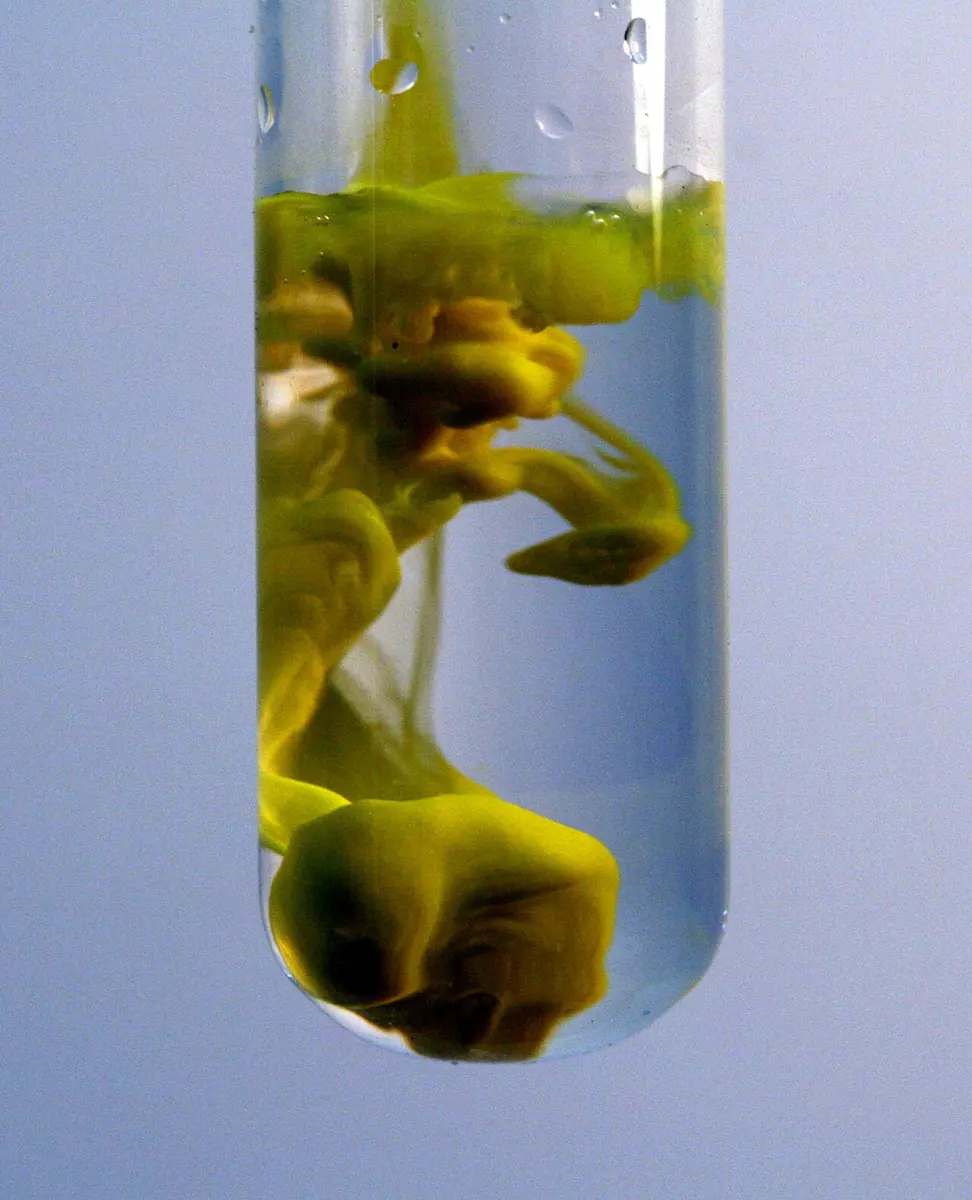
Golden rain. Mix colorless solutions of lead nitrate and potassium iodide, and a brilliant yellow solid, lead iodide, appears at once. The two compounds swap partners Grade 10: Double displacement reaction:
Pb(NO₃)₂ + 2KI → 2KNO₃ + PbI₂↓
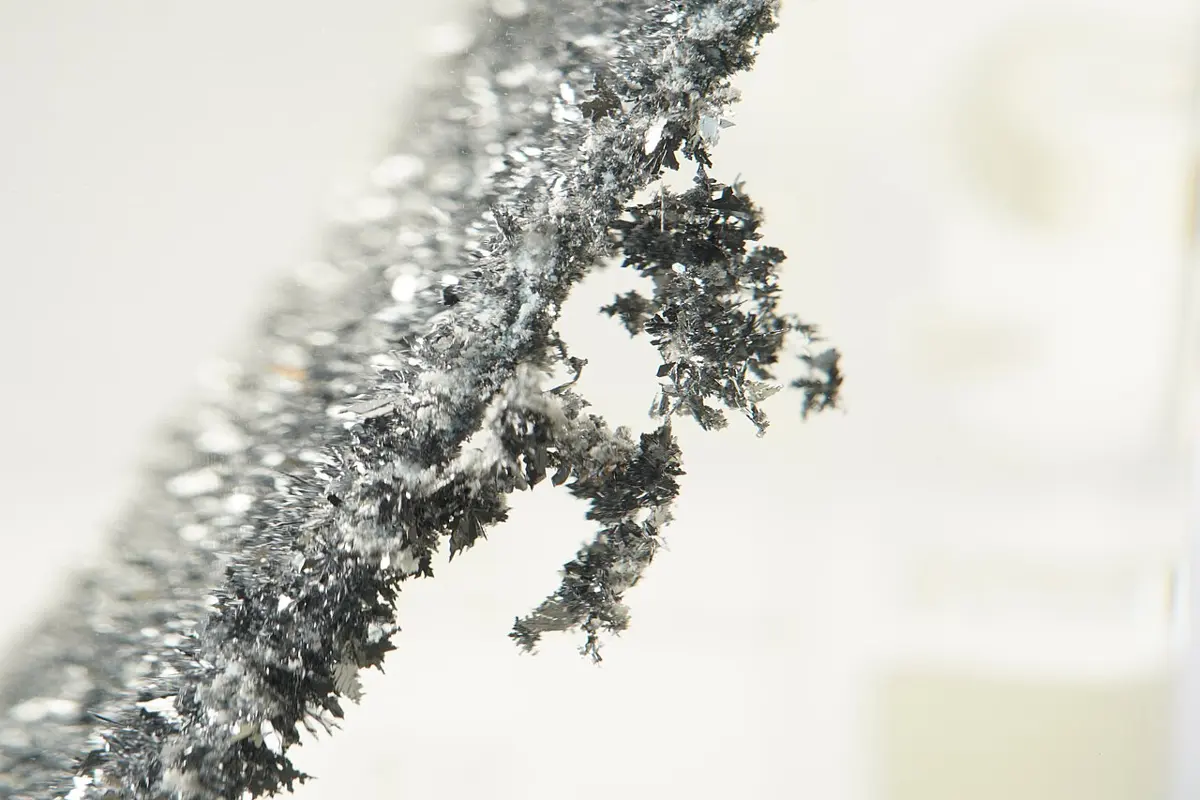
Lead iodide dissolves in hot water; as the solution cools, it comes out again as glittering golden flakes, the “golden rain”.
A strip of zinc is placed in lead nitrate solution. What happens?
Pick an answer to see why.
Lead in daily life and in Nepal
Batteries. By far the biggest use of lead today is in lead–acid batteries: in every car, bus and motorbike, and in the inverters that keep lights on in many Nepali homes during power cuts. Each cell has a plate of lead and a plate of lead dioxide in dilute sulphuric acid. The French physicist Gaston Planté made the first in 1859, and the design is still in use, because it is cheap, reliable and can be recharged many times.
Old batteries are worth recycling, and in many countries almost all of them are. But melting them down in backyards, without protection, poisons the workers and the children who live nearby.
Other uses. Shields against X-rays and gamma rays, in hospitals and nuclear plants; lead crystal glass (about a quarter lead oxide), which sparkles more than ordinary glass; fishing weights and bullets; and, mixed with tin, solder and fuse wire, which melt easily Grade 8: Fuse.
Uses that have stopped. For most of history lead also went into paint (white lead, and bright red and yellow pigments), water pipes, and petrol. Since 1921 a lead compound, tetraethyl lead, was added to petrol to help engines run smoothly, and for decades car exhausts spread lead dust over every city in the world. Country by country it was banned, and in July 2021, when the last country (Algeria) stopped selling it, leaded petrol ended everywhere.
Nepal set one of the world’s strictest limits on lead in paint, 90 parts per million, in December 2014, in force from June 2015 Grade 9: Lead in paint. But lead is still found where it shouldn’t be: a Nepali study reported in 2026 found lead in about a third of the cosmetics and personal-care products it tested, among them some sindur and eye liners.
Isotopes of lead
Natural lead is a mixture of four isotopes: lead-204, lead-206, lead-207 and lead-208. Three of them are the end points of radioactive decay: uranium-238 becomes lead-206, uranium-235 becomes lead-207, and thorium-232 becomes lead-208. So the mixture is slightly different in different rocks, and lead’s atomic mass is given as 207.2 Grade 9: Atomic mass.
Lead-208 has 82 protons and 126 neutrons, two numbers that make a nucleus especially stable. It is the heaviest atom that has never been seen to decay Grade 9: Nuclear stability.
Lead and your health
Lead does nothing useful in the body, and doctors now say there is no safe level of it Grade 9: Harmful effects of lead. The body mistakes it for calcium and iron, so it gets into the bones, the blood and the brain:
- In children it slows the growing brain, lowering learning and attention for life, even at levels that cause no symptoms. A child’s body absorbs much more of the lead it swallows than an adult’s does.
- It causes anemia, by blocking the making of hemoglobin, and harms the kidneys and nerves.
- It is stored in the bones for years, and can pass from a mother to her unborn baby.
UNICEF estimated in 2020 that about one child in three in the world has a blood lead level high enough to need action. In a study of 312 young children (6 to 36 months old) at three hospitals in the Kathmandu Valley, published in 2017, about two-thirds had such levels, and lead paint on walls and windows at home was one of the main reasons.
Surprising facts and records
- Lead floats on mercury. Mercury (13.5 g/cm³) is denser still.
- A superconductor. Cooled below about −266 °C, lead carries electricity with no resistance at all (the theory of superconductors).
- The heaviest stable atom. No element after lead has an isotope that lasts forever; bismuth, just after it, decays, though so slowly that it seems stable.
- Sweet and deadly. Lead acetate tastes sweet, and was once called “sugar of lead”. Romans boiled grape juice in lead pots to make a sweet syrup, and so ate lead without knowing it.
In your science books
- Grade 8: symbols from Latin names (Pb from plumbum), metallic minerals: galena, minerals in Nepal and the fuse.
- Grade 9: variable valency, nuclear stability, hydrogen reduces lead oxide, the reactivity series, pencil “lead” is graphite and the harmful effects of lead.
- Grade 10: electronic configuration, properties down a group, roasting and reduction, and double displacement: lead iodide.
- Going further: from uranium to lead and where the heavy atoms came from.
More to explore
- Nobel Prizes with lead in them: the crystal radio (1909, its detector was a crystal of galena), Rutherford’s elements that transform (1908), superconductors (2003, lead is one of the classic ones) and lithium-ion batteries (2019, which are replacing lead–acid ones).
- Play: find lead in Guess the Element, Higher or Lower and the Periodic Table Jigsaw.
- Read more: lead at the Royal Society of Chemistry and at PubChem.