
- Atomic number
- 81
- Atomic mass
- 204.38
- Shells
- 2, 8, 18, 32, 18, 3
- Configuration
- 1s² 2s² 2p⁶ 3s² 3p⁶ 4s² 3d¹⁰ 4p⁶ 5s² 4d¹⁰ 5p⁶ 6s² 4f¹⁴ 5d¹⁰ 6p¹
- In the table
- period 6, group 13 (IIIA), p-block
- Kind
- Other metal
- Valency
- 1 and 3 (thallous Tl⁺, thallic Tl³⁺)
- State at 25 °C
- solid
- Melts · boils
- 304 °C · 1,473 °C
- Density
- 11.8 × as heavy as water
- Known since
- 1861
In 1861 a young English chemist was looking at a glowing flame through a spectroscope, an instrument that spreads light out into its colors. Suddenly a bright green line flashed into view, a green that no known element gave. He had found a new element, and he named it after its color: thallium, from the Greek thallos, a fresh green shoot.
Thallium is a soft, heavy, gray metal, a little like lead. It is also one of the most poisonous elements, because the body mistakes it for something it needs. You will almost never meet it, but its story shows how the periodic table explains even a poison, and how the same trick is used in hospitals to look at the heart.
The thallium atom
A thallium atom has 81 protons, so thallium’s atomic number is 81, and a neutral atom has 81 electrons. The commoner kind, thallium-205, has 124 neutrons: 81 + 124 = 205.
The electrons fill six shells: 2, 8, 18, 32, 18, 3 Grade 8: Bohr and Bury’s rule. In subshells, in the order they fill Grade 10: The Aufbau principle, it ends:
… 6s² 4f¹⁴ 5d¹⁰ 6p¹
Its place in the periodic table
- Period 6, because its electrons are in six shells.
- Group 13, called IIIA in the older naming, because it has three outer electrons (6s² 6p¹).
- p-block, because its last electron goes into a p subshell.
Thallium is at the bottom of the boron family: boron, aluminium, gallium, indium and thallium. Boron is a metalloid; the rest are metals, and they become more metallic going down the group Grade 10: How properties change down groups.
Its valency: the lazy pair
Aluminium always gives up all three outer electrons and becomes Al³⁺, with valency 3. You might expect thallium to do the same. It can, as Tl³⁺ (thallic), but its usual ion is Tl⁺ (thallous), with valency 1 Grade 9: Variable valency.
The reason is the 6s pair. In these very heavy atoms, the two 6s electrons are held so tightly that they hardly take part in reactions; chemists call them the inert pair. Only the single 6p electron is easy to lose. Lead, next door, shows the same thing: its usual valency is 2, not 4.
Aluminium and thallium are both in group 13. Which ions do they usually form?
Pick an answer to see why.
How thallium was found and named
William Crookes, in London, had some sludge left over from a factory making sulphuric acid. He was looking for the element tellurium in it. When he heated it in a flame and looked through his spectroscope, he saw instead a single bright green line that matched no known element. He announced the new element in March 1861. Each element gives out light of its own exact colors, so a new line means a new element (Why each element has its own lines).
Crookes made only a little of the metal. In France, Claude-Auguste Lamy got more raw material, made thallium in quantity and in 1862 showed an ingot of it at the great International Exhibition in London, where he won a medal. Crookes was furious, and the judges gave him a medal too. He went on to a long career in science; his glass “Crookes tubes” helped others discover X-rays and the electron.

The name comes from the Greek thallos, a green twig, for that green line; the symbol is Tl.
Where thallium is found
In the universe. Like all elements heavier than iron, thallium was made in old giant stars and in collisions of dead stars, when atoms caught neutrons one after another (Heavier than iron).
In the Earth’s crust. Thallium is not especially rare, less than one gram in a tonne of rock, about ten times as common as silver, but it is spread thinly through ordinary rocks and clays, often beside potassium. A few rare minerals are mostly thallium, among them crookesite, named after Crookes, and lorandite. Thallium is not mined for itself: it is collected from the dust and fumes given off when ores of copper, lead and zinc are roasted Grade 10: Roasting. The world makes only about 10 tonnes a year (2023), mostly in China, Kazakhstan and Russia (USGS, 2025). Compare that with about 4 million tonnes of lead.
In your body. Thallium does nothing useful in any living thing.
What thallium is like
- Soft and heavy. It can be cut with a knife, and with a density of 11.8 g/cm³ it is even heavier for its size than lead (11.3).
- Melts at 304 °C, low for a metal, close to lead’s 327 °C.
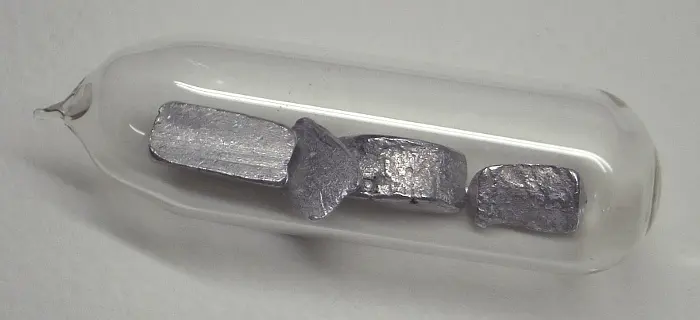
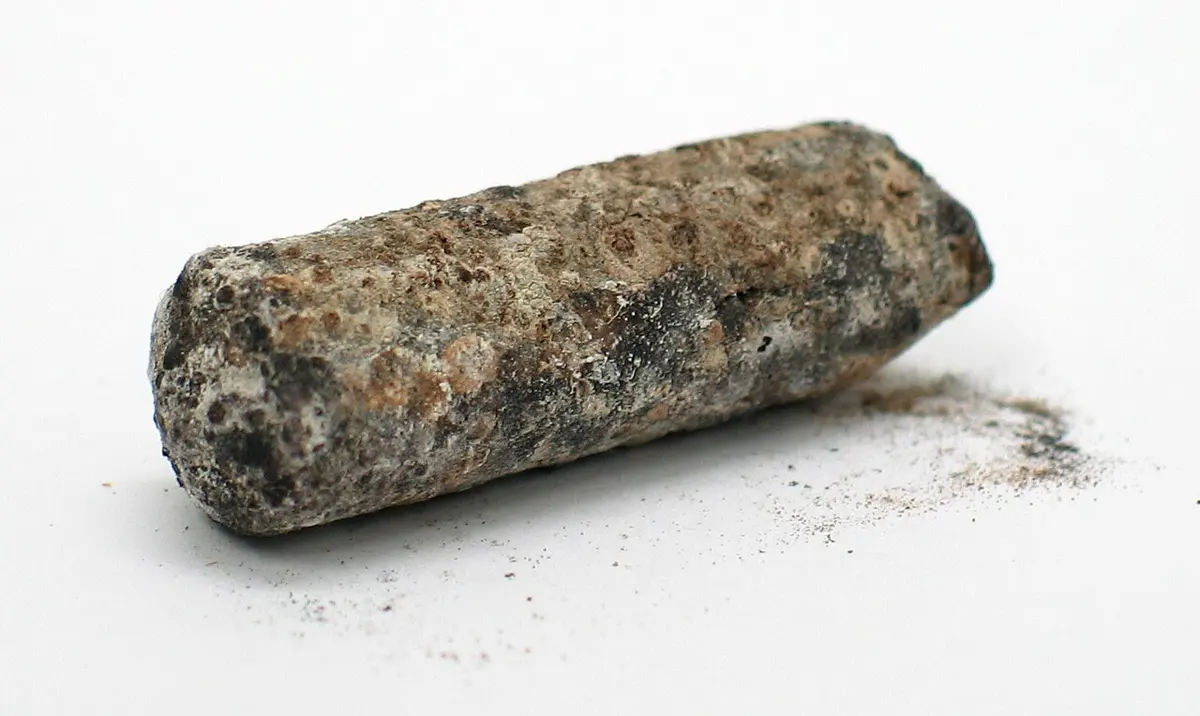
- Silvery when freshly cut, but in air it soon goes dull and bluish-gray, then dark, as it reacts with oxygen and moisture. Pure thallium is kept sealed in glass, in argon gas or under oxygen-free water.
How thallium reacts
In air, thallium forms an oxide; with moisture, it slowly makes thallium hydroxide (TlOH), which dissolves in water to give a strong alkali, like potassium hydroxide. It dissolves in acids, forming salts of Tl⁺ such as thallium sulphate, Tl₂SO₄ Grade 9: Metals and dilute acids:
2Tl + H₂SO₄ → Tl₂SO₄ + H₂
The Tl⁺ ion behaves like two quite different ions at once. Like K⁺, it has a soluble hydroxide and soluble sulphate and carbonate. Like Ag⁺, it makes a chloride that does not dissolve: add salt water to a solution of Tl⁺ and white thallium chloride falls out, as silver chloride does. A French chemist called thallium the “duck-billed platypus of the metals”, because, like that strange animal, it seemed to belong to several families at once.
Why the body mistakes it for potassium
Every cell in your body pumps potassium ions (K⁺) in through its outer membrane. Nerves and muscles, the heart above all, need them to work Grade 9: Nervous system. The Tl⁺ ion has the same charge as K⁺ and is almost the same size, so the cell’s pumps carry it in as if it were potassium.
Once inside, thallium cannot do potassium’s job, and it sticks to the cell’s proteins, especially to the sulphur in them, and stops them from working. That is why it is so dangerous, and also why it is useful in medicine.
Why does the body take in thallium so easily?
Pick an answer to see why.
Thallium in daily life
For most of the twentieth century, thallium sulphate was sold as a poison for rats and ants: it has no taste or smell, so animals ate it. It poisoned many people too, often children, and from the 1970s it was banned for use in homes in the United States and many other countries Grade 10: Safety with pesticides. Today the small amount made goes into:
- Radiation detectors. Crystals of sodium iodide with a trace of thallium flash with light when gamma rays pass through them; they are in the scanners of hospitals, airports and laboratories.
- Special glass and lenses: thallium compounds make glass that bends light strongly, glass that melts at a low temperature, and lenses that let infrared (heat rays) through.
- Thermometers for great cold: mercury freezes at −39 °C, but mercury with about 8% thallium stays liquid down to about −60 °C.
- Superconductors: in 1988 a copper oxide containing thallium carried electricity with no resistance at all at about −148 °C (125 K), a record until 1993 (Superconductors that work in liquid nitrogen).
A heart scan
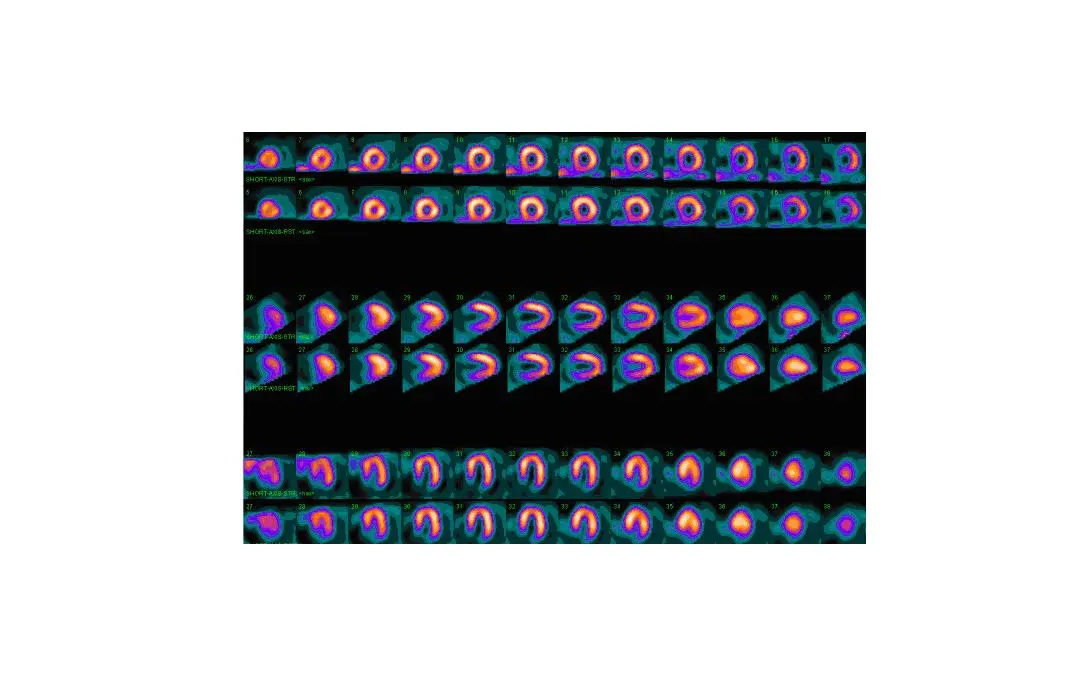
Because heart muscle takes in potassium, it takes in thallium too, wherever blood reaches it. Doctors inject a tiny amount of a radioactive kind, thallium-201, into a vein. A camera that sees its gamma rays then shows which parts of the heart muscle are getting enough blood and which are not, for example where a blood vessel of the heart is blocked Grade 10: Heart attack. Thallium-201 has a half-life of about 3 days, so it soon fades away. The amount used is far too small to poison anyone. Today a technetium compound is used more often for the same scan.
Isotopes of thallium
Natural thallium is a mixture of two stable isotopes, thallium-203 and thallium-205 Grade 9: Atomic mass.
Thallium-205 is also where a long chain of radioactive decays ends: the very slow decay of bismuth-209, the element two places on, gives thallium-205 (see bismuth).
Thallium and your health
Thallium and its compounds are highly poisonous. They can enter the body when they are swallowed, breathed in as dust, or even through the skin. The signs come slowly, over days: pain and tingling in the feet and legs as nerves are damaged, stomach pain, and, after a week or two, the hair falls out. That last sign is so typical that it helps doctors recognize the poisoning.
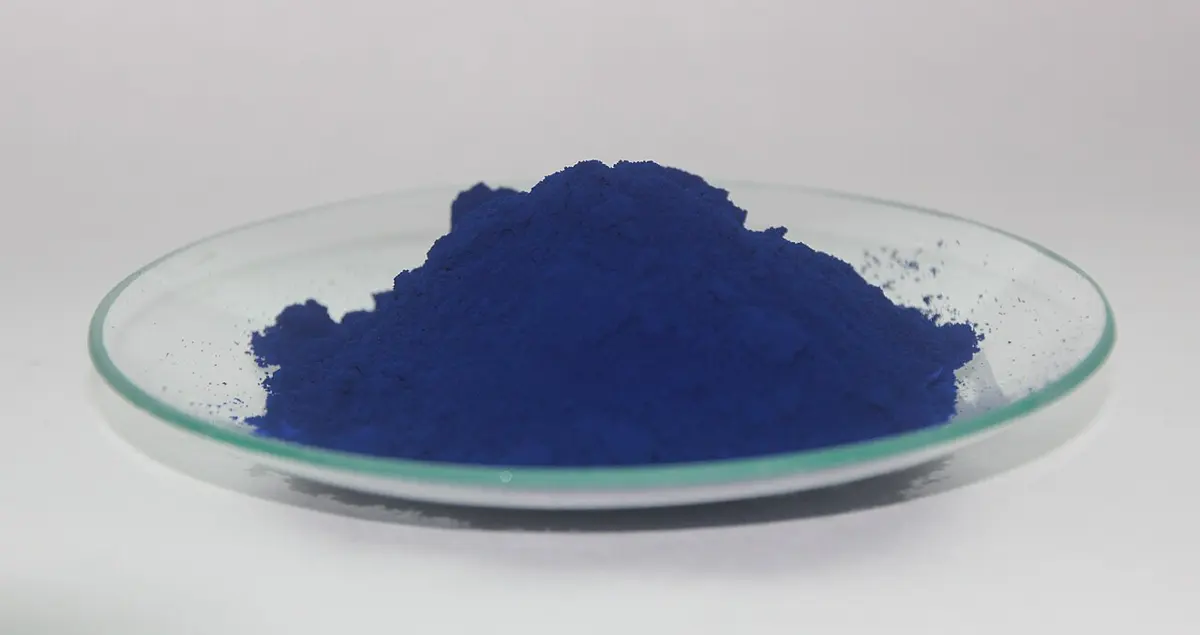
There is a medicine against it. Prussian blue, a blue pigment used in paints for 300 years, given by mouth, holds on to thallium in the gut so that it leaves the body instead of being taken back in. Doctors use it, with other treatment, and it saves lives.
Surprising facts and records
- Found by its color. Thallium was one of the first elements discovered with a spectroscope, after cesium and rubidium (1860–61) and just before indium (1863), each named after the color of its lines.
- A gamma-ray catcher. Many of the radiation detectors that find tumors, check luggage and study stars use a crystal with a pinch of thallium.
- Costly, though not rare. So little is made that pure thallium cost about 9,500 US dollars a kilogram in 2024 (USGS), about ten times the price of silver.
In your science books
- Grade 8: the 2n² rule.
- Grade 9: variable valency (thallous and thallic), atomic mass, metals and acids and the nervous system.
- Grade 10: electronic configuration, properties down a group, roasting ores, heart attack and safety with pesticides.
- Going further: why each element has its own lines and where the heavy atoms came from.
More to explore
- Nobel Prizes: superconductors that work in liquid nitrogen (1987; a thallium copper oxide later held the record).
- Its neighbors: indium, found by its color two years later, lead and mercury.
- Play: find thallium in Guess the Element and the Periodic Table Jigsaw.
- Read more: thallium at the Royal Society of Chemistry and at PubChem.