
- Atomic number
- 15
- Atomic mass
- 30.97
- Shells
- 2, 8, 5
- Configuration
- 1s² 2s² 2p⁶ 3s² 3p³
- In the table
- period 3, group 15 (VA), p-block
- Kind
- Non-metal
- Valency
- 3 and 5 (as in PCl₃ and P₂O₅)
- State at 25 °C
- solid
- Melts · boils
- 44 °C · 280 °C
- Density
- 1.8 × as heavy as water
- Known since
- 1669
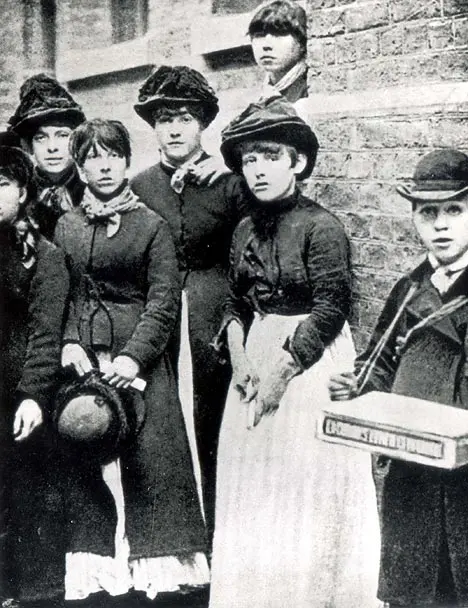
Strike a match on the side of a सलाई box and it bursts into flame: that brown strip holds phosphorus. Your bones and teeth are built of a phosphorus compound, and every cell in your body uses phosphorus to store its genes and to carry energy. The fields of Nepal need it too: it is the P in the NPK on a sack of fertilizer.
Yet phosphorus was first found in a most unlikely place, by a man boiling down buckets of urine in the hope of making gold.
The phosphorus atom
A phosphorus atom has 15 protons, so its atomic number is 15, and a neutral atom has 15 electrons. Every natural phosphorus atom has 16 neutrons, so the mass number is 15 + 16 = 31.
The electrons fill the K and L shells (2 and 8) and leave 5 for the M shell: 2, 8, 5 Grade 8: Bohr and Bury’s rule. In subshells that is 1s² 2s² 2p⁶ 3s² 3p³ Grade 10: The Aufbau principle: the three 3p electrons spread out, one in each of the three p orbitals.
Its place in the periodic table
- Period 3, because it has three shells.
- Group 15, called VA in the older naming, because it has five valence electrons. Nitrogen is directly above it.
- p-block, because its last electrons go into a p subshell.
Phosphorus is a non-metal, on the right of the staircase. With five outer electrons, it needs three more to complete an octet. It can gain three to become the phosphide ion, P³⁻, or, much more often, share three in covalent bonds, as in phosphorus trichloride, PCl₃: valency 3. But phosphorus can also use all five outer electrons in bonds, as in phosphorus pentachloride, PCl₅, and phosphorus pentoxide, P₂O₅: valency 5. So phosphorus has a variable valency of 3 and 5 Grade 9: Variable valency. Its most important ion is phosphate, PO₄³⁻ Grade 9: Negatively charged ions.
Nitrogen and phosphorus are in the same group. Which of these is true for both?
Pick an answer to see why.
How phosphorus was found and named
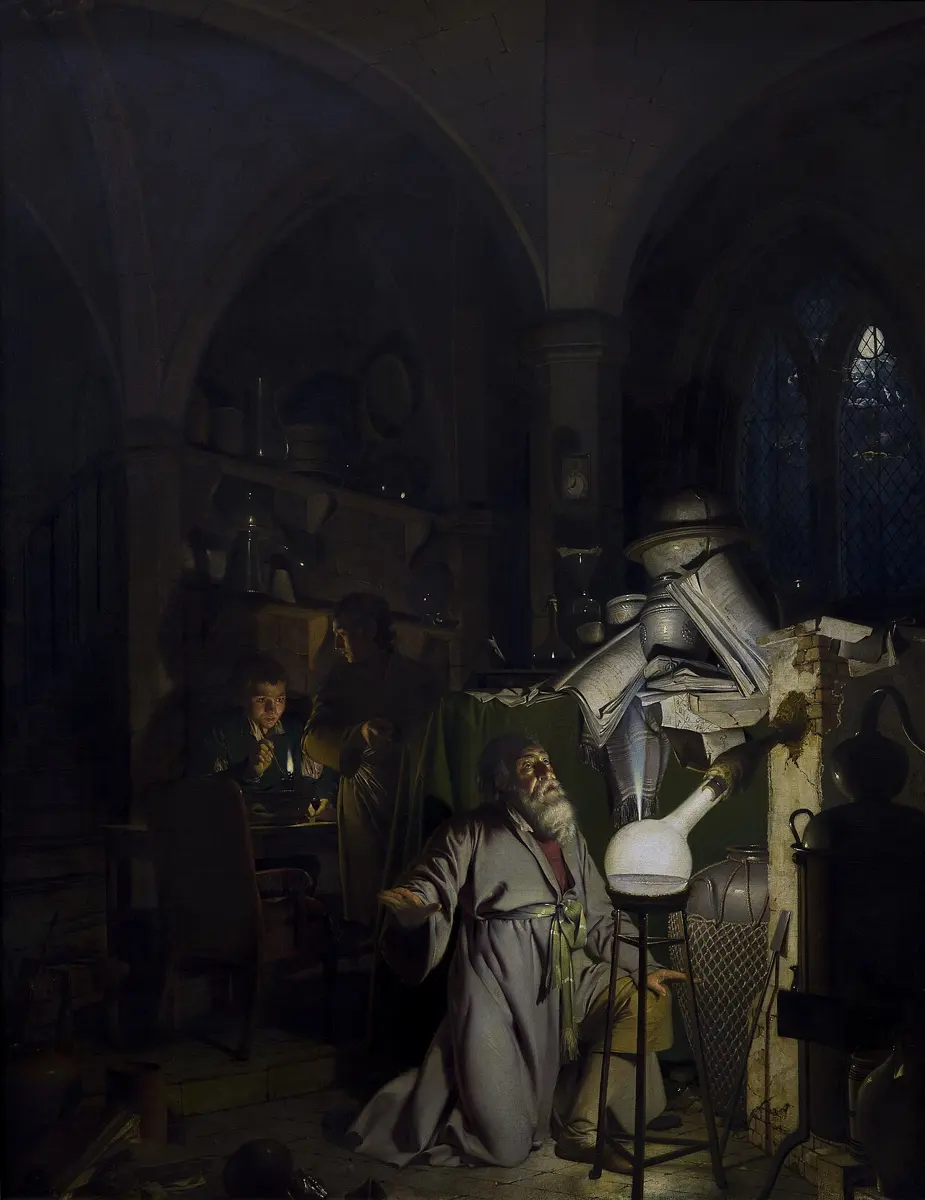
In 1669, in the German city of Hamburg, Hennig Brand (also spelled Brandt) was searching for the philosopher’s stone, a substance alchemists believed could turn ordinary metals into gold. He thought the golden color of urine might hold the secret. He collected a great deal of it, let it stand, boiled it down to a paste, and heated the paste until it was red-hot. A vapor came off, which he led into water. There it settled as a white, waxy solid that glowed in the dark with a ghostly green light and could burst into flame by itself.
It was not gold, but it was the first element whose discoverer we know by name. Brand kept his method secret and sold samples; within about ten years others, including the English scientist Robert Boyle (1680), worked out how to make it. A century later, in 1769, the Swedish chemists Gahn and Scheele showed that bones contain phosphorus, and bone ash replaced urine as its source.
The name comes from Greek phosphoros, “light-bringer”, an old name for the planet Venus when it shines as the morning star. Its symbol is P. In Nepali it is फस्फोरस, from the English; the dictionary gives its everyday meaning as a fertilizer used on crops.
Where phosphorus is found
In the universe. Phosphorus is made in massive stars late in their lives and thrown into space when they explode (Getting the atoms out). It is much rarer than carbon, nitrogen or oxygen, yet every living thing needs it.
In the Earth’s crust. It makes up only about 0.1% of the crust, about one gram in every kilogram of rock, and is never found free: it reacts with air far too easily. Almost all of it is in phosphate minerals, mainly apatite, a calcium phosphate. Rock rich in it, laid down on old sea floors, is called phosphate rock or phosphorite. In 2024 the world mined about 240 million tonnes of phosphate rock, most of it in China, Morocco, the United States and Russia (US Geological Survey). Morocco holds about two-thirds of all the known reserves that are worth mining.
In Nepal. Phosphorite has been found in Dang, Pyuthan and Baitadi Grade 8: Minerals in Nepal; geologists described the Baitadi deposit in the early 1980s. None of it is mined for fertilizer: Nepal has no fertilizer factory, and brings in all its chemical fertilizers, such as DAP (diammonium phosphate), from other countries.
In your body. An adult holds about 700 grams of phosphorus, about 1% of the body’s weight. About 85% of it is in the bones and teeth (see below).
The three faces of phosphorus
Phosphorus comes in several forms, called allotropes: the same atoms joined in different ways, just as diamond and graphite are both carbon Grade 9: Allotropes.
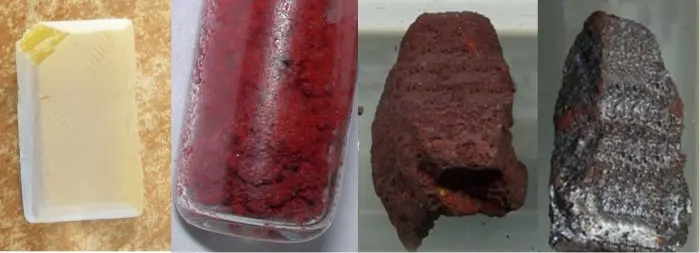
- White phosphorus is made of separate P₄ molecules: four atoms at the corners of a tiny pyramid with a triangular base. The bonds in this cramped shape are strained, so it is very reactive. It is a soft, waxy, white or yellowish solid that melts at 44 °C (the melting point, boiling point and density on this page’s card are white phosphorus’s). In air it glows, and it catches fire by itself at about 30 °C, so it is kept under water. It is very poisonous.
- Red phosphorus is made by heating white phosphorus to about 250 °C without air. The P₄ units open up and join into long chains. It is a dark red powder, far less reactive: it does not glow, does not catch fire unless heated strongly, and is not poisonous. This is the form on matchboxes.
- Black phosphorus, first made in 1914 by squeezing white phosphorus at enormous pressure, has its atoms in flat, puckered layers, like graphite. It is the most stable form, looks black and flaky, and conducts electricity.
Why is white phosphorus stored under water?
Pick an answer to see why.
How phosphorus reacts
With oxygen. Phosphorus burns with a brilliant white flame and thick white smoke of phosphorus pentoxide Grade 9: Chemical properties of oxygen:
4P + 5O₂ → 2P₂O₅
(Chemists often write P₄O₁₀, because the real molecule is two P₂O₅ units joined.)
Its oxide is acidic. Like other non-metal oxides, phosphorus pentoxide dissolves in water to give an acid, phosphoric acid:
P₂O₅ + 3H₂O → 2H₃PO₄
Phosphorus pentoxide grabs water so strongly that chemists use it to dry gases. Phosphoric acid gives cola drinks their sharp taste, removes rust from iron, and is added to hydrogen peroxide as a negative catalyst, to slow its breakdown Grade 10: Catalyst. Its salts are the phosphates.
With metals, phosphorus forms phosphides. Two are used as poisons for rats and grain pests: zinc phosphide and aluminium phosphide, which give off the deadly gas phosphine, PH₃, when damp Grade 10: Types of pesticides.
How a match lights
A safety match keeps its two halves apart. The head holds potassium chlorate, which gives off oxygen when hot, and sulphur, a fuel, with powdered glass and glue. The striking strip on the box holds red phosphorus, with more powdered glass. Neither lights alone.
The safety match was invented in Sweden: in 1844 Gustaf Erik Pasch put the red phosphorus on a separate strip, and from the 1850s the Lundström brothers made such matches in huge numbers.
Phosphorus and life
Phosphorus is in every living cell:
- Bones and teeth are hard because they are made largely of calcium phosphate, laid down among fibers of protein Grade 9: Hard connective tissue.
- DNA, the molecule of your genes, has a backbone of sugar and phosphate groups Grade 10: DNA.
- ATP, the molecule that carries energy to every part of the cell, is adenosine triphosphate: its energy is released when a phosphate group is broken off (Catching the energy: ATP).
- The thin membrane round every cell is made of phosphate-containing fats.
Phosphorus on the farm
Plants need phosphorus for strong roots, flowers, seeds and fruit; it is one of the three primary nutrients, with nitrogen and potassium Grade 9: Necessary nutrients for plants. Maize short of phosphorus grows slowly, and its leaves turn a dark purplish color. Every harvest carries phosphorus away from the field, so it must be put back, as manure, compost and bone meal, or as phosphatic fertilizers made from phosphate rock: DAP, single superphosphate, and the P in NPK Grade 9: Phosphatic fertilizers.
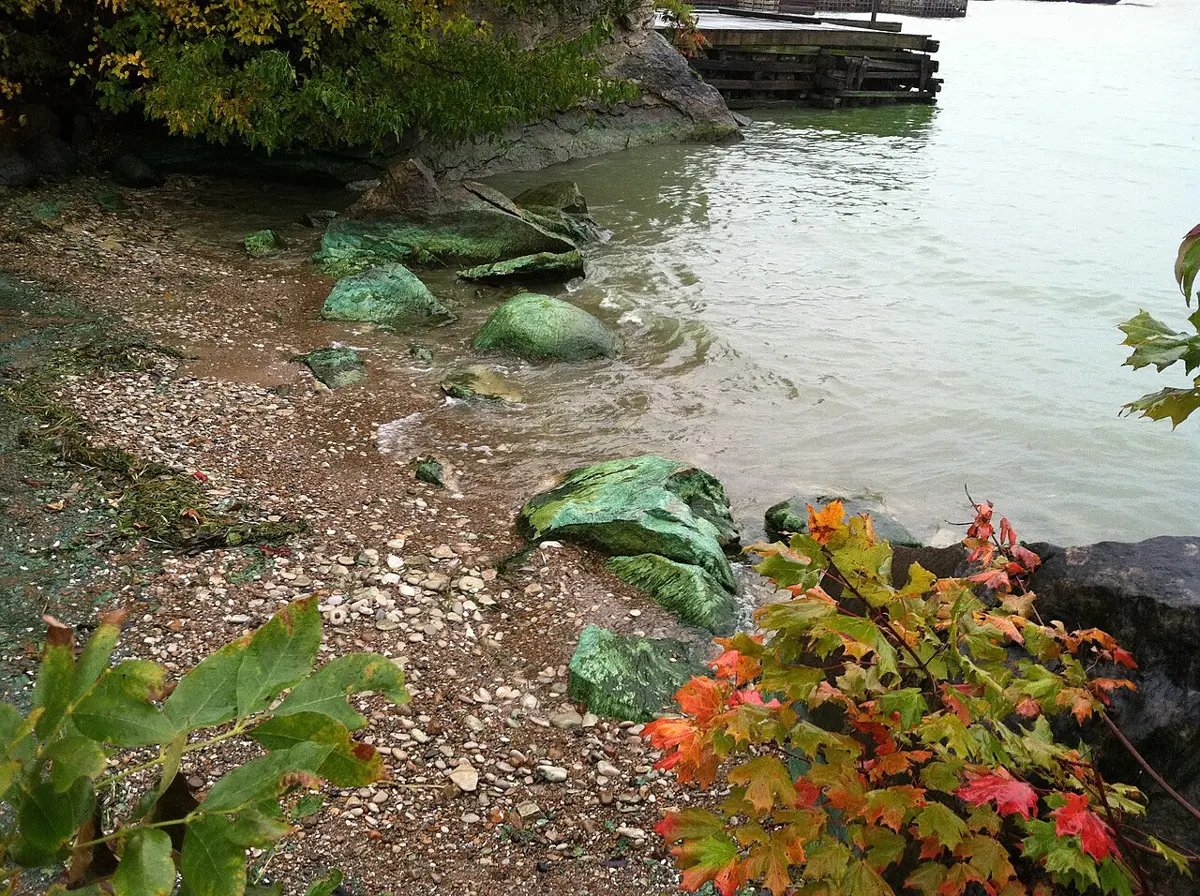
But phosphate washed off fields, and from sewage and some detergents, into ponds and lakes feeds the algae there. They grow into a thick green scum, then die and rot, and the bacteria that rot them use up the oxygen in the water, so fish die. This is eutrophication.
Isotopes of phosphorus
Natural phosphorus has only one stable isotope, phosphorus-31, so its atomic mass, 30.97, is almost a whole number. A radioactive isotope, phosphorus-32, has a half-life of 14.3 days: in research laboratories it is built into DNA as a “label” whose radiation shows where the DNA goes. And the first radioactive atom ever made by people was a phosphorus atom, phosphorus-30, made in 1934 by firing alpha particles at aluminium (Nobel Prize in Chemistry 1935).
Phosphorus and your health
Your body needs a good supply of phosphorus, mostly as phosphate, for growing bones and teeth. Adults need about 700 milligrams a day, and children and teenagers from 9 to 18 years about 1,250 milligrams, because their bones are growing fastest. Milk, curd, paneer, meat, fish, eggs, dal, beans, nuts and whole grains all supply it, so almost no one with enough to eat runs short. People with kidney disease must eat less of it, because their kidneys cannot remove the extra.
Surprising facts and records
- The painting of the discovery. In 1771 the English painter Joseph Wright of Derby imagined Brand’s moment as a scene in a dark, church-like room lit by the glowing flask.
- Phosphorus in your fridge and phone. Phosphates are in baking powder, toothpaste and processed cheese, and lithium iron phosphate is the material of the positive electrode in many batteries of electric buses and scooters (The lithium-ion battery).
- Doping silicon. A few atoms of phosphorus in a million million of silicon give it the spare electrons of n-type silicon, in every computer chip and solar cell (see silicon).
In your science books
- Grade 8: atoms and symbols, the 2n² rule, valency, ATP in the cell and minerals in Nepal.
- Grade 9: variable valency, the phosphate ion, burning phosphorus in oxygen, bone, plant nutrients and phosphatic fertilizers.
- Grade 10: electronic configuration, DNA, catalysts and pesticides.
- Going further: ATP and where the atoms in your body came from.
More to explore
- Nobel Prizes with phosphorus in them: the first artificial radioactive atoms (1935, phosphorus-30), the double helix (1962), how cells switch proteins on and off with phosphate (1992), the ATP motor (1997) and the lithium-ion battery (2019).
- Play: find phosphorus in Guess the Element and the Periodic Table Jigsaw.
- Read more: phosphorus at the Royal Society of Chemistry and at PubChem.