
- Atomic number
- 76
- Atomic mass
- 190.23
- Shells
- 2, 8, 18, 32, 14, 2
- Configuration
- 1s² 2s² 2p⁶ 3s² 3p⁶ 4s² 3d¹⁰ 4p⁶ 5s² 4d¹⁰ 5p⁶ 6s² 4f¹⁴ 5d⁶
- In the table
- period 6, group 8 (VIIIB), d-block
- Kind
- Transition metal
- Valency
- 4 (as in OsO₂) and 8 (as in OsO₄); also 2, 3 and 6
- State at 25 °C
- solid
- Melts · boils
- 3,033 °C · 5,012 °C
- Density
- 22.6 × as heavy as water
- Known since
- 1803
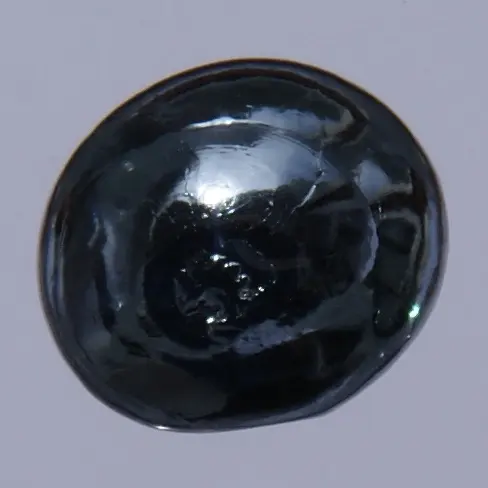
Fill a one-liter water bottle with water and it weighs a kilogram. Fill it with lead, and you would need both hands: more than 11 kg. Fill it with osmium (say “OZ-mee-um”), and it would weigh about 22.6 kg, as much as a big sack of rice. No element is denser.
Osmium is also one of the rarest metals on Earth, it once lit up homes in the first metal-filament light bulbs, and its name means “smell”. Here is its story.
The osmium atom
An osmium atom has 76 protons, so osmium’s atomic number is 76, and a neutral atom has 76 electrons. The most common kind, osmium-192, has 116 neutrons: mass number 76 + 116 = 192.
By the 2n² rule Grade 8: Bohr and Bury’s rule, the shells are 2, 8, 18, 32, 14, 2: the fourth shell (N) full with 32, the fifth (O) still filling, and two electrons already in the sixth (P).
In subshells Grade 10: The Aufbau principle, the first 70 electrons fill everything up to 6s² and then 4f¹⁴, and the last six go into 5d:
1s² 2s² 2p⁶ 3s² 3p⁶ 4s² 3d¹⁰ 4p⁶ 5s² 4d¹⁰ 5p⁶ 6s² 4f¹⁴ 5d⁶
This follows the Aufbau order exactly, like iron above it (4s² 3d⁶). Ruthenium, between them, is the odd one out: it moves one electron from 5s into 4d.
Its place in the periodic table
- Period 6, because its electrons are in six shells. It sits between rhenium (75) and iridium (77).
- Group 8, the first of the three columns that older tables call VIIIB, below iron and ruthenium.
- d-block: a transition metal Grade 10: Metals.
Osmium is the heaviest of the six platinum group metals: ruthenium, rhodium and palladium in period 5, and osmium, iridium and platinum in period 6. They are rare, unreactive, and found together in the same ores.
Its valency
Osmium has a variable valency Grade 9: Variable valency: 2, 3, 4, 6 and even 8. In osmium tetroxide, OsO₄, it uses all eight of its outer electrons. Ruthenium, above it, can do the same, but no element has a common compound with a higher valency.
How many electrons are in the outermost shell of an osmium atom?
Pick an answer to see why.
In osmium tetroxide, OsO₄, oxygen has a valency of 2. What is the valency of osmium?
Pick an answer to see why.
How osmium was found and named
In the 1700s, chemists in Europe began to study platinum, a strange white metal from South America. To purify it, they dissolved it in aqua regia, a mixture of concentrated nitric and hydrochloric acids. A little black powder was always left behind. Most thought it was graphite.
The English chemist Smithson Tennant, the man who had shown in 1796 that diamond is a form of carbon Grade 9: Diamond and graphite, worked with his friend William Hyde Wollaston on a large batch of platinum ore. In 1803 he took the black powder and treated it again and again with acids and alkalis, and found in it two new metals.
One gave salts of many colors, so he called it iridium, after the rainbow. The other gave off a sharp, unpleasant smell when heated with alkali and air. He called it osmium, from the Greek osme, “a smell”. He announced both to the Royal Society in London in 1804. The smell was the vapor of osmium tetroxide.
Osmium’s symbol is Os. Nepali uses the English name: ओस्मियम.
Where osmium is found
In the universe. Like all elements much heavier than iron, osmium was built by atomic nuclei catching neutrons, in giant stars and when dead stars collide (Heavier than iron).
In the Earth. Osmium is one of the rarest stable elements in the crust, only about 50 parts per trillion: a twentieth of a gram in a thousand tonnes of rock. Most of the Earth’s osmium sank with the iron into its core when the young Earth was molten, because osmium dissolves easily in molten iron.
It is found as the free metal, in small grains of a natural alloy with iridium called osmiridium, and mixed into the ores of platinum, nickel and copper. The main sources are the same as for platinum: the Bushveld rocks of South Africa, and nickel mines in Russia and Canada. Osmium is separated in the very last steps of refining those metals. So little is made that no one publishes exact figures: estimates run from about a hundred kilograms to a few tonnes a year.
In Nepal and in your body. None is mined in Nepal, and no living thing uses it.
What osmium is like
- A hard, bluish-white metal, shiny even when hot.
- The densest element: about 22.6 g/cm³, twice as dense as lead.
- Melts at 3,033 °C Grade 9: High melting points: only tungsten and rhenium, among the metals, melt at a higher temperature.
- Hard to squeeze. It is one of the least compressible substances known, about as hard to squeeze as diamond.
- Brittle. Unlike most metals, it cannot be hammered or drawn into wire: it shatters Grade 9: Malleable. So it is made as a powder and pressed, or used in alloys.
Why is it so dense?
Density depends on two things: how heavy each atom is, and how tightly the atoms are packed. Osmium wins on both.
- Heavy atoms. Each osmium atom has 76 protons and about 114 neutrons, so it weighs about 190 times as much as a hydrogen atom.
- Small atoms. Across period 6, the 14 electrons of the 4f subshell are added before 5d. They do not shield the outer electrons well from the growing pull of the nucleus, so the atoms after them are smaller than you would expect, hardly bigger than the atoms one row above them Grade 10: Atomic size. Osmium’s atom is almost the same size as ruthenium’s, but nearly twice as heavy.
- Tight packing. Its atoms are stacked like oranges in a market pile, the closest way spheres can pack.
For many years, careful measurements could not tell whether osmium or iridium was denser: the two differ by only about one part in a thousand. Only in the 1990s did X-ray measurements of their crystals settle it: osmium 22.59 g/cm³, iridium 22.56. Some tables still give slightly different numbers.
A gold atom (atomic mass 197) is heavier than an osmium atom (190). Why is osmium denser than gold?
Pick an answer to see why.
How osmium reacts
A solid piece of osmium is very unreactive: aqua regia, which dissolves gold and platinum, does not attack it. But powdered osmium slowly reacts with the oxygen of the air, even at room temperature, and burns when heated, to give osmium tetroxide Grade 9: Metals react with oxygen:
Os + 2O₂ → OsO₄
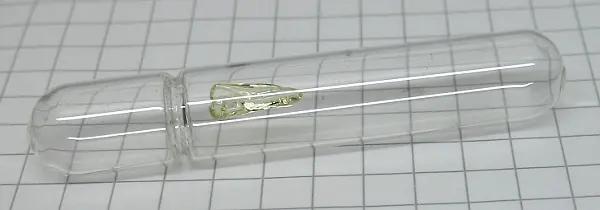
Osmium tetroxide is unusual for a metal oxide. It is not a basic oxide, and it is not even a hard solid: it forms pale yellow crystals that melt at about 40 °C and turn into a vapor at room temperature. That vapor has the sharp, chlorine-like smell that gave osmium its name, and it is very poisonous.
Osmium at work
In microscopes and on fingerprints
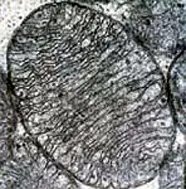
Osmium tetroxide’s danger is also its use. It reacts with the fats in cell walls and other membranes and leaves osmium behind there. Osmium’s heavy atoms block the beam of an electron microscope, so the membranes stand out dark and sharp. Many of the best pictures of the inside of cells were made this way. For the same reason, it can darken the oils of a fingerprint.
Chemists also use a tiny amount of osmium tetroxide as a catalyst Grade 10: Catalyst to add two –OH groups across a double bond. The American chemist Barry Sharpless found how to make it give only one of a molecule’s two mirror-image forms, part of the Nobel Prize in Chemistry in 2001.
Hard tips that last
Mixed with other platinum group metals, osmium makes some of the hardest-wearing alloys known. Osmiridium and similar alloys tipped the gold nibs of fountain pens for over a century, and the needles of record players in the 1940s and 1950s, and are still used for compass pivots and electrical contacts that must not wear down.
The bulb, the company and the fertilizer
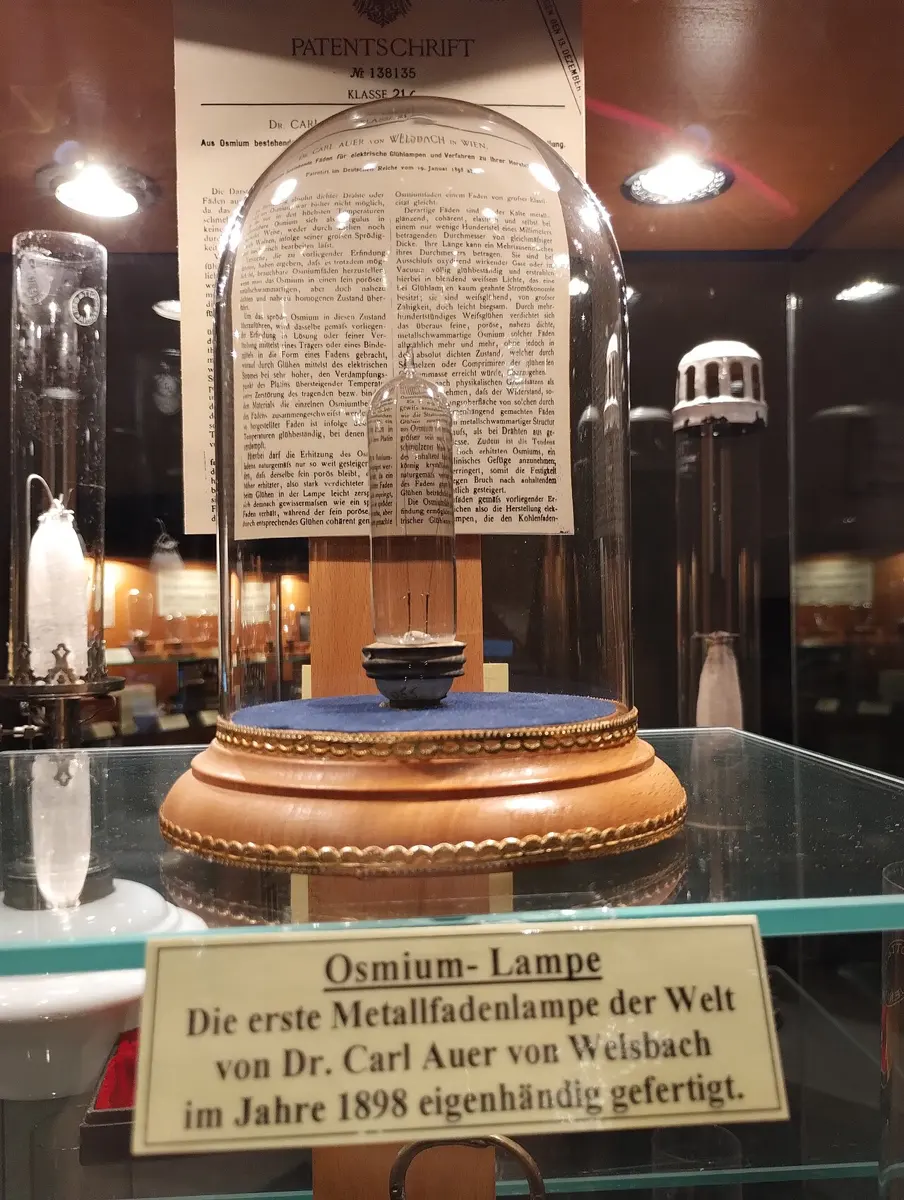
- The osmium lamp. In 1898, the Austrian chemist Carl Auer von Welsbach made the first light bulbs with a metal filament, of osmium, which glowed brighter and used less electricity than the carbon filaments of the time. They went on sale in 1902, but osmium was rare and brittle, and within a few years tungsten took its place. In 1906, a German company making the new bulbs took its name from Osmium and Wolfram (the German name for tungsten): Osram, still a well-known name in lighting.
- The first ammonia. In 1909, Fritz Haber made ammonia from nitrogen and hydrogen with an osmium catalyst, the start of the process that now makes most of the world’s fertilizer. The company BASF bought up almost all the world’s osmium to build on it, but soon found a much cheaper catalyst based on iron. Haber won the Nobel Prize in Chemistry in 1918.
Isotopes of osmium
Natural osmium is a mixture of seven isotopes, from osmium-184 to osmium-192. The commonest are osmium-192 (about 41%) and osmium-190 (26%). Two are faintly radioactive, but so slowly that they count as stable.
One of them, osmium-187, is special. Some of it has been made, over billions of years, by the slow radioactive decay of rhenium-187 (Rhenium). Geologists measure how much osmium-187 has built up in a rock beside its rhenium, and read it as a clock (A clock inside the atom).
Osmium also helped tell the story of the dinosaurs’ end. The rocks of an asteroid have a different mixture of osmium isotopes from the Earth’s crust, and the thin clay layer left round the world 66 million years ago carries the asteroid’s mixture (see iridium).
Osmium and your health
Your body has no use for osmium, and there is almost none in food. The solid metal is harmless. The danger is osmium tetroxide (above), which a fine osmium powder can slowly give off into the air. So osmium powder is kept sealed.
Surprising facts and records
- The densest element found on Earth: a 1 cm cube weighs 22.6 g, and a cube 30 cm on a side would weigh over 600 kg.
- One of the rarest stable elements in the crust, far rarer than gold or platinum.
- A light bulb’s name. Every Osram bulb carries osmium in its name, though none has osmium in it.
- Valency 8: only a handful of elements ever reach it, among them ruthenium and xenon.
In your science books
- Grade 8: the 2n² rule and groups and periods.
- Grade 9: variable valency, metals react with oxygen, high melting points and diamond (Tennant’s other discovery).
- Grade 10: electronic configuration, transition metals, atomic size and catalysts.
- Going further: clocks inside atoms and where heavy atoms are made.
More to explore
- Nobel Prizes with osmium in them: ammonia from the air (1918, Haber’s first catalyst was osmium) and left-handed and right-handed molecules (2001, Sharpless’s osmium catalyst).
- Its family and neighbors: iron and ruthenium above it in group 8; iridium, found with it in 1803; rhenium, whose atoms turn into osmium; and tungsten, which replaced it in light bulbs.
- Play: find osmium in Guess the Element and the Periodic Table Jigsaw.
- Read more: osmium at the Royal Society of Chemistry and at PubChem.