
- Atomic number
- 39
- Atomic mass
- 88.91
- Shells
- 2, 8, 18, 9, 2
- Configuration
- 1s² 2s² 2p⁶ 3s² 3p⁶ 4s² 3d¹⁰ 4p⁶ 5s² 4d¹
- In the table
- period 5, group 3 (IIIB), d-block
- Kind
- Transition metal
- Valency
- 3 (Y³⁺)
- State at 25 °C
- solid
- Melts · boils
- 1,522 °C · 3,345 °C
- Density
- 4.5 × as heavy as water
- Known since
- 1794
Switch on an LED bulb and look at it from the side, with the power off: the little lights inside are yellow. Yet the light they give is white. The yellow coating that does this trick, in almost every white LED bulb, phone torch and solar lantern, is a crystal made with the element yttrium (say IT-ree-um).
Yttrium is in the lasers eye doctors and dentists use, in the strongest ceramic teeth, and in the material that made headlines in 1987 by carrying electricity with no resistance at all. It also has one of the strangest names in chemistry. Here is its story.
The yttrium atom
A yttrium atom has 39 protons, so yttrium’s atomic number is 39, and 39 electrons. Every yttrium atom found in nature has 50 neutrons, so its mass number is 39 + 50 = 89.
You might expect the shells to be 2, 8, 18, 8, 3: after strontium (2, 8, 18, 8, 2), one more electron in the outer shell. But yttrium is 2, 8, 18, 9, 2. The 39th electron goes back into the N shell, which could hold up to 32 Grade 8: Bohr and Bury’s rule.
The reason shows in subshells Grade 10: The Aufbau principle. After 4p comes 5s, which has a little less energy than 4d. Rubidium and strontium fill 5s; then, with 5s full, yttrium’s 39th electron starts 4d, which belongs to the fourth shell:
1s² 2s² 2p⁶ 3s² 3p⁶ 4s² 3d¹⁰ 4p⁶ 5s² 4d¹
This is the same pattern as scandium, the element above yttrium: there, 4s fills and then 3d begins.
How are yttrium’s 39 electrons arranged in shells?
Pick an answer to see why.
Its place in the periodic table
- Period 5, because its electrons are in five shells. It comes after strontium (38) and before zirconium (40).
- Group 3, called IIIB in the older naming many books use, below scandium.
- d-block, because its last electron goes into a d subshell. That makes yttrium the first transition metal of period 5 Grade 10: Metals.
Scandium, yttrium and the fifteen lanthanides are together called the rare-earth elements. Yttrium’s atoms and ions are almost exactly the size of those of two lanthanides, holmium and dysprosium. So in rocks, and in the chemist’s flask, yttrium mixes with them so well that separating it is hard.
Its valency
In its compounds, yttrium loses all three of its outer electrons, the two 5s and the one 4d, to become the ion Y³⁺ Grade 9: Cations. Its valency is 3. Y³⁺ is left with 2, 8, 18, 8: the electrons of the noble gas krypton. With no d electrons left, yttrium’s compounds are white or colorless, like scandium’s and aluminium’s.
With the criss-cross method Grade 9: The criss-cross method, yttrium (3) and oxygen (2) give Y₂O₃, yttrium oxide, also called yttria. With chloride it gives YCl₃.
What is the formula of yttrium sulphate?
Pick an answer to see why.
How yttrium was found and named
A black rock from Ytterby
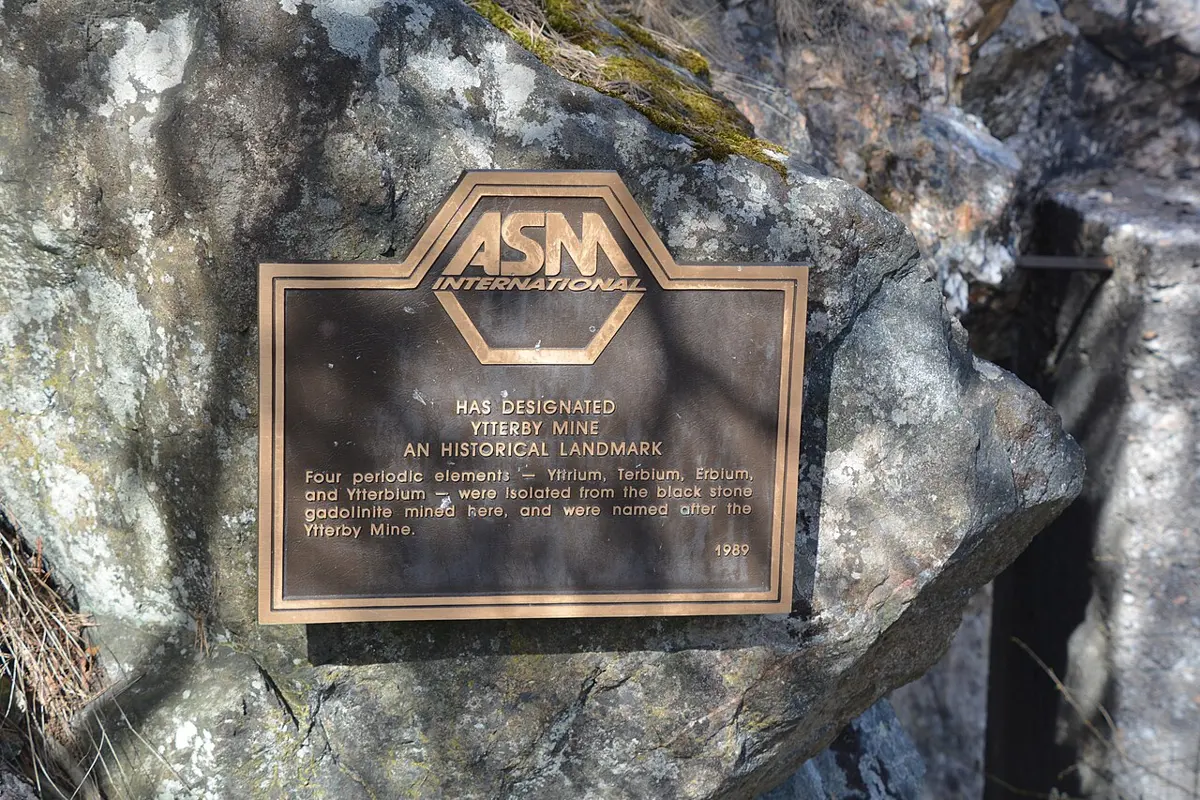
Ytterby (“outer village”) is a small village on an island near Stockholm, in Sweden. Its quarry dug feldspar, a mineral used to make porcelain.
- 1787. Carl Axel Arrhenius, a young army officer who loved minerals, found a heavy black rock in the quarry. He thought it might hold the newly found metal tungsten, and sent pieces to chemists.
- 1794. Johan Gadolin, a chemist in Turku (now in Finland), showed that 38% of the rock was a new earth (a metal oxide) that no one had seen before. In 1797 it was named yttria, after the village. It is the first rare earth ever found.
- 1828. Friedrich Wöhler, in Germany, made a little of the impure metal, by heating yttrium chloride with potassium. The element became yttrium; its symbol was Yt until the 1920s, and is now Y.
The black rock was renamed gadolinite, after Gadolin.
One rock, many elements
Gadolin’s yttria was not pure. In 1843 Carl Gustaf Mosander split it into three oxides: a white one, still called yttria, a yellow one and a rose-colored one, the oxides of two new elements, terbium and erbium. Later chemists found ytterbium in it too. So four elements are named after one village: yttrium, ytterbium, terbium and erbium. Over the next decades, more new elements were found in the same Ytterby minerals, including holmium (after Stockholm), thulium (after Thule, an old name for the far north) and gadolinium (after Gadolin).
Where yttrium is found
In the universe. Like strontium and zirconium, yttrium is made when atoms catch neutrons, mostly slowly, inside old giant stars (Slowly, in giant stars). Its nucleus has exactly 50 neutrons, an especially stable number, so yttrium-89 builds up there more than its neighbors.
In the Earth’s crust. Yttrium is not really rare: there are about 30 grams in every tonne of rock, more than lead. But it is spread thinly and never found as the metal. It is mined, together with the lanthanides, from a few minerals: xenotime (yttrium phosphate, YPO₄), monazite and bastnäsite, and from weathered clays in southern China that hold rare-earth ions loosely on their surface. In 2025 the world produced about 10,000 to 15,000 tonnes of yttrium oxide, most of it in China and Myanmar (USGS, 2026).
In Nepal and in your body. No yttrium deposit is known in Nepal. Your body holds only a tiny trace of yttrium, and has no use for it.
What yttrium is like
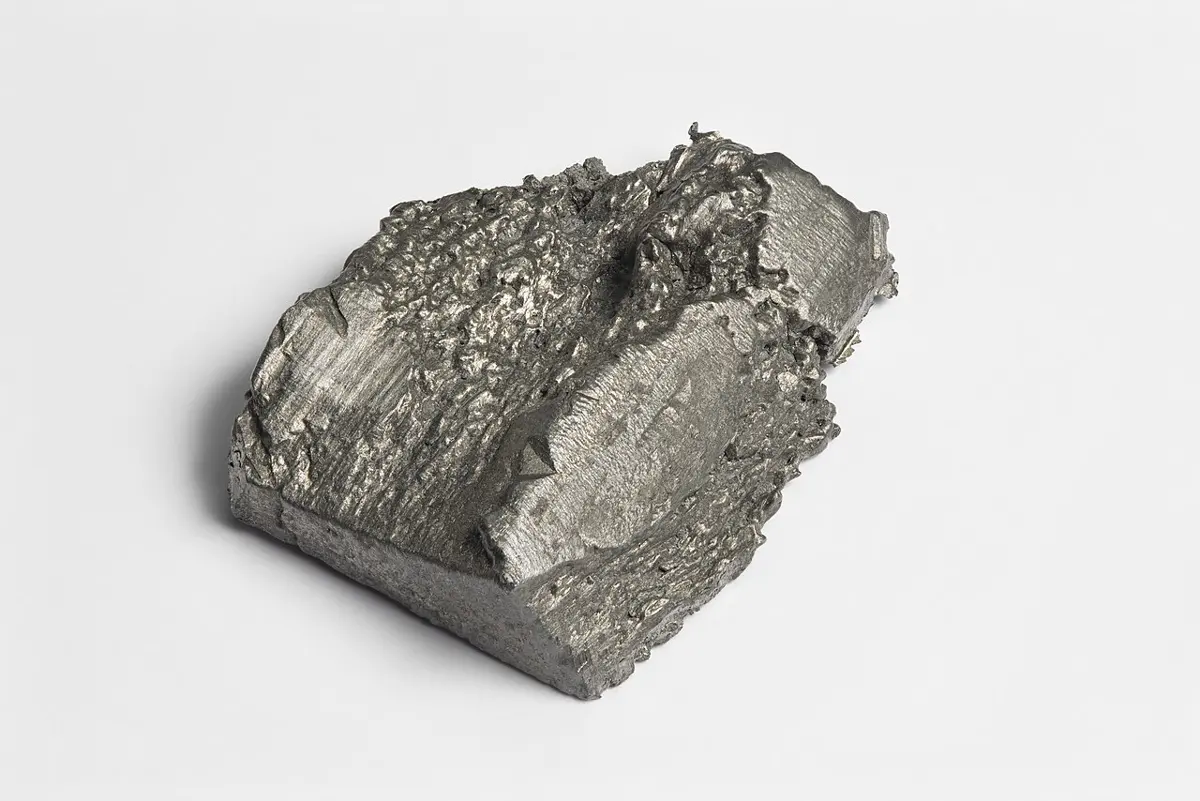
- A silvery-gray metal, fairly soft. In a lump it keeps well in air, because a thin, tight layer of oxide forms on its surface and protects it.
- Fairly light. Its density is 4.47 g/cm³, about the same as titanium’s.
- Melts at 1,522 °C, a little lower than iron (1,538 °C).
Yttrium metal itself has few uses. What makes it valuable is its compounds: yttrium oxide and the crystals made from it are hard, stand great heat, and can hold other atoms, such as cerium, europium or neodymium, in their crystal, which gives them their glow.
How yttrium reacts
Yttrium is a reactive metal, more like aluminium and the rare earths than like iron or copper.
- With air. A lump only tarnishes slowly. But shavings, heated above about 400 °C, catch fire, and burn to white yttrium oxide Grade 9: Metals react with oxygen:
4Y + 3O₂ → 2Y₂O₃ - With water, slowly, giving hydrogen.
- With dilute acids, faster, giving a salt and hydrogen Grade 9: Metals and dilute acids:
2Y + 6HCl → 2YCl₃ + 3H₂
In all its common compounds yttrium has a valency of 3: YCl₃, Y₂O₃, Y₂(SO₄)₃.
Yttrium in daily life
White light from a blue LED
An LED on its own gives light of just one color. The bright blue LED, invented in Japan in the early 1990s, won the Nobel Prize in Physics in 2014. White LED bulbs, on sale since 1996, are built on it.
Over the tiny blue chip lies a yellow powder, a phosphor: crystals of yttrium aluminium garnet (YAG, Y₃Al₅O₁₂) with a little cerium in them. The cerium atoms soak up some of the blue light and give out yellow light instead. The rest of the blue light passes straight through. Blue and yellow light together look white to your eye.
The LED bulbs that light homes all over Nepal use far less electricity than old filament bulbs for the same light Grade 9: An LED and a filament bulb. Before LEDs, yttrium oxide with a little europium gave the red light of color television tubes and of tube lights, and it still does in some lamps.
Lasers
A crystal of yttrium aluminium garnet with a little neodymium in it makes the Nd:YAG laser, one of the most used lasers in the world. Its invisible infrared beam can cut and weld metal, mark the numbers on machine parts and engrave stone.
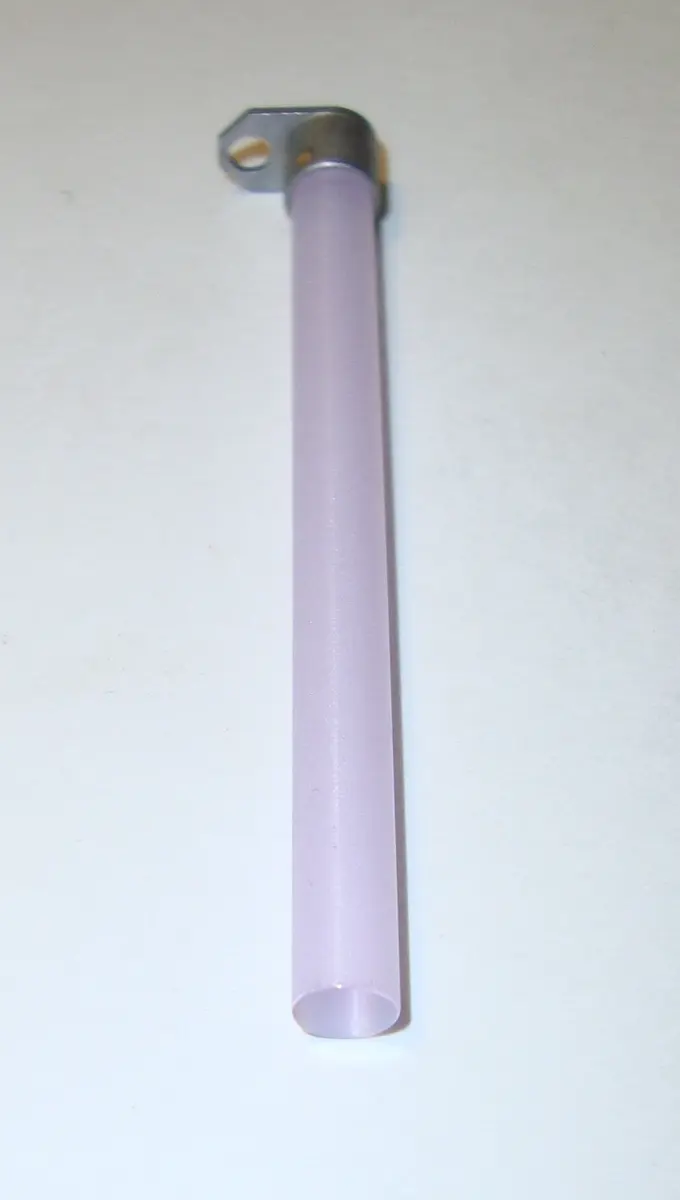
In hospitals, eye doctors use a YAG laser to clear the cloudy film that sometimes grows behind the new lens after cataract surgery, in a few minutes and without cutting the eye Grade 10: Cataract. Some dentists use a YAG laser with erbium in it to drill teeth.
Ceramics that do not crack
Pure zirconium oxide, the hard ceramic of zirconium, cracks as it cools, because its crystals change shape. A few percent of yttrium oxide keeps the crystals in their strong form. This yttria-stabilized zirconia makes white dental crowns, ceramic knives, the sparkling cubic zirconia of cheap jewelry, the oxygen sensors in car exhausts, and heat shields on jet-engine blades.
Superconductors
A superconductor is a material that, below a certain temperature, carries electricity with no resistance at all Grade 9: Factors affecting resistance. Until 1986 every superconductor had to be cooled almost to absolute zero, with costly liquid helium (−269 °C). In 1986 Georg Bednorz and Alex Müller found a ceramic of copper oxide that superconducted at a much higher temperature, and early in 1987 a team led by Paul Chu in Houston and Maw-Kuen Wu in Alabama, USA, replaced its lanthanum with yttrium. Their yttrium barium copper oxide (YBa₂Cu₃O₇, called YBCO) superconducts below about −181 °C, warmer than liquid nitrogen (−196 °C), which is made from air and is cheap.
A superconductor also pushes magnetic fields out of itself. So a small magnet placed over a piece of YBCO cooled in liquid nitrogen floats in mid-air.
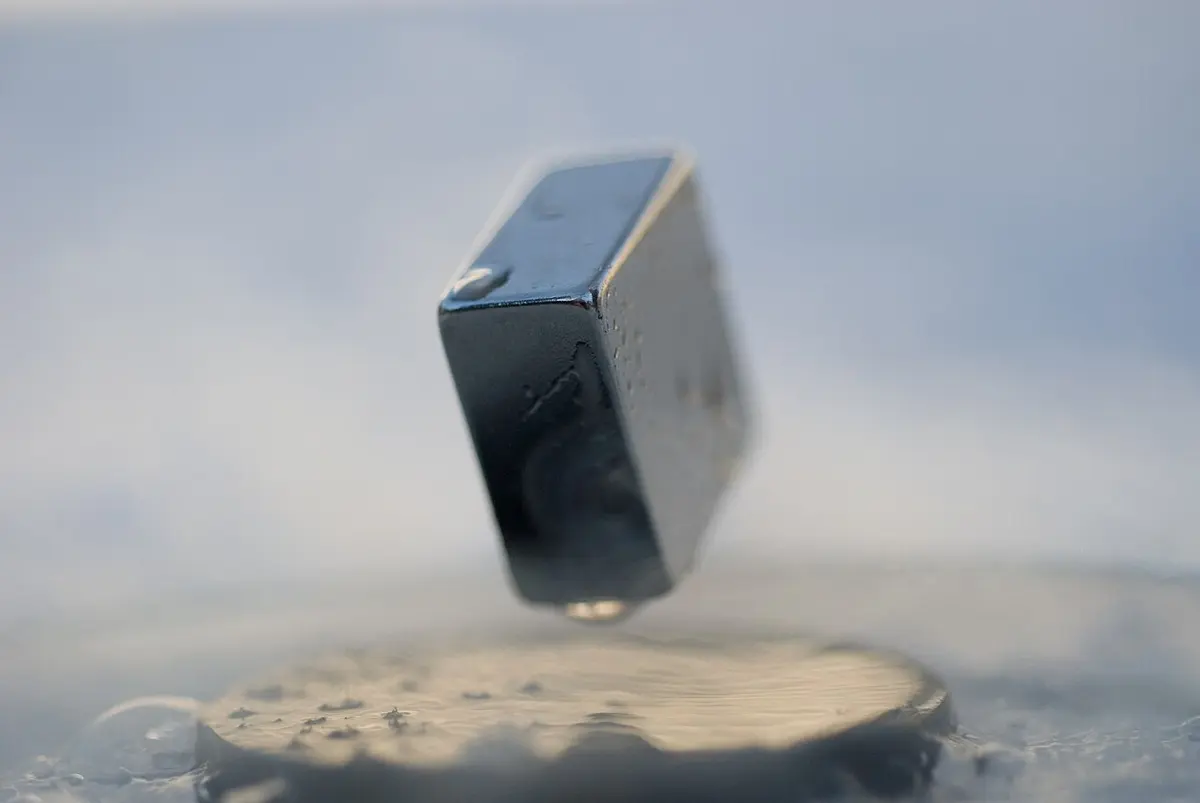
Tapes coated with YBCO now carry large currents in some power cables, and make some of the strongest magnets ever built, for experiments in fusion power.
Isotopes of yttrium
Natural yttrium has only one isotope, yttrium-89, with 39 protons and 50 neutrons. That is why its atomic mass, 88.906, is so close to a whole number: there is no mixture to average Grade 9: Atomic mass.
Yttrium-90 is radioactive, with a half-life of only 64 hours. It is made all the time by the decay of strontium-90, and it decays in turn into stable zirconium-90, giving out a beta particle (a fast electron) each time (Beta decay). Doctors use it to treat liver cancer: millions of tiny beads holding yttrium-90 are sent through the blood vessels into the tumor, where its radiation, which travels only a few millimeters in the body, kills the cancer cells close by. In two weeks almost all of it has decayed.
Yttrium and your health
Yttrium has no known job in any living thing, and the tiny amounts in food do no harm. Soluble yttrium compounds are mildly poisonous, and breathing in their dust can harm the lungs, so workers who handle them wear masks.
Surprising facts and records
- A village with four elements. Ytterby is the place that has given its name to more elements than any other.
- A new blue. In 2009 chemists at Oregon State University, USA, trying to make materials for electronics, made a brilliant new blue pigment from yttrium, indium and manganese, YInMn blue, the first new blue pigment in about 200 years.
- The first rare earth. Gadolin’s yttria (1794) was the first rare earth ever found. It took about 150 years to sort out all the elements hiding in such minerals.
In your science books
- Grade 8: the 2n² rule.
- Grade 9: cations, the criss-cross method, atomic mass, resistance and LED and filament bulbs.
- Grade 10: the Aufbau principle, transition metals and cataract.
- Going further: where yttrium is made and beta decay.
More to explore
- Nobel Prizes with yttrium in their story: the blue LED (2014, see how white LED light is made) and superconductors that work in liquid nitrogen (1987).
- Its neighbors: strontium before it, zirconium after it, and scandium above it.
- Play: find yttrium in Guess the Element, the Periodic Table Jigsaw and Higher or Lower.
- Read more: yttrium at the Royal Society of Chemistry and at PubChem.