
- Atomic number
- 38
- Atomic mass
- 87.62
- Shells
- 2, 8, 18, 8, 2
- Configuration
- 1s² 2s² 2p⁶ 3s² 3p⁶ 4s² 3d¹⁰ 4p⁶ 5s²
- In the table
- period 5, group 2 (IIA), s-block
- Kind
- Alkaline earth metal
- Valency
- 2 (Sr²⁺)
- State at 25 °C
- solid
- Melts · boils
- 777 °C · 1,377 °C
- Density
- 2.6 × as heavy as water
- Known since
- 1790
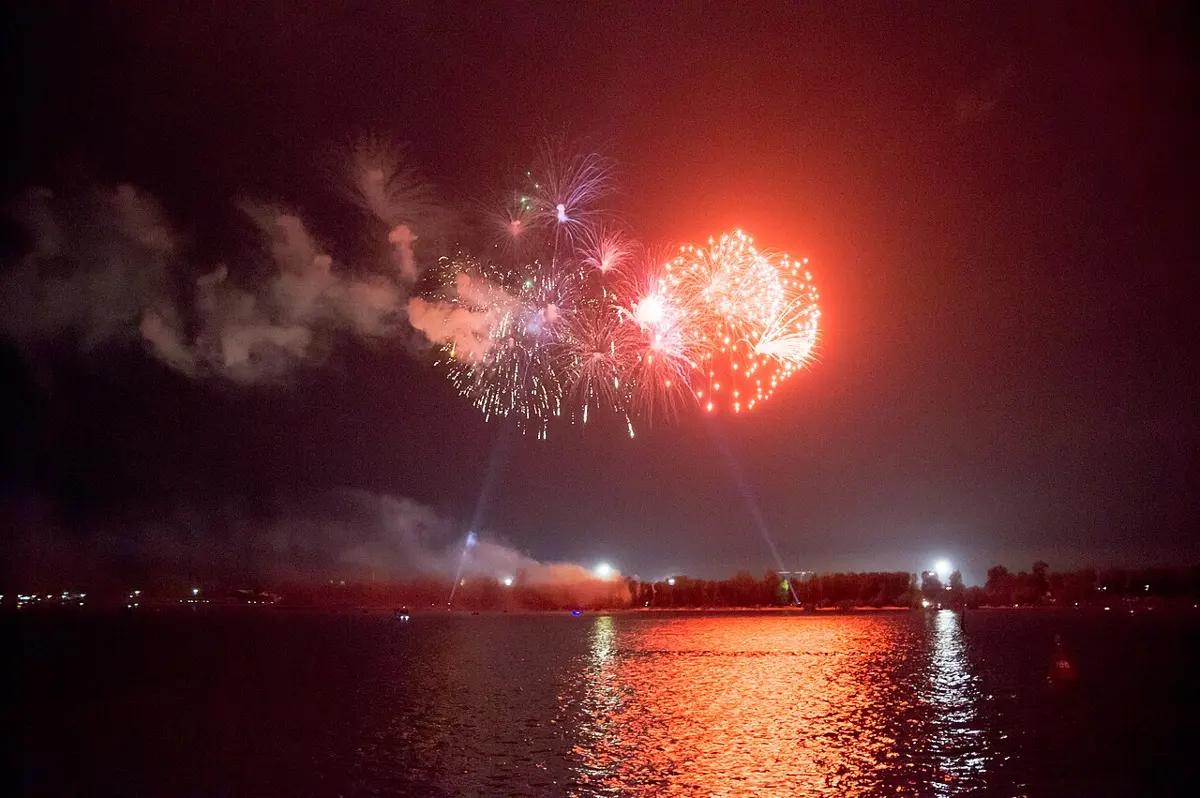
On the nights of Tihar, the sky over Nepal’s towns fills with fireworks that burst in gold, green, blue and a deep, glowing red. That red comes from one element, strontium. The same element makes the red flares that warn drivers of an accident, the glow of a sticker that shines in the dark, and the ticking of the most accurate clocks ever built.
Strontium also has a dark side. Its radioactive form, strontium-90, once fell from the sky after nuclear bomb tests and settled in children’s teeth. Here is its whole story.
The strontium atom
A strontium atom has 38 protons, so strontium’s atomic number is 38, and 38 electrons. Most strontium atoms (about 83%) also have 50 neutrons, so their mass number is 38 + 50 = 88.
By the 2n² rule Grade 8: Bohr and Bury’s rule, the K, L and M shells take 2, 8 and 18 electrons. The N shell could hold 32, but it takes only 8, and the last 2 go into the fifth shell, the O shell: 2, 8, 18, 8, 2.
The reason shows in subshells Grade 10: The Aufbau principle. After 4p, the next subshell to fill is 5s, which has less energy than 4d. So, just as calcium puts its last two electrons in 4s, strontium puts them in 5s:
1s² 2s² 2p⁶ 3s² 3p⁶ 4s² 3d¹⁰ 4p⁶ 5s²
Strontium gives away these two outer electrons. What is left, 2, 8, 18, 8, has a full outer shell, like the noble gas krypton. So strontium forms the strontium ion, Sr²⁺, and its valency is 2 Grade 8: Valency.
How many electrons does a strontium ion, Sr²⁺, have?
Pick an answer to see why.
With the criss-cross method Grade 9: The criss-cross method you can write strontium’s compounds just like calcium’s: SrCl₂ (strontium chloride), SrO (oxide), SrCO₃ (carbonate), SrSO₄ (sulphate), Sr(OH)₂ (hydroxide) and Sr(NO₃)₂ (nitrate).
Its place in the periodic table
- Period 5, because its electrons are in five shells.
- Group 2 (IIA), because it has two outer electrons.
- s-block, because they are in the 5s subshell.
Strontium is an alkaline earth metal, with beryllium, magnesium, calcium above it and barium and radium below Grade 8: Characteristics of groups. Its closest relative is calcium, the element just above it. The two behave so much alike that living things often cannot tell them apart, which matters a great deal, as you will see.
How strontium was found and named
Strontian (pronounced stron-TEE-an) is a small village in the Highlands of Scotland. In the 1700s there were lead mines in the hills above it, and the miners found a heavy, pale mineral among the lead ore.
- 1790. Two doctors in Edinburgh, Adair Crawford and William Cruickshank, studied the mineral from Strontian. It looked like a barium mineral, but it behaved differently. Crawford wrote that it probably held “a new species of earth”, meaning a new metal oxide.
- Early 1790s. Thomas Charles Hope, a chemistry professor in Glasgow and then Edinburgh, made a full study and proved it. He noticed that the new earth turned a candle flame red, while barium’s compounds did not. He called it strontites, after the village. In Germany, Martin Klaproth found the same new earth at about the same time.
- 1808. In London, Humphry Davy made the metal itself, with electricity, the way he had freed sodium and potassium a year before. He passed a current through moist strontium chloride mixed with mercury oxide; the strontium went into the mercury, and he boiled the mercury away. He named the metal strontium, symbol Sr.
So strontium is one of very few elements named after a village. Ytterby, in Sweden, has four (see yttrium). Strontian’s old Gaelic name, Sròn an t-Sìthein, means “the point of the fairy hill”.
Where strontium is found
In the universe. Strontium atoms are heavier than iron, so stars cannot make them by fusion. They are made when nuclei catch neutrons, slowly inside old giant stars and in a flash when dead stars collide (Heavier than iron: catching neutrons). Nuclei with exactly 50 neutrons are unusually stable and hardly catch another one, so atoms pile up there: strontium-88, yttrium-89 and zirconium-90, which all have 50 neutrons, are more common than their neighbors. In 2019 astronomers saw the lines of strontium in the light from the collision of two neutron stars, the first heavy element ever spotted being made (In a flash, when dead stars collide).
In the Earth’s crust. Strontium is not rare. There are about 300 to 400 grams in every tonne of rock, making it roughly the 15th most common element in the crust, more common than zinc or copper. Because it reacts with water and air, it is never found as the metal. Its two main minerals are:
- celestine (or celestite), strontium sulphate, SrSO₄, often pale sky-blue; its name comes from the Latin for “heavenly”;
- strontianite, strontium carbonate, SrCO₃, the mineral first found at Strontian.
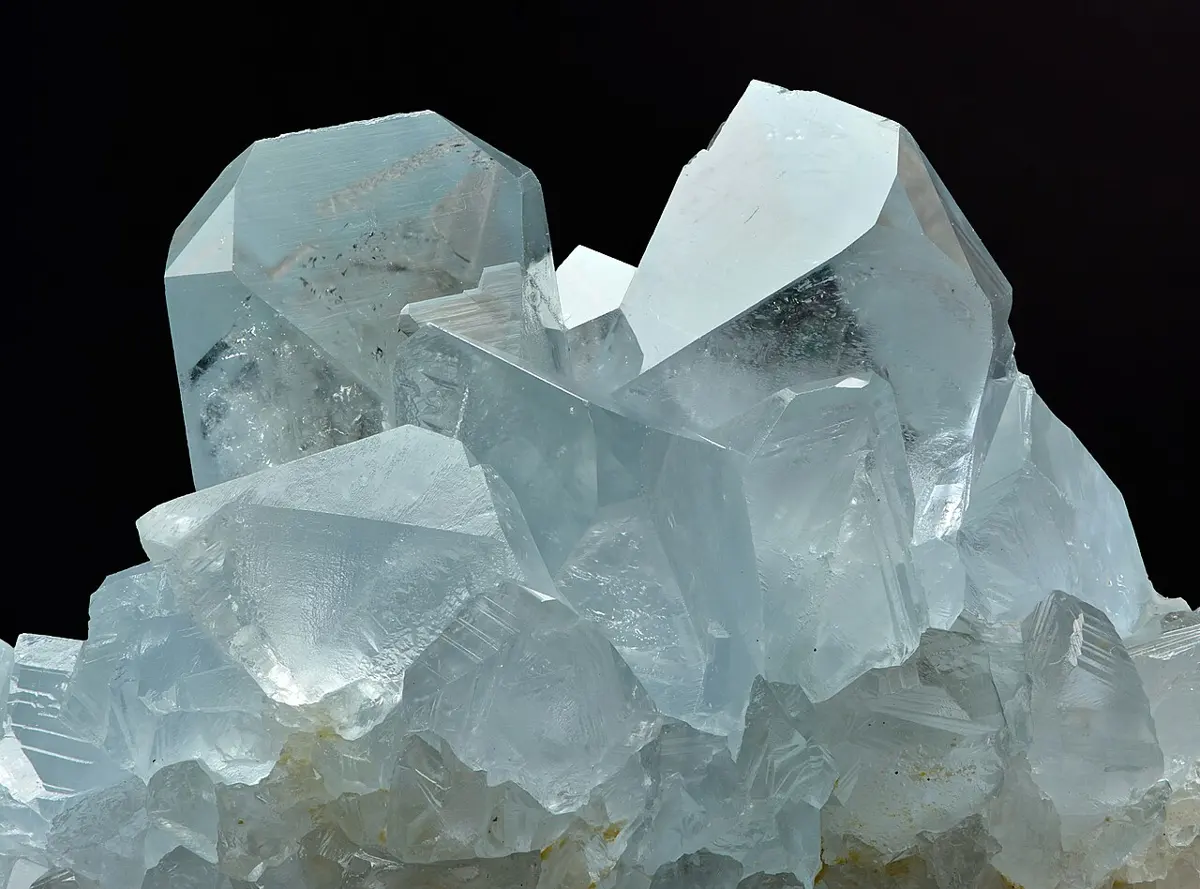
In 2025 the world mined about 450,000 tonnes of celestine. The biggest producer was Iran, followed by Spain and China (USGS, 2026). No strontium mineral is mined in Nepal.
In the sea and in living things. Every liter of seawater holds about 8 milligrams of strontium. Some corals build it into their skeletons, and some tiny sea creatures, the acantharians, make their whole skeleton of strontium sulphate. You take in a little with food and water every day, and your body stores it where it stores calcium: in your bones and teeth.
What strontium is like
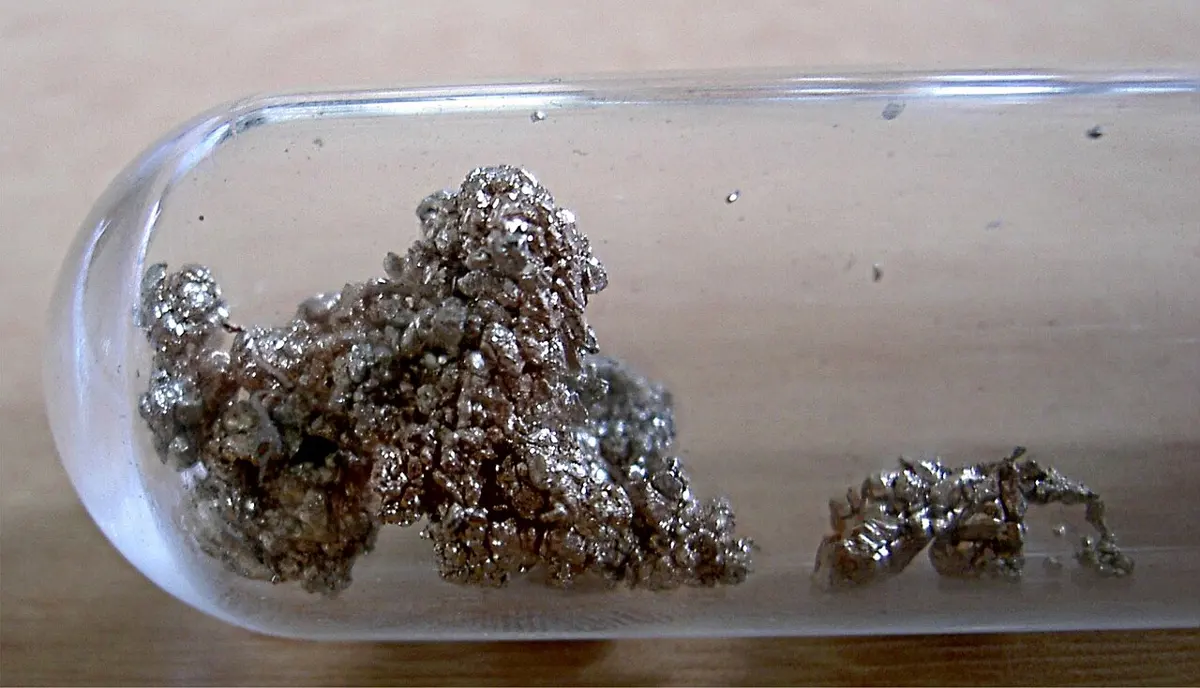
- A soft, silvery metal, softer than calcium. In air its surface quickly turns yellowish as a layer of oxide forms, so it is kept under oil or in sealed glass.
- Light, but heavier than water. Its density is 2.64 g/cm³, between calcium’s (1.54) and barium’s (3.62).
- Melts at 777 °C, a lower temperature than calcium (842 °C).
In group 2, the properties change steadily as you go down: the atoms get bigger, the outer electrons are farther from the nucleus, and they are easier to pull off. So each metal is more reactive than the one above it Grade 10: Chemical reactivity.
| metal | shells | melting point (°C) | density (g/cm³) | with cold water |
|---|---|---|---|---|
| magnesium | 2, 8, 2 | 650 | 1.74 | hardly reacts |
| calcium | 2, 8, 8, 2 | 842 | 1.54 | steady bubbles |
| strontium | 2, 8, 18, 8, 2 | 777 | 2.64 | faster |
| barium | 2, 8, 18, 18, 8, 2 | 727 | 3.62 | faster still |
How strontium reacts
Strontium is a reactive metal, a little more reactive than calcium.
With water. A piece of strontium sinks in cold water and fizzes steadily, giving hydrogen gas and strontium hydroxide, an alkali Grade 9: Very reactive metals react with water:
Sr + 2H₂O → Sr(OH)₂ + H₂
With oxygen. Heated in air, strontium catches fire and burns with a bright crimson flame, leaving white strontium oxide Grade 9: Metals react with oxygen:
2Sr + O₂ → 2SrO
With dilute acids, it gives a salt and hydrogen Grade 9: Metals and dilute acids:
Sr + 2HCl → SrCl₂ + H₂
Which of these metals reacts fastest with cold water?
Pick an answer to see why.
The red flame
Dip a clean wire in a strontium compound, such as strontium chloride, and hold it in a gas flame. The blue flame turns a brilliant red. This is strontium’s flame test.
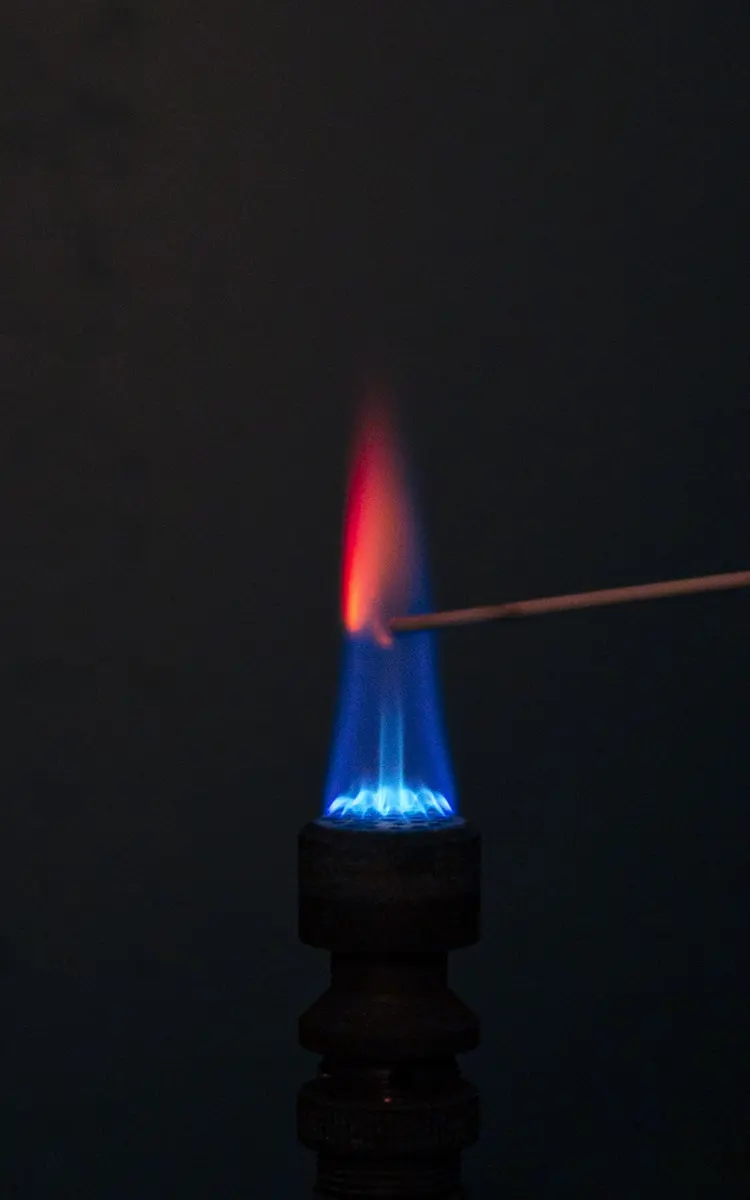
The heat of the flame gives the strontium electrons extra energy and lifts them to higher energy levels. When they drop back, they give out the extra energy as light, of a few exact colors that belong to strontium alone. For strontium, most of that light is red (Why each element has its own lines). Other metals have their own colors:
A firework maker wants a deep red. Which compound should go into the firework?
Pick an answer to see why.
Strontium in daily life
Fireworks and flares. The red stars of fireworks (आतसबाजी), the red flares carried on ships and in emergency kits, and the red flares used for signaling on railways all contain strontium compounds, usually strontium nitrate. The nitrate also gives oxygen, which helps the mixture burn.
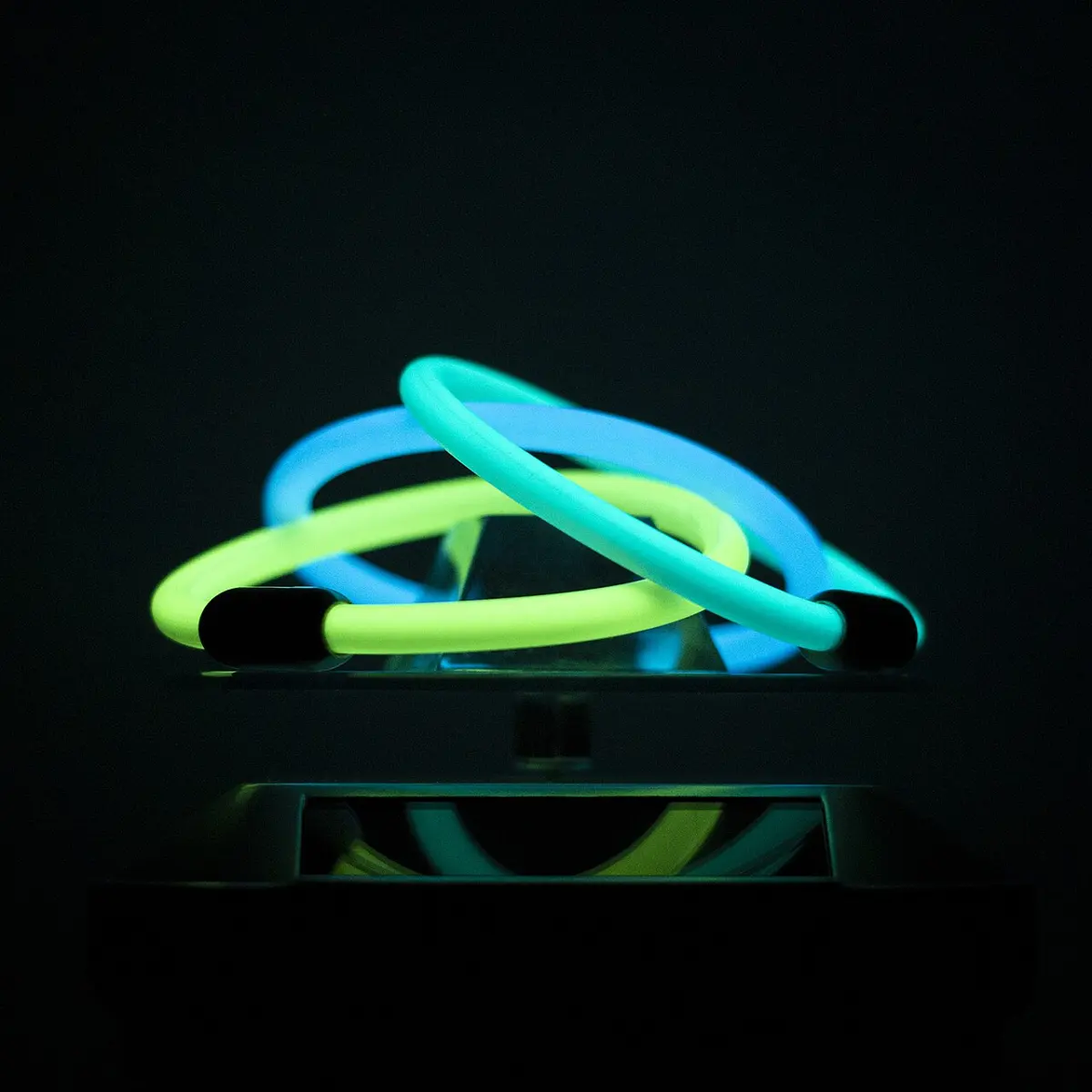
Glow-in-the-dark toys. Stickers, toys, watch hands and exit signs that glow in the dark often contain strontium aluminate, with a little europium added. It soaks up light by day and gives it out slowly for hours. Invented in Japan in 1993, it is about ten times brighter, and glows about ten times longer, than the zinc sulphide used before it. Long before that, watch dials glowed with paint made with radioactive radium, which harmed the people who painted them.
Magnets. Most fridge magnets, and the magnets in small motors and loudspeakers, are ferrite magnets: a ceramic of iron oxide made with strontium (or barium) carbonate Grade 8: Artificial magnets. They are cheap, do not rust, and keep their magnetism well.
Toothpaste. Some toothpastes for sensitive teeth contain strontium chloride or strontium acetate. It helps block the tiny tubes in teeth that carry the feeling of cold and heat to the nerve.
Oil and gas wells. In the United States, most celestine is ground up and added to drilling mud, to make the mud heavy enough to hold back the gas and oil underground (USGS, 2026).
Old televisions. Old box-shaped televisions and computer screens worked by firing electrons at the screen, which also made weak X-rays. Their glass held strontium oxide to stop the X-rays. When flat screens replaced them, the world needed much less strontium.
The best clocks in the world
The world’s official clocks count the second with atoms of cesium. But the most accurate clocks now use a cloud of a few thousand strontium atoms, cooled almost to absolute zero and held in place by laser light. In 2015 a strontium clock at JILA, in Colorado, USA, was so accurate that it would neither gain nor lose a second in 15 billion years, longer than the universe has existed. Such clocks may soon be used to define the second itself.
Isotopes of strontium
Natural strontium is a mixture of four isotopes (same 38 protons, different numbers of neutrons), none of them radioactive Grade 9: Atomic mass:
| isotope | neutrons | share of natural strontium |
|---|---|---|
| strontium-84 | 46 | 0.56% |
| strontium-86 | 48 | 9.86% |
| strontium-87 | 49 | 7.00% |
| strontium-88 | 50 | 82.58% |
Strontium-87 tells where you grew up. Some strontium-87 is made very slowly, over billions of years, by the radioactive decay of rubidium-87, so old granite has more of it than young volcanic rock. Plants take up strontium from the soil, and its mix of isotopes passes through food into the teeth of the people and animals that eat them. So the strontium in a tooth shows the kind of rock a person lived on as a child. Scientists used it (with other isotopes) to show that Ötzi, the Iceman with the copper axe, grew up in a valley south of where he died.
Radioactive strontium. Two radioactive isotopes are made when uranium splits in nuclear reactors and bombs Grade 9: Nuclear fission:
- Strontium-89 (half-life about 51 days) is used in hospitals: injected into the blood, it goes to the bones like calcium, and its radiation eases the pain of cancer that has spread to the bones.
- Strontium-90 (half-life about 29 years) is the dangerous one in fallout and nuclear waste. Once in a bone, it stays for years and keeps giving out radiation close to the bone marrow, where blood cells are made.
Strontium and your health
Ordinary strontium does your body no harm in the small amounts in food and water (a few milligrams a day), and it has no known job in the human body. Because it is so like calcium, a little goes into your bones. Large amounts of ordinary strontium can disturb bone growth in children.
Radioactive strontium-90 is different: it can damage the bone marrow and cause leukemia and bone cancer. That is why it is watched closely after nuclear accidents, such as Chernobyl (1986) and Fukushima (2011), and why its waste must be stored safely for centuries.
Surprising facts and records
- Named after a village. Strontium, strontianite and the village of Strontian share one name, and the village has a mineral in its honor.
- Sugar from strontium. In the late 1800s, sugar factories in Germany used strontium hydroxide to get more sugar out of sugar beet, and mined strontianite for it.
- Seen being made. Strontium was the first heavy element ever seen being made, in the light from two neutron stars colliding (2019).
- A clock for sale. In 2025 a strontium clock went on sale in Japan, for about 3.3 million US dollars.
In your science books
- Grade 8: the 2n² rule, valency, groups of the periodic table and artificial magnets.
- Grade 9: the criss-cross method, atomic mass, nuclear fission and metals with water.
- Grade 10: the Aufbau principle and reactivity down a group.
- Going further: flame colors and spectra, where strontium is made and what happens when a nucleus decays.
More to explore
- Nobel Prizes behind strontium’s story: how atoms give out light of exact colors (1922), atomic clocks (1989), cooling atoms with lasers (1997), the frequency comb (2005, which made strontium clocks possible) and crown ethers (1987, molecules that can pull radioactive strontium out of nuclear waste).
- Its neighbors: calcium above it, yttrium after it, and magnesium, higher up its group.
- Play: find strontium in Guess the Element, the Periodic Table Jigsaw and Higher or Lower.
- Read more: strontium at the Royal Society of Chemistry and at PubChem.