
- Atomic number
- 97
- Atomic mass
- 247.07
- Shells
- 2, 8, 18, 32, 27, 8, 2
- Configuration
- 1s² 2s² 2p⁶ 3s² 3p⁶ 4s² 3d¹⁰ 4p⁶ 5s² 4d¹⁰ 5p⁶ 6s² 4f¹⁴ 5d¹⁰ 6p⁶ 7s² 5f⁹
- In the table
- period 7, group none (f-block), f-block
- Kind
- Actinide
- Valency
- 3 (Bk³⁺) and 4 (Bk⁴⁺)
- State at 25 °C
- solid
- Melts · boils
- 986 °C · not known
- Density
- 14.8 × as heavy as water
- Known since
- 1949
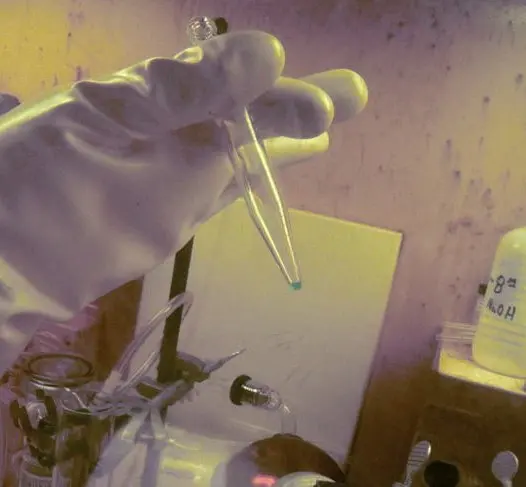
How do you make a new element that has never existed on Earth? You need a target with as many protons as possible, and something to hit it with. In 2010, the target that made element 117 was a tiny drop of berkelium, element 97, which no one has ever found in nature and which no one uses for anything else.
The berkelium atom
A berkelium atom has 97 protons (atomic number 97) and 97 electrons. The kind made in reactors, berkelium-249, has 249 − 97 = 152 neutrons. By shells, the electrons are 2, 8, 18, 32, 27, 8, 2, and in subshells Grade 10: The Aufbau principle:
… 6p⁶ 7s² 5f⁹
Curium, just before it, broke the filling order to keep its 5f half full. Berkelium goes back to the normal order: all its newest electrons are in 5f, nine of them.
Berkelium is in period 7, the ninth of the actinides in the f-block Grade 10: Features of the modern periodic table, and a metal. Like most actinides it usually gives away three electrons to form Bk³⁺. It can also give away a fourth, as Bk⁴⁺, just as terbium above it can. Chemists use that fourth electron to separate berkelium from its neighbors.
How many neutrons are in a berkelium-249 nucleus?
Pick an answer to see why.
How berkelium was made and named
In December 1949, Stanley Thompson, Albert Ghiorso, Glenn Seaborg and Kenneth Street Jr. fired alpha particles (2 protons and 2 neutrons) at a thin layer of americium-241 in the cyclotron at the University of California in Berkeley. An americium nucleus (95 protons) that captured an alpha particle had 97 protons: a new element. The atoms they made lasted only a few hours, and there were so few that the team found them only by the X-rays they gave out.
Element 97 sits directly below terbium, which is named after Ytterby, the Swedish village where its ore was found. So the team named element 97 after their own town: berkelium, symbol Bk.
It took until 1958 to make enough berkelium to see, a few millionths of a gram, and until 1962 to make its first compound.
Where berkelium comes from
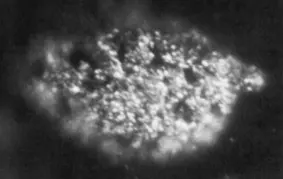
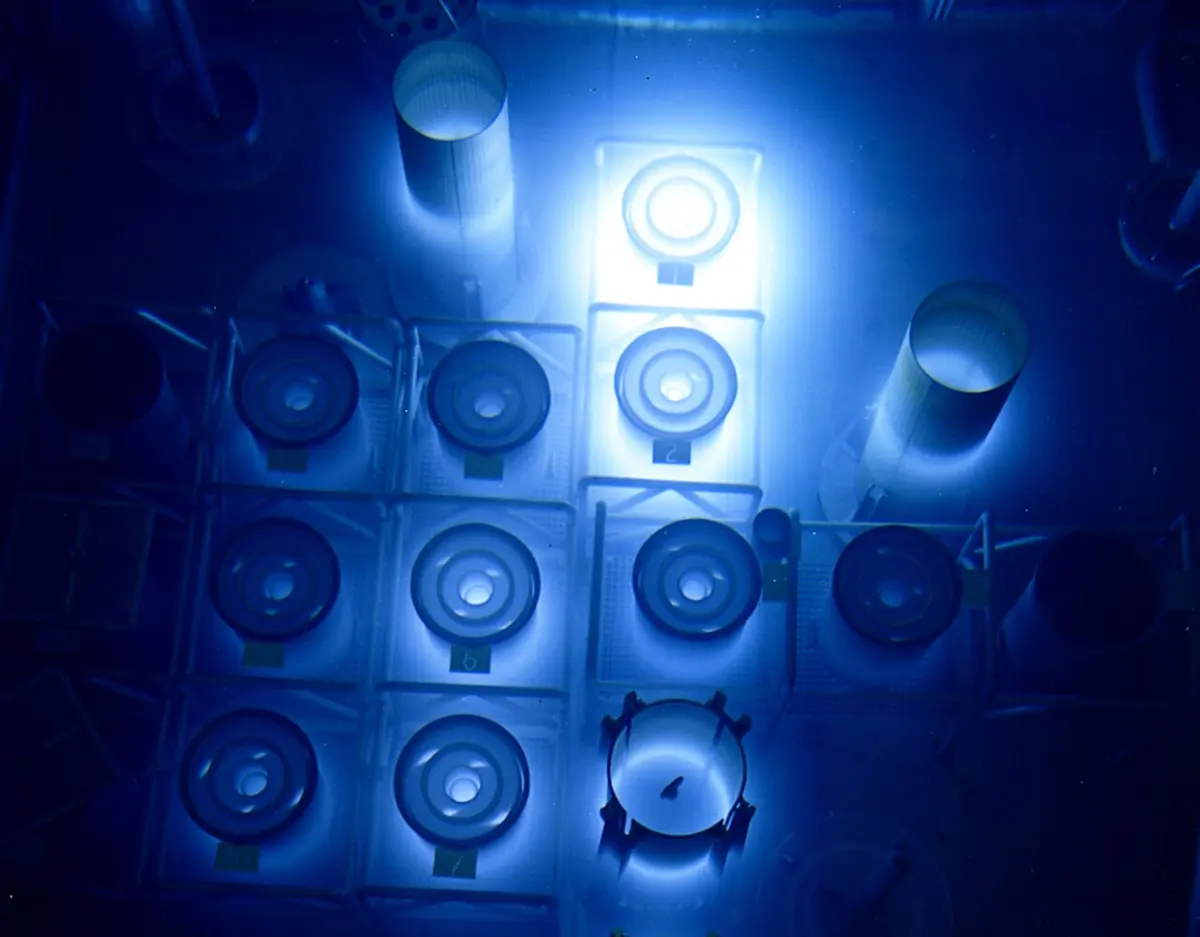
No berkelium is left from the Earth’s birth: its longest-lasting kind, berkelium-247, has a half-life of only about 1,400 years. All of it is made in a few nuclear reactors, mainly the High Flux Isotope Reactor at Oak Ridge in Tennessee, USA, and a reactor at Dimitrovgrad in Russia. There, plutonium and curium nuclei catch neutrons one after another, and some of the neutrons turn into protons (beta decay). Less than a gram is made in a year; since 1967 the United States has made only a little more than a gram in all.
What berkelium is like
What has been measured, on samples of a few millionths of a gram:
- It is a soft, silvery metal.
- It is very dense, about 14.8 g/cm³, nearly twice as dense as iron. (The facts card’s 14.0 is an older, rounder figure.)
- It melts at about 986 °C. The facts card’s 1,050 °C is an older measurement; the Royal Society of Chemistry and most newer tables give 986 °C.
- Its salts dissolved in water are green, as in the photo at the top of this page.
Its boiling point has never been measured, so the facts card leaves it out.
Berkelium-249 has a half-life of about 330 days. It gives out a beta particle (a fast electron), and the nucleus becomes californium-249, element 98. So a berkelium sample is never pure for long: after a year, more than half of it has become californium.
Berkelium-249 (97 protons) gives out a beta particle: one of its neutrons turns into a proton. What does it become?
Pick an answer to see why.
Berkelium and element 117
In 2008, Oak Ridge spent 250 days making berkelium-249 in its reactor, and early in 2009 three months purifying it: 22 thousandths of a gram in all, the drop in the photo at the top. It was sent to the Joint Institute for Nuclear Research in Dubna, Russia, and hit with a beam of calcium-48 for about five months. Each calcium nucleus brings 20 protons; 97 + 20 = 117.
The team found just six atoms of element 117 and announced it in 2010. In 2016 it was named tennessine (Ts), after Tennessee, the US state where the berkelium was made. The berkelium had to be used quickly: every day, a little more of it turned into californium.
Berkelium-249 has also been the target for making lawrencium (103), rutherfordium (104) and bohrium (107).
Berkelium and your health
The body has no use for berkelium. Berkelium-249’s own beta particles are weak, but it turns into californium-249, which gives out strong alpha particles. If it gets inside the body, it settles in the bones, where its radiation can damage the cells that make blood. It is handled only in sealed glove boxes, like the one in the top photo.
In your science books
- Grade 9: radioactive elements and shells and their energy.
- Grade 10: the actinides and the Aufbau principle.
- Going further: alpha decay and beta decay.
More to explore
- Nobel Prizes: Seaborg and McMillan’s prize (1951) for the elements beyond uranium.
- Its neighbors: curium, the element before it, californium, which it turns into, and terbium, the element above it.
- Play: find berkelium in Guess the Element and the Periodic Table Jigsaw.
- Read more: berkelium at the Royal Society of Chemistry and at PubChem.