
Look around your kitchen. The pressure cooker, the copper karuwa (water jug), the steel plates, the wires behind the switch, your mother’s gold earrings: all are metals. None of them was dug out of the ground looking like that. The pressure cooker began as a reddish lump of rock, the wire as a dull green or brassy stone, and the earrings as specks in river sand.
This unit is about that journey: where metals are found in nature, and how they are taken out of rock and made pure. It is one of the oldest technologies people have. The Iron Age, the Bronze Age and every phone, bus and bridge today depend on it.
Metals and non-metals around us
The matter around us is either pure or impure. Elements and compounds are pure substances; mixtures are impure. Of the 118 known elements, most (about 94) are metals, about 18 are non-metals, and only a handful are metalloids. You studied their properties in earlier classes, and in Unit 14 you saw where each class sits in the periodic table.
Minerals
Only a few metals, the least reactive ones, are found in nature as the free metal: gold, platinum, and sometimes silver and copper. We say they occur in the native (free) state. Reactive metals such as sodium, potassium, calcium and iron have joined with other elements long ago, and are found only as compounds: oxides, sulphides, carbonates and others.
The elements and compounds found naturally in the Earth’s crust are called minerals. Minerals are the sources of metals. A mineral is:
- natural (formed by nature, not made by people),
- inorganic (not made by living things),
- solid and usually crystalline (its particles are arranged in a regular pattern),
- pure, with a fixed chemical formula: hematite is always Fe₂O₃.
A rock is different: it is a mixture of one or more minerals. Granite, for example, is a rock made of the minerals quartz, feldspar and mica. Coal is not a mineral either: it was made from ancient plants, so it is organic. (In everyday and mining language, rocks and fuels like these are counted among the “mineral resources”.)
About 90% of the Earth’s crust is made of silicate minerals (compounds of silicon, oxygen and metals). Besides these, there are sulphide, oxide, carbonate, sulphate and phosphate minerals, and these are where most metals come from.
Ores
Rock straight from a mine is mostly worthless material, with the useful mineral scattered through it. Some minerals hold a lot of metal that can be got out easily and cheaply; others hold only a little, or hold it so tightly that getting it out would cost more than the metal is worth.
A mineral from which a metal can be extracted in large amounts, easily and at low cost is called an ore of that metal. Minerals from which the metal can’t be extracted profitably are not ores. So:
All ores are minerals, but not all minerals are ores.
Clay is rich in aluminium, but aluminium is made from bauxite, not clay. Why?
Pick an answer to see why.
Ores of iron
| Ore | Formula | Note |
|---|---|---|
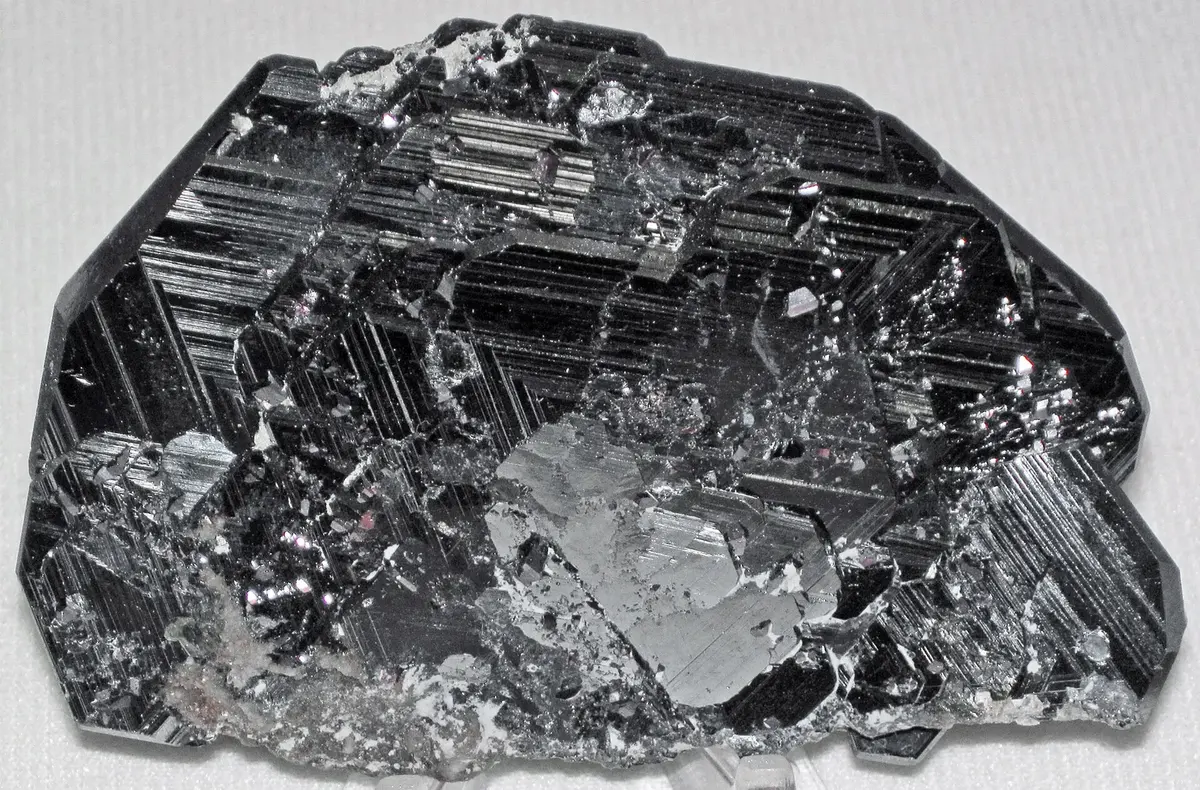
| hematite | Fe₂O₃ | the chief ore of iron; up to 70% iron |
| magnetite | Fe₃O₄ | magnetic; 72% iron, the richest of all |
| siderite | FeCO₃ | a carbonate |
| limonite | 2Fe₂O₃·3H₂O | hydrated (water-holding) iron oxide; yellow-brown |
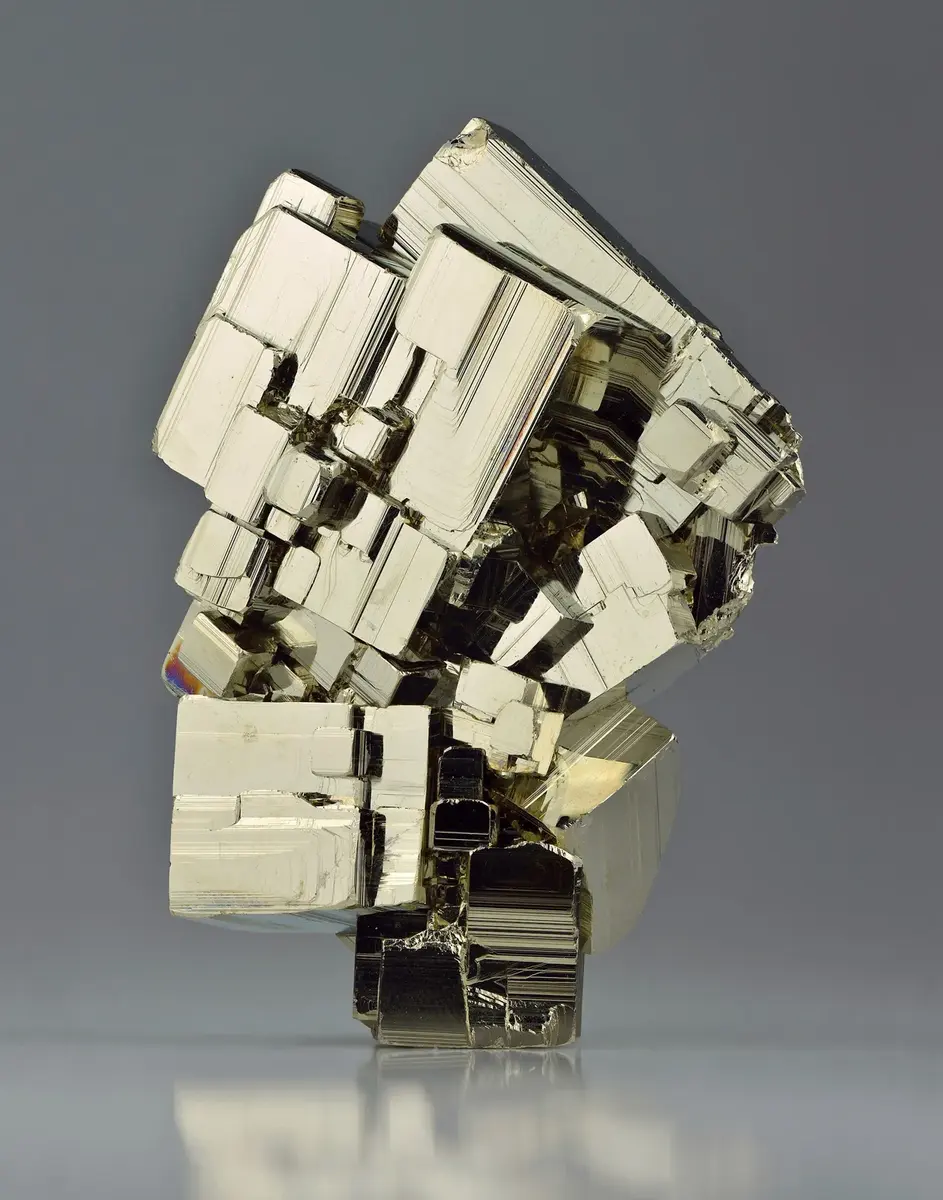
| iron pyrite | FeS₂ | “fool’s gold”; not used for iron, because of its sulphur |
Hematite is the main ore of iron: it is plentiful and rich in iron. Pure hematite is 70% iron by mass (2 × 56 = 112 parts iron in 160), and magnetite is a little richer, 72%; hematite is the chief ore because there is so much of it.
Ores of aluminium
| Ore | Formula |
|---|---|
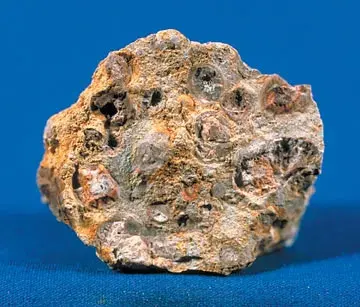
| bauxite | Al₂O₃·2H₂O |
| cryolite | Na₃AlF₆ |
| corundum | Al₂O₃ |
Bauxite is the chief ore of aluminium; it contains about 40–60% alumina (aluminium oxide, Al₂O₃), so the aluminium metal in it is about half as much. Cryolite is used too, but not as a source of the metal: it is melted with the alumina to lower its melting point, from over 2,000 °C to about 950 °C, in the factory where aluminium is made. Corundum is very hard; red corundum is ruby, and blue is sapphire.
Ores of copper
| Ore | Formula |
|---|---|
| chalcocite (copper glance) | Cu₂S |
| chalcopyrite (copper pyrite) | CuFeS₂ |
| cuprite | Cu₂O |
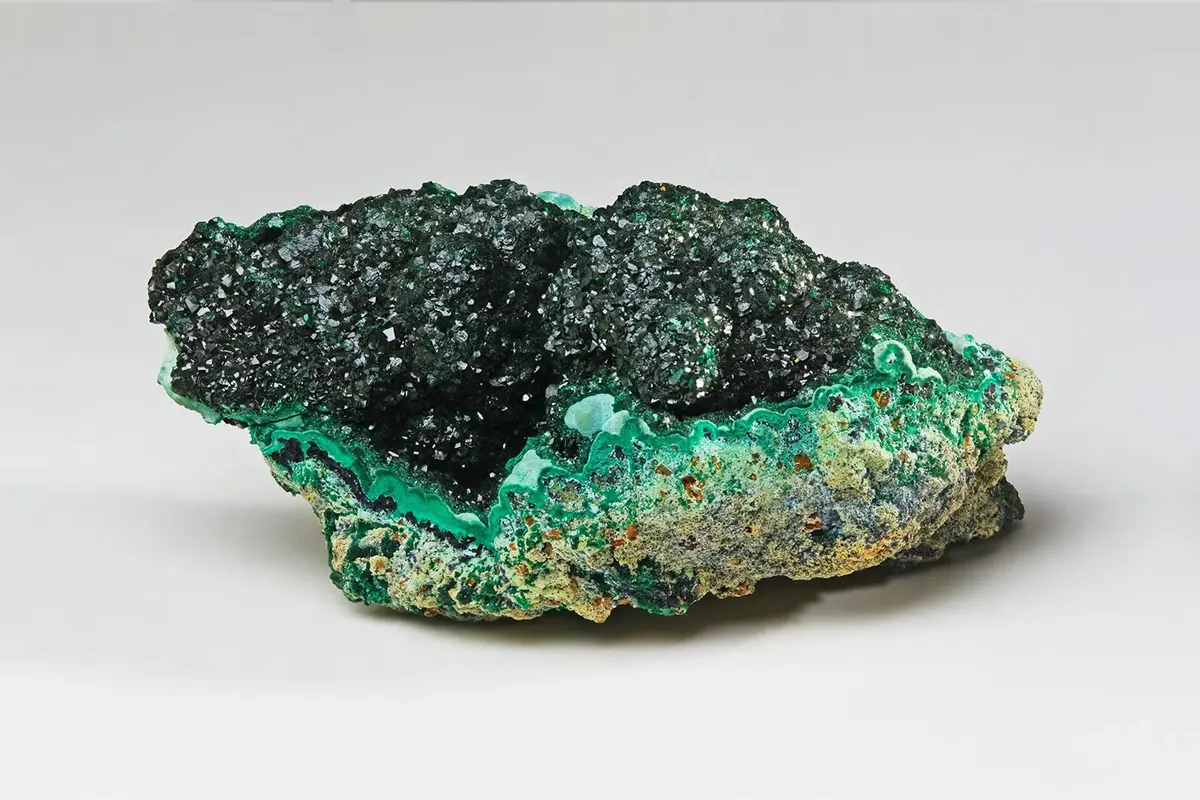
| malachite | Cu₂(OH)₂CO₃ |
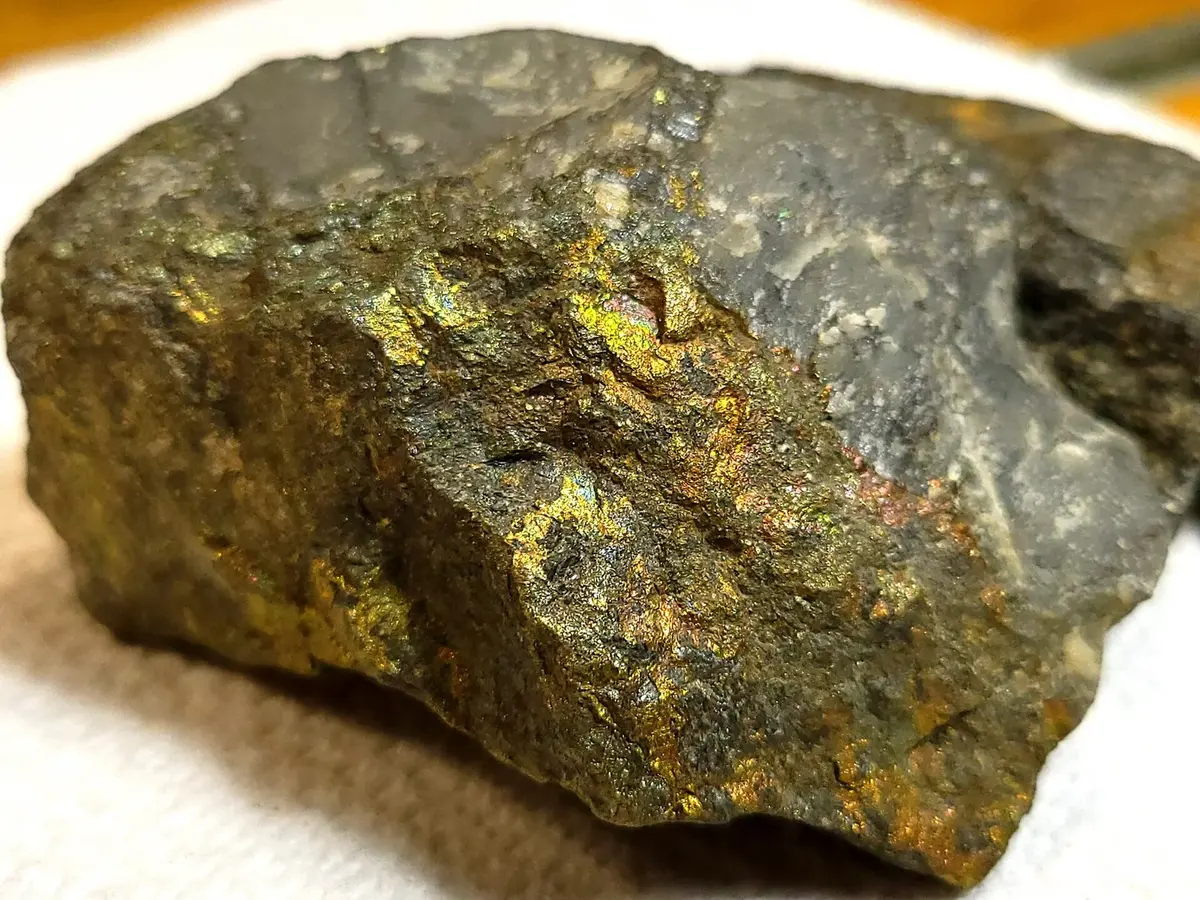
Chalcopyrite (copper pyrite) is the main ore of copper; it contains about 34.5% copper.
Ores of silver
| Ore | Formula |
|---|---|
| argentite (silver glance) | Ag₂S |
| horn silver | AgCl |
| ruby silver | Ag₃SbS₃ |
| silver copper glance | (Ag,Cu)₂S |
Argentite is the chief ore of silver; it contains about 87% silver.
Gold
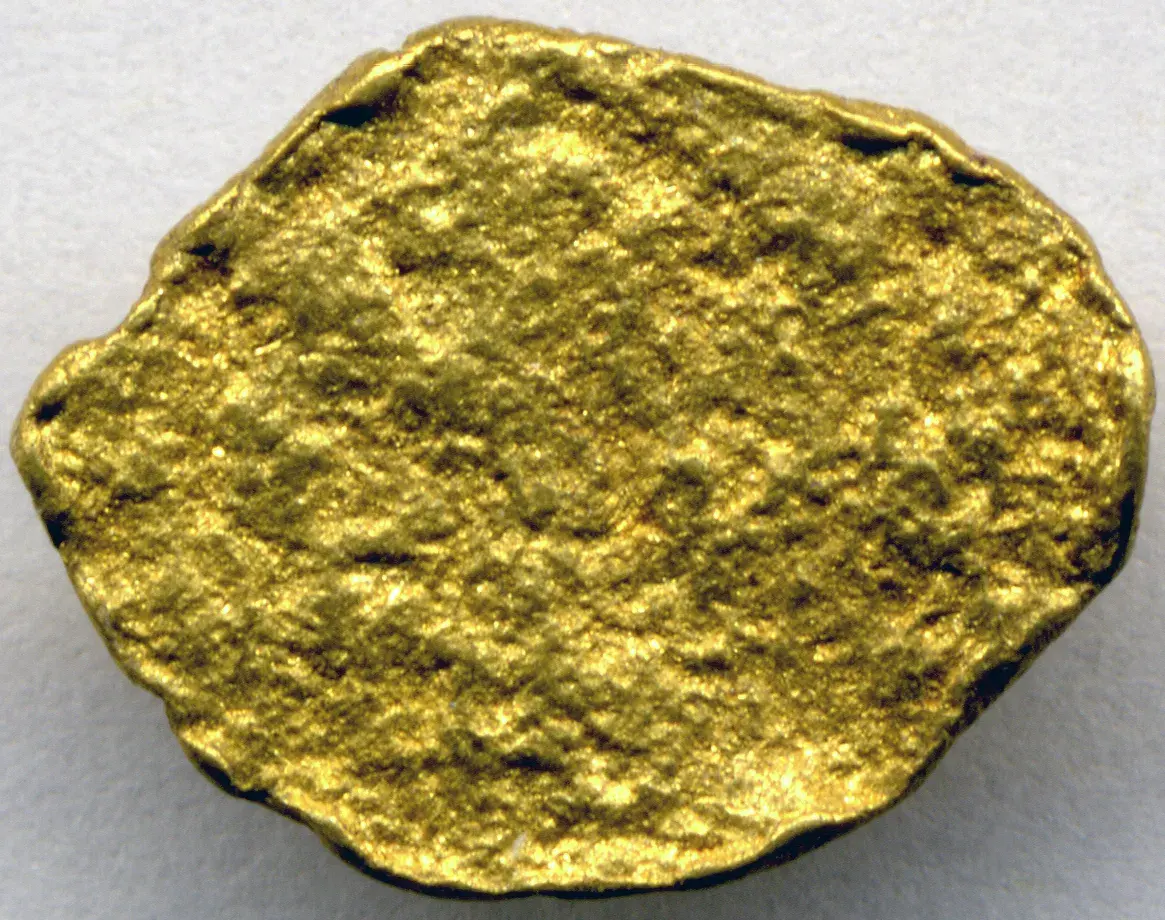
Gold is so unreactive that it is found in the native (pure) state: as grains and nuggets in veins of quartz rock, and as specks in the alluvial sand and gravel that rivers wash down from those rocks. Getting gold is mostly a matter of separating it from rock and sand, not of breaking a compound.
Which metal is mined as the free metal, not from a compound?
Pick an answer to see why.
Metallurgy
To get a metal, its ore is first dug out of the ground. Taking useful substances and minerals out of the Earth’s crust is called mining: coal, petroleum, gold and the ores of metals are all mined. Then the metal is extracted from its ore in a series of steps.
Metallurgy is the science of the properties, production and purification of metals, including the step-by-step extraction of metals from their ores. Generally, these are the main steps:
Grinding
This is the first step. The big lumps of ore are crushed into small pieces, then ground into a powder between the rollers or balls of crushing machines. This is grinding (also called crushing or pulverization). A powder has a huge surface area, which makes every later step faster (you saw why in Unit 15).
1. Concentration
The ground ore is still mixed with mud, sand, rock and other unwanted material, called gangue (say “gang”). Removing the gangue, so that the percentage of metal in the ore goes up, is concentration, also called ore dressing. The method depends on how the ore and the gangue differ:
- Gravity (hydraulic) separation, when the ore is heavier than the gangue. The powder is washed with a stream of water: the light sand and clay are carried away, and the heavy ore particles settle. This is how hematite and tin ore are concentrated, and how a gold panner works.
- Magnetic separation, when one of them is magnetic. The powder falls past a magnetic roller: magnetic particles (like magnetite) stick to it and drop off on one side, non-magnetic ones fall straight down.
- Froth flotation, when one of them is wetted by water (hydrophilic, “water-loving”) and the other is not (hydrophobic, “water-fearing”). The powder is stirred into water with a little pine oil, and air is blown through. Sulphide ore particles, which are not wetted by water, stick to the oily bubbles and float up in a froth, which is skimmed off; the sand and rock, wetted by water, sink.
2. Oxidation: roasting and calcination
It is easiest to get a metal out of its oxide, so a concentrated ore that is not already an oxide is first changed into one. There are two ways.
a. Roasting
The ore is heated strongly in a supply of air (oxygen), below its melting point. Roasting is used for sulphide ores: the sulphur burns off as sulphur dioxide. Zinc blende (zinc sulphide, ZnS) becomes zinc oxide:
b. Calcination
The ore is heated strongly without air (or with very little). Calcination is used for carbonate ores (and to drive the water out of hydrated ores like bauxite): carbon dioxide is driven off. Calamine (zinc carbonate) and limestone:
Copper glance (Cu₂S) has been concentrated. What is the next step?
Pick an answer to see why.
3. Reduction
Reduction is the removal of oxygen from the metal oxide. The oxide is heated with a reducing agent, a substance that takes the oxygen for itself, such as carbon (coke), carbon monoxide or hydrogen:
How a metal is reduced depends on how tightly it holds on to oxygen, which follows the reactivity series you met in Unit 15:
| Metal | How its oxide is reduced |
|---|---|
| K, Na, Ca, Mg, Al (very reactive) | their oxides are very stable: only electrolysis (passing electricity through the molten compound) works |
| Zn, Fe, Pb, Cu (middle) | heating with carbon, carbon monoxide or hydrogen; zinc oxide only with carbon: ZnO + C → Zn + CO |
| Hg, Ag (unreactive) | their oxides are unstable: heat alone breaks them, 2HgO → 2Hg + O₂ |
| Au, Pt | found native; no reduction needed |
Smelting
Usually the reduction is done hot enough to melt the metal. Heating an ore above the metal’s melting point with a reducing agent, so that the molten metal separates from the remaining impurities, which leave as gases or float off as a glassy waste called slag, is smelting. Smelting is a kind of reduction.
4. Refining
The metal from reduction is still impure, so it is refined to make it pure. There are several methods; two are:
a. Distillation
The impure metal is heated until it boils; its vapor is cooled and condensed back into pure metal, leaving the impurities behind. This works for metals with low boiling points, such as mercury (357 °C) and zinc (907 °C).
b. Electro-refining
Electro-refining uses electrolysis to purify metals such as copper, silver and gold. A block of the impure metal is made the anode (connected to the positive terminal of the battery), and a thin sheet of pure metal is made the cathode (the negative terminal). Both hang in a solution of a salt of the same metal, the electrolyte, in a vessel called a voltameter.
When the current flows, metal atoms of the anode lose electrons and go into the solution as ions; at the cathode, ions from the solution gain electrons and are deposited as pure metal. For copper:
The anode slowly wears away and the cathode grows. The impurities either stay dissolved or fall below the anode as anode mud.
Project work
Exercise
1. Choose the correct option
a. Which is the main ore of iron?
Pick an answer to see why.
b. Which metal is found in the pure state in nature?
Pick an answer to see why.
c. Which is the first step of extracting a metal?
Pick an answer to see why.
d. Which of these ores is oxidized by roasting?
Pick an answer to see why.
e. In which process is smelting included?
Pick an answer to see why.
2. Give reasons
All ores are minerals, but all minerals are not ores.
Answer
Every ore is a naturally occurring compound or element in the Earth’s crust, so every ore is a mineral. But an ore is a mineral from which a metal can be extracted easily and profitably. Many minerals contain a metal in such small amounts, or so tightly bound, that extracting it costs too much; these are minerals but not ores. For example, clay contains aluminium but is not its ore; bauxite is.
Ores are oxidized after concentration.
Answer
A metal is most easily obtained from its oxide, by reducing the oxide with carbon, carbon monoxide or hydrogen. So sulphide and carbonate ores are first changed into oxides (by roasting or calcination). This is done after concentration so that only the ore, not the useless gangue, has to be heated, which saves fuel; the oxidation also burns off or drives out impurities such as sulphur, carbon dioxide and water.
3. Write the differences between
Mineral and ore
Answer
| Mineral | Ore |
|---|---|
| a natural, inorganic, crystalline element or compound in the Earth’s crust | a mineral from which a metal can be extracted easily and profitably |
| may contain little metal | contains a high percentage of metal |
| extracting metal from it may not be economical | extracting metal from it is economical |
| all minerals are not ores | all ores are minerals |
| e.g. clay (for aluminium) | e.g. bauxite (for aluminium) |
Roasting and calcination
Answer
| Roasting | Calcination |
|---|---|
| the ore is heated strongly in a supply of air | the ore is heated strongly without air (or with very little) |
| used for sulphide ores | used for carbonate (and hydrated) ores |
| sulphur dioxide is given off | carbon dioxide (and water vapor) is given off |
| e.g. 2ZnS + 3O₂ → 2ZnO + 2SO₂ | e.g. ZnCO₃ → ZnO + CO₂ |
Oxidation and reduction
Answer
| Oxidation | Reduction |
|---|---|
| addition of oxygen (or removal of hydrogen) | removal of oxygen (or addition of hydrogen) |
| in metallurgy, it changes the ore into an oxide | in metallurgy, it changes the oxide into the metal |
| done by roasting or calcination | done with a reducing agent (C, CO, H₂) or by electrolysis |
| e.g. 2ZnS + 3O₂ → 2ZnO + 2SO₂ | e.g. ZnO + C → Zn + CO |
4. Answer these questions
What are the sources of metals?
Answer
Metals come from the Earth’s crust, in the form of minerals. Unreactive metals such as gold and platinum (and sometimes silver and copper) are found in the free, native state; reactive metals are found as compounds (oxides, sulphides, carbonates, chlorides and others). The minerals from which metals can be extracted profitably are their ores. Sea water is a source of some metals too (magnesium is extracted from it), and recycled scrap is an ever more important source.
Make a list of the ores of iron, copper, aluminium and silver.
Answer
- Iron: hematite (Fe₂O₃), magnetite (Fe₃O₄), siderite (FeCO₃), limonite (2Fe₂O₃·3H₂O), iron pyrite (FeS₂).
- Copper: chalcocite or copper glance (Cu₂S), chalcopyrite or copper pyrite (CuFeS₂), cuprite (Cu₂O), malachite (Cu₂(OH)₂CO₃).
- Aluminium: bauxite (Al₂O₃·2H₂O), cryolite (Na₃AlF₆), corundum (Al₂O₃).
- Silver: argentite (Ag₂S), horn silver (AgCl), ruby silver (Ag₃SbS₃), silver copper glance ((Ag,Cu)₂S).
How is metallurgy a stepwise process? Explain.
Answer
A metal can’t be taken out of its ore in one go; each step prepares the ore for the next:
- Grinding: the ore is crushed into powder, so its surface area is large.
- Concentration: the gangue (sand, mud, rock) is removed by gravity separation, magnetic separation or froth flotation, so the percentage of metal rises.
- Oxidation: the concentrated ore is changed into an oxide, by roasting (sulphide ores, in air) or calcination (carbonate ores, without air).
- Reduction: oxygen is removed from the oxide by heating it with a reducing agent such as carbon, carbon monoxide or hydrogen (often as smelting), or, for reactive metals, by electrolysis.
- Refining: the impure metal is purified by distillation or electro-refining.
Example: zinc blende (ZnS) → froth flotation → roasting to ZnO → reduction with carbon to zinc → distillation to pure zinc.
How is pure metal obtained by electro-refining? Explain with an activity.
Answer
In electro-refining, a block of impure metal is made the anode and a thin sheet of pure metal the cathode, in a solution of a salt of the same metal, and an electric current is passed.
Activity (copper): fill a voltameter with copper sulphate solution. Connect impure copper to the positive terminal of a battery (anode) and a thin pure copper plate to the negative terminal (cathode), and pass a current.
At the anode, copper atoms lose electrons and dissolve as ions: Cu → Cu²⁺ + 2e⁻. At the cathode, copper ions gain electrons and are deposited as pure copper: Cu²⁺ + 2e⁻ → Cu. The anode wears away and the cathode grows thicker with pure copper, while the impurities fall below the anode as anode mud or stay in the solution. The copper obtained is about 99.99% pure.
Practice every question in the book, and keep track of the ones you miss →