
- Atomic number
- 90
- Atomic mass
- 232.04
- Shells
- 2, 8, 18, 32, 18, 10, 2
- Configuration
- 1s² 2s² 2p⁶ 3s² 3p⁶ 4s² 3d¹⁰ 4p⁶ 5s² 4d¹⁰ 5p⁶ 6s² 4f¹⁴ 5d¹⁰ 6p⁶ 7s² 6d²
- In the table
- period 7, group none (f-block), f-block
- Kind
- Actinide
- Valency
- 4 (Th⁴⁺, as in ThO₂)
- State at 25 °C
- solid
- Melts · boils
- 1,750 °C · 4,788 °C
- Density
- 11.7 × as heavy as water
- Known since
- 1828
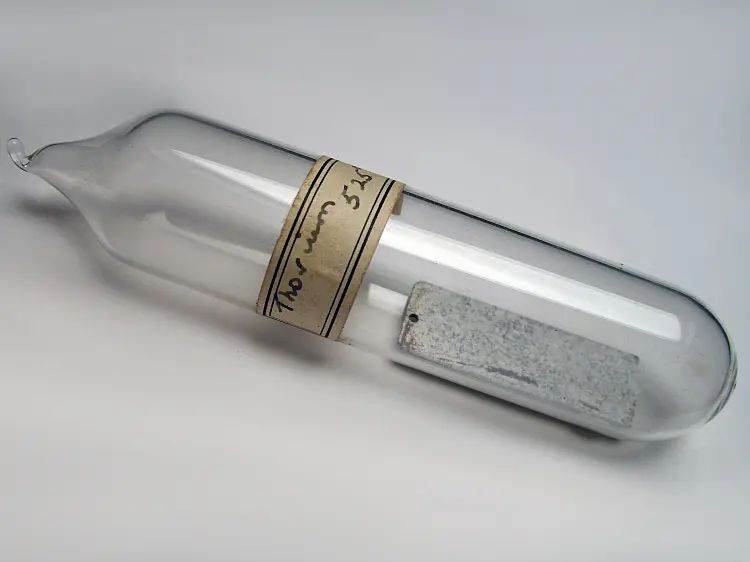
Before electricity reached most villages in Nepal, a wedding or a late-night shop was lit by a hissing pressure lantern. Its bright white light did not come from a flame. It came from a tiny bag of ash-white net, the mantle, glowing in the flame. For about a hundred years, most mantles were made of thorium oxide.
Thorium is radioactive, yet its atoms break down so slowly that four-fifths of the thorium the Earth was born with is still here. Its slow decay helps keep the inside of our planet hot, and some countries hope it will one day fuel their power stations.
The thorium atom
A thorium atom has 90 protons, so its atomic number is 90, and a neutral atom has 90 electrons. Almost all natural thorium is thorium-232, with 142 neutrons: 90 + 142 = 232.
By shells, the electrons are 2, 8, 18, 32, 18, 10, 2: the first four shells are full Grade 8: Bohr and Bury’s rule, and the outer three are only partly filled because of the order in which subshells fill.
Thorium comes just after actinium, which ends 7s² 6d¹. By the Aufbau order Grade 10: The Aufbau principle you would expect thorium to start filling 5f. It doesn’t. Its new electron goes into 6d as well:
… 6p⁶ 7s² 6d²
The 5f and 6d subshells have almost the same energy here, and in thorium 6d wins. So thorium, the second actinide, has no f electrons at all. Like copper’s, it is an exception to learn, not to work out.
Its place in the periodic table
- Period 7, because its electrons are in seven shells.
- One of the actinides, the 15 elements from actinium (89) to lawrencium (103), printed in a row of their own below the main table Grade 10: Features of the modern periodic table. They are counted in the f-block, even though thorium itself has no f electron.
- It is a metal.
Thorium gives away all four outer electrons (7s² 6d²) to form the ion Th⁴⁺ Grade 9: Cations. So its valency is 4, and its oxide is thorium dioxide, ThO₂.
Thorium has a valency of 4 and chlorine a valency of 1. What is the formula of thorium chloride?
Pick an answer to see why.
How thorium was found and named
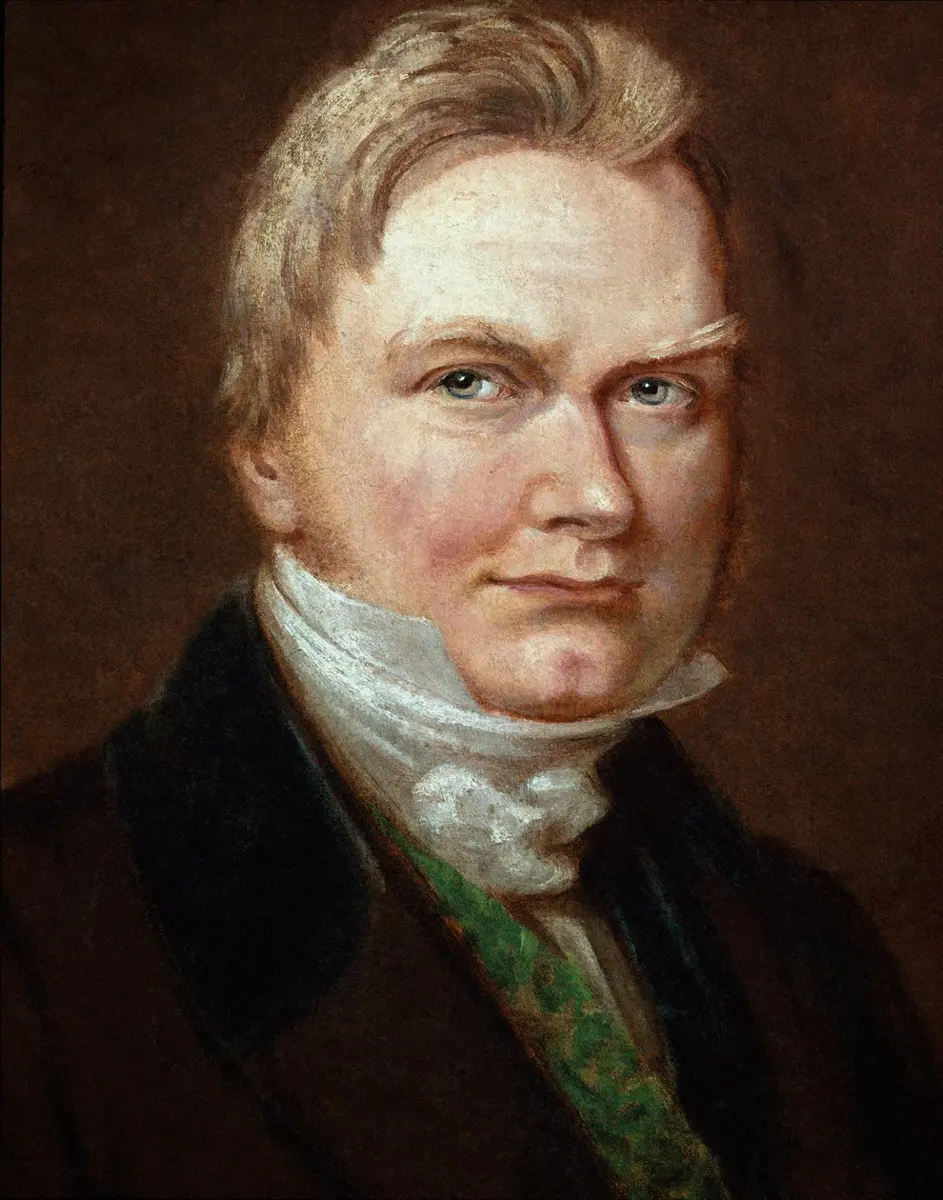
The great Swedish chemist Jöns Jacob Berzelius named an element thorium once before it was real. In 1815 he thought he had found a new earth in a mineral from Falun, and named it after Thor, the Norse god of thunder. A few years later he realized it was only yttrium phosphate, a compound of an element already known.
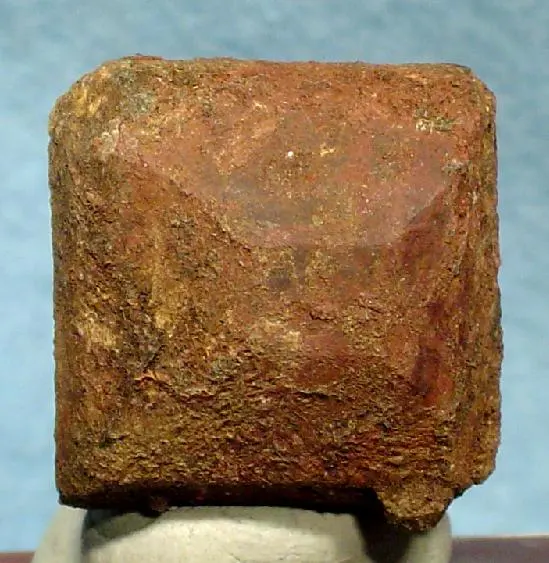
In 1828 a Norwegian priest and mineral collector, Morten Thrane Esmark, found a heavy black mineral on an island near Brevik, in southern Norway, and a piece reached Berzelius in Stockholm. In it he found a truly new element, announced it in 1829, and gave it the name he had kept: thorium, symbol Th. The mineral is called thorite, a thorium silicate. In Nepali the element is थोरियम, a borrowed name.
Nobody knew thorium was radioactive until 1898, when Gerhard Schmidt in Germany and Marie Curie in France each found that it gives out rays, as uranium does. Three years later, at McGill University in Canada, Ernest Rutherford and Frederick Soddy noticed that thorium kept giving off a radioactive gas that was not thorium. Thorium was turning, all by itself, into other elements: the first proof that one element can change into another (“They’ll have our heads off as alchemists”). The gas was a kind of radon, now called thoron (radon-220).
Where thorium is found
In the universe. Thorium, like uranium and gold, was made by the rapid catching of neutrons when neutron stars collided, or in rare exploding stars (In a flash when dead stars collide).
In the Earth. Thorium is far from rare: ordinary rock and soil hold about 6 grams per tonne, about three times as much as uranium, and about as much as lead. Its main ore is monazite, a heavy, brownish phosphate of the rare earths with a few per cent of thorium in it. Monazite is worn out of rocks by rivers and waves and piles up in dark beach sands. The richest are on the coasts of southern and eastern India, which has more thorium than any other country.
Inside the Earth. Each time a thorium, uranium or potassium-40 nucleus in the rocks breaks down, it gives out a little heat. Together they give about half of the heat flowing out of the Earth, which helps drive the movement of the plates that is still pushing up the Himalaya (Where the heat comes from).
What thorium is like
- A soft, silvery-white metal. In air it slowly tarnishes gray, then black. Its powder can catch fire by itself.
- Heavy: its density is 11.7 g/cm³, about the same as lead.
- Melts at 1,750 °C and boils at about 4,790 °C.
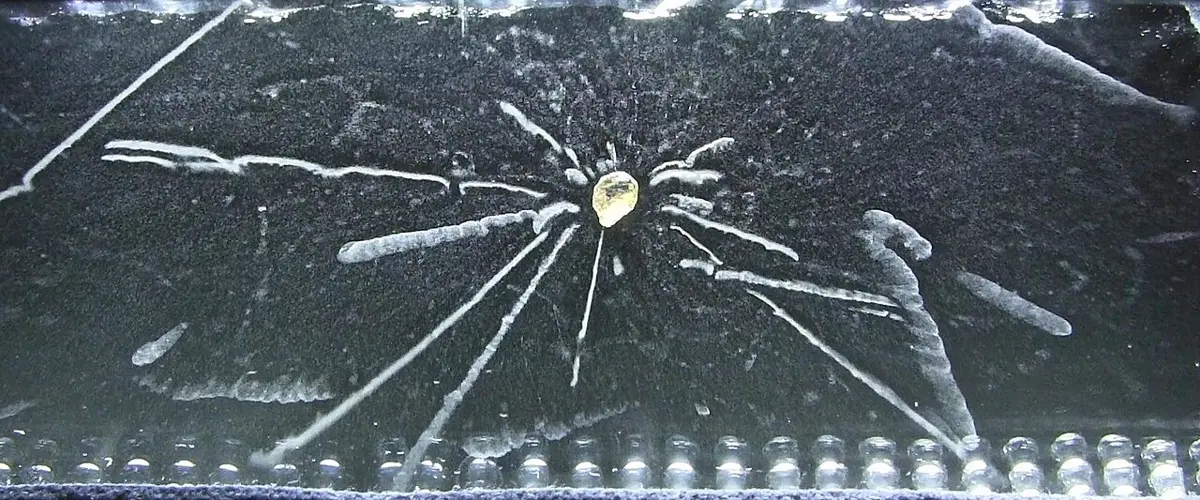
- Weakly radioactive. Thorium-232 gives out alpha particles, which a sheet of paper or your skin stops Grade 9: Radioactive emission.
- The longest-lasting of the radioactive elements found in nature in large amounts. The half-life of thorium-232, the time for half of it to decay, is 14 billion years: longer than the age of the universe (13.8 billion years).
When thorium-232 does decay, it starts a chain of ten steps, through radium, radon-220 and polonium, ending at stable lead-208 (From uranium to lead).
Thorium-232 has a half-life of 14 billion years and uranium-238 one of 4.5 billion years. In a rock 4.5 billion years old, which has lost a bigger share of what it started with?
Pick an answer to see why.
Thorium in daily life
A light brighter than a flame
Thorium dioxide has the highest melting point of any oxide, about 3,350 °C. In a gas flame it does not melt but glows white-hot. In 1891 the Austrian chemist Carl Auer von Welsbach found that a net of 99% thorium oxide with 1% cerium oxide glows a brilliant white: the gas mantle. It lit the streets and homes of the world’s cities before electric light took over, and it still lights pressure and camping lanterns. Most mantles sold today are made thorium-free, but some still contain it. (How the cerium makes the light, on the cerium page.)
Other uses
- Welding rods. A little thorium oxide in a tungsten electrode helps it give out electrons and start the arc more easily. Rods without thorium are now often used instead.
- Strong alloys. Thorium makes magnesium alloys stronger at high temperatures, for aircraft engines.
- Camera lenses. From the 1940s to the 1970s, some fine camera lenses had thorium oxide in their glass, because it bends light strongly. Over the years, the thorium’s own radiation slowly turns the glass yellow.

Thorium as a nuclear fuel
A nuclear power station gets its heat from fission: nuclei splitting in two Grade 9: Nuclear fission. The usual fuel is uranium-235. Thorium-232 does not split easily, so it cannot keep a reactor going alone. But it can be turned into something that does.
A thorium nucleus that catches a slow neutron becomes thorium-233. Within minutes, one of its neutrons turns into a proton and an electron flies out (beta decay, A neutron becomes a proton): it is now protactinium-233, element 91. Over a few weeks a second beta decay makes it uranium-233, element 92, and uranium-233 splits when a neutron hits it (Figure 7). A material like thorium, which is not a fuel itself but can be made into one, is called fertile.
So a thorium reactor needs some uranium-235 or plutonium to start it, and then makes much of its own fuel from the thorium. Why bother?
- There is about three times as much thorium as uranium in the Earth’s crust, and almost all of it is thorium-232, while only 0.7% of uranium is uranium-235.
- Countries with little uranium but much thorium, like India, could make their own fuel. India has planned for decades to run power stations on its beach-sand thorium, and China has built a small experimental reactor to test a thorium fuel.
But there are difficulties. Thorium oxide melts so high that fuel is hard to make, the used fuel is fiercely radioactive, and uranium is still cheap. A few reactors have run on thorium-based fuels, some even making electricity for a grid; none run on it as a business today.
Thorium and your health
The body has no use for thorium. Outside the body its alpha particles do little harm, because the skin stops them. Inside it is different: thorium swallowed or breathed in as dust settles in the liver, bones and lungs, and stays there for years, with its rays hitting the cells next to it.
In your science books
- Grade 8: minerals in Nepal and energy minerals.
- Grade 9: radioactive elements, nuclear stability, nuclear fission and nuclear energy.
- Grade 10: the Aufbau principle, the actinides and large-scale sources of electricity.
- Going further: alpha decay (with Rutherford and Soddy’s thorium), beta decay, decay chains and the heat inside the Earth.
More to explore
- Nobel Prizes: Rutherford’s elements that transform (1908), found with thorium, and radioactivity (1903).
- Its relatives: actinium, just before it, protactinium, which thorium becomes in a reactor, uranium, the other actinide found in large amounts, and cerium, its partner in the gas mantle.
- Play: find thorium in Guess the Element and the Periodic Table Jigsaw.
- Read more: thorium at the Royal Society of Chemistry and at PubChem.