
- Atomic number
- 52
- Atomic mass
- 127.6
- Shells
- 2, 8, 18, 18, 6
- Configuration
- 1s² 2s² 2p⁶ 3s² 3p⁶ 4s² 3d¹⁰ 4p⁶ 5s² 4d¹⁰ 5p⁴
- In the table
- period 5, group 16 (VIA), p-block
- Kind
- Metalloid
- Valency
- 2 (H₂Te, the telluride ion Te²⁻), also 4 (TeO₂) and 6 (TeF₆)
- State at 25 °C
- solid
- Melts · boils
- 450 °C · 988 °C
- Density
- 6.2 × as heavy as water
- Known since
- 1782
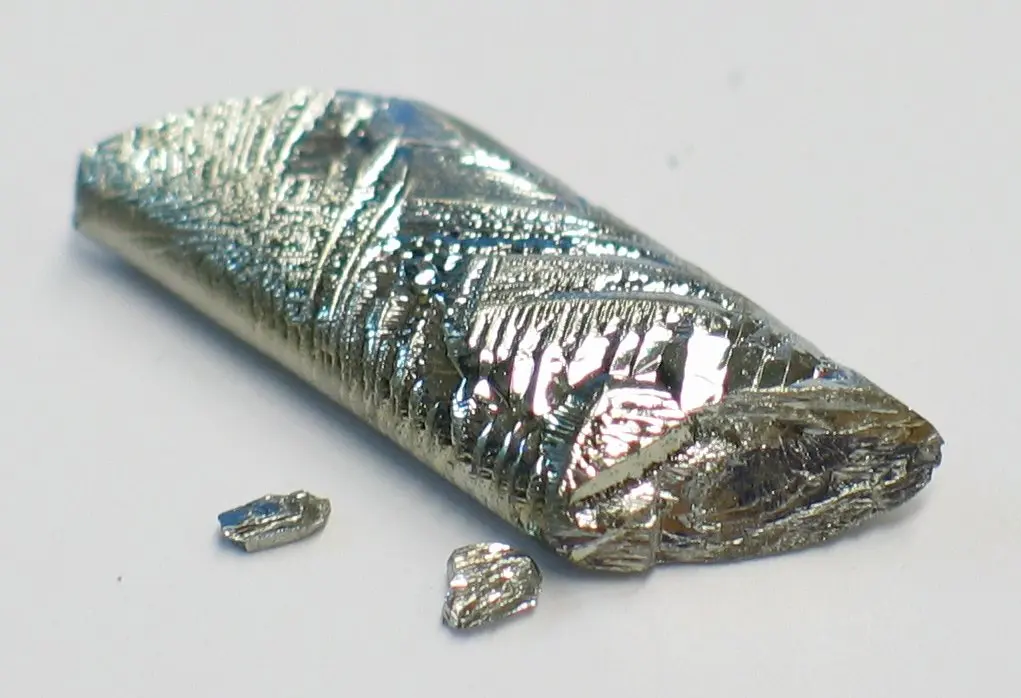
In the rocks of the Earth, tellurium is rarer than gold. Most people have never heard of it, and never seen it. Yet it is in some of the solar panels that cover whole fields of land, in the small electric coolers that keep drinks cold in a car, and in the power supply of the rover now driving across Mars.
Tellurium is also a puzzle element. It shines like a metal but breaks like glass; it was the “problem metal” that nobody could name for years; and it is heavier than the element that comes after it in the periodic table. Here is its story.
The tellurium atom
Every tellurium atom has 52 protons, so tellurium’s atomic number is 52, and a neutral atom has 52 electrons. Natural tellurium is a mixture of eight isotopes. The commonest, about a third of all tellurium atoms, has 78 neutrons: mass number 52 + 78 = 130.
Its shells and subshells
By the 2n² rule Grade 8: Bohr and Bury’s rule, the K, L and M shells fill as 2, 8 and 18. That leaves 24 electrons. The N shell could hold 32, but an outer shell holds at most 8, so it stops at 8 while the O shell begins. Then, as the d subshell of the N shell fills, the N shell grows to 18, and the O shell is left with 6: 2, 8, 18, 18, 6.
Subshells show it more clearly Grade 10: The Aufbau principle. After krypton (element 36), the order of filling is 5s, then 4d, then 5p:
1s² 2s² 2p⁶ 3s² 3p⁶ 4s² 3d¹⁰ 4p⁶ 5s² 4d¹⁰ 5p⁴
The 4d electrons belong to the N shell, which is why it ends up with 18. The outermost shell, O, holds 5s² 5p⁴: 6 valence electrons, the same as oxygen (2s² 2p⁴), sulphur (3s² 3p⁴) and selenium (4s² 4p⁴) above it.
How many electrons are in the outermost shell of a tellurium atom?
Pick an answer to see why.
Its place in the periodic table
- Period 5, because its electrons are in five shells.
- Group 16, called VIA in the older naming: oxygen, sulphur, selenium, tellurium and polonium, the oxygen family.
- p-block, because its last electrons go into a p subshell.
Going down group 16, the elements become more like metals: oxygen and sulphur are non-metals, polonium at the bottom is a metal, and tellurium, just above it, is a metalloid: an element with some properties of metals and some of non-metals Grade 10: Metalloids.
Tellurium is two electrons short of an octet. With hydrogen it shares two electrons, making hydrogen telluride, H₂Te, built like water, H₂O Grade 9: Covalent bond. From a reactive metal it can take two electrons and become the telluride ion, Te²⁻, as in zinc telluride, ZnTe. So its usual valency is 2. With oxygen and fluorine it also uses four or all six of its outer electrons: valency 4 in tellurium dioxide, TeO₂, and 6 in tellurium hexafluoride, TeF₆ Grade 9: Variable valency.
Heavier than the element after it
The periodic table is in order of atomic number. Almost always that is also the order of atomic mass, but tellurium is an exception: its atomic mass is 127.6, while iodine, element 53, has only 126.9.
When Mendeleev built his table in 1869, by atomic weight, this pair was in the wrong order. Tellurium plainly belongs with sulphur and selenium, and iodine with chlorine and bromine, so he put tellurium first anyway and guessed that its weight had been measured wrongly Grade 10: The trouble with atomic weight. It hadn’t. The answer came in 1913, when atomic numbers were found: an element’s place is set by its protons, not its weight.
So why is tellurium heavier? Because of its neutrons. Iodine has only one natural isotope, iodine-127. Two thirds of tellurium atoms are tellurium-128 or tellurium-130, with 76 or 78 neutrons. One proton fewer, but many more neutrons.
Tellurium (atomic mass 127.6) comes before iodine (126.9) in the modern periodic table. Why?
Pick an answer to see why.
How tellurium was found and named
In 1782, Franz-Joseph Müller von Reichenstein, the chief inspector of mines in Transylvania (now part of Romania), was studying a pale, shiny gold ore from a mine near the town now called Zlatna. He expected it to hold the metal antimony or bismuth, but his tests found neither. It held gold and a metal no one knew. He tested it for three years, in more than fifty experiments. When heated, it gave off white smoke with a smell like radishes. He called it metallum problematicum, the “problem metal”, and aurum paradoxum, “puzzling gold”.
Müller published his work in a little-read journal, and it was nearly forgotten. In 1789 the Hungarian chemist Pál Kitaibel found the same new element in another ore. Then Müller sent a sample to Martin Heinrich Klaproth in Berlin, one of the best chemists of the time. Klaproth confirmed it, made the element pure, and in 1798 named it tellurium, from the Latin tellus, “the Earth”: hence the symbol Te. He gave the credit for the discovery to Müller.
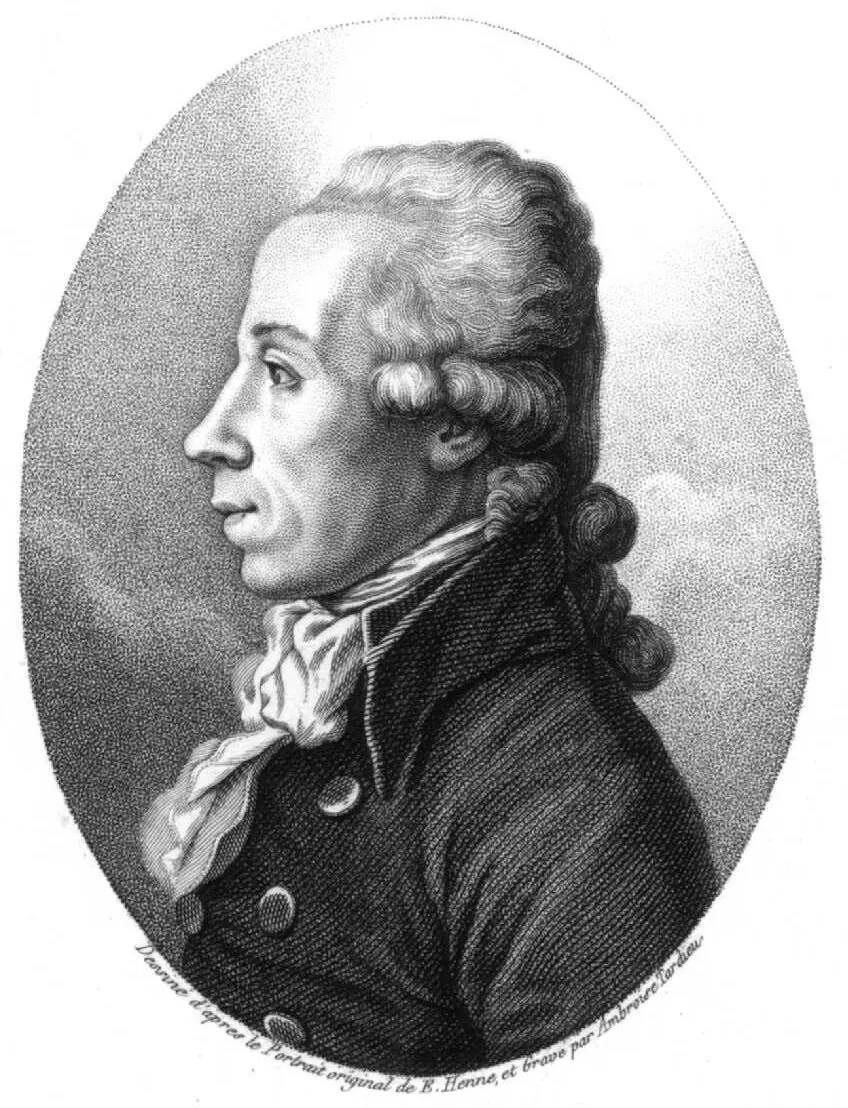
Twenty years later the Swedish chemist Berzelius found an element very like it, and named it after the Moon, selenium (from the Greek selene), to pair it with the Earth (Selenium). In Nepali tellurium is simply टेलुरियम.
Where tellurium is found
In the universe. Atoms of tellurium are heavier than iron, so stars cannot make them by fusion. They are made when nuclei catch neutrons, slowly in old giant stars and in a flash when dead stars collide (Heavier than iron: catching neutrons). In 2023 the James Webb Space Telescope saw the light of tellurium in the glowing cloud thrown out by the collision of two neutron stars, freshly made.
In the Earth’s crust. Tellurium is one of the rarest elements in rocks: about one milligram in every tonne, less even than gold. Now and then it is found as the pure element, but more often joined to metals. Gold is usually found as the pure metal; when it is found in a compound, the other element is usually tellurium. The gold tellurides, such as calaverite (AuTe₂), were the ores in which tellurium was discovered.
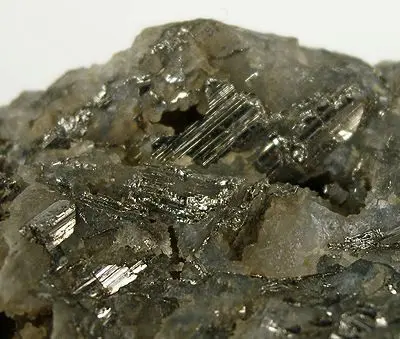
How it is obtained. Tellurium is not mined for its own sake. Almost all of it is a by-product of copper. When copper is purified by electrolysis, the impurities that do not dissolve sink under the anode as anode mud, and tellurium is collected from it, along with selenium, silver and gold Grade 10: Electro-refining. The mud can be up to 8% tellurium.
In 2025 the world refined roughly 1,000 tonnes of tellurium, about four fifths of it in China; Russia, Japan and Sweden came next (USGS, 2026). For comparison, the world mines about 23 million tonnes of copper a year.
What tellurium is like
- A silvery-white, shiny solid, which looks like a metal.
- Brittle. Hit it with a hammer and it shatters, and it is easily ground to a gray powder. A metal would bend or flatten Grade 9: Malleable.
- Melts at 450 °C and boils at 988 °C; its density is 6.2 g/cm³.
- A semiconductor. It conducts electricity, but far less than a metal; and unlike a metal, it conducts better when it is warmed, and a little better in light.
Inside a crystal of tellurium, the atoms are joined by covalent bonds into long spiral chains, three atoms to each turn of the spiral, lying side by side. The bonds hold most of the electrons in place, so few are free to carry a current: hence a semiconductor, not a metal Grade 9: What is inside a metal.
| a metal (copper) | tellurium | a non-metal (sulphur) | |
|---|---|---|---|
| looks | shiny | shiny | dull yellow |
| hammered | flattens | shatters | crumbles |
| conducts electricity | very well | weakly | hardly at all |
| warmed | conducts a little worse | conducts better | still hardly at all |
A gray solid shines like a metal, shatters when hit with a hammer, and conducts electricity weakly, more so when warm. What is it most likely to be?
Pick an answer to see why.
How tellurium reacts
Tellurium reacts like sulphur and selenium, its neighbors in group 16, but less strongly.
- Burning. Heated in air, it burns with a blue flame, giving white tellurium dioxide:
Te + O₂ → TeO₂
- Metals. Heated with metals, it forms tellurides, as sulphur forms sulphides: zinc telluride (ZnTe), cadmium telluride (CdTe), lead telluride (PbTe) and bismuth telluride (Bi₂Te₃). These are the useful tellurium compounds.
Zn + Te → ZnTe
- Hydrogen. Hydrogen telluride, H₂Te, is a poisonous gas with a foul smell. It is unstable, and soon breaks up again into tellurium and hydrogen. Going down group 16, the hydrides H₂O, H₂S, H₂Se and H₂Te become less stable, because the bigger atom holds hydrogen less tightly (Water, the odd one out).
- Water and acids. It does not react with water or dilute hydrochloric acid, but concentrated nitric acid dissolves it.
Sodium sulphide is Na₂S. What is the formula of sodium telluride?
Pick an answer to see why.
Tellurium in daily life
According to the USGS, in 2025 about 70% of the world’s tellurium went into solar panels, 15% into thermoelectric devices, 10% into metals and 5% into everything else.
Solar panels
Most solar panels, like those on Nepali rooftops, are made of thin slices of silicon Grade 9: Solar electricity. The main other kind uses a film of cadmium telluride, CdTe, only a few thousandths of a millimeter thick, laid on a sheet of glass. Cadmium telluride absorbs sunlight so strongly that this thin film does the work of a much thicker slice of silicon, so the panels take less material and energy to make. They are built mostly for large solar farms (Cadmium).
Electric coolers and Mars rovers
Join two different semiconductors in a loop and pass a current through them, and one junction gets cold while the other gets hot: the current carries heat from one side to the other. This is the Peltier effect, and the best materials for it at room temperature are made of bismuth telluride. A Peltier cooler has no moving parts and no gas: it is a flat tile a few centimeters across. Such tiles cool small car fridges and picnic boxes, and the lasers and light sensors inside some machines, which must be kept at a steady temperature.
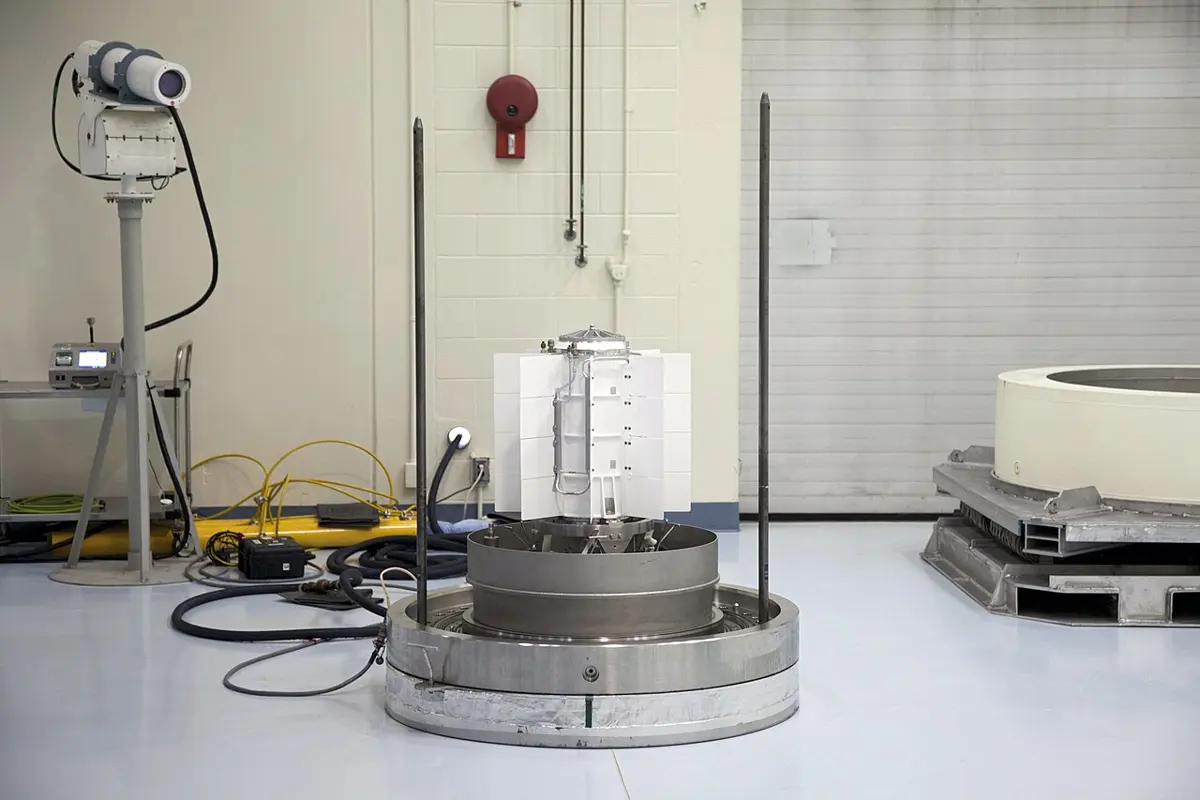
Run it the other way, and it works backwards: keep one side hot and the other cold, and the tile makes electricity. NASA’s rovers Curiosity (on Mars since 2012) and Perseverance (since 2021) are powered this way. Each carries a generator in which the heat of radioactive plutonium warms one side of hundreds of thermoelectric couples, made of lead telluride and other tellurium compounds, while the cold Martian air cools the other side. It gives a little over 100 watts, day and night, through dust storms and winter, for many years.
Rewritable discs and other uses
- Rewritable CDs, DVDs and Blu-ray discs store data in a thin layer of an alloy of tellurium with germanium and antimony. A laser heats a tiny spot until it melts; cooled quickly, it sets as a disordered glass, which reflects less light. Heated gently, it turns back into a crystal. So the disc can be written, erased and written again.
- Metals. A little tellurium in copper or steel makes the metal much easier to cut on a lathe, without making copper conduct worse; in lead, it makes it stronger.
- Rubber and colors. Tellurium helps harden (vulcanize) some rubber, and its compounds color glass and pottery.
Isotopes of tellurium
Natural tellurium is a mixture of eight isotopes, all with 52 protons. The two commonest are tellurium-130 (34%) and tellurium-128 (32%), and tellurium-126 (19%) is next Grade 9: Atomic mass.
Strangely, the commonest of them all, tellurium-130, is radioactive. But it decays so slowly that its half-life is roughly 8 × 10²⁰ years, tens of billions of times the age of the universe. In a lump of tellurium the size of your fist, holding about 3 × 10²⁴ atoms of tellurium-130, only a few thousand decay in a whole year. It can do this only by an extremely rare process, giving out two electrons at once and becoming xenon-130 (Beta decay).
Tellurium also helps make medicines. In a nuclear reactor, tellurium is bombarded with neutrons; tellurium-130 catches one, becomes tellurium-131, and decays within minutes into iodine-131, which hospitals use to treat diseases of the thyroid gland (Iodine).
Tellurium and your health
Tellurium has no known use in the human body, and there is very little of it in food. It and its compounds are poisonous, though poisoning is rare: it is met mostly by workers in factories and laboratories.
Its most famous effect is a smell. The body turns tellurium into a gas, dimethyl telluride, which leaves through the lungs and smells strongly of garlic. Workers who breathe even a tiny trace of tellurium dust get “tellurium breath”, which can last for weeks or months. Selenium does the same, a little less strongly: the body treats both of them like sulphur, their neighbor in group 16.
Surprising facts and records
- Rarer than gold. In the Earth’s crust, tellurium is rarer than gold or platinum, yet hundreds of tonnes are used every year, because the world refines so much copper.
- Earth and Moon. Tellurium (the Earth) and selenium (the Moon) sit one above the other in group 16, named by different chemists twenty years apart.
- The slowest clocks. Two of tellurium’s natural isotopes, tellurium-128 and tellurium-130, decay so slowly that their half-lives are among the longest ever measured.
In your science books
- Grade 8: the 2n² rule and groups in the periodic table.
- Grade 9: covalent bonds, variable valency, atomic mass and solar electricity.
- Grade 10: Mendeleev and the pair in the wrong order, the Aufbau principle, metalloids and electro-refining (where tellurium comes from).
- Going further: water, the odd one out (H₂O, H₂S, H₂Se and H₂Te compared), beta decay and where the atoms in your body came from.
More to explore
- A Nobel Prize with tellurium in it: strange new states of matter (2016; the first “topological insulator” predicted by its ideas was found in a thin layer of mercury telluride).
- Elements next door: selenium above it, iodine after it, cadmium, its partner in solar panels, and copper, from whose refining it comes.
- Play: find tellurium in Guess the Element and the Periodic Table Jigsaw.
- Read more: tellurium at the Royal Society of Chemistry and at PubChem.