
- Atomic number
- 72
- Atomic mass
- 178.49
- Shells
- 2, 8, 18, 32, 10, 2
- Configuration
- 1s² 2s² 2p⁶ 3s² 3p⁶ 4s² 3d¹⁰ 4p⁶ 5s² 4d¹⁰ 5p⁶ 6s² 4f¹⁴ 5d²
- In the table
- period 6, group 4 (IVB), d-block
- Kind
- Transition metal
- Valency
- 4 (Hf⁴⁺, as in HfO₂)
- State at 25 °C
- solid
- Melts · boils
- 2,233 °C · 4,603 °C
- Density
- 13.3 × as heavy as water
- Known since
- 1923
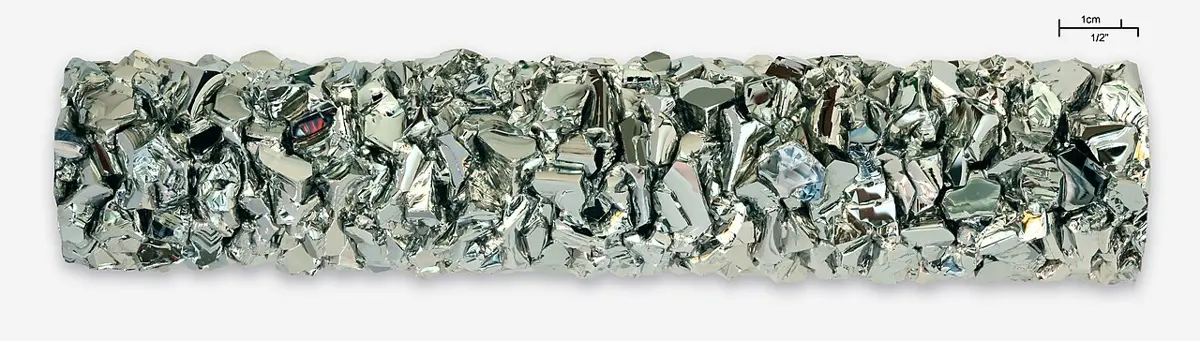
The chip that runs your phone holds billions of tiny switches. In almost every one of them, a layer of a hafnium compound only a few atoms thick keeps electricity from leaking where it shouldn’t. Far away, in the reactor of a nuclear submarine, rods of hafnium metal soak up neutrons to keep the reactor under control.
Yet for more than a hundred years after zirconium was found, nobody knew hafnium existed. It was hiding inside zirconium all along. Here is the story of the twin that nobody noticed.
The hafnium atom
A hafnium atom has 72 protons, so hafnium’s atomic number is 72, and a neutral atom has 72 electrons. The most common kind of hafnium atom, about a third of them, has 108 neutrons: mass number 72 + 108 = 180.
The 72 electrons fill six shells: 2, 8, 18, 32, 10, 2 Grade 8: Bohr and Bury’s rule. In subshells, the inside 68 electrons fill everything up to 4f¹⁴, and the last two go into 5d Grade 10: The Aufbau principle:
… 6s² 4f¹⁴ 5d²
Compare zirconium, just above it: … 5s² 4d². Both have two electrons in the outer s subshell and two in the d subshell below it, four outer electrons in all.
Its place in the periodic table
- Period 6, because its electrons are in six shells. It is the first element after the fifteen lanthanides (lanthanum to lutetium) that sit in the separate row below the table Grade 10: Features of the modern periodic table.
- Group 4, called IVB in the older naming, under titanium and zirconium.
- d-block: a transition metal Grade 10: Metals.
Hafnium uses all four outer electrons, so its valency is 4, as in hafnium oxide, HfO₂, and hafnium chloride, HfCl₄.
Hafnium has a valency of 4 and chlorine 1. What is the formula of hafnium chloride?
Pick an answer to see why.
Why it is zirconium’s twin
Going down a group, each element has one more shell than the one above it, so its atoms are bigger Grade 10: Atomic size. From titanium to zirconium, that is just what happens. But from zirconium to hafnium, the atoms hardly grow at all.
The reason is the fifteen lanthanides. Between zirconium (40) and hafnium (72) there are 32 elements, not 18. In the lanthanides, each step adds a proton to the nucleus and an electron to the deep 4f subshell. Electrons in 4f are poor at screening the outer electrons from the nucleus, so as the nuclear charge grows, the outer electrons are pulled in more and more tightly. By the time we reach hafnium, this shrinking, called the lanthanide contraction (lanthanum), has canceled the growth that a new shell should bring.
So a hafnium atom is the same size as a zirconium atom, with the same four outer electrons. In chemical reactions they behave almost exactly alike. Where zirconium goes in nature, hafnium goes too, fitting into the same places in the same crystals.
Why are hafnium and zirconium so hard to tell apart in chemical reactions?
Pick an answer to see why.
How hafnium was found and named
- 1869. Dmitri Mendeleev’s table left room for an element below zirconium.
- 1914. The young English physicist Henry Moseley found that each element gives out X-rays of its own wavelength, which depends on its atomic number. His measurements showed that element 72 was missing.
- 1911–1922. The French chemist Georges Urbain said he had found element 72 among the rare earths (the lanthanides) and called it celtium. Others were not convinced.
- 1921–1922. From the new ideas about how electrons fill shells, Charles Bury in Britain and Niels Bohr in Copenhagen argued that element 72 could not be a rare earth: it should be like zirconium.
- 1923. In Bohr’s institute in Copenhagen, Dirk Coster, from the Netherlands, and George de Hevesy, from Hungary, looked at the X-rays from zirconium ores, a zircon from Norway among them. They found the lines of element 72. It had been inside zirconium all along.
They named it hafnium, after Hafnia, the Latin name of Copenhagen. The symbol is Hf. The Dutch chemists Anton van Arkel and Jan Hendrik de Boer made the first pure metal a year or two later, letting hafnium iodide vapor break up on a white-hot tungsten wire, so that the hafnium grew on it as a crystal bar, like the one at the top of this page. Nepali books use the English name.
Hafnium was one of the very last stable elements to be found: only rhenium, recognized in 1925, came later. Every sample of “pure” zirconium measured before 1923 held a little hafnium, so even zirconium’s atomic mass had been measured wrongly.
Where hafnium is found
In the universe. Like other elements heavier than iron, hafnium was built when atomic nuclei caught neutrons one after another, mostly slowly inside old giant stars (Slowly, in giant stars).
In the Earth’s crust. Hafnium is rare: about 3 grams in every tonne of rock, roughly one fortieth as much as zirconium. It has no ores of its own. It is found only inside zirconium minerals, above all zircon (ZrSiO₄), where a few of every hundred zirconium atoms are hafnium (usually 1 to 3 in a hundred; sources give figures up to 5). Zircon is mined from beach sands, mostly in Australia and South Africa (USGS, 2026), and all hafnium comes from refining it.
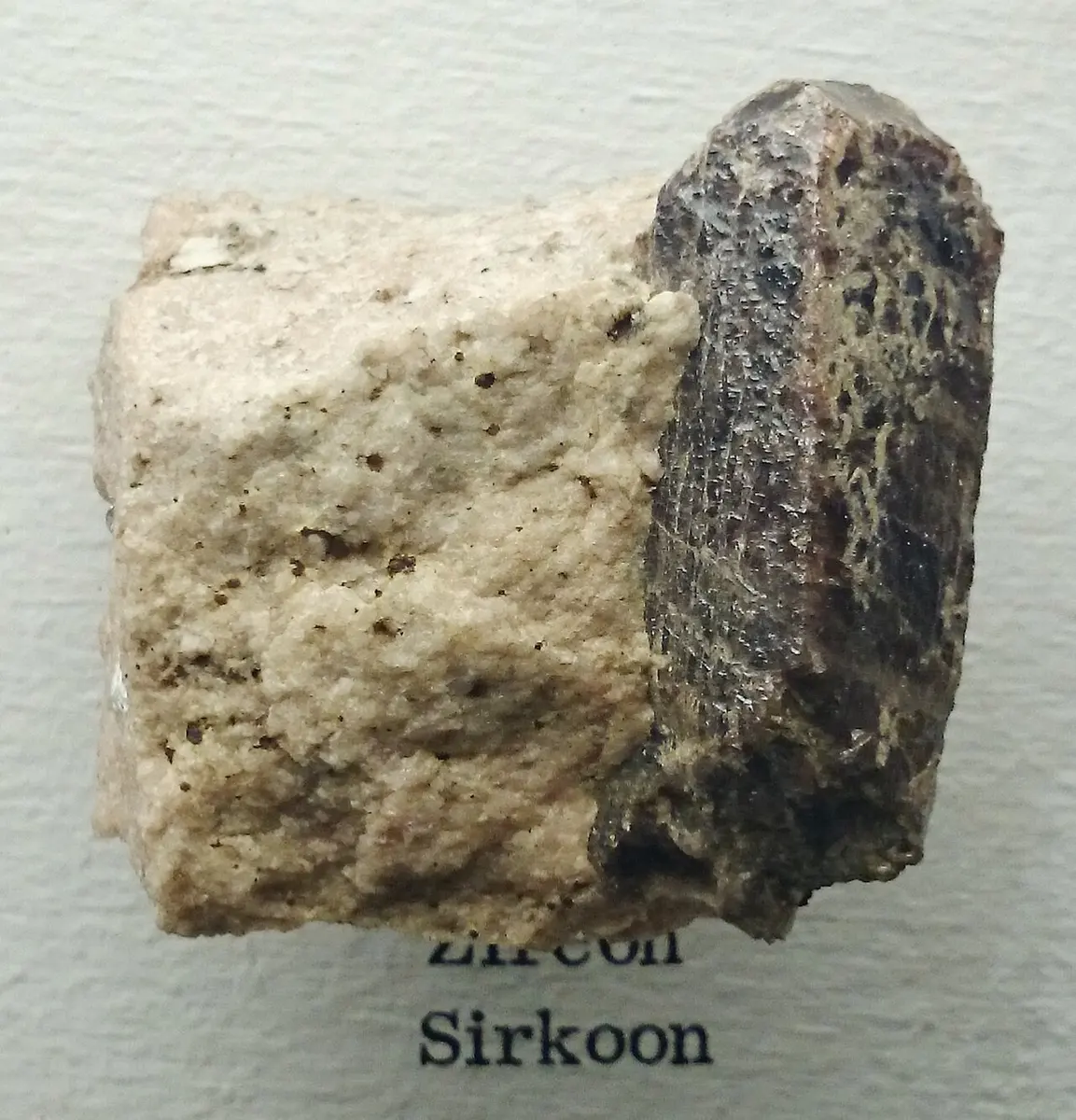
In Nepal. No hafnium is mined in Nepal. The sand of Nepal’s rivers carries tiny grains of zircon washed out of the Himalaya, and each holds a trace of hafnium (see zirconium).
What hafnium is like
- A shiny, silvery-gray metal that can be drawn into wire Grade 9: Ductile.
- Melts at 2,233 °C, higher than zirconium (1,855 °C) and far higher than iron (1,538 °C).
- Heavy: its density is 13.3 g/cm³, about twice zirconium’s (6.5 g/cm³). This is the one big difference between the twins. Same size of atom, but a hafnium atom has nearly twice the mass, so the metal is twice as dense.
- Does not corrode. A thin, tight layer of hafnium oxide forms on its surface at once and protects it, as on zirconium and titanium.
- Soaks up neutrons, hundreds of times more strongly than zirconium.
How hafnium reacts
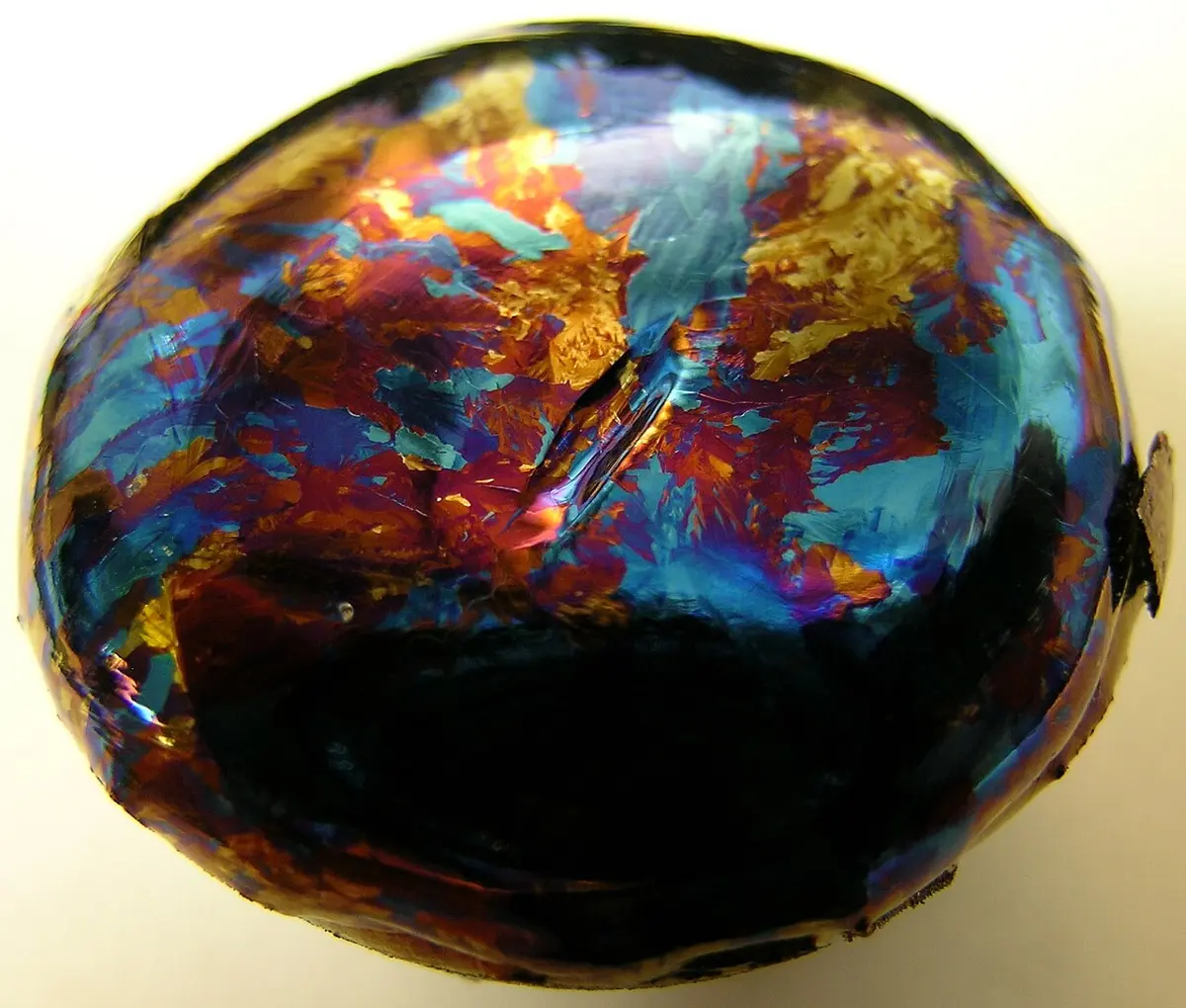
A block of hafnium is safe, protected by its oxide. But hafnium is a reactive metal underneath, like zirconium.
- With oxygen. Strongly heated, it burns to white hafnium oxide Grade 9: Metals react with oxygen:
Hf + O₂ → HfO₂
Fine hafnium powder is so reactive that it can catch fire in air by itself, so it is stored wet. - Making the metal. As for zirconium and titanium, hafnium chloride is heated with the more reactive metal magnesium, which takes the chlorine (the Kroll process; Reduction):
HfCl₄ + 2Mg → Hf + 2MgCl₂
Separating the twins. Before that, the hafnium must be taken out of the zirconium, and this is one of the hardest separations in all of chemistry. Their compounds differ only very slightly, for example in how easily they dissolve in certain liquids. Factories shake a solution of the two again and again with a liquid that takes up a little more of one than the other, many times over, until they are apart.
Hafnium in nuclear reactors
In a nuclear reactor, uranium nuclei split when they catch a slow neutron, giving out energy and two or three more neutrons, which split more nuclei: a chain reaction Grade 9: Nuclear fission. The uranium fuel is packed in tubes of zirconium, which lets neutrons pass straight through.
Hafnium does the opposite. Its nuclei swallow neutrons readily, and several of its isotopes can each swallow two or three in turn. So:
- Zirconium for the fuel tubes must be almost free of hafnium. Even the 2% of hafnium in natural zirconium would soak up too many neutrons. That is why the twins are separated at all, and why most hafnium is a by-product of making reactor-grade zirconium.
- The hafnium makes control rods. Control rods are pushed into a reactor to soak up neutrons and slow the chain reaction, or pulled out to speed it up. Hafnium is strong, does not corrode in hot water, and keeps soaking up neutrons for many years, so it is used for the control rods of the small, long-lived reactors that power submarines and some research reactors. Most power stations use cheaper boron or alloys of silver, indium and cadmium instead.
Why must hafnium be removed from the zirconium used for reactor fuel tubes?
Pick an answer to see why.
Hafnium in your phone
A computer chip is built of transistors: tiny switches with no moving parts. A modern phone’s chip has billions of them. Each has a gate, a strip of conductor that sits over a channel of silicon, separated from it by a very thin layer of insulator. A voltage on the gate pulls charges into the channel below and turns the switch on; no voltage, and it is off. The gate works through the insulator, as a magnet works through paper.
To make chips faster, engineers made the transistors smaller and smaller, and the insulator thinner. By the early 2000s, the layer of silicon dioxide (SiO₂) under the gate was only about 1.2 nanometers thick: about five layers of atoms. That was too thin. Electrons began to slip straight through it, wasting power as heat and draining batteries.
The answer was hafnium oxide, HfO₂. It passes the gate’s electric pull through much more strongly than silicon dioxide does, so a layer several times thicker controls the channel just as well, and the thicker layer stops the leak. In 2007, Intel began selling chips made this way, with transistors 45 nanometers in size, and other chipmakers followed. Today almost every powerful chip, in phones, laptops and computers, has a few atoms’ thickness of a hafnium compound in every transistor. The layers are built up one layer of atoms at a time, from hafnium chloride vapor.

Hafnium in daily life
Hafnium is too rare and too expensive for ordinary things. In 2025 a kilogram of hafnium metal cost about 3,800 US dollars, nearly five times its price in 2021 (USGS, 2026). It is used only where nothing else will do:
- Superalloys. A little hafnium, a percent or so, is added to the nickel alloys of jet engine and gas turbine blades. It helps the protective oxide skin stick to the blade as it heats and cools again and again. In the USA this is now its biggest use (USGS, 2026).
- Rocket nozzles. An alloy of niobium with about 10% hafnium and a little titanium stays strong when red-hot, and is used for the nozzles of small rocket engines (see niobium).
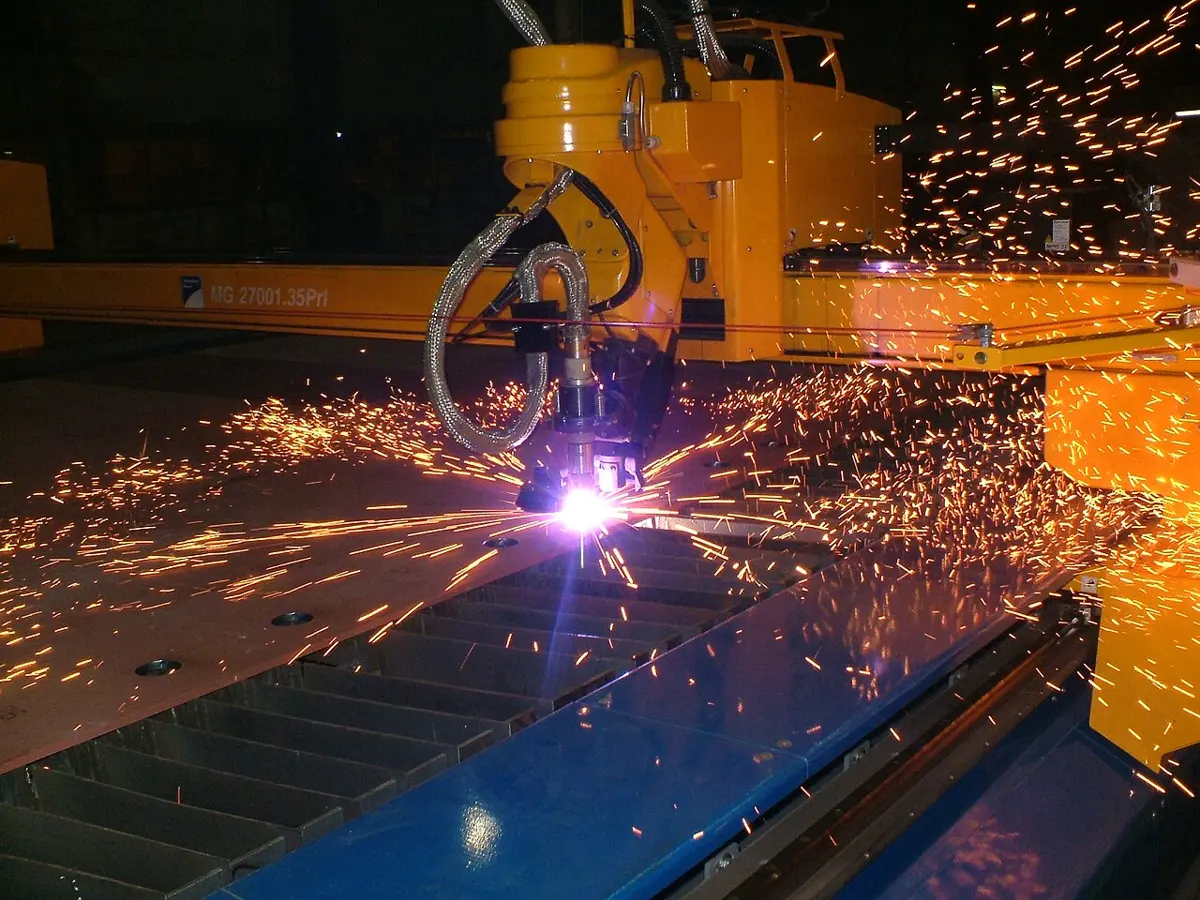
- Plasma cutters. A plasma cutter cuts thick steel with a jet of gas heated by an electric spark to many thousands of degrees. The spark leaps from a tiny insert of hafnium in the tip of the electrode, because hafnium gives off electrons easily and stands the heat.
Isotopes: a clock for the Earth’s core
Natural hafnium is a mixture of six isotopes, hafnium-174 and 176 to 180. Hafnium-180 is the most common, about 35%.
When the Earth formed, it also held a radioactive isotope, hafnium-182, which decays into tungsten-182 with a half-life of about 9 million years. It is long gone, but it left a clue. When the young Earth was partly molten, its iron sank to the middle to make the core. Tungsten likes to dissolve in iron, so most of the Earth’s tungsten went down into the core with it; hafnium stays in rock, so it stayed behind in the rocky mantle.
If the core had formed late, after all the hafnium-182 had decayed, the mantle’s tungsten would have an ordinary mix of isotopes. Instead, the mantle’s rocks have a little extra tungsten-182, made from hafnium-182 that was still decaying after the core had taken the rest of the tungsten away. So the core must have formed while hafnium-182 was still around. Measuring that extra tungsten-182 shows that the Earth’s core formed within roughly the first 30 million years of the solar system: early, when you remember that the Earth is about 4.5 billion years old (How old is the Earth?).
A second hafnium clock, hafnium-176 made from lutetium-176, is used to date old rocks and zircon grains.
Hafnium and your health
Hafnium has no known job in the body. The metal and its oxide are not poisonous in the amounts anyone meets; no one at home ever handles it. In factories, the real danger is fine hafnium powder and shavings, which can catch fire in air by themselves, and hafnium chloride, which gives off hydrochloric acid fumes when it meets moist air.
Surprising facts and records
- A hidden twin. It took 134 years after zirconium was found (1789) to notice the hafnium inside it (1923).
- Among the hardest substances to melt. Hafnium carbide (HfC) melts at almost 4,000 °C, and mixtures of hafnium and tantalum carbides, and hafnium carbonitride, at a little more. Which substance holds the record is still being measured, but hafnium is in all the leading ones.
In your science books
- Grade 8: the 2n² rule.
- Grade 9: the criss-cross method, nuclear fission and properties of metals.
- Grade 10: the Aufbau principle, the lanthanides’ place in the table, atomic size down a group and reduction.
- Going further: where the heavy elements were made and the Earth’s first billion years.
More to explore
- Its family: titanium and zirconium above it; lutetium before it and tantalum after it.
- Play: find hafnium in Guess the Element and the Periodic Table Jigsaw.
- Read more: hafnium at the Royal Society of Chemistry and at PubChem.