
The coldest stuff in the universe
Nobel Prize in Physics, 2001: Eric Cornell, Wolfgang Ketterle, and Carl Wieman
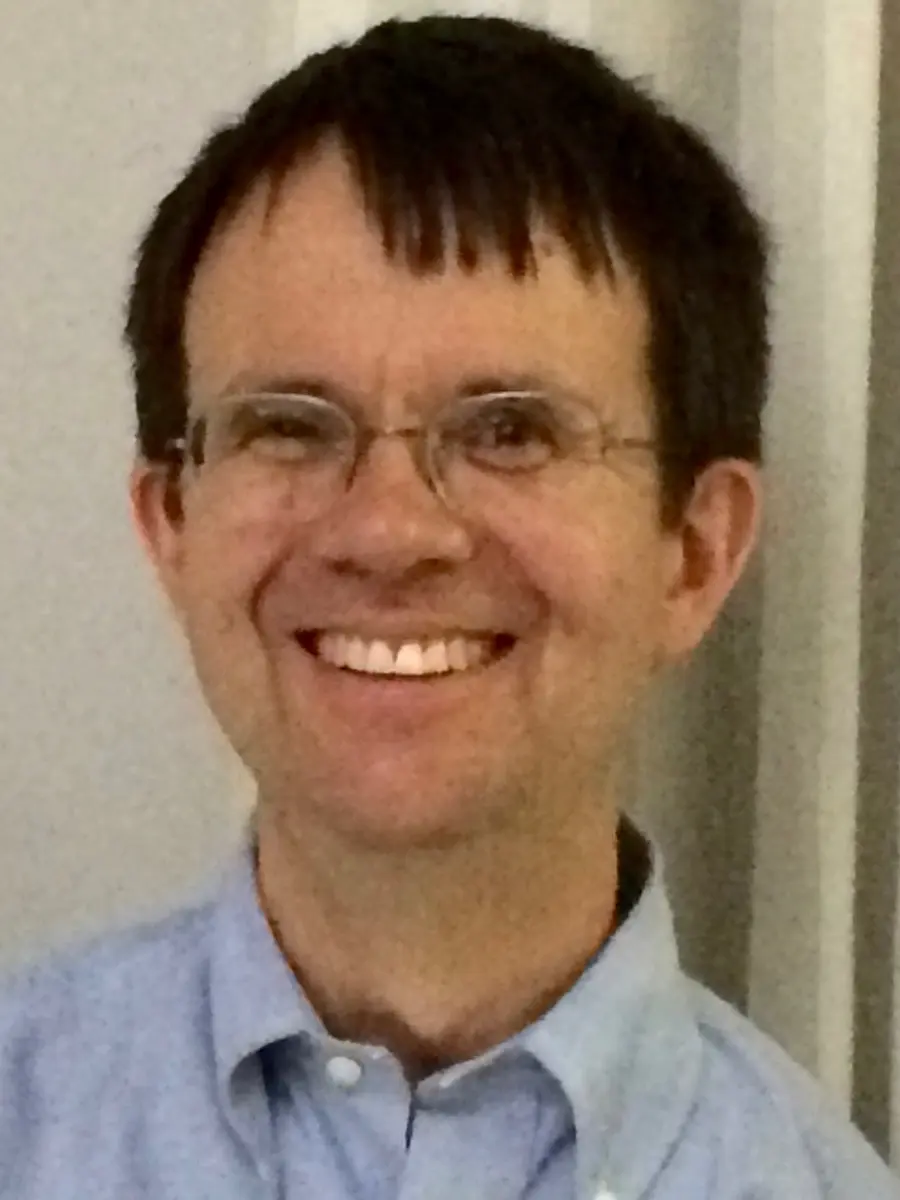
Eric Cornell
born 1961 in Palo Alto, United States
As a student he took time off to teach English in Taiwan and study Chinese, then came back to physics. He was 33 when his team made the first condensate.
Photo: Betsythedevine, CC BY-SA 4.0
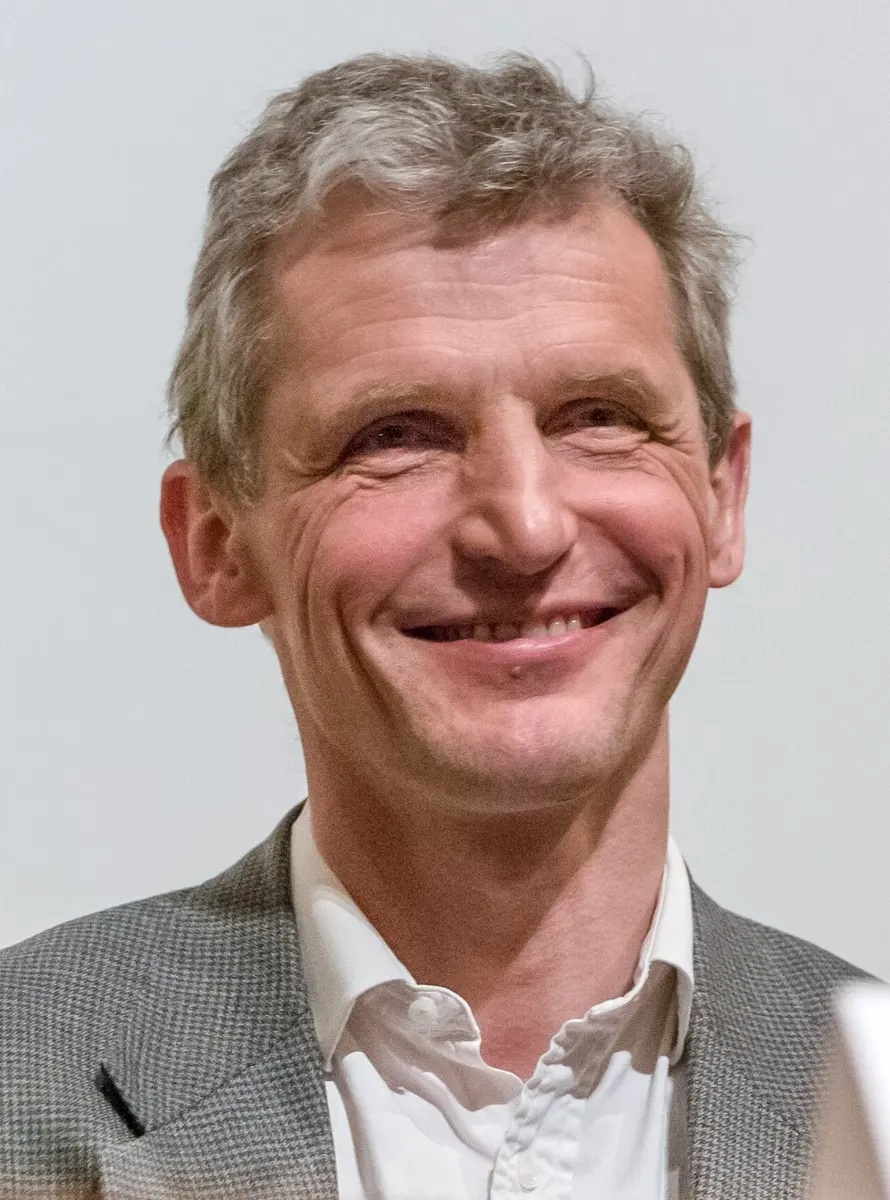
Wolfgang Ketterle
born 1957 in Heidelberg, Germany
He studied flames for years, then changed fields in his early thirties and moved to the United States to work on cold atoms.
Photo: Kzirkel, CC BY-SA 3.0
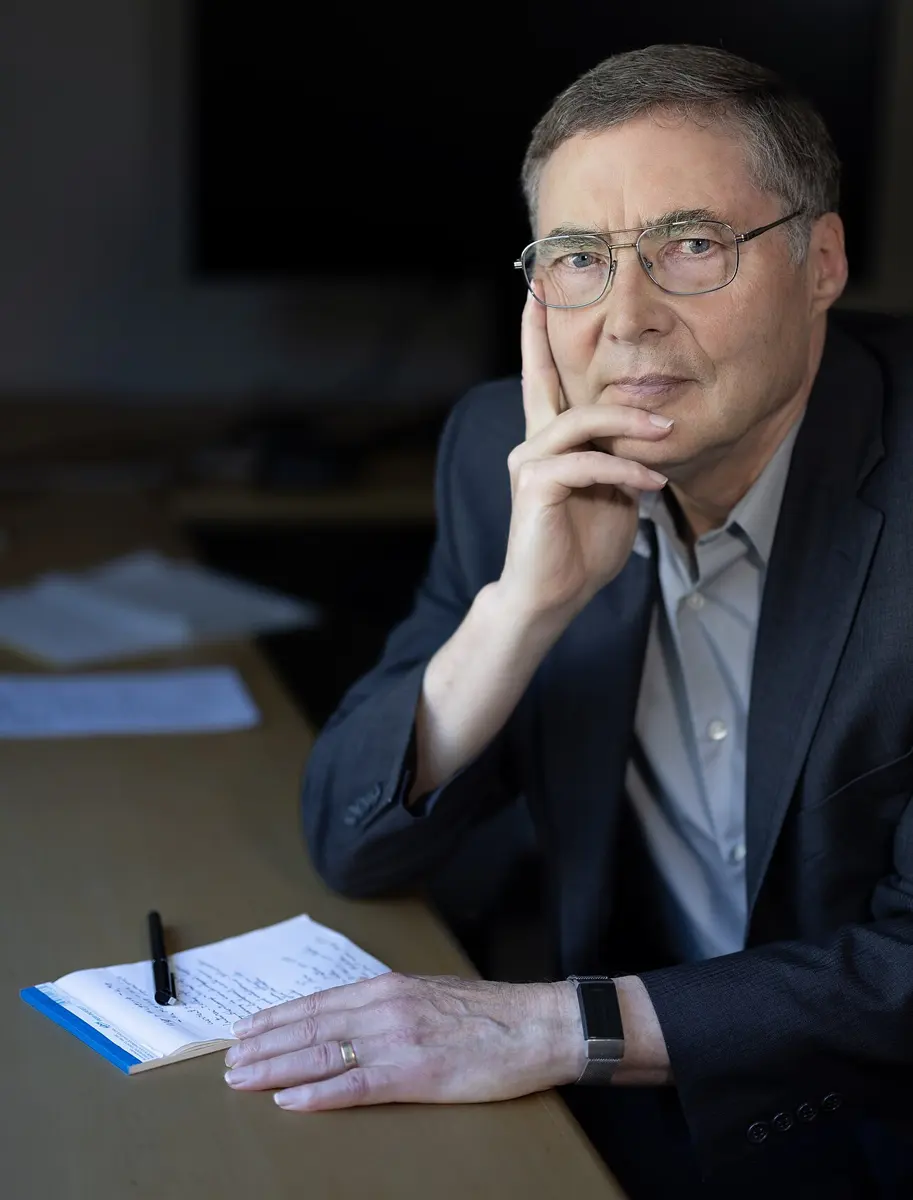
Carl Wieman
born 1951 in Corvallis, United States
He grew up deep in the forests of Oregon. Later he spent much of his life on how science is taught, and started the free PhET science simulations used in classrooms around the world.
Photo: Christopher Michel, CC BY-SA 4.0
On a winter night in Mustang or at Everest Base Camp, the temperature can drop to −20 °C or lower. The coldest temperature ever measured on the Earth’s surface, in Antarctica, was −89 °C. But there is a limit to how cold anything can get, absolute zero: −273.15 °C Grade 10: absolute zero. Nothing can ever be colder.
In 1995, in two laboratories in the United States, scientists cooled a wisp of gas to less than a millionth of a degree above absolute zero, far colder than anywhere in nature. At that temperature the atoms did something no atoms had ever been seen to do: thousands of them began to act as if they were one single atom. This new state of matter, a Bose–Einstein condensate, had been predicted seventy years earlier, by a young physicist in Dhaka and by Albert Einstein. The 2001 Nobel Prize in Physics went to the three people who made it: Eric Cornell, Carl Wieman and Wolfgang Ketterle.
The problem: a prediction that waited seventy years
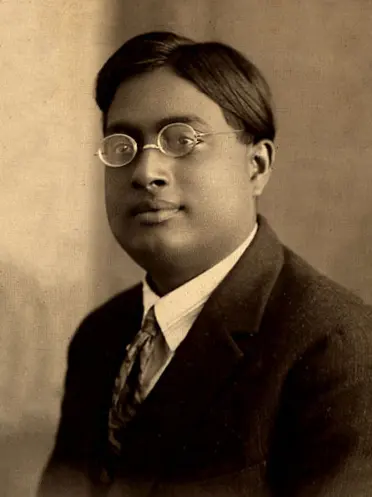
In 1924, Satyendra Nath Bose, a young physics lecturer (a reader) at the University of Dhaka (then in British India, now in Bangladesh), found a new way to count how particles of light share out their energy. A British journal turned his paper down, so he sent it to Einstein. Einstein saw at once that it was important, translated it into German himself and had it published.
Einstein then applied Bose’s counting to atoms. He found something strange. If a gas of the right kind of atoms is cooled enough, a large share of the atoms should all drop into the very same state, the lowest-energy state there is, and behave as one. This became known as Bose–Einstein condensation. Particles that can do this are called bosons, after Bose.
For seventy years, nobody could test it in a gas. Nobody knew how to make a gas cold enough.
How it works: atoms are waves too
You learn that matter is made of tiny particles that never stop moving (particles that never stop). The hotter a gas, the faster its atoms move. In air in your room, a typical molecule moves at about 500 meters per second, faster than many bullets.
But atoms are not only tiny balls. In quantum physics, the physics of very small things, every particle also behaves like a wave, a little smeared-out patch, a bit like light, which is both a wave and a stream of particles (wave or particle?). The slower an atom moves, the bigger its wave becomes.
- In a warm gas, each atom’s wave is tiny, much smaller than the gap between atoms. The atoms behave like little balls bouncing about.
- Cool the gas, and the waves grow.
- Cool it far enough, and the waves become as big as the gaps between the atoms. They overlap and merge. For bosons, the merged waves then lock together into one big wave, and all those atoms move together, as one “super-atom”. That is the condensate.
Why does a gas have to be so cold for a Bose–Einstein condensate to form?
Pick an answer to see why.
Why it was hard
Three things made it seem almost impossible.
- It has to be unbelievably cold. For a thin gas, the atoms must move at only a few millimeters per second, slower than an ant walks. That means a temperature of about a ten-millionth of a degree above absolute zero.
- The gas must not freeze. Cool almost any gas and it turns into a liquid and then a solid, long before it gets that cold. To stop this, the gas must be kept extremely thin, about a hundred thousand times thinner than air, so the atoms rarely meet and stick together.
- No container can touch it. Any wall, even one cooled with liquid helium, is far too warm. One touch would heat the atoms. The gas must float in the middle of an empty chamber, held by light and magnets alone.
What they did, step by step
First, slow the atoms with light
The first tools came from others. From the 1980s, physicists learned to slow atoms with laser light (this work won the 1997 Nobel Prize in Physics). Light pushes on whatever absorbs it, very gently. If an atom moving towards a laser absorbs light from it, the light’s push slows it down, like running into a stream of tiny ping-pong balls. With laser beams from six directions, atoms are slowed wherever they move, and magnets herd them into a small cloud in the middle. This is called a magneto-optical trap.
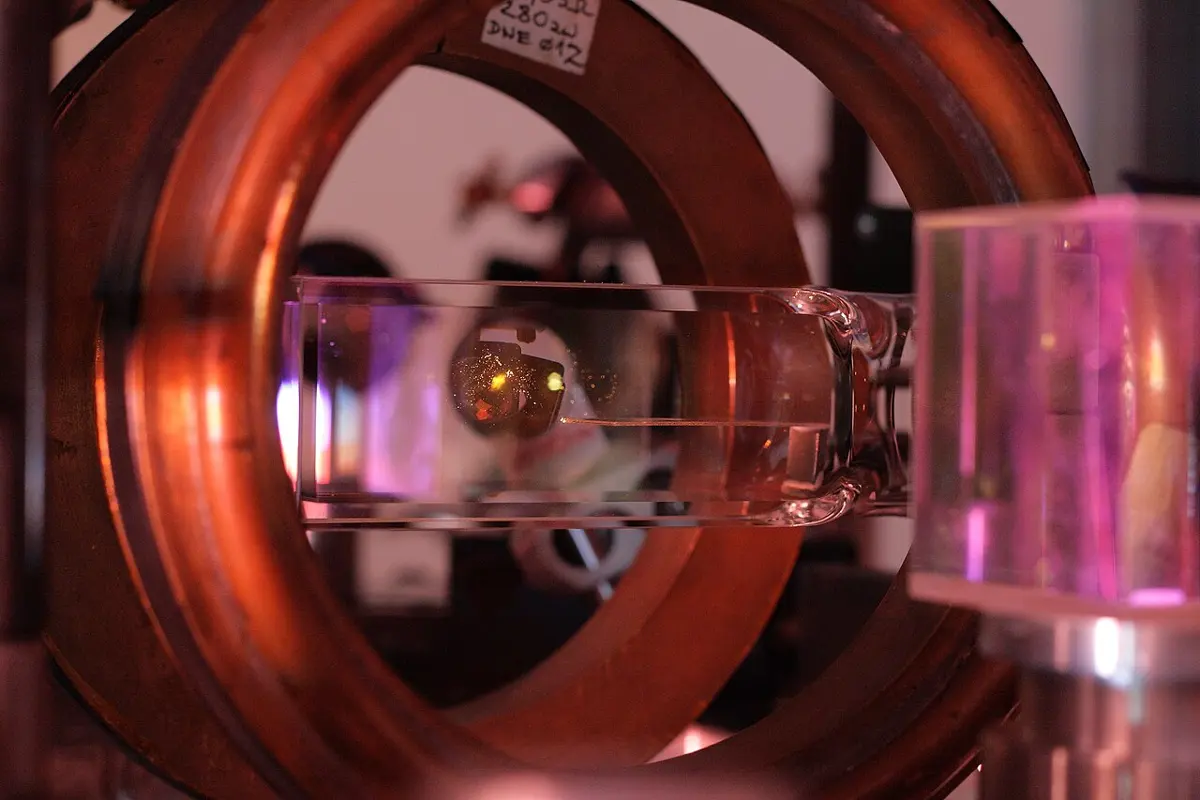
Laser cooling gets atoms down to about a ten-thousandth of a degree above absolute zero. That is very cold, but still about a thousand times too warm.
Wieman and Cornell: the rubidium condensate
Carl Wieman worked at JILA, a research institute in Boulder, Colorado. Around 1990 he drew up a plan. He used cheap lasers of the kind then found in CD players, to save money. Eric Cornell joined him, first as a young researcher, soon as his partner. They worked with rubidium atoms.
- Laser cooling. They gathered a cloud of rubidium atoms in a magneto-optical trap and cooled it with lasers.
- A magnetic bowl. They switched off the lasers and held the atoms with magnets alone. Each rubidium atom is a tiny magnet, and the magnetic field forms a kind of bowl that the atoms roll about in.
- Evaporative cooling. Then came the final trick. The fastest atoms climb highest up the sides of the bowl. The team sent in radio waves tuned so that they flip only those high-climbing atoms, which the magnet then pushes out of the trap. The atoms left behind share out less energy, so they are colder. Lowering the radio “rim” step by step left a smaller and colder cloud each time.
- Plugging a leak. At the very bottom of the bowl the magnetic field drops to zero, and atoms leaked out there. Cornell found a way round it: a magnetic field that spins round very fast, so the leak keeps moving and the atoms never find it.
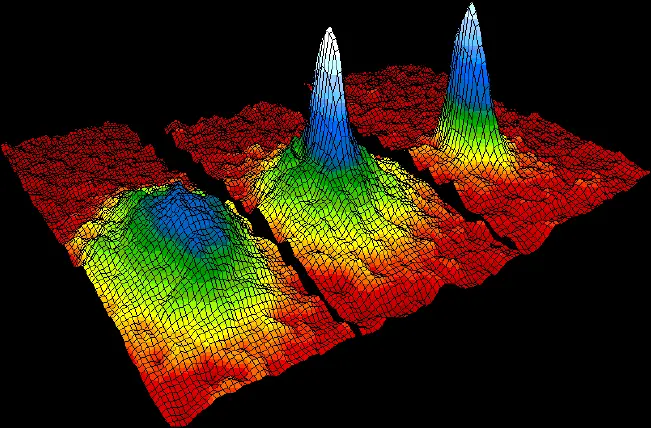
- June 1995. At about 170 billionths of a degree above absolute zero, the condensate appeared. By cooling further, to about 20 billionths of a degree, they had a nearly pure condensate of about 2,000 atoms.
To see the condensate, they switched off the trap and let the cloud spread for a moment, then shone a laser through it and photographed its shadow. Ordinary atoms fly apart in all directions. The condensate atoms, almost motionless, stayed together in a sharp spike in the middle.
Ketterle: the sodium condensate
Wolfgang Ketterle, at the Massachusetts Institute of Technology (MIT), was racing the Colorado team with sodium atoms, the atoms that give street lamps their yellow light.
- A plug of light. He had the same leak at the bottom of the magnetic bowl. He plugged it with a strong laser beam aimed at the center, which pushed atoms away from the leak.
- September 1995, a big condensate. About four months after the JILA team, Ketterle’s team made a condensate with hundreds of times more atoms. That made it big enough to experiment on.
- 1997, matter waves. Ketterle made two condensates and let them spread into each other. They made a pattern of light and dark stripes, the same pattern two overlapping water waves make (waves that cancel). It showed directly that the condensate is one big matter wave.
- The atom laser. He let drops of the condensate fall out of the trap one after another, a beam of atoms all marching in step, like the light in a laser. It has been called an atom laser.
In 1997 Ketterle let two condensates overlap and saw stripes. What did the stripes show?
Pick an answer to see why.
How it works now
Since 1995, hundreds of laboratories around the world have made condensates, with many kinds of atoms. In 2003 Ketterle’s group cooled one to less than half a billionth of a degree above absolute zero, the coldest temperature ever reached at that time. The same year, Deborah Jin at JILA made a condensate of atoms of the other kind, ones that are not bosons, by first making them pair up.
In 2018 NASA sent a laboratory for cold atoms, the Cold Atom Lab, to the International Space Station. In orbit, where the atoms float without falling, it made condensates in space for the first time.
In your life today
You won’t find a Bose–Einstein condensate in your home. But the work around it is never far away.
- Clocks. The world’s most accurate clocks, which keep official time, use clouds of atoms cooled by lasers, the same first step that Cornell, Wieman and Ketterle used. The timing signals that phone networks, GPS and the internet depend on are checked against such clocks.
- Measuring. Cold atoms, being waves, can be used to measure gravity and rotation very finely. Instruments built on this are being tested for finding minerals underground and for steering ships and planes without GPS.
- In your classroom. Carl Wieman went on to study how science is best taught. The free PhET simulations he started in 2002 let you play with circuits, waves and atoms on a computer or phone, and are used by teachers around the world.
- A South Asian name. Every boson in physics, including the Higgs boson, is named after Satyendra Nath Bose.
What came next
Condensates are now used to build quantum simulators: atoms held in grids made of laser light, arranged to copy hard problems in materials, such as how electricity can flow with no resistance at all in a superconductor. Others hope that cold atoms will become the working parts of quantum computers.
An open question: if we could understand exactly how electrons pair up and flow without resistance, could we make a material that superconducts at room temperature? Today’s superconductors must be cooled to well below −100 °C. One that worked at room temperature would carry electricity without any loss, and cold-atom experiments are one of the ways scientists are hunting for the answer.
In your science books
- Grade 10: thermal energy, heat and temperature (absolute zero and the kelvin) and measuring temperature.
- Grade 8: what matter is.
- Going further: particles that never stop, evaporation, kinetic energy, waves that cancel and wave or particle?
Learn more
- The Nobel Prize’s own explanation: New state of matter revealed: Bose-Einstein condensate (nobelprize.org).
- The Nobel lectures: Cornell and Wieman (a joint lecture) and Ketterle.
- PhET Interactive Simulations, free science simulations started by Carl Wieman.
The official reason
The prize was given “for the achievement of Bose-Einstein condensation in dilute gases of alkali atoms, and for early fundamental studies of the properties of the condensates.”