
Ion channels: the tiny gates of every cell
Nobel Prize in Physiology or Medicine, 1991: Erwin Neher and Bert Sakmann

Erwin Neher
born 1944 in Landsberg, Germany
A physicist who, as a schoolboy, was already reading everything he could find on how nerves send signals. He set out to become a “biophysicist”.
Photo: Molgen, Public domain
-
Bert Sakmann
born 1942 in Stuttgart, Germany
A medical doctor who, as a boy, built model ships and remote-control airplanes. His grandfather was a doctor to the King of Siam (Thailand).
Touch a hot pan and you pull your hand away before you even feel the pain. A message has raced from your fingertip to your spinal cord and back to the muscles of your arm in a fraction of a second. That message is electrical. But there are no copper wires in your body. The electricity is carried by ions, atoms with an electric charge, passing through tiny gates in the skin of your cells.
These gates are called ion channels. Each one is a single molecule, and its opening is only as wide as one ion. In the 1970s, two German scientists, Erwin Neher and Bert Sakmann, found a way to measure the electric current through one of these gates, and to watch it open and close. For this they shared the 1991 Nobel Prize in Physiology or Medicine.
The problem: signals nobody could see
Every cell is wrapped in a thin skin, the cell membrane Grade 8: The covering of the cell. It is mostly fat, so water and ions can’t pass through it on their own. Yet the body’s salts, dissolved in water, are ions: sodium (Na⁺), potassium (K⁺) and chloride (Cl⁻) Grade 9: Ion. The inside of a cell has lots of potassium; the liquid outside has lots of sodium.
Because the ions are spread unevenly, there is a small voltage across the membrane, the membrane potential: between about 0.03 and 0.1 volts, roughly a twentieth of the voltage of a torch cell. A nerve cell uses it to send signals. When a signal comes, gates for sodium open for a moment, sodium rushes in, and the voltage flips. This flip runs along the nerve fiber like a flame along a fuse Grade 9: Neuron or nerve cell.
Two British scientists, Alan Hodgkin and Andrew Huxley, worked this out in the early 1950s by measuring currents in the giant nerve fiber of a squid, and won the Nobel Prize in 1963. But they measured the current of a whole nerve fiber at once, the sum of many thousands of gates. Nobody knew what a single gate was like. Some scientists thought the ions might be carried across by little “ferry boat” molecules instead. Nobody had ever seen one gate open.
Why can’t sodium ions simply pass through a cell membrane on their own?
Pick an answer to see why.
How an ion channel works
An ion channel is a protein, a large molecule that sits right through the membrane, with a narrow tunnel, the pore, down its middle. The pore is about half a millionth of a millimeter wide, the width of a single ion. Most of the time it is shut.
When the right signal comes, the protein changes its shape and the pore opens. Different channels listen for different signals:
- some open when the voltage across the membrane changes, like the sodium channels that carry a nerve signal;
- some open when a messenger chemical fits into them, like a key into a lock.
Each channel lets through only certain ions. A sodium channel lets sodium through but not potassium, though potassium ions are only slightly bigger. Some channels are lined with negative charges, so they let positive ions through and turn negative ones away.
When a channel opens, ions pour through, millions of them every second. Ions carry charge, so moving ions are an electric current Grade 9: Electric current. But it is a fantastically small one: about a few picoamperes. A picoampere is a million-millionth of an ampere. A phone on its charger draws about one ampere: a million million picoamperes.
Why it was hard
- The current is tiny. A few picoamperes is far smaller than the random electrical crackle, the noise, of the glass and liquids and of the amplifier itself. A single channel’s signal was buried in it.
- The channels are crowded. A small piece of a nerve or muscle cell has thousands of channels. Measuring one meant shutting out the current of all the others.
- The channel is buried in the membrane. You can’t pick up one molecule and put a meter on it. It only works while it sits in a living membrane.
What they did, step by step
Neher and Sakmann: two friends in Göttingen
Erwin Neher studied physics in Munich and, for a year, in the United States, then switched to studying nerve cells. Bert Sakmann trained as a medical doctor. They met in the late 1960s as young researchers at a research institute in Munich, where Neher was measuring currents in snail nerve cells, and became friends. Sakmann then went to London to work with Bernard Katz (Nobel Prize 1970), who had found indirect hints of single channels in the flickering “noise” of muscle currents.
By the mid-1970s both were working at the Max Planck Institute for Biophysical Chemistry in Göttingen. They decided to try to record one channel. Their idea was simple:
- A glass pipette. Heat a thin glass tube and pull it out until its tip is only about a thousandth of a millimeter across. Fill it with salty water, put a fine wire inside, and connect the wire to a very sensitive amplifier.
- Press it onto a cell. Under a microscope, touch the tip gently against the membrane of a muscle cell. The tip now covers a tiny patch of membrane, small enough to hold just one or a few channels. Current flowing through the pipette can only come through the channels in that patch. This is why the method is called the patch clamp.
- 1976, the first single-channel recordings. On muscle cells from a frog, with a chemical that acts like acetylcholine in the pipette, they saw the current jump up in little square steps, a few picoamperes high, and drop back again a moment later. Each step was one channel opening and closing. For the first time, people saw a single molecule at work.
The seal that made it work (about 1980)
The 1976 recordings were noisy. The glass did not fit tightly against the membrane, so current leaked round the edge, and with it came noise that hid small signals. The leak’s resistance Grade 9: Electric resistance was about 50 million ohms. Neher and Sakmann tried for years to make it bigger, with different cells and different ways of treating the glass.
- A lucky discovery. Around 1980 they found that if the glass tip was very clean, and they sucked very gently on the pipette, the membrane suddenly stuck to the glass. The resistance jumped to more than ten thousand million ohms, hundreds of times tighter than before. The noise dropped, and even the smallest channels could be heard clearly.
- 1981, new ways to use it. The seal was so strong that the patch stayed stuck to the pipette when it was pulled away from the cell. Then you could change the liquid on the inside of the membrane too, or, by sucking a little harder, break the patch and measure the whole cell at once. Together with their young colleagues Owen Hamill, Alain Marty and Fred Sigworth, they published all these methods in 1981.
In a patch clamp recording, the current suddenly jumps up by 3 pA, stays level, then drops back. What happened?
Pick an answer to see why.
After the patch clamp: what they each did next
- Neher: watching cells release their messages (1982 onward). Cells such as those in the pancreas that make insulin store their hormones in tiny bubbles. To release them, a bubble joins the cell’s outer membrane, and the membrane grows a little bigger. Neher found how to measure this growth electrically, so precisely that he could detect each single bubble joining.
- Sakmann: taking a channel apart (from about 1985). Working with the Japanese scientist Shosaku Numa, who could change the genes for the acetylcholine channel, Sakmann changed one part of the protein at a time and recorded what happened. They found which parts make up the gate, and which make up the filter that picks out the right ions. Later, Sakmann found ways to record from nerve cells in thin slices of brain.
How it works now
The patch clamp is now one of the most used tools in biology. A scientist looks down a microscope at a living cell, moves the glass pipette up to it with fine controls, and sucks gently to make the seal. The recordings show the life of single molecules: how long each channel stays open, which ions it lets through, and which medicines block it.
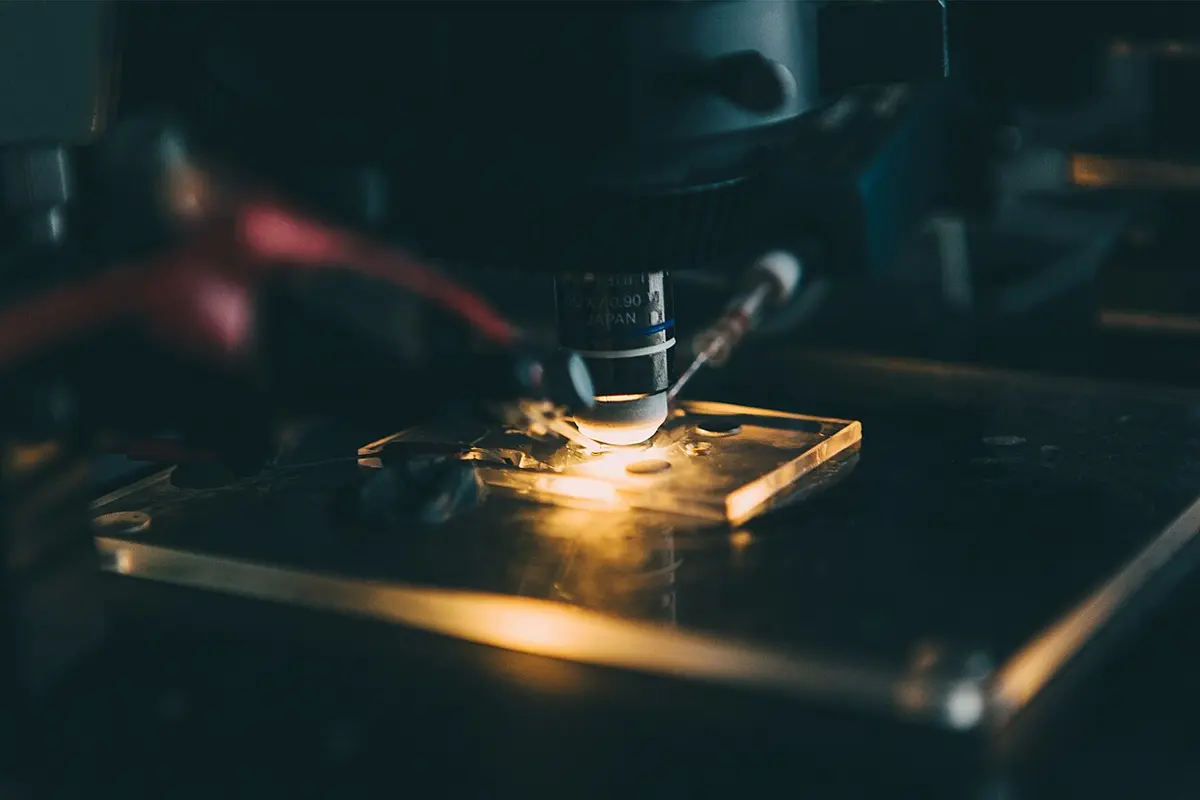
Today, robot patch clamps test hundreds of cells at once. New medicines are checked this way, to make sure they don’t block an important channel in the heart by mistake.
In your life today
- At the dentist. The injection that numbs your tooth is a local anesthetic. It blocks the sodium channels in the nerves of that part of your mouth, so pain signals can’t travel to the brain.
- Diabetes. Diabetes is common in Nepal Grade 10: Diabetes. In the cells of the pancreas that make insulin, sugar from the blood is turned into energy, and this closes a type of potassium channel. That starts a chain of changes that releases insulin. Some tablets for diabetes work by closing those same channels.
- Other diseases. Faulty channels cause cystic fibrosis, a lung disease (a chloride channel), some kinds of epilepsy, and some heart rhythm problems. Medicines for epilepsy, for anxiety and for heart problems act on ion channels.
- Poisons. Many poisons work by jamming ion channels. The venom of kraits, snakes found in Nepal’s Terai, paralyzes by stopping the signal between nerves and muscles; one krait poison, α-bungarotoxin, sticks fast to the very acetylcholine channels Neher and Sakmann first recorded.
A local anesthetic blocks sodium channels in a nerve. Why does that stop you feeling pain?
Pick an answer to see why.
What came next
- Seeing the gate. In 1998 Roderick MacKinnon saw the shape of a potassium channel atom by atom, and how its filter lets potassium through but not the smaller sodium. He shared the Nobel Prize in Chemistry in 2003 (Chemistry 2003).
- Channels for heat, touch and cold. Channels in the nerve endings of your skin open with heat, with the hot chemical in chilli, or with pressure. Their discovery won the Nobel Prize in 2021 (Medicine 2021).
- Hundreds of channels. Our genes make hundreds of kinds of ion channels. For many we still don’t know exactly what they do in the body, or which diseases a fault in them can cause. That is an open question for the next generation of scientists.
In your science books
- Grade 8: the covering of the cell, the cell membrane.
- Grade 9: ions, electric current and its units, resistance, the nerve cell, the nervous system, reflex action and the pancreas.
- Grade 10: diabetes.
- Going further: messages along nerves, and chilli and mint.
Learn more
- The Nobel Assembly’s press release, which explains ion channels and the patch clamp, and the presentation speech (nobelprize.org).
- The Nobel lectures: Neher’s and Sakmann’s, and their autobiographies: Neher, Sakmann.
The official reason
The prize was given “for their discoveries concerning the function of single ion channels in cells.”