
The Braggs: seeing atoms with X-rays
Nobel Prize in Physics, 1915: William Henry Bragg and Lawrence Bragg
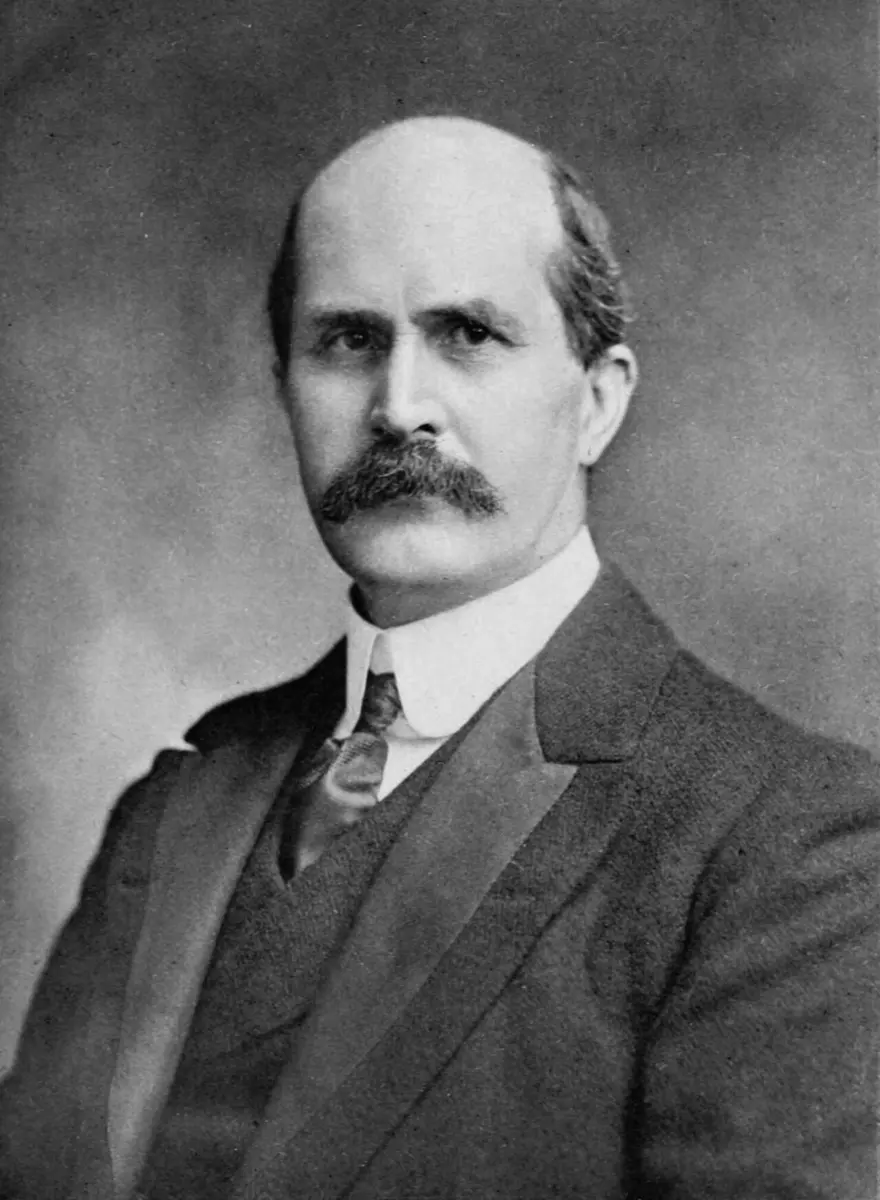
William Henry Bragg
1862–1942, born in England
A much-loved teacher in Australia who turned to research only after many years of teaching, and built the instrument that made the discoveries possible.
Photo: Nobel foundation, Public domain
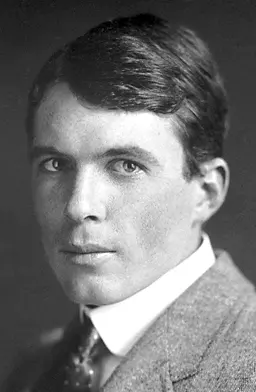
Lawrence Bragg
1890–1971, born in Australia
William’s son. He was 22 when he had the key idea, and at 25 he is still the youngest winner of the Nobel Prize in Physics.
Photo: Nobel foundation, Public domain
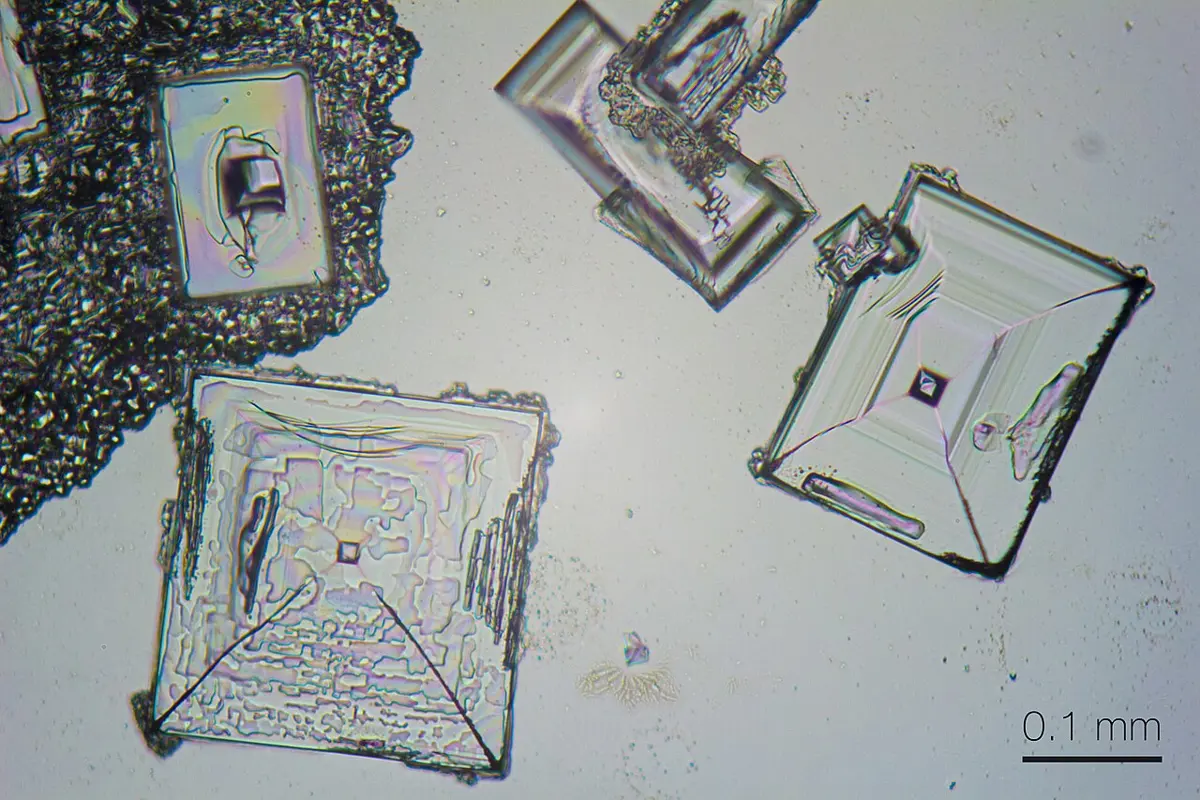
Put a few grains of salt under a magnifying glass. Each grain is a tiny cube with flat faces and sharp corners. Sugar, alum, ice and the quartz in sand also form crystals: solids with flat faces that meet at fixed angles. For centuries people guessed that the neat outside shape comes from atoms packed in a neat pattern inside. But atoms are far too small to see. How could anyone find out where they are?
In 1912 and 1913 a father and son in England, William Henry Bragg and Lawrence Bragg, found a way: shine X-rays through the crystal and measure where they go. For the first time, people could say exactly where the atoms sit. They won the Nobel Prize in Physics in 1915.
The problem: atoms nobody could see
By 1900, most scientists believed in atoms, but nobody knew how they were arranged in a solid. Is table salt made of separate molecules of NaCl, each one sodium atom joined to one chlorine atom, like the formula suggests? How are the carbon atoms joined in diamond, the hardest natural substance? A microscope could not help. Light waves are thousands of times longer than the gap between two atoms, and you cannot see details smaller than the wave you look with.
There was a second puzzle. In 1895 Wilhelm Röntgen had discovered X-rays, invisible rays that pass through flesh and show the bones Grade 9: X-rays. Seventeen years later, nobody was sure what they were. Some scientists, William Bragg among them, thought they were a stream of tiny particles. Others thought they were waves, like light but with a much shorter wavelength.
How waves and patterns make spots
When light passes through a regular pattern of very fine gaps, such as the threads of a cloth, the waves spread out from each gap and meet again. Where the crests of two waves arrive together, they add up and make a bright spot. Where a crest meets a trough, they cancel. The result is a pattern of bright spots, called diffraction. It only works well when the gaps are not much bigger than the wavelength (Light bends round edges).
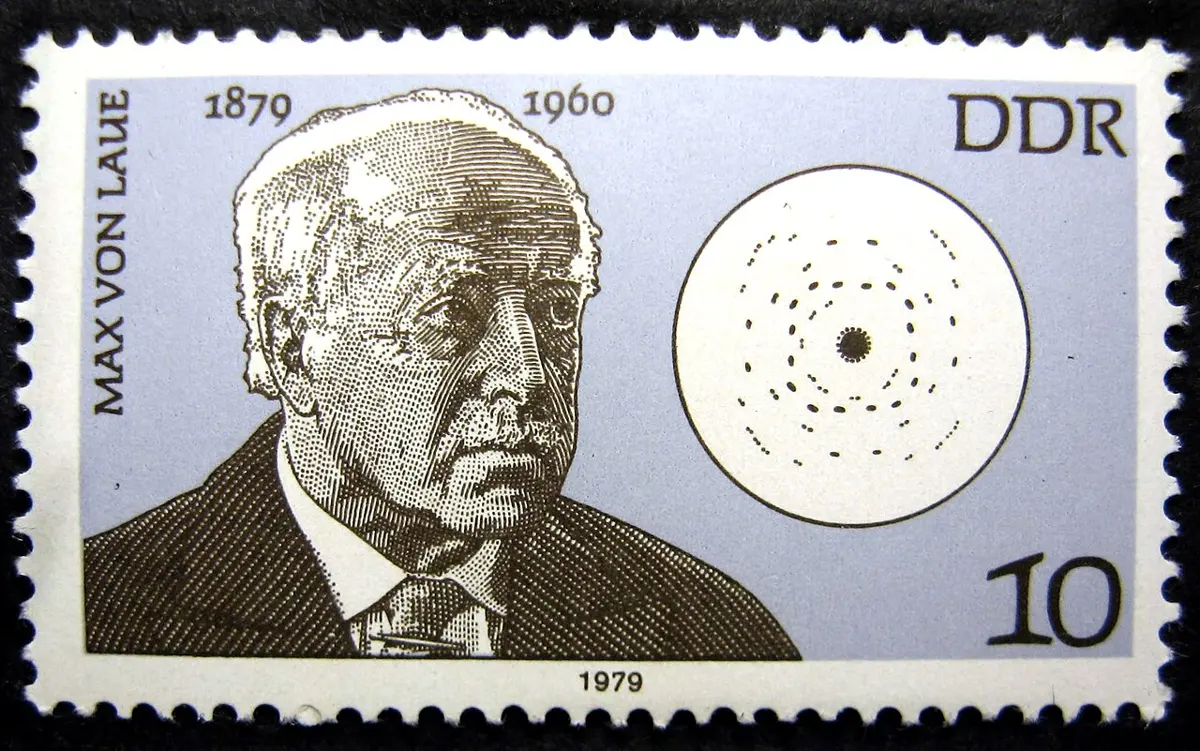
In 1912, in Munich, Max von Laue had an idea. If X-rays are waves with a very short wavelength, and if the atoms in a crystal are in a regular pattern, then a crystal should act like that cloth for X-rays. Two young scientists working with him, Walter Friedrich and Paul Knipping, sent a narrow beam of X-rays through a crystal of copper sulphate onto a photographic plate. Around the central spot they found a ring of small, regular spots. X-rays were waves after all, and crystals really were regular patterns of atoms. Laue won the Nobel Prize in Physics in 1914.
Why it was so hard
Laue’s photographs proved that the crystal’s atoms make the pattern, but they were very hard to read.
- The mathematics was complicated. Laue’s method treated every atom separately, in three dimensions. Working back from the spots to the arrangement of the atoms was almost impossible, even for a simple crystal.
- Too many things were unknown. The X-rays from the tubes of the time were a mixture of many wavelengths, and nobody knew those wavelengths. Nobody knew the spacing of the atoms either. With two unknowns, you cannot find either one.
What they did, step by step
1. A letter on holiday (summer 1912)
In June 1912 William Bragg, a professor at the University of Leeds, got a letter describing Laue’s experiment. He was on holiday on the Yorkshire coast with his son Lawrence, a 22-year-old who had just finished his degree at Cambridge. Father and son talked it over for days. William at first thought the spots might be caused by particles traveling down channels between the atoms.
2. Lawrence’s idea: layers of atoms as mirrors (autumn 1912)
Back in Cambridge, Lawrence kept thinking about the spots. One day, walking by the river, he had the key idea: think of the crystal not as separate atoms but as flat layers of atoms, stacked one above another, like the pages of a book. Each layer reflects a tiny part of the X-rays, like a very faint mirror.
X-rays reflected from the second layer travel a little further than those from the first layer, those from the third layer further still, and so on. Usually the reflected waves are out of step and cancel. But at certain angles the extra distance is exactly one whole wavelength, or two, or three. Then all the reflected waves are in step, they add up, and a strong reflected beam comes out.
He worked out how big the extra distance is. If the layers are a distance d apart and the X-rays meet them at an angle θ (the Greek letter theta), the extra distance is 2d sin θ. A strong reflection comes only when this equals a whole number n of wavelengths λ (lambda). This is Bragg’s law:
So if you measure the angle of a strong reflection and know the wavelength, you get the spacing of the layers of atoms. Lawrence presented his idea in Cambridge on 11 November 1912. Using it, he explained the spots in Laue’s photographs of zinc sulphide.
X-rays are reflected by many layers of atoms in a crystal. When do they give a strong reflected beam?
Pick an answer to see why.
3. William’s instrument: the X-ray spectrometer (1913)
William Bragg was a skilled builder of instruments. To use his son’s idea, he built the X-ray spectrometer. A narrow beam of X-rays hits a crystal on a turntable. Instead of a photographic plate, the reflected X-rays go into a closed chamber of gas, where they make the gas conduct a little electricity; the current shows how strong the X-rays are. Turning the crystal and the chamber step by step, he could measure exactly at which angles the strong reflections came.
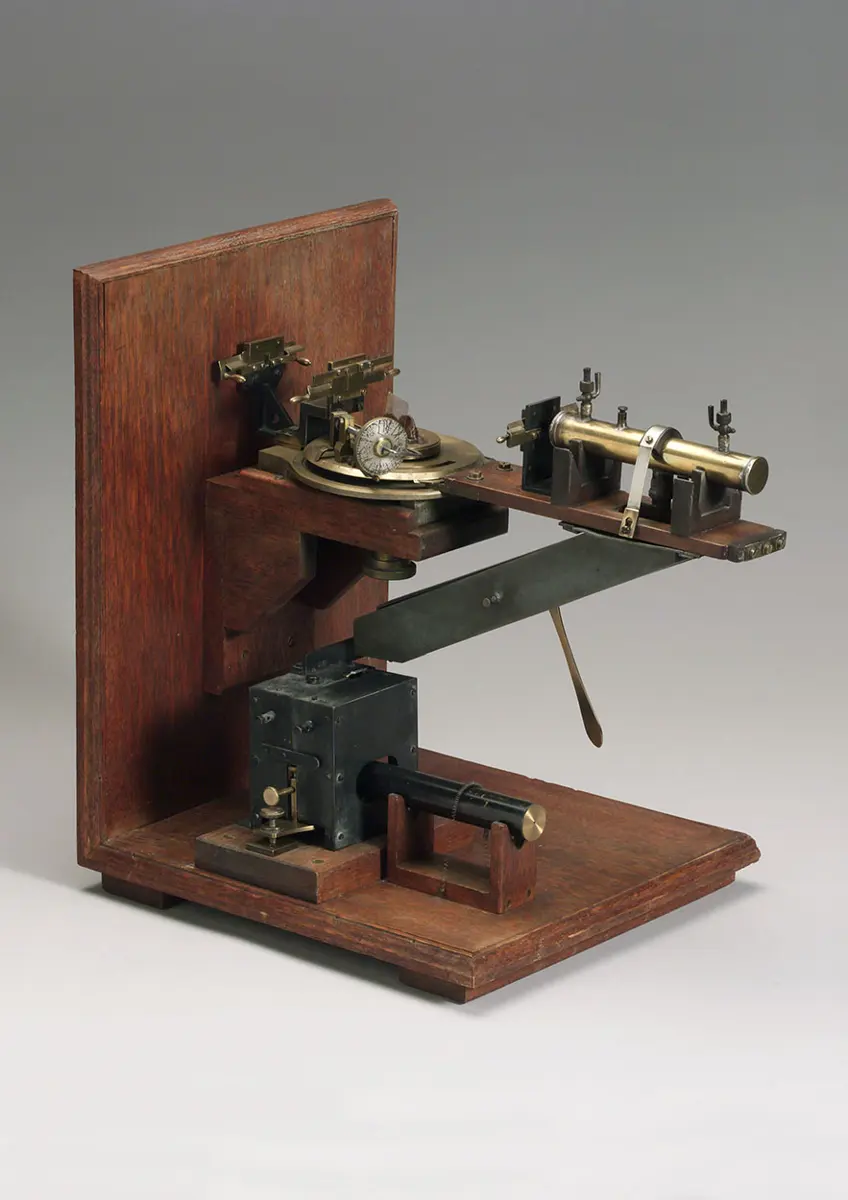
This did two things at once. With a crystal whose spacing was known, the spectrometer measured the wavelengths of X-rays: each metal used in an X-ray tube gives off X-rays of its own few, fixed wavelengths. And with X-rays of a known wavelength, it measured the spacings in a crystal. Father and son worked together for about two years. Lawrence later called it a time “like discovering a new goldfield where nuggets could be picked up on the ground”.
4. What they found: salt and diamond (1913)
Salt. The Braggs found that in a crystal of sodium chloride there are no separate NaCl molecules. Sodium and chlorine take turns in a cubic pattern, like the black and white squares of a chess board in three dimensions. Every sodium has six chlorines around it, at exactly the same distance, and every chlorine has six sodiums. The formula NaCl only tells you that there is one sodium for each chlorine. Many chemists at first found this hard to accept. Today we know that salt is made of charged ions, Na⁺ and Cl⁻, held together by their opposite charges Grade 9: Formation of sodium chloride.
Diamond. In diamond, every carbon atom is joined to four others, which sit at the corners of a tetrahedron (a pyramid with a triangle for its base) around it. These strong links run in every direction through the whole crystal, which is why diamond is so hard (Networks of atoms: diamond and sand). Chemists had guessed that carbon makes four bonds pointing to the corners of a tetrahedron. The Braggs showed it was really so.
How X-ray crystallography works today
The method the Braggs started is called X-ray crystallography. Today it works like this:
- Grow a crystal of the substance, even if it is a huge molecule, such as a protein from your body.
- Shine a narrow beam of X-rays of one wavelength through it, often from a giant machine called a synchrotron, which makes X-rays millions of times brighter than an X-ray tube.
- Record thousands of spots with a digital detector, while the crystal is turned a little at a time.
- A computer uses the positions and brightness of the spots to work out a map of where the electrons are, and so where every atom is.
In your life today
- Medicines. Chemists find the exact shape of the proteins in viruses and bacteria, then design medicines to fit them like a key in a lock. Many medicines for HIV and some for cancer were designed this way.
- The shape of life’s molecules. X-ray patterns showed the shape of penicillin, vitamin B₁₂, the double helix of DNA, and of hundreds of thousands of proteins.
- Materials. X-ray diffraction is used to check which minerals are in a rock, to test cement and steel, and to design the materials in batteries and solar cells.
- On Mars. NASA’s Curiosity rover carries a small X-ray diffraction instrument to find out which minerals are in the Martian rocks.
What came next
- Bigger and bigger molecules. Lawrence Bragg spent his life on crystallography. As head of the Cavendish Laboratory in Cambridge, he supported the young scientists who found the structures of proteins and DNA: Max Perutz and John Kendrew (Nobel Prize in Chemistry, 1962), and Francis Crick and James Watson (Medicine, 1962). William Bragg’s laboratory in London trained many crystallographers too, including Kathleen Lonsdale and a young J. D. Bernal.
- Dorothy Hodgkin found the structures of penicillin and vitamin B₁₂ with X-rays (Nobel Prize in Chemistry, 1964).
- An open question: Some important molecules, such as many of the proteins in cell membranes, are very hard to grow into crystals. New methods, such as freezing molecules and photographing them with electrons, now help. But how a long protein chain folds itself into its exact shape in a fraction of a second is still being worked out.
In your science books
- Grade 9: X-rays, the electromagnetic spectrum, and how sodium chloride forms, with the properties of electrovalent compounds.
- Going further: What does a molecule look like?, Why does salt melt at 801 °C but ice at 0 °C? and Is light a wave or a stream of particles?, which explains how waves add up and cancel.
Learn more
- The prize at nobelprize.org: The Nobel Prize in Physics 1915, with the presentation speech and a longer story of the father and son, Perspectives.
- Lawrence Bragg’s Nobel lecture, “The diffraction of X-rays by crystals”, given in 1922.
The official reason
The prize was given “for their services in the analysis of crystal structure by means of X-rays.”