
Jump off a low wall onto a concrete floor, and without thinking you bend your knees. Catch a hard cricket ball, and your hands move back with it. Drop an egg onto a stone floor and it breaks; drop it from the same height onto a folded blanket and it may not. Each time, the thing arrives at the same speed and ends up stopped. So why does it matter so much how it is stopped?
On Nepal’s roads it matters a great deal. As of 2026, more than 8 in 10 of Nepal’s 6.2 million registered vehicles are motorcycles. Wearing a helmet properly cuts a rider’s risk of dying in a crash by more than six times, and the risk of a brain injury by up to 74%, according to the World Health Organization. A helmet is only a few centimeters of foam inside a plastic shell. An airbag is only a bag of gas. Neither can make a crash slower. This topic explains how they still save lives, with one idea that grows out of Newton’s laws: momentum.
Momentum: how hard is it to stop?
A bus and a motorbike are coming towards you at the same speed. Which would you rather try to stop? Not the bus: it has far more mass. Now a cricket ball, tossed gently to you, or the same ball from a fast bowler? The fast one is much harder to stop. How hard a moving thing is to stop depends on both its mass and its velocity.
Physicists put the two together. The momentum of a body is its mass times its velocity:
where p is the momentum, m the mass in kilograms and v the velocity in meters per second. So momentum is measured in kilogram meters per second, kg m/s.
| Moving thing | Mass | Velocity | Momentum |
|---|---|---|---|
| a rifle bullet | 0.010 kg | 800 m/s | 8 kg m/s |
| a cricket ball from a fast bowler | 0.16 kg | 40 m/s (144 km/h) | 6.4 kg m/s |
| you, walking | 60 kg | 1.5 m/s | 90 kg m/s |
| a motorbike and its rider | 200 kg | 14 m/s (50 km/h) | 2,800 kg m/s |
| a loaded bus | 12,000 kg | 11 m/s (40 km/h) | 132,000 kg m/s |
A bullet is tiny but very fast; a bus is slow but enormous. Momentum puts them on one scale.
You met velocity in Grade 9: it is speed in a given direction Grade 9: Speed and velocity. Momentum has a direction too, the direction of the velocity. On a straight road, choose one direction as positive (say, to the right, or east); then anything moving the other way has a negative velocity, and a negative momentum. Two trolleys of 1 kg, one moving right at 2 m/s and one moving left at 2 m/s, have momenta of +2 and −2 kg m/s: the same size, opposite directions.
A truck is parked by the road. What is its momentum?
Pick an answer to see why.
Force changes momentum
You learned Newton’s second law in Grade 9 as F = ma Grade 9: Newton’s second law of motion. Acceleration is the change in velocity divided by the time taken, . Put that in:
mu is the momentum at the start and mv the momentum at the end. So
The force on a body equals the rate at which its momentum changes. This is actually how Newton himself wrote his second law, in 1687: “the alteration of motion is ever proportional to the motive force impressed” (in the English translation of 1729), where by “motion” he meant mass times velocity, what we call momentum.
The force multiplied by the time it acts, Ft, is called the impulse. It is measured in newton seconds, N s, which is the same as kg m/s. The rule Ft = mv − mu says: the impulse on a body equals its change in momentum.
Read it backwards and you have the secret of this whole topic. To stop something, you must take away all its momentum. That change is fixed: it is the momentum it arrived with. But you can choose how long the stop takes. A short stop needs a big force; a long stop needs only a small one:
In a real stop, the force isn’t steady: it rises and falls. Then the impulse is the area under the graph of force against time, and the force worked out from F = Δp ÷ t is the average force. The largest force, the peak, is what breaks eggs and bones, so it matters even more.
A boxer “rides” a punch by moving his head back with the glove. Why does that help?
Pick an answer to see why.
In a collision, momentum is shared, not lost
Now think about two things that hit each other: a moving trolley running into one at rest, a bat meeting a ball, two buses. Newton’s third law Grade 9: Newton’s third law of motion says that while A pushes B, B pushes A back, with a force equal in size and opposite in direction. And since each force exists only while A and B touch, the two forces act for exactly the same time. They start when A and B first touch and stop when they part.
So the impulse on B (force × time) is equal and opposite to the impulse on A. That means:
Whatever momentum A loses, B gains, to the last bit. Add them up, and the total momentum of A and B together hasn’t changed at all. This is the law of conservation of momentum:
When no outside force acts on a group of bodies, their total momentum stays the same, whatever they do to each other.
The group of bodies we are looking at is called a system, and a force from something outside the system is an external force. The forces A and B exert on each other are internal: they only move momentum from one to the other. For two bodies in a straight line, with velocities u₁ and u₂ before and v₁ and v₂ after:
Before you try it with any masses and speeds you like, one more example, with things moving in opposite directions. Then the signs matter.
Momentum is conserved even when things start at rest and fly apart. Their total momentum was zero, so it must stay zero: the two pieces go off with equal and opposite momentum. That is the recoil of a gun, the kick of a balloon rocket from Grade 9, and the reason a rocket can move forward by throwing gas backwards, with nothing to push against.
A heavy truck hits a small car. Which feels the larger force during the collision?
Pick an answer to see why.
A 1 kg trolley moving right at 4 m/s hits a 3 kg trolley at rest, and they stick. What is their velocity after?
Pick an answer to see why.
Checking the law with measurements
A law in science is only as good as the evidence for it. Here is how a class can test conservation of momentum, and the kind of results it gets.
Two trolleys run on a level track. Trolley 1 is pushed towards trolley 2, and a motion sensor (or a phone video, measured frame by frame) gives each trolley’s velocity just before and just after they collide and stick together. Here are five runs, typical of what a class gets (made-up numbers, not one real class’s measurements), with velocities to the right as positive:
| Run | m₁ (kg) | u₁ (m/s) | m₂ (kg) | u₂ (m/s) | v after, stuck together (m/s) |
|---|---|---|---|---|---|
| 1 | 0.50 | 0.80 | 0.50 | 0 | 0.39 |
| 2 | 1.00 | 0.60 | 0.50 | 0 | 0.39 |
| 3 | 0.50 | 0.90 | 1.00 | 0 | 0.29 |
| 4 | 1.00 | 0.50 | 1.00 | −0.30 | 0.09 |
| 5 | 1.50 | 0.40 | 0.50 | −0.60 | 0.14 |
A longer stop, a smaller force
Back to the question we started with. In a crash, your body arrives with a certain momentum, and it must all be taken away: the crash decides the change in momentum, not you. The only thing that can be changed is how long the stop takes, and so, by F = Δp ÷ t, how big the force is. Every safety device in this section works by making the stop longer. (The other way is to have less momentum to lose in the first place: drive slower, or slow down before the hit, as the brakes do, or as a parachute does for a falling skydiver, Grade 10.)
A longer stop also means a longer stopping distance: the body moves while it slows down. A helmet’s foam gives the head a few centimeters to stop in instead of a few millimeters. A car’s front gives the passengers most of a meter.
- Crumple zone. The front of a car is designed to crush, folding up like an accordion. While it crushes, the strong passenger section keeps moving forward, slowing steadily, instead of stopping dead. A car that didn’t crumple would look better after a crash, and the people inside would be worse off. The idea was patented by Béla Barényi, an engineer at Mercedes-Benz, in 1952, and first built into a car in 1959.
- Safety cell. The passenger section itself is made rigid, so that it doesn’t crush onto the people inside.
- Seatbelt. It holds you to the car, so that you slow down with it, over the whole crumpling time, instead of flying on and stopping in a hundredth of a second against the dashboard. It is made to stretch a little, adding time. Wearing one reduces the risk of death in a crash by up to half, according to the WHO.
- Airbag. It gives the head, which is heavy and moves on a bendy neck, something soft to sink into, so it stops over many centimeters instead of a few millimeters against the steering wheel.
- Helmet. Its foam liner crushes, so the head stops over a centimeter or two instead of a millimeter or so on the road. Its hard shell spreads the force over a wide area of the foam and the skull.
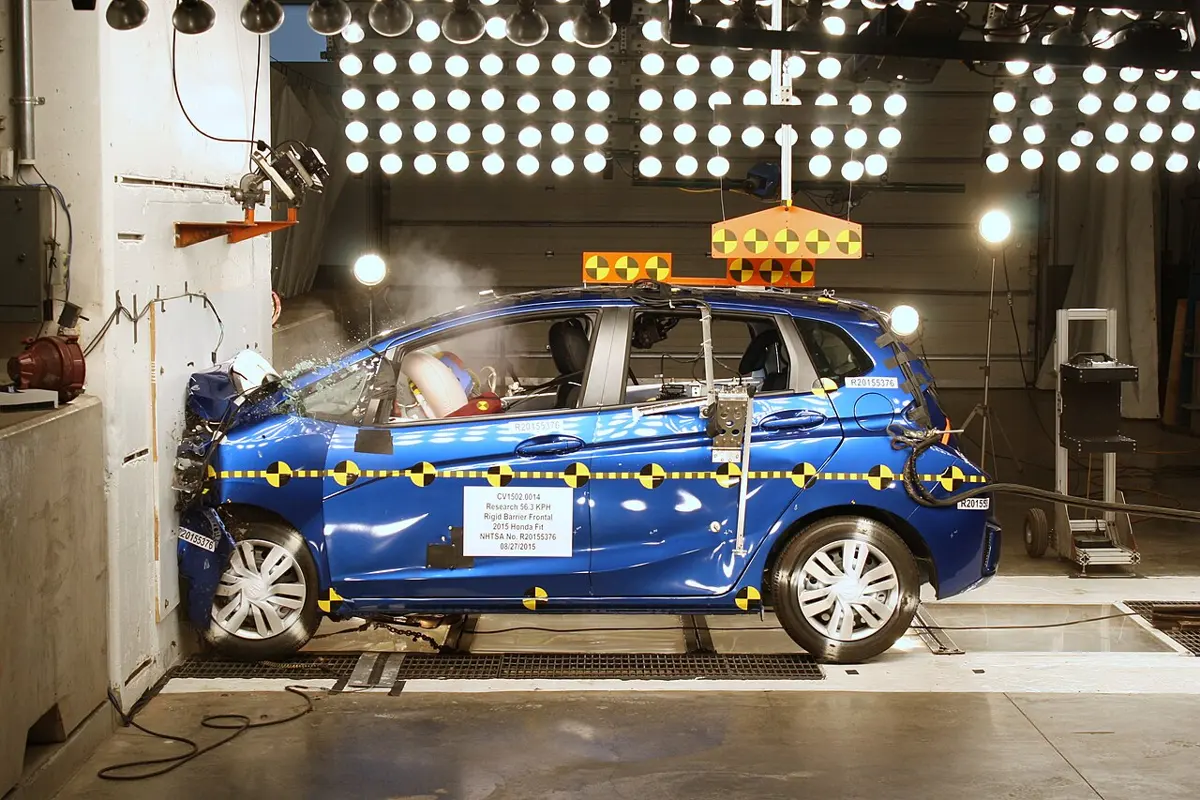
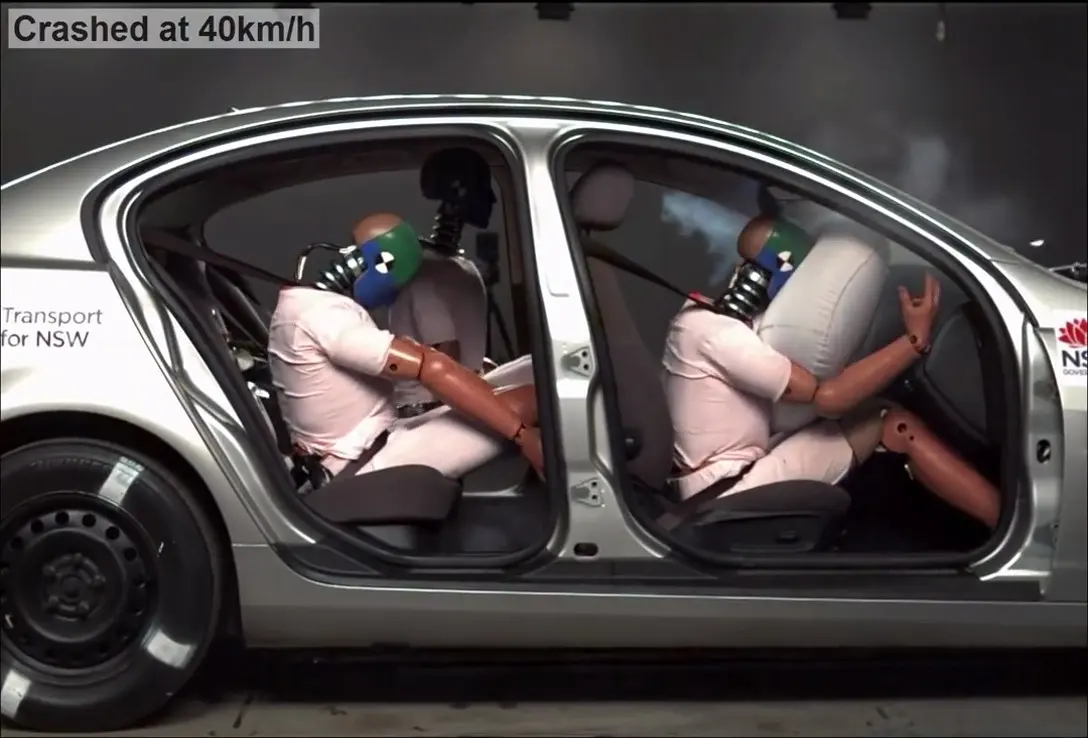
The same idea is everywhere, once you look for it. Long jumpers land in a pit of soft sand; pole vaulters and high jumpers on thick foam mats. Eggs and phones are packed in molded thermocol or cardboard. A goalkeeper’s gloves are padded; a cricket batter’s helmet is lined with foam. Gymnasium floors are sprung. A climbing rope stretches when it catches a fall, and it is made to.
Why does a car’s crumple zone make a crash safer, though it wrecks the car?
Pick an answer to see why.
How an airbag works
An airbag has to do something remarkable: fill up between your head and the steering wheel after the crash has started, but before your head gets there. The whole crash is over in about a tenth of a second.
- A sensor in the car measures how fast it is slowing down. Braking hard slows a car at about 1 g; a crash slows it at 20 g or more. Within about 15 to 30 thousandths of a second (milliseconds, ms) of the crash starting, the car’s computer decides that this is a serious crash.
- It sends an electric current to an igniter, which sets off a small charge of chemicals in the inflator. They react in a flash and make a large volume of gas: in the first airbags, sodium azide breaking up into sodium and nitrogen gas, 2NaN₃ → 2Na + 3N₂, with other chemicals added to make the sodium harmless. Most airbags today use other chemicals, such as guanidine nitrate, because sodium azide is poisonous.
- The gas fills the folded nylon bag in about 30 ms, bursting it out through the cover of the steering wheel.
- Your head, still moving forward, meets the bag. The bag has vent holes, and your head pushes the gas out through them, so the bag gives way steadily under you instead of bouncing you back like a balloon. Your head sinks in and slows down over many centimeters.
- A moment later the bag is empty and limp, so you can see and get out.
Designing for a crash
How do engineers design a helmet, or an airbag, or packing for a phone? Not by guessing once. They follow a cycle that every kind of engineer uses:
- Define the problem. What must the device do? These are its criteria: a helmet must keep the force on the head below a safe limit. What limits the design? These are its constraints: it must be light and small enough to wear, cheap enough to buy, and pass the official test.
- Imagine and plan. Think of several ways to do it, and choose one, using what you know (here: a longer stop means a smaller force).
- Build and test a model.
- Evaluate: did it meet the criteria? Where did it fail?
- Improve, changing one thing at a time, and test again.
A bicycle helmet sold in Europe must pass a test like this. A metal test head of about 5 kg, wearing the helmet, is dropped about 1.5 m onto a steel block, hitting it at 5.42 m/s. The helmet fails if the head is ever slowed down at more than 250 g, that is, if the force on it is more than 250 times its own weight.
The liner of a helmet is expanded polystyrene (EPS), the same white bubbly foam as thermocol packing. When it is pressed hard enough, its tiny bubbles collapse, and it crushes at a steady force, using up the head’s energy as it goes. It doesn’t spring back. That’s exactly what you want for a smooth stop, but it means a helmet that has been in a crash has done its job and must be replaced, even if it looks fine.
Questions
A cyclist’s helmet hit the road in a fall. It has no cracks you can see. What should she do?
Pick an answer to see why.
Two ice skaters stand still facing each other, then push apart. The 40 kg skater moves off at 3 m/s. How fast does the 60 kg skater move?
Pick an answer to see why.
A railway wagon of mass 20,000 kg moving at 3 m/s hits a wagon of 10,000 kg at rest, and they couple together.
- i.Find their velocity just after.
- ii.Find the kinetic energy before and after.
- iii.Where has the missing energy gone?
Answer
- i.Momentum before = 20,000 × 3 + 0 = 60,000 kg m/s. After, 30,000 kg moves at v: v = 60,000 ÷ 30,000 = 2 m/s, in the first wagon’s direction.
- ii.KE before = ½ × 20,000 × 3² = 90,000 J. KE after = ½ × 30,000 × 2² = 60,000 J.
- iii.30,000 J has been changed into other forms: the sound of the crash, heat in the couplings and buffers, and work done bending or squashing them. Momentum is conserved; kinetic energy isn’t.
A tennis ball of mass 0.058 kg hits a wall at 20 m/s and bounces straight back at 15 m/s. It is in contact with the wall for 0.005 s.
- i.Find its change in momentum.
- ii.Find the average force of the wall on the ball.
- iii.Why is the change in momentum bigger than if the ball had stopped dead against the wall?
Answer
Take the ball’s direction towards the wall as positive.
- i.Before: 0.058 × 20 = 1.16 kg m/s. After: 0.058 × (−15) = −0.87 kg m/s. Change = −0.87 − 1.16 = −2.03 kg m/s (away from the wall).
- ii.F = 2.03 ÷ 0.005 = 406 N, away from the wall.
- iii.The wall must first take away all the ball’s momentum towards it (1.16), and then give it new momentum the other way (0.87). Stopping dead would need only the first. A bounce is a bigger change in momentum than a stop, and so needs a bigger impulse.
A student says: “When a moving car hits a parked car, momentum is lost, because a minute later both cars are standing still.” Explain what is right and what is wrong in this.
Answer
It is right that both cars end up still, so the momentum of the two cars is gone in the end. But conservation of momentum applies only while no outside force acts on the system. During the crash itself, lasting about a tenth of a second, the forces between the cars are far bigger than friction from the road, so the total momentum just after the crash equals the total just before: the parked car is shoved forward and the moving car slowed. Afterwards, friction between the tyres and the road, an outside force, acts for a long time and takes the momentum away. It isn’t destroyed: it goes into the Earth, which has so much mass that its change in velocity is far too small to notice. If the Earth is counted as part of the system, momentum is conserved the whole time.
Two designs are proposed for a phone case. Case A is thin, hard plastic, 1 mm thick. Case B is soft silicone rubber, 3 mm thick, with thicker pads at the corners.
- i.Using momentum, explain which is likely to protect the phone better in a fall onto a stone floor.
- ii.Name two constraints a designer must also consider.
- iii.Describe a fair test to compare them.
Answer
- i.Case B. In a fall, the phone’s change in momentum is the same with either case: from its speed on landing to zero. The soft, thicker silicone squashes, so the phone takes longer to stop, and by F = Δp ÷ t the force on it is smaller. The hard 1 mm case barely squashes, so the stop is short and the force large. The corner pads matter because phones usually land on a corner.
- ii.Any two of: the case must not make the phone too thick or heavy to hold and carry; it must cost little; it must leave the buttons, camera and charging port usable; it must last for months of use; it must look good enough that people want it.
- iii.Put the same kind of phone (or a model of the same mass and shape, with an accelerometer app or a fragile part inside) in each case, and drop each from the same height, in the same way (corner first), onto the same floor, several times. Compare the damage or the peak force measured. Change only the case: everything else stays the same.
A seatbelt is made to stretch a little in a crash.
- i.Why is that safer than a belt that doesn’t stretch at all?
- ii.Why mustn’t it stretch too much?
Answer
- i.The person’s change in momentum in a crash is fixed. A belt that stretches makes the stop take a little longer, so the force on the person (F = Δp ÷ t) is smaller.
- ii.If it stretched too much, the person would move so far forward that the head or chest would hit the steering wheel, dashboard or windscreen, and be stopped by them in a very short time with a huge force, the very thing the belt is there to prevent. Like the helmet foam, the best design uses all the safe space there is, and no more.
Where to go next
- Why is spider silk so strong? A spider’s web stops a flying insect without snapping. How the shapes of molecules make a material strong, or stretchy, or both.
- Where does the energy go when a ball bounces? In a crash, momentum is kept but kinetic energy disappears. Follow the energy into heat and sound, and watch the total stay the same.
- Why is gravity so weak? The forces that push trolleys apart in a collision are electric forces between atoms. How strong they are, compared with gravity.