
In 1835 the French philosopher Auguste Comte gave an example of something people could never know. We can measure the stars’ distances and how they move, he wrote, but we will never be able to study, by any method, what they are made of. Nobody can go there, and nobody can bring a piece back.
Twenty-four years later he was proved wrong, without anyone leaving the Earth. Today we know that the Sun is about three-quarters hydrogen and a quarter helium, with a pinch of oxygen, carbon, iron and other elements. We know the same for millions of stars. Everything we know about what stars are made of came to us in their light. This topic shows how to read it.
Light is a mixture of colors
You know from Grade 10 that a prism spreads white light into a spectrum, red to violet Grade 10: Dispersion of light, and from Grade 9 that visible light is a small part of the electromagnetic spectrum Grade 9: Electromagnetic spectrum. Each color is light of a different wavelength, measured in nanometers (nm; 1 nm = 10⁻⁹ m):
| Color | Wavelength (roughly) |
|---|---|
| violet | 400–450 nm |
| blue | 450–490 nm |
| green | 490–565 nm |
| yellow | 565–590 nm |
| orange | 590–625 nm |
| red | 625–700 nm |
An instrument that spreads light out carefully enough for the wavelengths to be measured is a spectroscope. With one, you can see that not all light is the same mixture.
Three kinds of spectrum
Look at different lights through a spectroscope and you see three different kinds of spectrum.
- A hot solid gives out every color: the wire in an old light bulb, a red-hot iron rod, the glowing coils of a heater. Its spectrum is a smooth band with no gaps, a continuous spectrum. (A hot, dense gas does the same, like the gas at the surface of the Sun.)
- A hot, thin gas gives out only a few colors. Its spectrum is a few bright lines on a dark background, an emission spectrum. Each element has its own lines, at its own wavelengths, and no two elements have the same pattern.
- When the light of a hot solid passes through a cool gas on its way to you, the gas takes out exactly the colors it would give out if it were hot. The spectrum is the full rainbow with dark lines across it, an absorption spectrum, and the dark lines are in the same places as that gas’s bright lines.
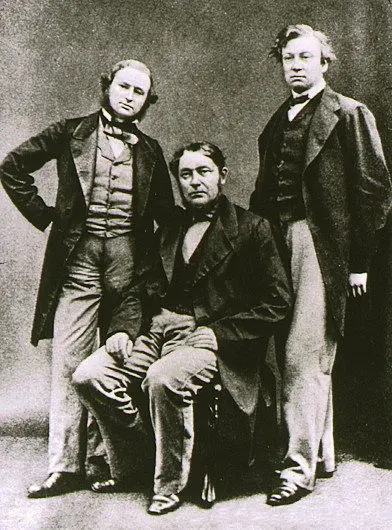
These are known as Kirchhoff’s laws of spectra, after the German physicist who worked them out in 1859. The second and third are what make chemistry from far away possible: an element’s lines are its fingerprint, or its barcode, whether they shine bright or show up dark.
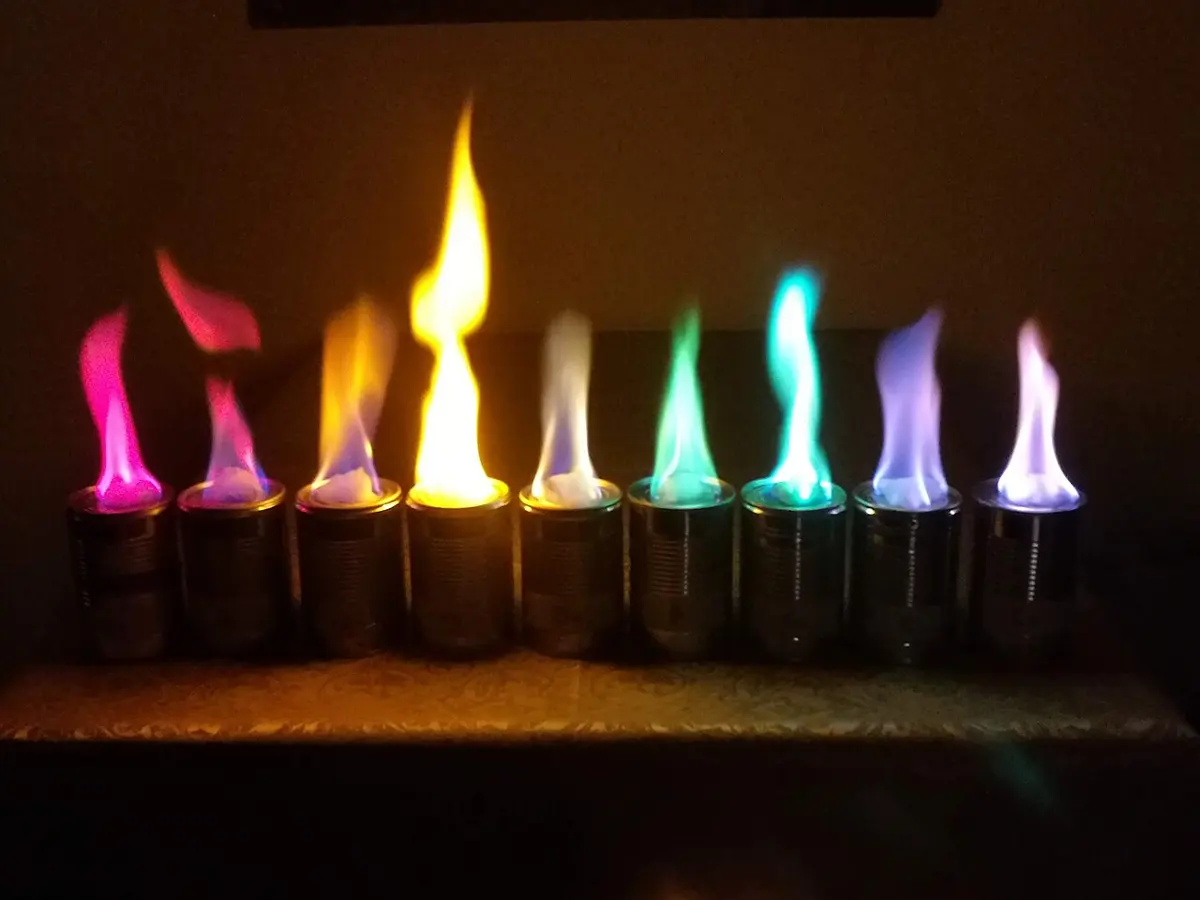
You have probably seen sodium’s fingerprint at home. When salty dal boils over onto a gas flame, the flame flashes bright yellow: that is sodium, from the salt, giving out its two yellow lines. Other metals color a flame in their own way, which is how fireworks get their colors.
A street lamp gives a yellow light. Through a spectroscope you see one bright yellow line at 589 nm, and almost nothing else. What gas is in the lamp?
Pick an answer to see why.
Why each element has its own lines
Why should a gas give out only certain colors? The answer is inside its atoms.
You learned in Grade 9 that an atom’s electrons are in shells, and that the shells have different energies: the farther from the nucleus, the more energy. An electron can be in one shell or another, but never in between. So an electron in an atom can only have certain amounts of energy, called its energy levels, like the steps of a staircase: you can stand on a step, but not halfway between two.
When a gas is heated, or electricity passes through it, its atoms are knocked about and some electrons are pushed up to higher levels. They don’t stay there. Within a tiny fraction of a second each one drops back down, and gives out the energy it loses as a little packet of light, a photon.
The photon’s energy is exactly the difference between the two levels. And the energy of a photon decides its color. The German physicist Max Planck found in 1900 that the energy of light comes in packets of
where f is the light’s frequency, λ its wavelength, c the speed of light (3.00 × 10⁸ m/s) and h a tiny number called Planck’s constant, 6.63 × 10⁻³⁴ J s. So more energy means a higher frequency and a shorter wavelength: a violet photon carries more energy than a red one.
Every atom of hydrogen has the same staircase, so every hydrogen atom can only make the same few drops, and give out the same few colors. Other elements have different staircases, and so different colors. That is the fingerprint.
The same staircase explains the dark lines. A cool hydrogen atom has its electron on a low step. Light of every color passes by, and the atom can only take a photon whose energy exactly fits one of its jumps up. So it takes exactly the colors it would give out coming down, and those colors go missing from the light that reaches you.
The barcode in sunlight
In 1814 the German glassmaker Joseph von Fraunhofer was testing the glass for telescope lenses. Looking at sunlight through a prism and a small telescope, he saw that the Sun’s rainbow was crossed by dark lines, hundreds of them. He mapped 574 of them, and labeled the strongest with letters, A to K. He had no idea what they were.
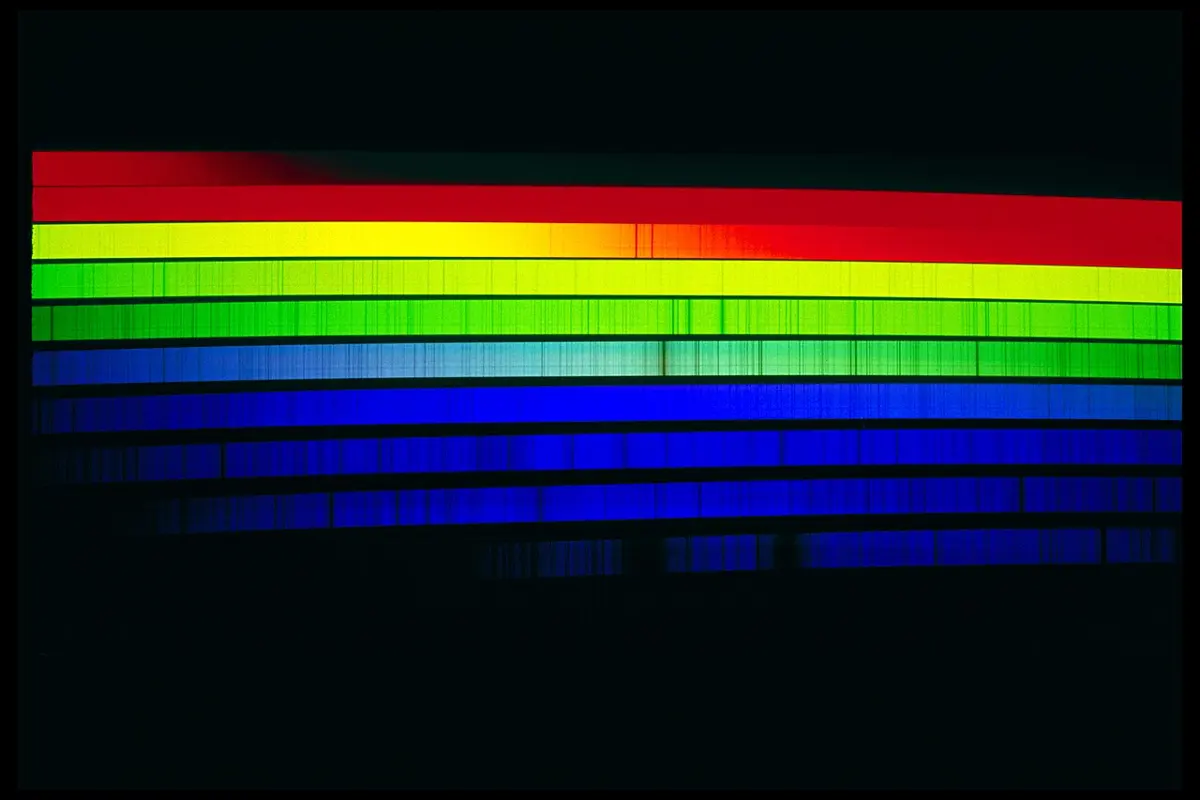
In 1859 Kirchhoff solved the puzzle. He noticed that two dark lines in the yellow, Fraunhofer’s D lines, were exactly where sodium’s two bright yellow lines are. Then he passed sunlight through a sodium flame, expecting the flame’s yellow light to fill the gaps in. Instead, the dark lines grew darker. The cooler sodium in the flame was taking out the same colors.
So the Sun’s dark lines are absorption lines. The Sun’s hot, dense surface gives out a continuous spectrum, and the cooler gas above it takes out the colors of the elements it contains. Sodium is in the Sun. So, Kirchhoff found, are iron, calcium, magnesium and others: elements we know on Earth, in the Sun, 150 million kilometers away.
Now it’s your turn to read a star.
Where do the dark lines in a star’s spectrum come from?
Pick an answer to see why.
Reading the stars
By 1900 astronomers had photographed the spectra of hundreds of thousands of stars, and sorted them by the pattern of their lines. Some showed very strong hydrogen lines, others weak ones; some showed helium, most didn’t. Most astronomers thought the differences showed what the stars were made of, and that stars were made of much the same mix as the Earth’s rocks, iron and all.

A star’s spectrum tells us more than what it is made of:
- Its temperature, from which lines are strong, and from its color (the colors of stars, red to blue, from Grade 9).
- How it moves. If a star moves towards us or away, all its lines shift a little, towards blue or towards red. That shift is how we know the universe is expanding: the next topic.
- Whether it has a hidden partner. A star with an unseen planet or star going round it wobbles, and its lines shift back and forth.
Make a spectroscope

Questions
A star’s spectrum shows strong hydrogen lines but no helium lines. What can you say about helium in the star?
Pick an answer to see why.
Why does a light bulb’s filament give a continuous spectrum, but a tube of hot hydrogen gives only four bright lines?
Answer
In a thin gas, the atoms are far apart, and each gives out light on its own, only in the drops its electrons can make between their fixed energy levels: so only a few wavelengths, hydrogen’s four visible lines. In a hot solid, the atoms are packed tightly and jostle each other, so their energy levels are smeared out and the light is given out at every wavelength: a continuous spectrum.
Explain why the dark lines of an element in an absorption spectrum are at exactly the same wavelengths as the bright lines in its emission spectrum.
Answer
Both come from the same jumps between the same energy levels. When an electron drops from a higher level to a lower one, the atom gives out a photon whose energy is the difference between the levels. When an electron is on the lower level, the atom can absorb only a photon with exactly that energy, to jump up. Equal energies mean equal wavelengths (E = hc/λ), so the colors taken out of the light are the same as the colors a hot gas of that element gives out.
Hydrogen’s violet line has a wavelength of 410.2 nm. Calculate (i) its frequency and (ii) the energy of one photon of it. (iii) Is this more or less energy than a photon of hydrogen’s red line, 3.03 × 10⁻¹⁹ J? Why?
Answer
- i.f = c ÷ λ = 3.00 × 10⁸ ÷ (410.2 × 10⁻⁹) = 7.31 × 10¹⁴ Hz.
- ii.E = hf = 6.63 × 10⁻³⁴ × 7.31 × 10¹⁴ = 4.85 × 10⁻¹⁹ J.
- iii.More: violet light has a shorter wavelength, so a higher frequency, and a photon’s energy is proportional to its frequency. In the atom, the violet line comes from the biggest drop of the four, from level 6 to level 2.
How was helium discovered in the Sun before it was found on Earth?
Answer
During the total eclipse of the Sun on 18 August 1868, seen from India, astronomers looked at the glowing gas around the edge of the hidden Sun through spectroscopes. They saw a bright yellow line at 587.6 nm that matched the lines of no known element; it was near sodium’s yellow lines, but not on them. Norman Lockyer concluded that it came from a new element and named it helium, after the Greek helios, the Sun. It was found on Earth only in 1895, by William Ramsay.
The Sun is about 150 million kilometers away and nobody has taken a sample of it. Explain, step by step, how we know there is sodium in it.
Answer
- Sodium heated in a flame in a laboratory gives out two bright yellow lines, at 589.0 and 589.6 nm: its fingerprint.
- Sunlight spread out by a spectroscope shows dark lines at exactly 589.0 and 589.6 nm (Fraunhofer’s D lines).
- A cool gas takes out of light exactly the wavelengths it gives out when hot (Kirchhoff showed this by passing sunlight through a sodium flame: the D lines grew darker).
- So the D lines are made by sodium in the cooler outer layers of the Sun, taking those colors out of the light from the hot surface below.
Where to go next
- How do we know the universe is expanding? The lines in the light of distant galaxies are all shifted towards red. How that tells us the galaxies are moving away, and the universe is growing.
- How do we find planets around other stars? The wobble in a star’s lines is one of the ways astronomers have found thousands of them.
- Where did the atoms in your body come from? The stars are mostly hydrogen and helium. So where did the carbon, oxygen and calcium in you come from?