
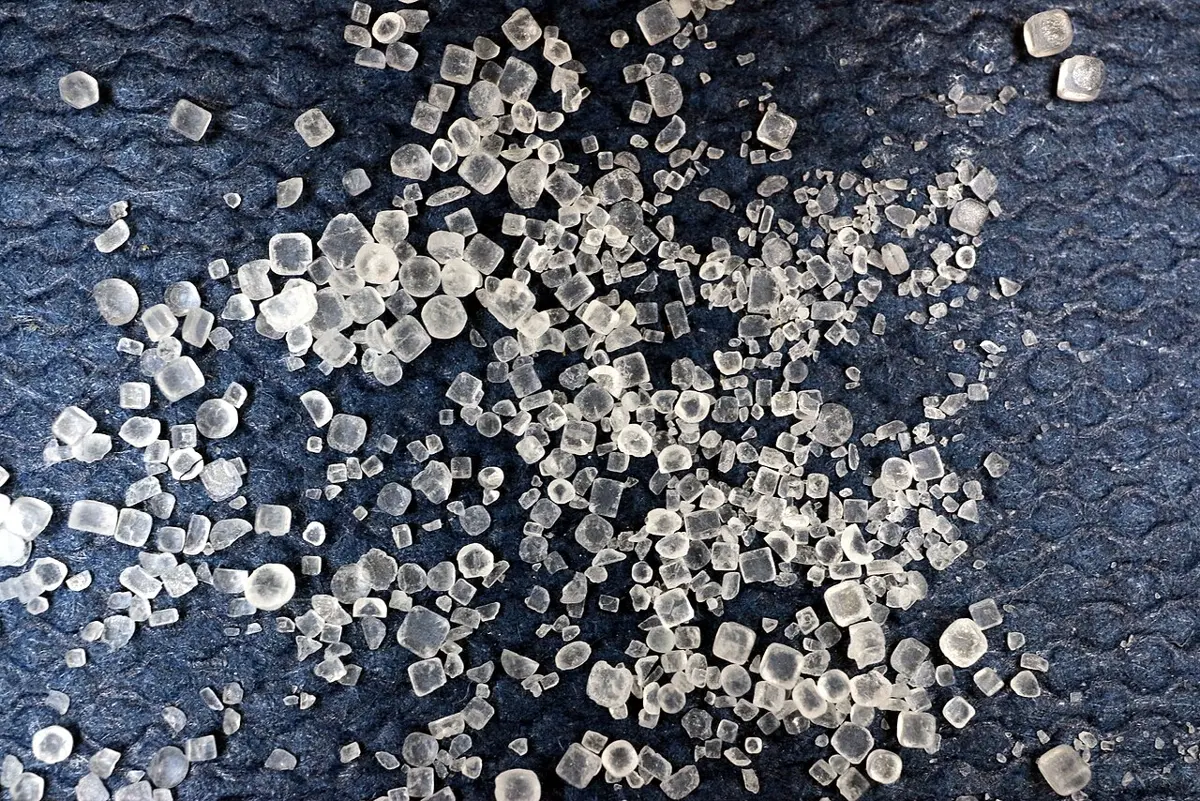
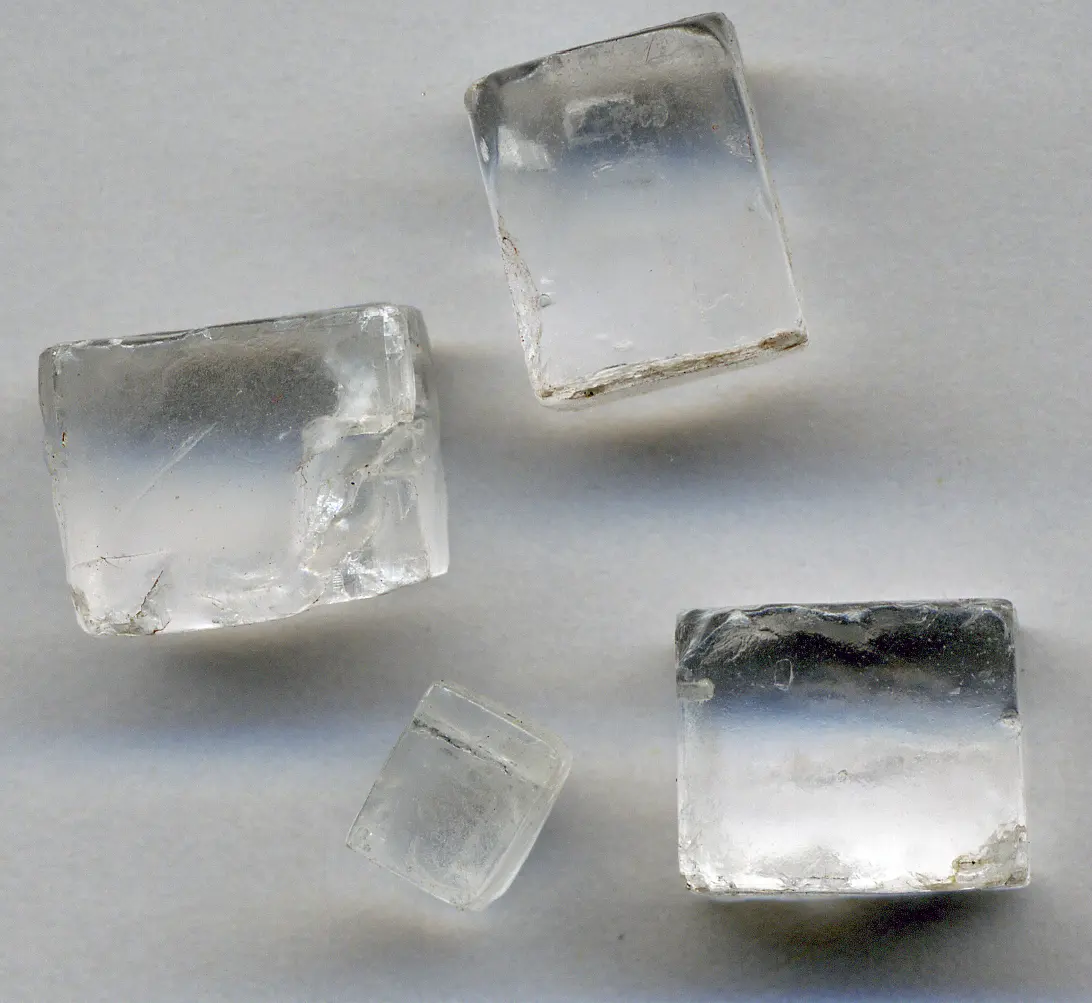
Tip a little salt (nun) from the kitchen onto a dark plate and look at it closely, with a magnifying glass if you have one. Every grain is a tiny cube, or a broken piece of one. Nobody cut them that way. Why should salt grow in cubes?
You know salt’s formula, NaCl, and water’s, H₂O. A formula is a list: which atoms, and how many of each. But a list doesn’t tell you how the atoms hold on to each other, or what shape they make. For that, scientists build models. In this topic you will build molecules yourself, turn them round to see their shapes, and then find out why salt is not made of molecules at all, but of one endless grid that grows in cubes.
What a formula tells you
In Grade 7 you met atoms, and compounds such as water and salt, in which atoms of different elements are joined in a fixed ratio. In Grade 8 you learned that a molecule is two or more atoms joined together, and that its molecular formula says which atoms are in it and how many of each Grade 8: Molecular formula. H₂O: two hydrogen atoms and one oxygen atom.
A formula is like the list of parts on the box of a toy. It tells you what is inside, but not how the parts fit together. Does the oxygen sit between the two hydrogens, or at one end, H–H–O? Is the molecule straight, or bent? Flat, or a 3-D shape? The formula can’t say.
Sometimes two quite different substances even have the same formula. Ethanol, the alcohol in hand sanitizer, and a gas called dimethyl ether are both C₂H₆O: two carbon atoms, six hydrogen atoms, one oxygen atom. Ethanol is a liquid that boils at 78 °C; dimethyl ether is a gas that boils at −24 °C. Same parts, different molecules. The difference is in how the atoms are joined, and to see that, you need a model.
A model in science is a simpler copy of something, made to help us think about it, explain it and make predictions. A globe is a model of the Earth; a map is another. Atoms are far too small to see (a water molecule is about 0.3 nanometers across, and you could line up more than 3 million of them across one millimeter), so models are how chemists “see” molecules.
The formula of glucose, the sugar in your blood, is C₆H₁₂O₆. What does the formula tell you?
Pick an answer to see why.
Four ways to show a molecule
Chemists show molecules in several ways. Each shows something the others don’t (Figure 1.2).
- The molecular formula, H₂O, lists the atoms.
- A structural formula draws a line between each pair of atoms that are joined: H–O–H. Each line is a bond, the link that holds two atoms together. Now you can see that the oxygen is in the middle, and each hydrogen is joined only to the oxygen.
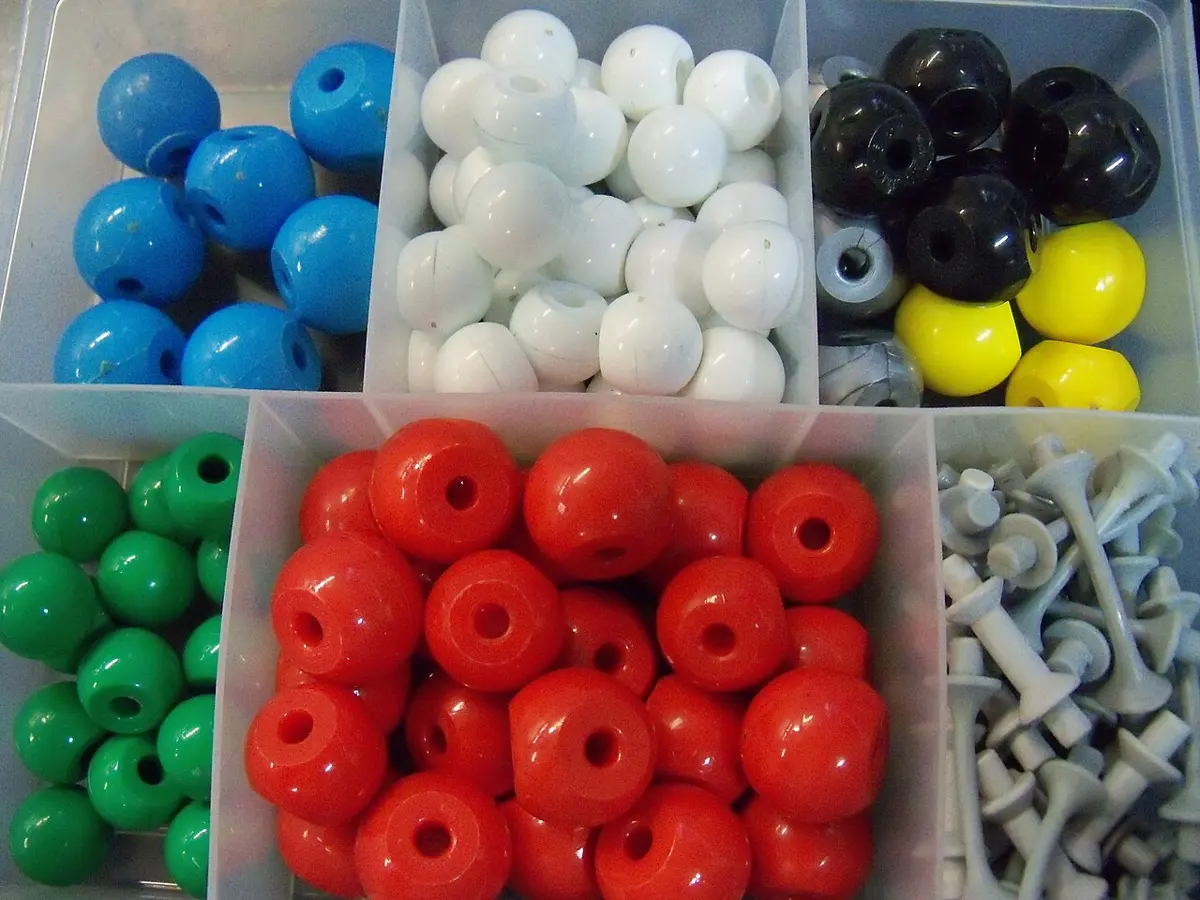
- A ball-and-stick model shows each atom as a ball and each bond as a stick, in three dimensions, at the right angles. It shows the molecule’s shape: water is bent, like a wide V.
- A space-filling model shows how much room the atoms take up. The atoms overlap where they are joined, and the molecule looks like a round head with two ears. This is closer to what the molecule is “like”, but the bonds are hidden inside.
Nearly all model kits use the same color code: hydrogen white, carbon black, oxygen red, nitrogen blue, chlorine green. The colors are only a code. A real atom has no color at all: it is thousands of times smaller than the waves of light, so light can’t show it.
You want to show a friend that a water molecule is bent at 104.5°, and which atom is joined to which. Which is the best choice?
Pick an answer to see why.
How many hands?
To build a molecule, you need one rule. In Grade 8 you met an atom’s valency: the number of “hands” it has for joining with other atoms Grade 8: Valency. In a molecule, each hand holds one end of a bond. So an atom makes as many bonds as it has hands:
| Atom | Hands (bonds it makes) |
|---|---|
| hydrogen, H | 1 |
| chlorine, Cl | 1 |
| oxygen, O | 2 |
| nitrogen, N | 3 |
| carbon, C | 4 |
In the molecules in this topic, and in most you will meet, every hand is used, and every bond uses two hands, one from each atom it joins. Two atoms can also hold each other with two hands each (a double bond, drawn =) or three (a triple bond, ≡).
That one rule decides how a formula’s atoms can join. Take water, H₂O. Each hydrogen has only one hand, so a hydrogen can never be in the middle, holding two atoms. Oxygen has two hands: it must be in the middle, holding one hydrogen in each. H–O–H is the only way.
C₂H₆O is the puzzle from the start of the topic. In ethanol, the two carbons hold each other, and the oxygen sits at one end with a hydrogen: CH₃–CH₂–O–H. In dimethyl ether, the oxygen sits between the two carbons: CH₃–O–CH₃ (Figure 1.5). The same nine atoms, joined in two different ways, make two different substances. Two compounds with the same formula but different structures are called isomers. Only a model can tell them apart.
A student draws water as H–H–O. What is wrong with it?
Pick an answer to see why.
Molecules have shapes
A structural formula is flat, because paper is flat. Real molecules are 3-D. Why should they have particular shapes?
The bonds around an atom push each other away, so they spread out as far apart as they can. Try it with your own hands: hold two pencils in one fist and spread them as far apart as you can; they point in opposite directions, in a straight line. With four, they point to the four corners of a pyramid with a triangle for its base: a tetrahedron. That is the shape of methane, the gas in biogas: its four hydrogens point to the corners of a tetrahedron, every bond at 109.5° from every other. A carbon atom with four single bonds always spreads them this way.
Water is bent, at 104.5°, not straight, because the oxygen has two pairs of electrons of its own, not in bonds, which push the two bonds down (Grade 9 explains these “lone pairs”). Ammonia is a low pyramid, a nitrogen on top of three hydrogens like the legs of a stool. Carbon dioxide, with its two double bonds and nothing else round the carbon, is straight.
| Molecule | Formula | Shape | Angle between bonds |
|---|---|---|---|
| water | H₂O | bent | 104.5° |
| carbon dioxide | CO₂ | straight | 180° |
| ammonia | NH₃ | low pyramid | 107° |
| methane | CH₄ | tetrahedron | 109.5° |
Shape matters. Because water is bent, its oxygen end and its hydrogen end are different, and water molecules stick to each other more strongly than straight molecules would. That is one reason water is a liquid at room temperature while carbon dioxide, a heavier molecule, is a gas.
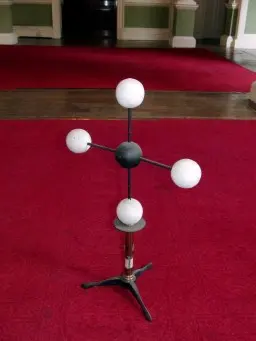
A model of methane has its four hydrogens in a flat cross around the carbon, at 90° to each other. What is wrong with it?
Pick an answer to see why.
Not everything is made of molecules
Water is made of molecules. A glass of water holds a huge number of separate H₂O molecules, each one a little group of three atoms, sliding past each other. Pour some out, boil it, freeze it: each molecule stays a group of three.
Salt is different. In Grade 9 you will learn that when sodium and chlorine join, the sodium atoms each give an electron to a chlorine atom, so they become charged particles called ions: sodium ions (Na⁺) and chloride ions (Cl⁻). Opposite charges pull on each other, and every ion pulls on all the ions near it. So the ions don’t pair off. They pack together into a grid, sodium, chloride, sodium, chloride, in every direction, like the squares of a chessboard in three dimensions (Figure 1.8).
Inside a salt crystal, each sodium ion touches six chloride ions: above, below, left, right, in front and behind. And each chloride ion touches six sodium ions. No sodium ion belongs to one chloride ion more than to any other, so there is no NaCl molecule. The whole grain is one piece, and the grid carries on until the grain ends. A structure like this, a pattern of atoms or ions repeated over and over in every direction, is called an extended structure (or a giant structure).
So what does NaCl mean? For salt, the formula gives the ratio: for every sodium ion there is one chloride ion. It doesn’t mean pairs.
And the cubes? The grid of ions is built of cubes, so a crystal that grows slowly, adding ions to its faces, grows as a cube too. The cube you see in a grain of salt is the shape of the grid, carried on for about a million ions along each edge.
Why is there no such thing as a single molecule of salt?
Pick an answer to see why.
Networks of atoms: diamond and sand
Atoms can make extended structures by sharing bonds too, not only ions. Then the whole crystal is one huge network of atoms, each joined to its neighbors by bonds like the ones in a molecule.
Diamond is pure carbon. Each carbon atom is joined to four other carbon atoms, its four bonds pointing to the corners of a tetrahedron, exactly as in methane. But every one of those four neighbors is joined to four carbons too, and so on, through the whole stone. There are no separate molecules: a diamond is in a sense one giant molecule. To scratch it, you would have to break bonds, and the bonds run in every direction: there are no weak layers to slide apart. That is why diamond is the hardest natural substance.
Graphite, the “lead” in your pencil, is also pure carbon, but each atom is joined to only three others, in flat sheets of hexagons, like chicken wire. The sheets lie on top of each other, held only weakly, and slide off onto your paper as you write. Same atoms, different arrangement, completely different stuff (more in Grade 9: Diamond, graphite and fullerene).
Sand is mostly quartz, made of silicon and oxygen, and it is a network too. Each silicon atom is joined to four oxygen atoms, at the corners of a tetrahedron. Each oxygen atom is joined to two silicon atoms, linking the tetrahedra together in every direction. The formula SiO₂ again gives only a ratio. You can work it out from the model.
Which of these is not an extended structure?
Pick an answer to see why.
Build your own models
Questions
How many atoms are in one molecule of sulphuric acid, H₂SO₄?
Pick an answer to see why.
Which model would best show how much space a molecule takes up?
Pick an answer to see why.
In a crystal of salt, each sodium ion is surrounded by…
Pick an answer to see why.
Hydrogen sulphide, H₂S, is the gas that smells of rotten eggs. In H₂S, sulphur, like oxygen, has 2 hands.
- i.How many bonds does a molecule of H₂S have?
- ii.Draw its structural formula.
- iii.Predict its shape. Which molecule in this topic is it most like?
Answer
- i.Hands: 2 × 1 + 2 = 4, so 4 ÷ 2 = 2 bonds.
- ii.H–S–H: sulphur, with two hands, in the middle; each hydrogen holds only the sulphur.
- iii.It is most like water, H–O–H, with sulphur in place of oxygen, so it should be bent. (It is, at about 92°.)
Hydrogen peroxide, H₂O₂, is used to clean wounds. Use the hands of each atom to work out its structural formula. Why can’t it be H–O–H with the second oxygen joined to the hydrogen?
Answer
Hands: 2 × 1 + 2 × 2 = 6, so 3 bonds. Each hydrogen can hold only one atom, so the hydrogens must be at the ends, and the two oxygens in the middle, joined to each other: H–O–O–H. Each oxygen then has 2 bonds (one to H, one to O), and each hydrogen 1.
In H–O–H with the other oxygen on a hydrogen, that hydrogen would hold two atoms with only one hand, and the oxygen at the end would have a free hand. So it can’t be joined that way.
Ethanol and dimethyl ether are both C₂H₆O.
- i.Draw the structural formula of each.
- ii.Explain how two different substances can have the same formula.
- iii.What is the name for such compounds?
Answer
- i.Ethanol: H₃C–CH₂–O–H, the two carbons joined, the oxygen between a carbon and a hydrogen. Dimethyl ether: H₃C–O–CH₃, the oxygen between the two carbons. (In full, every C has four bonds: three or two to H, and the rest to C or O.)
- ii.A formula only lists the atoms. The same atoms can be joined in different orders, giving molecules of different shapes, and molecules of different shapes behave differently: ethanol is a liquid that boils at 78 °C, dimethyl ether a gas that boils at −24 °C.
- iii.Isomers.
Explain the difference between a substance made of molecules and an extended structure. Give two examples of each.
Answer
In a substance made of molecules, the atoms are joined into small, separate groups, all the same, and each group (molecule) is held to the others only weakly: water (H₂O), carbon dioxide (CO₂), methane, sugar. Its formula gives the atoms in one molecule.
In an extended structure, the atoms or ions are joined in one pattern that repeats in every direction through the whole crystal, with no separate groups: salt (a grid of Na⁺ and Cl⁻ ions), diamond (a network of carbon atoms), quartz (SiO₂). Its formula gives only the ratio of the atoms or ions.
A student builds a model of salt with 50 sodium balls and 50 chlorine balls, glued together in pairs, and the pairs piled in a jar. Explain what is wrong with the model, and how to make it better.
Answer
The ratio, 1 : 1, is right, but salt is not made of pairs. In a real crystal, each sodium ion is surrounded by six chloride ions, all equally close, and each chloride ion by six sodium ions, in a regular grid (like a 3-D chessboard) that carries on through the whole crystal. A pile of loose pairs would also fall apart easily, but a salt crystal is hard.
A better model: join the balls into a cube, alternating sodium and chlorine in every row, column and layer, so that each ball has the other kind on all sides. (With 4 balls along each edge, that uses 32 of each.)
In rutile, a form of titanium dioxide (the white in most white paint), each titanium ion touches 6 oxide ions, and each oxide ion touches 3 titanium ions. Use this to show that its formula is TiO₂.
Answer
Take 100 titanium ions. Each touches 6 oxide ions: 100 × 6 = 600 titanium–oxide contacts. Each oxide ion has 3 of these contacts, so there are 600 ÷ 3 = 200 oxide ions. 100 titanium to 200 oxide is 1 : 2: TiO₂.
Diamond and graphite are both made only of carbon atoms. Use models of their structures to explain why diamond is very hard and graphite soft.
Answer
In diamond, every carbon atom is joined by strong bonds to four others, pointing in all directions, so the whole crystal is one rigid 3-D network. To scratch or break it, you must break bonds, whichever way you push, which is very hard.
In graphite, each carbon atom is joined strongly to only three others, in flat sheets. The sheets are held to each other only weakly, so they slide over each other and peel off easily: that is why graphite feels soft and slippery and leaves a mark on paper.
Same atoms, different arrangement, different properties.
Where to go next
- Where Does Plastic Come From? Plastics are made of giant molecules, chains of thousands of atoms built from small ones. How chemists make them from oil and gas.
- Where Does the Heat Go When Ice Melts? What the molecules of water do as ice melts and water boils, and why the temperature stops rising while it happens.
- Can You Make a Hand Warmer? When atoms come apart and join up in new ways, energy goes in or comes out. Design something that uses it. Can You Make a Hand Warmer?