
Laser cooling: slowing atoms with light
Nobel Prize in Physics, 1997: Steven Chu, Claude Cohen-Tannoudji, and William D. Phillips

Steven Chu
born 1948 in the United States
A model-builder as a child, he made the first “optical molasses” at Bell Labs and later served as the United States Secretary of Energy.
Photo: Department of Energy, Public domain
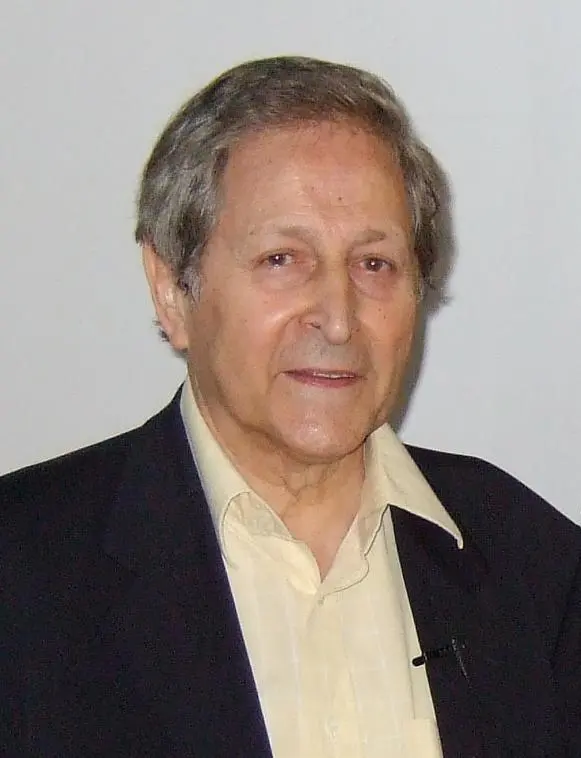
Claude Cohen-Tannoudji
born 1933 in Algeria
A theorist and experimenter in Paris who explained why the atoms got colder than anyone thought possible, and then made them colder still.
Photo: Amir Bernat, CC BY-SA 4.0

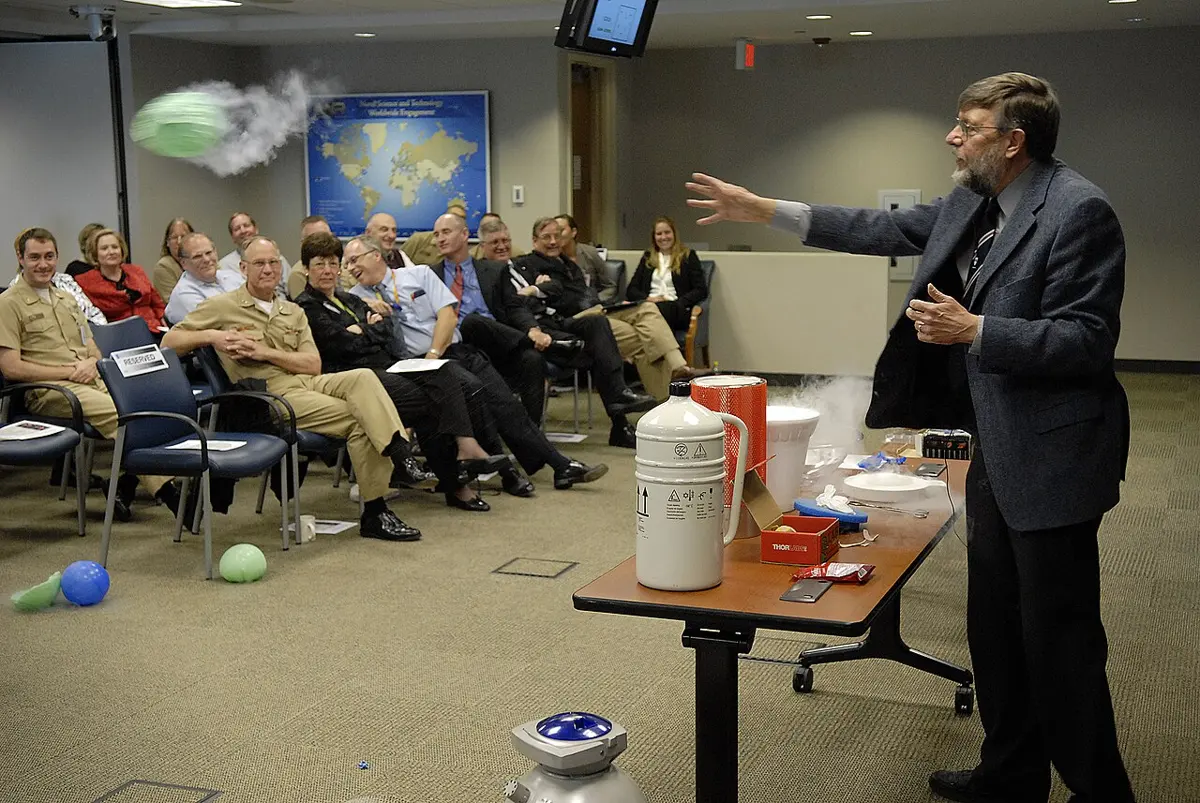
William D. Phillips
born 1948 in the United States
A cheerful government scientist who first stopped a beam of atoms with light, and loves showing school students what cold can do.
Sit still in a quiet room. The air around you seems calm, but it isn’t. Its molecules are rushing about at about 500 meters per second, faster than a passenger jet, each one crashing into another about a billion times every second. Every gas is like this. Its atoms never sit still long enough to be studied one by one.
To slow atoms down, you must cool them, because temperature is a measure of how fast the particles of a thing are moving (particles that never stop). In the 1980s, three physicists found a way to cool atoms with something that seems to do the opposite: laser light. They slowed atoms to a few centimeters per second, a millionth of a degree above the coldest possible temperature. For this, Steven Chu, Claude Cohen-Tannoudji and William Phillips shared the 1997 Nobel Prize in Physics.
The problem: atoms that won’t keep still
Why would anyone want slow atoms? Atoms give out and take in light of exact colors, as if each kind of atom had its own fingerprint. Measuring those colors very precisely tells us how atoms are built, and it is how the most accurate clocks keep time. But a fast atom is a poor subject:
- It flies out of the place you are looking at in a fraction of a second.
- Its movement changes the color of the light it takes in, so the fingerprint looks smeared.
The obvious answer is to cool the gas. Cool it enough, though, and something else happens: the gas turns into a liquid, and then a solid. In a liquid or solid the atoms are packed together and pull on one another, and you can no longer study single atoms. The physicists wanted something strange: a gas of atoms, far apart from each other, but almost standing still.
Even near the bottom of the temperature scale, atoms are not slow. At −270 °C, just three degrees above absolute zero (−273.15 °C, the temperature at which particles would have the least possible energy), atoms of a gas still move at hundreds of kilometers per hour. Only within a millionth of a degree of absolute zero do they slow to a walking pace or less Grade 10: temperature and the kelvin. Temperatures this low are measured in microkelvin (µK): millionths of a degree above absolute zero.
How light can push an atom
Light is a wave, but it also comes in tiny packets of energy called photons (Einstein’s packets of light). A photon has no mass, but it still carries a little momentum, a push in the direction it travels. When an atom swallows a photon, it takes the photon’s push.
Think of a carrom board. If you flick the striker into a coin rolling towards it, the coin slows down. A photon hitting an atom head-on does the same, only far more gently: one photon changes a sodium atom’s speed by about 3 cm/s, while the atom may be moving at hundreds of meters per second.
The trick is to do it again and again, very fast:
- The atom swallows a photon coming towards it, and is pushed backwards, against its motion.
- About a hundred-millionth of a second later, the atom gives out a photon. That gives it a small kick too, but in a random direction.
- It swallows the next photon from the beam, and the next.
Over thousands of photons, the random kicks of step 2 cancel out (they point every way), but the pushes of step 1 all point the same way. The atom slows down. In a strong laser beam, the push can be about 100,000 times stronger than gravity on Earth.
There is a catch. An atom swallows a photon only if its color is exactly right, matching a jump between two of the atom’s energy levels, like a key in a lock Grade 9: shells and their energy. And a moving atom “sees” light slightly changed in color, by the Doppler effect.
You know the Doppler effect from sound. A bus sounding its horn as it comes towards you sounds higher-pitched than when it drives away (the Doppler effect). In the same way, an atom moving towards a laser sees its light slightly bluer, with a higher frequency, than it really is.
So physicists tune the laser slightly redder (a lower frequency) than the color a still atom would swallow. Then:
- an atom moving towards the laser sees the light shifted bluer, back to just the right color: it swallows photons and is slowed;
- an atom moving away from the laser sees it even redder: it hardly swallows any, so it is not pushed faster.
Why is the laser tuned slightly redder than the color a still atom absorbs?
Pick an answer to see why.
Why it was hard
The idea of cooling atoms with lasers was put forward in 1975, by two pairs of physicists in the United States. Making it work took ten more years, because:
- The atom drops out of tune. As the atom slows down, the Doppler shift gets smaller, and the light no longer has the right color for it. The slowing stops.
- One beam only pushes one way. A single beam can slow atoms flying along it, but atoms move in every direction.
- Slow atoms fall. An atom moving at a few centimeters per second falls out of the laser beams under gravity within about a second, unless something holds it.
- Measuring was hard. How do you take the temperature of a tiny cloud of atoms in a vacuum? You cannot put a thermometer in it.
What they did, step by step
Phillips: stopping a beam of atoms (early 1980s)
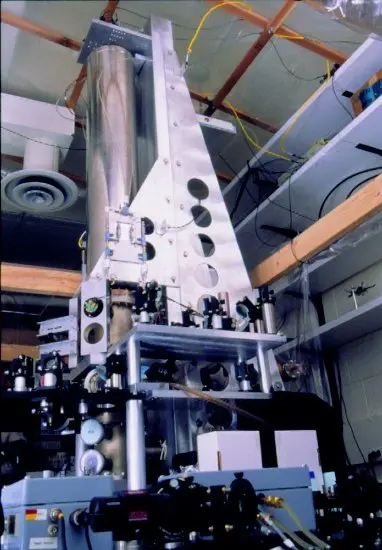
William Phillips worked at the United States’ national laboratory for measurement, now called NIST, near Washington. He sent a beam of sodium atoms, fast as bullets, down a long tube, against a laser beam coming the other way.
- Keeping the atoms in tune. To stop the atoms falling out of tune as they slowed, Phillips wound a coil round the tube with a magnetic field that changed along its length. A magnetic field shifts an atom’s energy levels a little. As each atom slowed, the field shifted its levels by just the right amount to keep it swallowing photons. This device is called a Zeeman slower.
- Atoms brought to a stop. By the middle of the 1980s, his team could slow atoms to a stop, and in 1985 they caught them in a trap made of magnets alone.
Chu: optical molasses (1985)
Steven Chu worked at Bell Laboratories in New Jersey, in the United States. He solved the problem of direction.
- Six beams. Chu crossed six laser beams: one pair facing each other along each of the three directions (left–right, front–back, up–down). All were tuned slightly red.
- Nowhere to go. Whichever way an atom moved, it ran into a beam it saw in tune, and was pushed back. Where the beams crossed, the atoms moved as if stuck in thick syrup. Chu called it optical molasses (molasses is a thick, dark syrup made from sugar cane).
- A glowing pea. Sodium atoms, first slowed by another laser, drifted into the crossing. There they formed a glowing cloud about the size of a pea, about a million atoms, at about 240 µK. Their speed was only about 30 cm/s, slower than you walk.
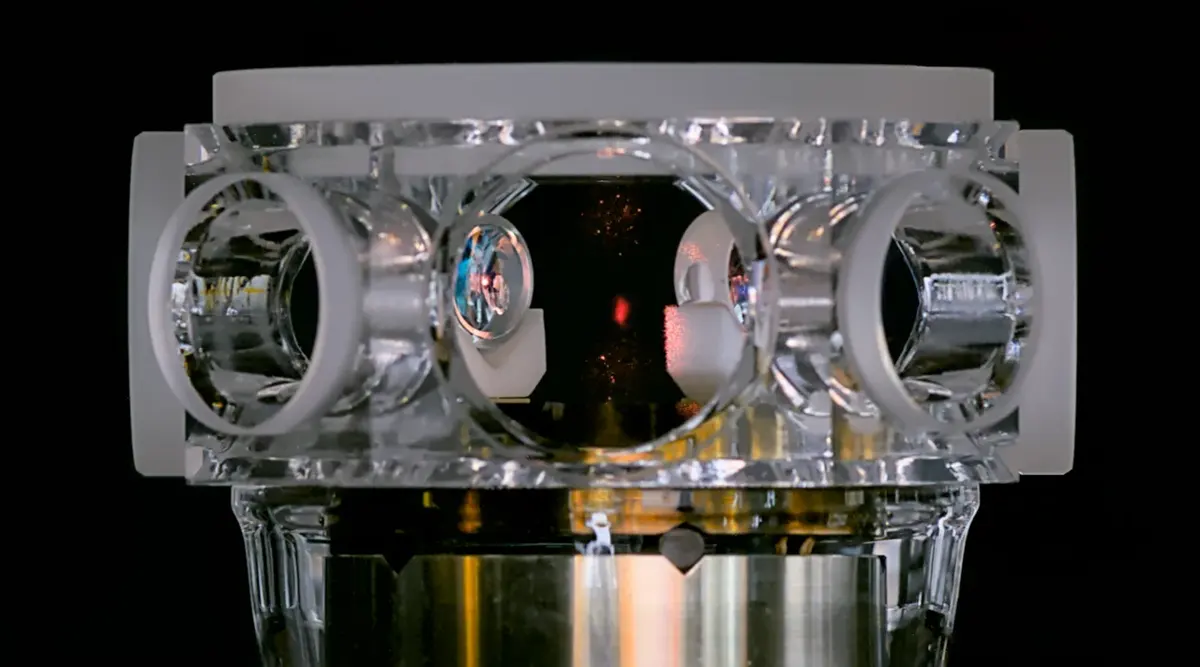
But molasses only slows atoms; it does not hold them. They still fell out in about a second. In 1987, Chu and others added two magnetic coils round the crossing, which made a force pulling the atoms towards the middle. This magneto-optical trap catches atoms and holds them for many seconds. It is now the first step of almost every cold-atom experiment in the world.
Phillips again: colder than possible (1988)
There was a theory for how cold molasses could get. As atoms get slower, the random kicks from the photons they give out keep shaking them, and the theory said this would stop the cooling at a certain temperature, the Doppler limit. For sodium it was about 240 µK, just what Chu had measured.
Phillips decided to check. He measured the temperature in a new way: he switched off the lasers, let the cloud of atoms fall, and timed how they arrived at a probe laser beam below. Fast atoms spread out quickly; slow atoms arrive together.
In 1988 his team found the atoms were at about 40 µK, six times colder than the limit. This almost never happens in physics: an experiment had worked better than the theory said it could. Phillips checked and rechecked, because results like this are usually mistakes. It was real.
In 1988 Phillips found the atoms in optical molasses were six times colder than the theory allowed. What did this show?
Pick an answer to see why.
Cohen-Tannoudji: Sisyphus, and the dark atoms (1988–1995)
Claude Cohen-Tannoudji and his group at the École Normale Supérieure in Paris, including Jean Dalibard, had been studying how atoms and light act on each other, on paper and in the laboratory. They found the explanation.
- Uphill all the way. The old theory treated the atom as having just two energy levels. A real sodium atom has several close together, and the crossing laser beams make these levels rise and fall in hills and valleys every half wavelength of light. An atom moving through them keeps climbing hills, losing energy as it climbs. Just at the top, it is most likely to swallow a photon that drops it into a valley of the other level, and it must climb again. The Greek myth tells of Sisyphus, punished by having to roll a stone up a hill forever, so this is called Sisyphus cooling.
- A new limit. Even so, every photon an atom gives out kicks it a little. For the lightest atoms this sets a limit called the recoil limit. Working with Phillips’s team, Cohen-Tannoudji’s group cooled cesium atoms to about 2 µK in molasses.
- Below the recoil limit. Then Cohen-Tannoudji’s group found a way round even that. With carefully arranged beams, the slowest atoms fall into a dark state, in which they cannot absorb the light at all. They are no longer kicked, while the faster atoms keep being shuffled about until they too land in the dark state, slow. By 1995, with helium atoms and six beams, they reached about 0.18 µK. Those atoms crawled along at about 2 centimeters per second.
How it works now
Today the steps are routine in hundreds of laboratories:
- A small glass or steel vacuum chamber holds a thin vapor of atoms, often rubidium or cesium.
- Six laser beams, tuned slightly red, cross in the middle, and two coils make the magnetic field of a magneto-optical trap. In a fraction of a second, millions of atoms collect in a cloud a few millimeters across, at a few hundred microkelvin.
- Changing the lasers’ color and strength brings in Sisyphus cooling, down to a few microkelvin.
- For still colder atoms, the lasers are switched off and the atoms are held by magnets or light alone, and the fastest are let out, like steam from a cup of tea. This is how the first Bose–Einstein condensate was made in 1995 (the 2001 Nobel Prize).
In the textbooks, Newton’s third law says every push has an equal and opposite push Grade 9: Newton’s third law. The atom that swallows a photon is pushed one way; when it gives out a photon, it recoils the other way, like a gun when it fires.
In your life today
- The world’s time. The second is defined by the cesium atom: a cesium atom’s “tick” happens exactly 9,192,631,770 times each second. The best cesium clocks are fountain clocks, built on Chu’s idea of an atomic fountain: a ball of laser-cooled atoms is tossed upwards and falls back, giving almost a second to measure each atom’s tick. Such clocks help keep world time, from which Nepal Standard Time, five hours and 45 minutes ahead, is set. The time on your phone is set from it, through the internet or the phone network.
- Finding your way. Satellite navigation (the GPS that a phone map uses) works by timing radio signals from satellites to within billionths of a second. The satellites carry atomic clocks of their own, kept in step with time on the ground.
- Measuring gravity. Cold atoms falling in a vacuum can measure gravity extremely precisely, which can reveal what is underground.
- Colder than nature. The coldest natural place known, the Boomerang Nebula, is about 1 K (−272 °C). Laser-cooled atoms in laboratories are a million times colder.
What came next
- Clocks of light. Newer clocks use laser-cooled atoms held in a pattern of light, an optical lattice, and tick with light instead of microwaves. They are so precise that they would lose less than a second over the age of the Universe, and can feel the difference in time between a table and the floor, because time runs a little slower closer to the Earth.
- Quantum computers. Some quantum computers use single cold atoms, held by beams of light, as their memory.
- The open question. Cold atoms can be arranged to copy hard problems from other parts of physics, such as how electricity flows with no resistance in some materials. Whether they can answer questions our biggest computers cannot is still being tested.
In your science books
- Grade 10: thermal energy, heat and temperature, with the kelvin and absolute zero.
- Grade 9: Newton’s third law, the recoil of an atom, and shells and their energy, why each atom absorbs its own colors.
- Going further: Einstein’s packets of light, photons; the Doppler effect, with light from galaxies; and particles that never stop.
Learn more
- The prize at nobelprize.org: The Nobel Prize in Physics 1997, with the press release, which tells the story step by step, and the presentation speech.
- The three Nobel lectures: Chu, Cohen-Tannoudji and Phillips.
The official reason
The prize was given “for development of methods to cool and trap atoms with laser light.”