
The battery in your pocket
Nobel Prize in Chemistry, 2019: M. Stanley Whittingham, John B. Goodenough, and Akira Yoshino

M. Stanley Whittingham
born 1941 in the United Kingdom
Made the first rechargeable lithium battery, at an oil company, in the 1970s.
Photo: US Embassy Sweden, CC BY 2.0
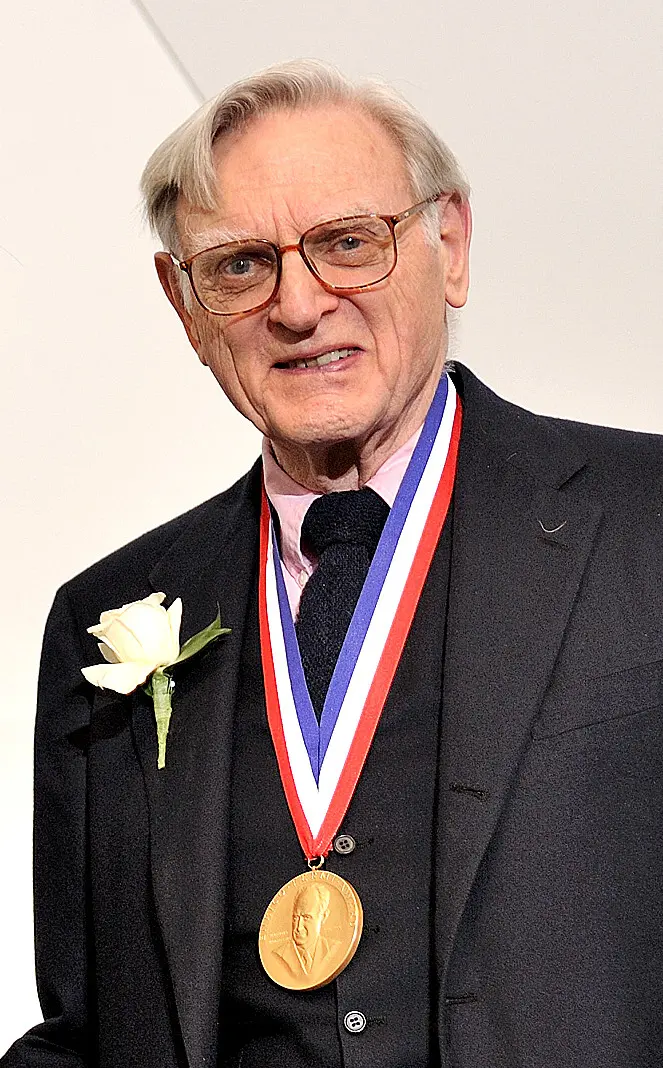
John B. Goodenough
1922–2023, born in Germany to American parents
Doubled the battery’s voltage. At 97 he became the oldest person ever to win a Nobel Prize.
Photo: U.S. Department of Energy, Public domain

Akira Yoshino
born 1948 in Japan
A company chemist who made the battery safe enough to sell.
Your phone’s battery is about the size of a biscuit, weighs about 50 grams, and yet it can run a computer, a camera, a radio and a bright screen for a whole day. Then you plug it in and fill it up again, hundreds of times. Before 1991, no battery could do that.
It is a lithium-ion battery. In 2019 the Nobel Prize in Chemistry went to the three scientists who made it, one step each.
The problem: heavy batteries that ran out
A battery (more exactly, a cell; a battery is several cells joined) stores energy as chemical energy and gives it out as electricity. In the 1970s there were two kinds you could recharge:
- the lead–acid battery, invented in 1859. It still starts most petrol cars and runs many home inverters. It is very heavy for the energy it holds.
- the nickel–cadmium battery. Lighter, but it holds little energy, and cadmium is poisonous.
At the same time, cities were filling with smoke from petrol cars, and people began to worry that oil would run out. Car makers and even oil companies started looking for a battery good enough to run a car. They needed one that was light, held lots of energy, and could be recharged many times.
How a battery makes a current
Every battery has three parts:
- a negative electrode, made of a material that gives up electrons easily;
- a positive electrode, made of a material that takes electrons in;
- between them, an electrolyte: a substance that lets ions (charged atoms) pass through it, but not electrons.
The electrons want to get from the negative electrode to the positive one, but the electrolyte blocks them. The only way round is through the wire outside, through your torch or phone. That flow of electrons through the wire is the electric current Grade 10: Direct current. At the same moment, ions move through the electrolyte inside, so the charges stay balanced.
How hard the battery pushes the electrons is its voltage (its e.m.f., Electromotive force). An ordinary torch cell gives 1.5 V. The bigger the difference between how much the two electrodes “want” electrons, the higher the voltage.
Why lithium?
Lithium is the lightest of all metals: it is so light that it floats on water (but don’t try it; it reacts with the water). Each lithium atom has three electrons, arranged 2, 1: just one electron in its outer shell, which it gives up very easily, becoming a positive lithium ion, Li⁺ Grade 9: Positive ions.
That makes lithium perfect for the negative electrode: it pushes its electrons out hard, so a lithium battery has a high voltage, and because lithium is so light, the battery is light. But the same eagerness makes lithium dangerous. It reacts with water and with air, so pure lithium is kept under oil Grade 9: Very reactive metals.
Why is lithium good for making a light, powerful battery?
Pick an answer to see why.
What they did, step by step
1. Whittingham: the first lithium battery (1970s)
In 1972 Stanley Whittingham, a British chemist, joined the oil company Exxon in the United States. Exxon wanted new kinds of energy and let its scientists research almost anything, as long as it wasn’t oil.
Whittingham was studying materials made of thin layers of atoms, with spaces between the layers where ions can slip in and out, like cards slipped between the pages of a book. This slipping in is called intercalation. He found that one such material, titanium disulfide, could take lithium ions between its layers and give out a lot of energy doing so.
So he built a battery: lithium metal for the negative electrode, titanium disulfide for the positive one. When it is used, lithium ions travel across and tuck themselves between the layers of titanium disulfide. When it is charged, they travel back. It gave more than 2 volts, it worked at room temperature, and it could be recharged. He announced it in 1976.
There was a problem. Each time the battery was charged, the lithium did not go back smoothly onto the metal. It grew thin, needle-like whiskers. When a whisker grew right across to the other electrode, the battery short-circuited, got very hot and could catch fire.
The fire brigade was called to Exxon’s laboratory more than once. Then, in the early 1980s, the price of oil fell, and Exxon stopped the project.
2. Goodenough: a better positive electrode (1980)
John Goodenough was then a professor at the University of Oxford, in England. He had struggled to learn to read as a boy (he was probably dyslexic), and turned to mathematics and then physics. He knew a lot about how atoms are arranged inside solids.
He predicted that a metal oxide (a compound of a metal with oxygen) would make a positive electrode with a much higher voltage than a metal sulphide. His team searched for an oxide that could take lithium ions in and let them out again without falling apart. In 1980 they found it: lithium cobalt oxide. The battery now gave about 4 volts, nearly twice as much.
Goodenough had one more clever idea. Earlier batteries were built already charged, full of reactive lithium metal. His could be built empty, with the lithium safely inside the oxide as ions, and charged afterwards.
3. Yoshino: no more lithium metal (1985)
In the West, cheap oil made people lose interest. In Japan, electronics companies wanted light batteries for new video cameras, cordless phones and laptops. Akira Yoshino, a chemist at the Japanese company Asahi Kasei, took Goodenough’s lithium cobalt oxide for the positive electrode and looked for a safe negative electrode, one that would hold lithium ions between layers instead of using lithium metal.
After trying many forms of carbon, in 1985 he found one that worked: petroleum coke, a carbon left over from oil refining. Now both electrodes simply stored lithium ions between their layers, and the ions just rocked back and forth between them. No lithium metal, so no whiskers.
How your phone’s battery works
Inside, a lithium-ion cell is a long, thin sandwich rolled up tight: a sheet of graphite (a layered form of carbon; today’s batteries use graphite rather than petroleum coke), a thin plastic separator soaked in electrolyte, and a sheet of a lithium metal oxide.
- When you use the phone, lithium ions leave the layers of graphite, cross the electrolyte, and slip into the layers of the metal oxide. Their electrons can’t cross the electrolyte, so they go the long way, through the phone. That is the current that runs the phone.
- When you charge it, the charger pushes the electrons back the other way, and the lithium ions travel back into the graphite, ready for next time.
Nothing is used up or rebuilt; the ions just move from one set of shelves to the other. That is why the battery can be charged hundreds of times.
When your phone is running on its battery, which way do the lithium ions move inside it?
Pick an answer to see why.
In your life today
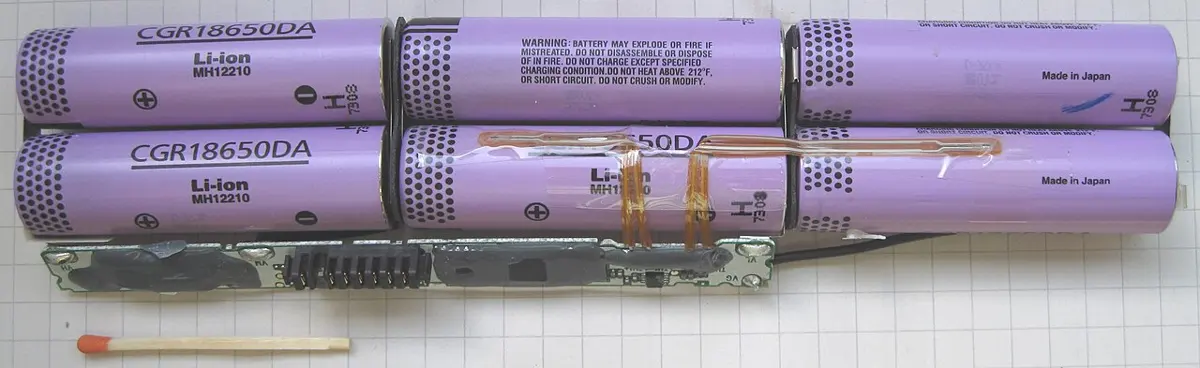
- Phones, laptops, earphones, power banks and cameras all run on lithium-ion batteries. A phone battery gives about 3.7 V, nearly as much as two and a half torch cells, from one small, flat cell.
- Electric scooters, cars and buses. A lithium-ion battery stores about four to five times as much energy per kilogram as a lead–acid one, which is what made electric cars practical. In recent years, electric cars have made up a large share of the new cars brought into Nepal.
- Storing electricity. Large banks of lithium-ion batteries store the electricity from solar panels and wind for when the sun isn’t shining, and some homes now use them in their inverters instead of lead–acid batteries.

What came next
- Cheaper, safer chemistry. In 1997 Goodenough’s team found another positive electrode, lithium iron phosphate, made from common iron instead of cobalt. It holds a little less energy, but lasts longer and is much less likely to catch fire. Many electric buses and cars now use it.
- Where does the cobalt come from? Much of the world’s cobalt is mined in the Democratic Republic of the Congo, some of it by hand in dangerous small mines, sometimes by children. This is one reason battery makers are trying to use less cobalt, or none.
- Batteries without lithium? Lithium is mined in only a few places. Sodium-ion batteries, using sodium, the metal in common salt, have started to be made. They are heavier, but sodium is everywhere.
- Recycling. Old batteries contain valuable lithium, cobalt, nickel and copper. Getting them back cheaply is a big open problem as millions of electric vehicles grow old.
In your science books
- Grade 9: ions (why lithium gives up one electron), very reactive metals (lithium and water), and electromotive force (a cell’s voltage).
- Grade 10: direct current (what a battery gives), electricity in Nepal, and chemical reactivity down the group of alkali metals.
Learn more
- The Nobel Prize’s own explanation: They developed the world’s most powerful battery (nobelprize.org).
- The laureates’ Nobel lectures: Goodenough, Whittingham and Yoshino.
The official reason
The prize was given “for the development of lithium-ion batteries.”