
The tip of your pencil, the black soot under a pot cooked on firewood, the diamond in a ring, the charcoal in an iron (istri), and about one-fifth of your own body by weight. What do they have in common?
They are all carbon. Soot and diamond are made of exactly the same atoms, arranged differently. And the same carbon atoms, joined to hydrogen, oxygen and a few others, build the rice you eat, the cotton you wear, the petrol in a bus and the DNA in your cells. No other element can do so much. This unit is about why.
Introduction to carbon
Coal, charcoal and soot are black, and they are all forms of carbon. The name comes from the Latin word carbo, meaning coal or charcoal. Carbon in these forms burns easily in air, giving heat and light; when something containing carbon burns without enough air, it gives thick black smoke.
This gives a simple test. If a substance chars black when heated, or burns with black, sooty smoke, it contains carbon. Paper, wood, sugar, cloth, plastic, kerosene and a candle all pass this test.
Carbon is a non-metal. Its atomic number is 6 (each atom has 6 protons and 6 electrons) and its atomic mass is 12. It is an unusual non-metal: one of its forms, graphite, conducts electricity, and another, diamond, is the hardest natural substance known. And today we use carbon in more ways than ever, from diamond-tipped drills to graphite in batteries. Above all, carbon is the main element of organic compounds, the compounds of living things.
Sources of carbon
When firewood burns, it gives black smoke. A candle flame blackens a spoon held over it. Sugar heated in a pan turns into black sugar charcoal. Each time, carbon that was hidden in the substance shows itself.
Carbon is found in every living thing: it is the main element in their bodies. So it is called the basic building block of life. Compounds of carbon are in our food, our clothes, the wooden table, paper and pens. Carbon is found in three ways:
| As the element (free carbon) | In inorganic compounds | In organic compounds |
|---|---|---|
| coal, soot, charcoal, diamond, graphite, graphene | carbonates (limestone, marble), bicarbonates (baking soda), carbides (calcium carbide CaC₂, silicon carbide SiC); in minerals and rocks; gases such as carbon dioxide (CO₂) and carbon monoxide (CO) | carbohydrates, proteins, fats, vitamins, urea, medicines, petrol, silk, cotton, paper, soap; hydrocarbon gases such as methane, ethane and LPG |
Which of these would not leave a black mass when heated strongly in a test tube?
Pick an answer to see why.
Nature of carbon
A carbon atom has 6 electrons: 2 in the first shell and 4 in the outer shell, the valence shell (its electron configuration is 2, 4). These four are its valence electrons. To become stable, an atom needs 8 electrons in its outer shell (an octet). Losing four electrons or gaining four would take too much energy, so carbon does neither. Instead, it shares its four outer electrons with other atoms, forming four covalent bonds. So the valency of carbon is four.
Carbon can form these bonds with hydrogen, oxygen, nitrogen, other carbon atoms and many other elements. That is why chemists know of millions of carbon compounds, many more than the compounds of all the other elements put together.
a. Catenation
Most elements can’t join with many atoms of their own kind. Carbon can: carbon atoms join to each other by covalent bonds in long chains, branched chains and rings. This property is called catenation (from the Latin catena, “chain”).
Butane, C₄H₁₀ (the main gas in the LPG cylinders in your kitchen), has a chain of four carbon atoms (Figure 18.1 b); pentane has five. In polythene and PVC (polyvinyl chloride, the plastic of water pipes), the chains are thousands of carbon atoms long.
Because of catenation, the number of carbon compounds is almost endless. They are so many that they have a branch of chemistry of their own: organic chemistry, the chemistry of carbon compounds.
A polythene bag is made of very long molecules in which carbon atoms are joined to one another in chains. Which property of carbon makes this possible?
Pick an answer to see why.
b. Allotropes and allotropy
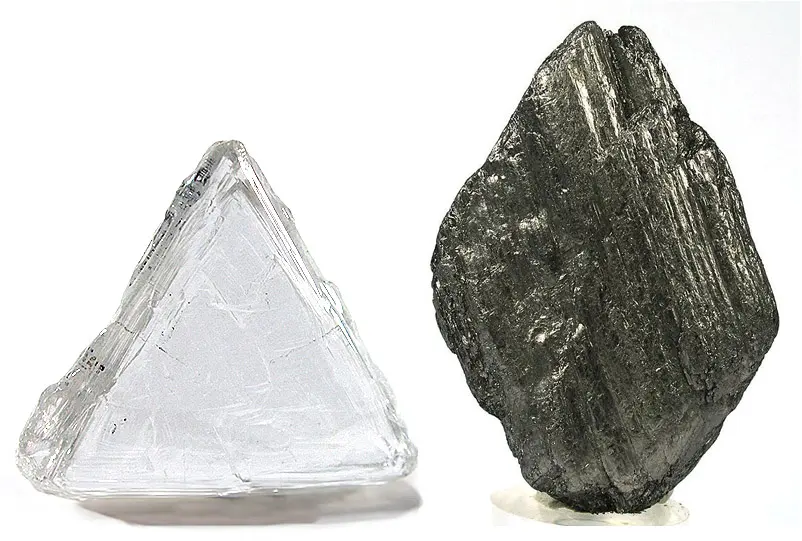
Coal, charcoal, soot, diamond, graphite and graphene are all made of carbon atoms only. They look and behave completely differently because their atoms are arranged differently. The different forms of the same element are called its allotropes, and the existence of an element in more than one form is called allotropy.
Allotropes of an element have different physical properties (color, hardness, conduction), but similar chemical properties: diamond, graphite and charcoal all burn in oxygen to give the same gas, carbon dioxide.
The allotropes of carbon are of two kinds:
| Crystalline allotropes | Amorphous allotropes |
|---|---|
| atoms in a regular, repeating pattern | no regular pattern |
| diamond, graphite, fullerene (and graphene, a single layer of graphite) | coal, charcoal, soot (lamp black) (and coke) |
Diamond, graphite and fullerene
In diamond, each carbon atom uses all four of its outer electrons to bond with four other carbon atoms. The bonds point in every direction, making a strong, rigid network through the whole crystal. There are no free electrons. So diamond is:
- the hardest natural substance;
- a bad conductor of electricity (no free electrons to carry a current);
- transparent and sparkling when cut.
In graphite, each carbon atom bonds with only three others, making flat sheets of hexagons, like chicken wire. The fourth electron of every atom is free to move along the sheet. The sheets lie on top of each other, held only by weak forces. So graphite is:
- a good conductor of electricity (and heat), thanks to its free electrons;
- soft and slippery: the sheets slide over each other easily. That is why pencil lead leaves a mark (sheets rub off onto the paper), and why graphite powder is used as a dry lubricant in locks and machines.
Fullerene (C₆₀, “buckminsterfullerene”) is a hollow ball of 60 carbon atoms, arranged in 20 hexagons and 12 pentagons, exactly like the patches of a football.
Why does graphite conduct electricity but diamond doesn’t?
Pick an answer to see why.
Physical properties of carbon
- Carbon is found as a solid. Diamond, graphite and fullerene are its crystalline allotropes; coal, charcoal and soot are amorphous.
- Carbon does not dissolve in water (nor in most other liquids).
- On strong heating, carbon doesn’t melt at ordinary pressure: at about 3,600 °C it turns directly from solid to gas. (This is called sublimation.)
- Most forms of carbon are black, but diamond is colorless and transparent.
- Most forms are dull, but diamond sparkles and graphite has a dull gray shine.
- Most forms are bad conductors of heat and electricity, but graphite is a good conductor. (Diamond, though it doesn’t conduct electricity, conducts heat extremely well.)
- The density of carbon depends on the allotrope: from about 1.5 g/cm³ (amorphous forms such as charcoal) and 2.2 g/cm³ (graphite) to 3.5 g/cm³ (diamond).
Chemical properties of carbon
1. Combustion
Carbon burns in oxygen. What it makes depends on how much oxygen there is.
With plenty of oxygen (complete combustion), carbon burns to carbon dioxide:
With too little oxygen (incomplete combustion), it gives carbon monoxide:
With even less air, some carbon doesn’t burn at all and goes up as black smoke: soot.
Carbon monoxide is a deadly gas. It has no color and no smell, so you can’t tell it is there. When you breathe it in, it sticks to the hemoglobin in your blood about 200 times more strongly than oxygen does, so your blood can no longer carry oxygen. First comes a headache and dizziness, then sleepiness, and then death.
In a room with all the windows closed, a charcoal fire slowly runs short of oxygen. Which gas does it start to make, and why is it dangerous?
Pick an answer to see why.
2. Reaction with metals
Heated strongly with some reactive metals, carbon forms compounds called carbides.
| Reaction | Carbide formed |
|---|---|
| 4Al + 3C → Al₄C₃ | aluminium carbide |
| 3Fe + C → Fe₃C | iron carbide (cementite) |
| 2Li + 2C → Li₂C₂ | lithium carbide |
| Ca + 2C → CaC₂ | calcium carbide |
Iron carbide is what makes steel harder than pure iron. Calcium carbide gives off a gas called acetylene when it gets wet; it is sometimes misused, dangerously, to ripen mangoes and bananas in a hurry (the carbide often carries arsenic and phosphorus compounds as impurities).
3. Reducing property
Removing oxygen from a compound is called reduction, and a substance that removes oxygen is a reducing agent. Carbon is a good reducing agent. Heated with the oxides of less reactive metals, it pulls the oxygen away and leaves the metal behind:
| Reaction | Metal obtained |
|---|---|
| Fe₂O₃ + 3C → 2Fe + 3CO | iron |
| ZnO + C → Zn + CO | zinc |
| PbO + C → Pb + CO | lead |
This is how iron has been made for 3,000 years: iron ore is heated with charcoal (today, with coke, a form of carbon made from coal) in a furnace.
Carbon also reacts with some other oxides at very high temperatures (about 2,000 °C, in an electric furnace) to form carbides and carbon monoxide:
Silicon carbide (SiC), made from sand and carbon, is nearly as hard as diamond: it is the grit on sandpaper and grinding wheels.
4. Reaction with steam
When steam is passed over red-hot carbon (coke) at about 1,000 °C, it forms carbon monoxide and hydrogen:
This mixture of carbon monoxide and hydrogen is called water gas. Both gases burn, so water gas is used as a fuel in industry, and as a source of hydrogen for making ammonia and fertilizers (Unit 19).
What is water gas?
Pick an answer to see why.
Organic and inorganic compounds
Some compounds around us contain carbon and some don’t. Chemists sort compounds into two groups.
Organic compounds
Methane, ethane, methanol, urea, insulin, proteins, carbohydrates and oils are organic compounds. Organic compounds are the hydrocarbons (compounds of carbon and hydrogen only) and the compounds made from them. In almost every organic compound, carbon is bonded to hydrogen, and the atoms are joined by covalent bonds. Besides hydrogen and other carbon atoms, carbon in organic compounds is often bonded to oxygen, nitrogen, the halogens (such as chlorine), sulphur and phosphorus; a few organic compounds even contain metals (chlorophyll contains magnesium).
Carbon dioxide, carbon monoxide, carbonates, bicarbonates and carbides contain carbon, but they are counted as inorganic compounds: they behave like minerals.
Most organic compounds don’t dissolve in water: ghee, wax, petrol and kerosene float on water and don’t mix with it. Their molecules can’t form hydrogen bonds (a special attraction) with water molecules. Organic compounds that can form hydrogen bonds with water, such as sugar and alcohol, do dissolve. Most organic compounds dissolve in organic solvents, liquids such as ether, carbon tetrachloride, benzene, petrol and kerosene.
Inorganic compounds
Inorganic compounds are all the compounds that are not organic. Carbon is not needed in them: they are made from all sorts of elements. Most inorganic compounds are held together by electrovalent (ionic) bonds; some have covalent bonds, and some have both. Inorganic acids, bases and salts are inorganic compounds, and so are the oxides of carbon, carbonates, bicarbonates and carbides.
Most inorganic compounds dissolve in water, because in water they split up (dissociate) into ions: sodium chloride (NaCl), hydrochloric acid (HCl) and sodium hydroxide (NaOH), for example. But not all: silver chloride (AgCl), barium sulphate (BaSO₄) and calcium carbonate (CaCO₃, limestone) hardly dissolve in water at all.
Differences between organic and inorganic compounds
| Basis | Organic compounds | Inorganic compounds |
|---|---|---|
| physical state | found as solids, liquids and gases | mostly solids; a few liquids (water, hydrochloric acid) and gases (CO₂, H₂S) |
| chemical bond | covalent bonds | mostly electrovalent (ionic) bonds; sometimes covalent |
| ionization | mostly don’t split into ions | many split into ions in water |
| solubility | most don’t dissolve in water but dissolve in organic solvents | most dissolve in water but not in organic solvents |
| melting and boiling points | low | high |
| combustibility | most burn easily (ghee, oil, petrol, LPG) | most don’t burn (salt, limestone) |
Uses of organic compounds in daily life
From the moment you wake up, you are surrounded by organic compounds:
- Food: dal, rice, vegetables, fish, meat, milk, curd and fruits contain carbohydrates, proteins, fats and vitamins, all organic compounds.
- Clothes: cotton, silk, wool and jute are natural organic materials; nylon, polyester and acrylic are organic compounds made in factories.
- Medicines: most medicines, from paracetamol to antibiotics, are organic compounds.
- Energy: petrol, diesel, kerosene, LPG and spirit are organic fuels, used in vehicles, kitchens and lamps.
- Farming: crops such as rice, dal, vegetables and fruits are made of carbohydrates, proteins and vitamins; and much of what farmers use, such as many insecticides, weedkillers and animal feed, is organic too.
- Cosmetics: soaps, shampoos, creams, lipsticks and perfumes are mostly organic compounds.
Add to these plastics, paper, rubber, paints, dyes and the ink in your pen.
Exercise
1. Choose the correct answer
(i) Which of the following is a property of carbon?
Pick an answer to see why.
(ii) Polythene is made from carbon compounds. Which property of carbon is this related to?
Pick an answer to see why.
(iii) Which of the following is a group of organic compounds only?
Pick an answer to see why.
(iv) The outside of a pot used to cook food on a firewood fire turns black (sooty). What does this show?
Pick an answer to see why.
2. Differentiate between
Graphite and diamond
Answer
| Graphite | Diamond |
|---|---|
| Each carbon atom is bonded to three others, in flat layers of hexagons. | Each carbon atom is bonded to four others, in a rigid 3-D network. |
| Each atom has one free electron, so it is a good conductor of electricity. | No free electrons, so it is a bad conductor of electricity. |
| Soft and slippery: its layers slide over each other. | The hardest natural substance. |
| Black-gray and opaque, with a dull shine. | Colorless and transparent, and sparkles when cut. |
| Density about 2.2 g/cm³. | Density about 3.5 g/cm³. |
| Used in pencils, dry cells and as a lubricant. | Used in jewelry and for cutting glass and drilling rock. |
Organic compounds and inorganic compounds
Answer
| Organic compounds | Inorganic compounds |
|---|---|
| Contain carbon, almost always bonded to hydrogen. | May or may not contain carbon. |
| Atoms joined by covalent bonds. | Mostly ionic (electrovalent) bonds. |
| Mostly don’t dissolve in water, but dissolve in organic solvents. | Mostly dissolve in water, but not in organic solvents. |
| Low melting and boiling points. | High melting and boiling points. |
| Most burn easily. | Most don’t burn. |
| Examples: methane, sugar, urea, ghee. | Examples: common salt, water, limestone, carbon dioxide. |
3. Give reasons
In winter, we should not burn coal or firewood in a room with the windows and doors closed.
Answer
In a closed room, the fire soon uses up the oxygen. With too little oxygen, carbon burns incompletely and forms carbon monoxide (2C + O₂ → 2CO). Carbon monoxide has no color or smell. It combines with the hemoglobin of the blood far more strongly than oxygen does, so the blood can’t carry oxygen, and the people in the room can become unconscious and die in their sleep. (The fire also fills the room with carbon dioxide and smoke.) So the room must have fresh air coming in.
Graphite powder can be used as a dry lubricant.
Answer
In graphite, the carbon atoms are arranged in flat layers. The layers are held to each other only by weak forces, so they slide over one another easily. Graphite powder therefore makes surfaces slippery and reduces friction. Unlike oil, it is dry, so it doesn’t collect dust, and it works even at high temperatures.
Graphite and diamond are both allotropes of carbon, yet graphite conducts electricity and diamond doesn’t.
Answer
In graphite, each carbon atom forms covalent bonds with only three other carbon atoms, so one of its four outer electrons is free. These free electrons can move through the layers and carry an electric current. In diamond, each carbon atom uses all four outer electrons to bond with four other carbon atoms, so there are no free electrons, and no current can flow.
The melting and boiling points of inorganic compounds are higher than those of organic compounds.
Answer
Most inorganic compounds are ionic: their positive and negative ions are held in a crystal by strong electrostatic attractions, which need a lot of heat energy to overcome. Organic compounds are covalent and are made of separate molecules, which are held to one another only by weak forces. Little energy is needed to separate them, so organic compounds melt and boil at low temperatures.
When firewood burns in a stove, it sometimes gives black smoke, and sometimes burns well with little smoke.
Answer
Firewood contains carbon compounds. When the fire gets enough air (dry wood, not packed too tightly, with a good draught), the carbon burns completely to colorless carbon dioxide, and there is little smoke. When the air is not enough (wet wood, wood packed tightly, a choked stove), the carbon doesn’t burn completely: some of it escapes as tiny particles of unburnt carbon, which we see as black smoke (soot), and carbon monoxide forms too.
4. Answer the following questions
Define catenation and allotropy of carbon, with examples.
Answer
Catenation is the property of carbon atoms of joining with one another by covalent bonds to form long chains, branched chains and rings. Examples: butane (a chain of 4 carbon atoms), pentane (5), polythene and PVC (thousands).
Allotropy is the existence of an element in two or more forms with different physical properties but similar chemical properties; the forms are called allotropes. Their atoms are arranged differently. Examples: diamond, graphite and fullerene (crystalline allotropes of carbon), and coal, charcoal and soot (amorphous allotropes).
When sugar is heated for a long time, it gives a black mass. What can we conclude from this?
Answer
The black mass is sugar charcoal, which is carbon. So we conclude that sugar contains carbon. On heating, the hydrogen and oxygen in sugar (C₁₂H₂₂O₁₁) are driven off as water vapor, and the carbon is left behind.
Give two examples each of crystalline and amorphous allotropes of carbon.
Answer
Crystalline: diamond, graphite (also fullerene and graphene).
Amorphous: charcoal, soot (lamp black) (also coal and coke).
Under what conditions does burning carbon form carbon monoxide, and when carbon dioxide? Write the chemical equations.
Answer
When carbon burns in plenty of oxygen (complete combustion), it forms carbon dioxide:
C + O₂ → CO₂ + heat
When carbon burns in a limited supply of oxygen (incomplete combustion), it forms carbon monoxide:
2C + O₂ → 2CO + heat
What is water gas?
Answer
Water gas is a mixture of carbon monoxide and hydrogen gas. It is made by passing steam over red-hot carbon (coke) at about 1,000 °C: C + H₂O → CO + H₂. It is used as an industrial fuel and as a source of hydrogen.
What happens when carbon reacts with steam? Write the chemical equation.
Answer
When steam is passed over carbon heated to about 1,000 °C, the carbon takes the oxygen from the water, forming carbon monoxide, and hydrogen gas is set free. The mixture is called water gas.
C + H₂O → CO + H₂
Rohan couldn’t clean a grease stain from his clothes with soap and water. His mother advised him to rub a little petrol on the stain. Will this solve Rohan’s problem? Explain the cause of his problem and the solution, using scientific facts.
Answer
Yes, it will (mostly) solve it.
The cause: grease is an organic compound. Like most organic compounds, it doesn’t dissolve in water, because its molecules can’t form hydrogen bonds with water. That is why water alone couldn’t lift it.
The solution: organic compounds dissolve in organic solvents, and petrol is one. The petrol dissolves the grease, which can then be washed away. (Dry cleaners use organic solvents in the same way.)
But be careful: petrol catches fire very easily and its vapor is harmful. Use only a little, outdoors, far from any flame, and wash the cloth well afterwards. Kerosene works too, and so does rubbing a little detergent into the stain: detergent molecules have one end that holds on to grease and another that holds on to water.
Write any four examples of organic compounds you use in daily life.
Answer
- Sugar (sucrose) and starch (in rice), in food.
- LPG (butane and propane), as cooking fuel.
- Cotton (cellulose), in clothes.
- Paracetamol, a medicine.
(Others: petrol, kerosene, ghee and oil, soap, plastics, paper, vinegar.)
Practice every question in the book, and keep track of the ones you miss →