
The first radioactive atoms made by people
Nobel Prize in Chemistry, 1935: Irène Joliot-Curie and Frédéric Joliot
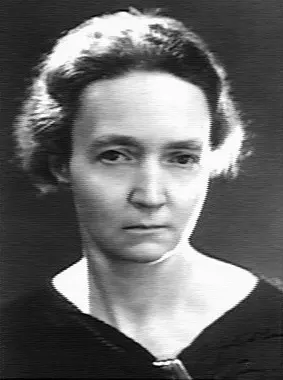
Irène Joliot-Curie
1897–1956, born in France
The daughter of Marie and Pierre Curie. At seventeen she was taking X-ray pictures of wounded soldiers in the First World War.
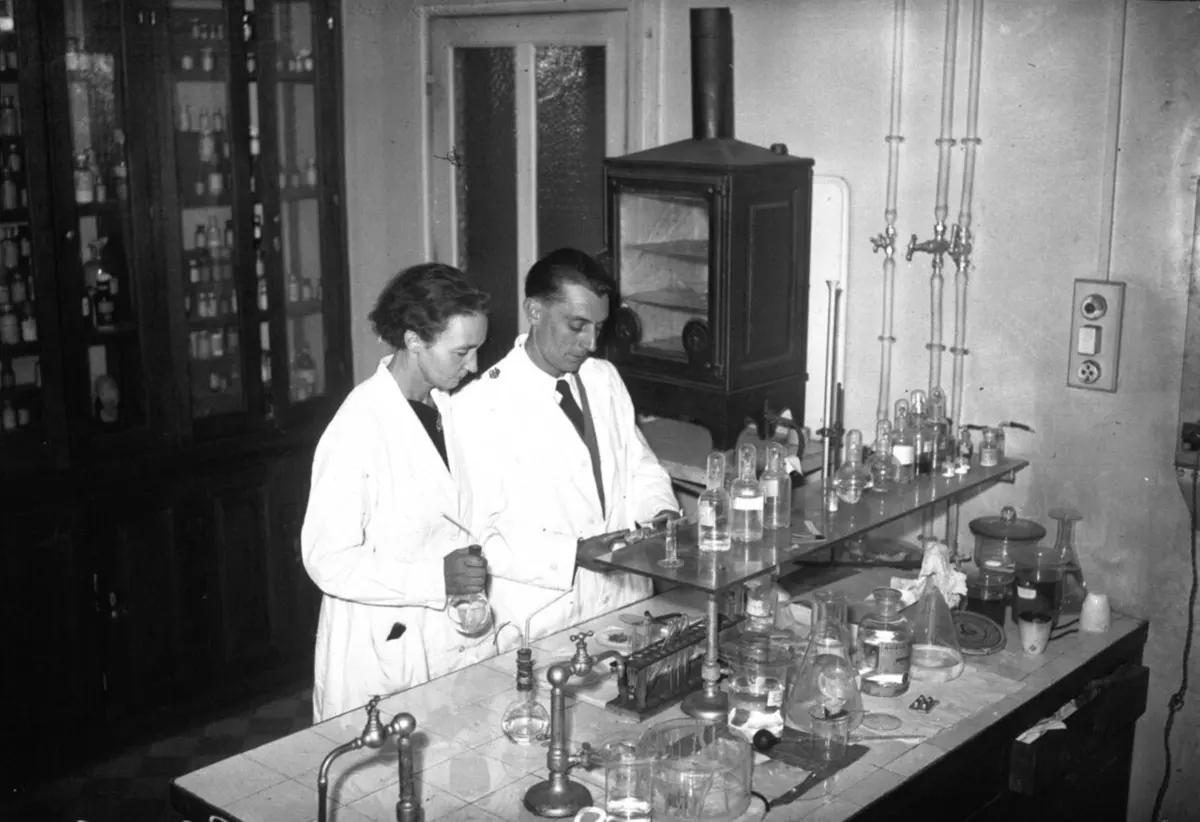
Photo: Harcourt, Public domain
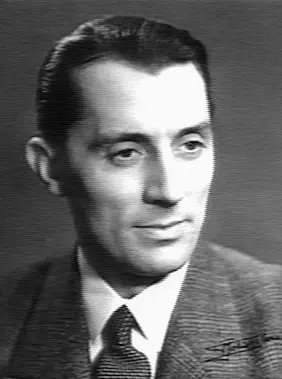
Frédéric Joliot
1900–1958, born in France
An engineer who came to work for Marie Curie, married her daughter, and became one of the best experimenters in Paris.
In some hospitals, a doctor who wants to see how a patient’s heart, bones or thyroid gland is working gives the patient a tiny amount of a radioactive substance. It travels through the body, and a special camera picks up the rays it gives out, showing exactly where it has gone. Almost none of the radioactive substances used this way are found in nature. They are made, in machines and in nuclear reactors.
The very first radioactive atoms ever made by people were made in Paris in January 1934, from a piece of aluminium foil, by a wife and husband: Irène Joliot-Curie and Frédéric Joliot. They won the Nobel Prize in Chemistry in 1935.
The problem: radioactivity nobody could control
In 1896 Henri Becquerel found that uranium gives out invisible rays all by itself. Two years later Marie and Pierre Curie, Irène’s parents, found two new elements that do it far more strongly, polonium and radium. This is radioactivity. A radioactive atom has an unstable nucleus, which sooner or later breaks down, shooting out a fast particle (an alpha particle, a beta particle) or a ray (a gamma ray), and becomes a different element Grade 9: radioactive elements and radioactive emission. Read the story on our pages about the Curies’ prize and Marie Curie’s radium.
By the 1930s scientists knew a few dozen radioactive substances, all of them found in nature, mostly in uranium and thorium ores. And nothing anyone did could change them. Heat a radioactive substance, cool it, crush it, dissolve it in acid: it went on giving out its rays at exactly the same rate. Each one has its own half-life, the time it takes for half of its atoms to break down. Radium’s is about 1,600 years.
There was one way to reach into a nucleus: hit it. In 1919 Ernest Rutherford fired alpha particles at nitrogen and knocked protons out of it, turning a few nitrogen atoms into oxygen. It was the first transmutation, one element changed into another, made to happen by a person. But it was very hard. A nucleus is so small that, as the Swedish Academy said when the prize was given, only about one alpha particle in ten million hits one. And the atoms Rutherford made were ordinary, stable ones. Nobody had ever made a radioactive atom.
Before 1934, what could scientists do to change how fast a radioactive substance gives out its rays?
Pick an answer to see why.
Two near misses
The Joliot-Curies were very good experimenters, but they twice saw something new and explained it wrongly.
- 1932, the neutron. German scientists had found that polonium’s alpha particles, hitting the metal beryllium, make a strange, very penetrating radiation. The Joliot-Curies showed that this radiation knocks fast protons out of paraffin wax. They thought it was a powerful kind of gamma ray. In Cambridge, James Chadwick read their paper, saw that no gamma ray could do that, and within weeks proved it was a new particle with no charge: the neutron. Chadwick won the Nobel Prize in Physics for it in 1935, the same year as the Joliot-Curies.
- 1932, the positron. In their cloud chamber photographs (a machine that shows the paths of particles as trails of mist; see our page on the cloud chamber) they saw tracks of particles curving the “wrong” way, but did not realize what they were. In the United States, Carl Anderson recognized them first: the positron, a particle just like an electron but with a positive charge.
The third time, they did not miss.
What they did, step by step
- Late 1933, aluminium. The Joliot-Curies were firing alpha particles from polonium at light elements, such as aluminium and boron, and measuring what came out. From aluminium came neutrons, protons, and also positrons.
- January 1934, the source taken away. Using a Geiger counter, an instrument that clicks each time a fast charged particle passes through it, they watched the positrons coming from a thin aluminium foil. Then they took the polonium away. Every reaction anyone had made in a nucleus stopped at once when the alpha particles stopped. This one did not. The counter went on clicking, fewer and fewer times, for several minutes. The number of positrons halved about every three minutes. The aluminium foil had itself become radioactive.
- 15 January 1934, the announcement. They reported to the French Academy of Sciences that they had made radioactivity happen. The same happened with boron and with magnesium, each with its own half-life.
What had happened inside the foil
The Joliot-Curies worked out what had happened in two steps.
Step 1, in an instant. An aluminium nucleus (13 protons and 14 neutrons, so aluminium-27) captures an alpha particle (2 protons and 2 neutrons) and immediately throws out one neutron. What is left has 15 protons and 15 neutrons. Fifteen protons make it phosphorus. But ordinary phosphorus has 16 neutrons (phosphorus-31). This was phosphorus-30, a kind of phosphorus never found in nature.
Atoms of the same element with different numbers of neutrons are called isotopes of that element (counting what is inside a nucleus). Phosphorus-30 is a radioactive isotope, sometimes called a radioisotope.
Step 2, minutes later. Phosphorus-30 has too few neutrons to be stable. One by one, in each nucleus, a proton turns into a neutron and a positron is shot out. The nucleus now has 14 protons and 16 neutrons: it has become silicon-30, which is stable.
Check the numbers: the top numbers (protons plus neutrons) add up to the same on both sides, and so do the bottom numbers (the charge). This is the “other beta decay”, with a positron instead of an electron (beta decay).
What was new about what happened in the aluminium foil?
Pick an answer to see why.
The chemical proof
Physicists believed the clicks. But this was a claim about a new element, and chemists would want to see it behave like phosphorus. There was a difficulty: the foil held only a few million atoms of phosphorus-30, far too few to see or weigh (less than a millionth of a billionth of a gram), and half of them disappeared every three minutes.
So the Joliot-Curies worked fast. They bombarded a foil, then dissolved it in hydrochloric acid. The acid reacts with aluminium and gives off hydrogen gas. If the radioactive atoms were phosphorus, they should leave with the gas (as a gas of phosphorus and hydrogen), while the aluminium stayed behind in the solution. They collected the gas in a thin tube and held it to the counter. The gas was radioactive; the solution was not. In another test, the radioactive atoms came out of the solution with a phosphorus compound. The new atoms were behaving as phosphorus does. All of this had to be done in a few minutes, before the atoms were gone.
It was the first time anyone had made one element into a new, unknown one and proved it with chemistry. That is why the prize was in chemistry: for the “synthesis of new radioactive elements”.
How a radioisotope dies away
Every radioisotope breaks down with its own half-life, and it doesn’t matter how much of it you start with: in each half-life, half of what is left breaks down.
Marie Curie lived to see her daughter’s discovery. She died in July 1934, of an illness caused by her many years of work with radioactive substances. Frédéric Joliot said in his Nobel lecture what a great satisfaction it had been to her to see the list of radioactive elements, which she and Pierre Curie had begun, grow longer.
In your life today
- Hospital scans. Soon after the discovery, people found that almost every element can be made radioactive this way, with neutrons, protons or other particles from machines and reactors. Today thousands of radioisotopes are known, nearly all of them made by people. Doctors use them as tracers: a substance carrying a radioactive atom goes wherever the body takes it, and a camera follows its rays. In Nepal, Bir Hospital in Kathmandu and Chitwan Medical College in Bharatpur have nuclear medicine departments that do such scans.
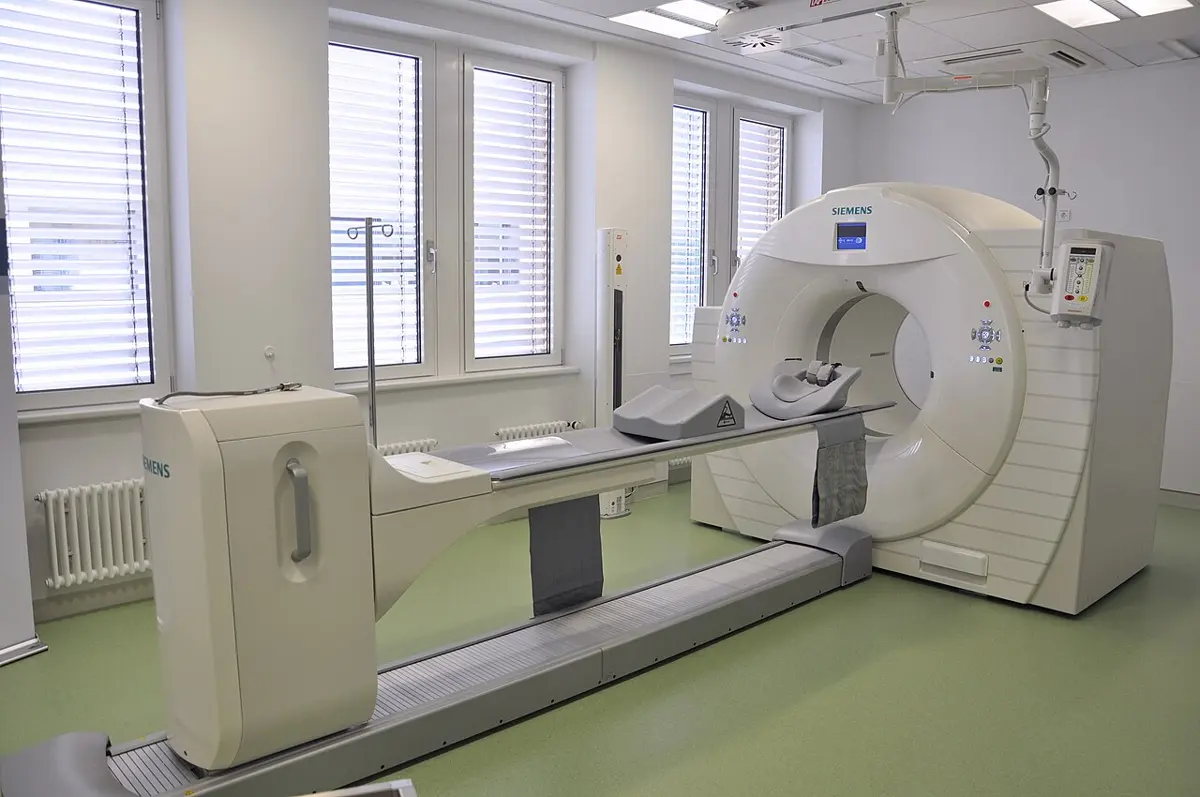
- PET scans. A PET scanner (positron emission tomography) works with radioisotopes that give out positrons, just as phosphorus-30 does. The most common is a kind of sugar carrying radioactive fluorine. Cancer cells use a lot of sugar, so they show up brightly on the scan.
- Treatment. Some radioisotopes are used to kill cancer cells or an overactive thyroid gland, with radiation aimed where it is needed.
- Farming research. Phosphorus is one of the main nutrients that plants need. Scientists add a little radioactive phosphorus to a fertilizer and measure how much of it ends up in the crop, to learn how much of the fertilizer a plant really uses and how much is wasted Grade 9: phosphatic fertilizers.
What came next
- Neutrons as bullets. In their first reports the Joliot-Curies suggested trying other particles. In Rome, Enrico Fermi used neutrons, which have no charge and so are not pushed away by the nucleus, and made dozens of new radioisotopes within months (Nobel Prize in Physics 1938). By the time of the Joliot-Curies’ Nobel lectures in December 1935, more than fifty had been made.
- Splitting the atom. In 1938 Irène Joliot-Curie’s experiments firing neutrons at uranium were an important step towards the discovery of nuclear fission, the splitting of uranium nuclei, by Otto Hahn and Fritz Strassmann in Germany. In 1939 Frédéric Joliot and his team showed that each split gives out extra neutrons, which can split more nuclei: a chain reaction Grade 9: nuclear fission. This led to nuclear power stations, and to nuclear weapons. In his Nobel lecture in 1935, Frédéric Joliot had already imagined such “transmutations of an explosive type”, and hoped that scientists would take “the necessary precautions”.
- The price. Irène Joliot-Curie died of leukemia in 1956, aged 58, probably caused by her years of work with polonium and X-rays; Frédéric died two years later. Today anyone who works with radioactive materials follows strict rules about time, distance and shielding.
- The heaviest elements. Scientists still make new elements the same way, by firing one nucleus at another. The heaviest yet, oganesson (element 118), lasts less than a thousandth of a second. Physicists think there may be an “island” of heavier elements that last much longer. Whether it exists, and whether we can ever reach it, is an open question.
Why are the radioisotopes used in hospitals made, rather than dug out of the ground?
Pick an answer to see why.
In your science books
- Grade 9: nuclear stability, radioactive elements and radioactive emission, nuclear fission; phosphatic fertilizers.
- Grade 10: the modern periodic table, where an element’s place is set by its number of protons.
- Going further: counting what is inside a nucleus (isotopes), beta decay and the positron, and half-life, from uranium to lead.
Learn more
- The Swedish Academy’s presentation speech (nobelprize.org).
- The two Nobel lectures: Irène Joliot-Curie’s Artificial production of radioactive elements and Frédéric Joliot’s Chemical evidence of the transmutation of elements.
The official reason
The prize was given “in recognition of their synthesis of new radioactive elements.”