
The double helix: the shape of DNA
Nobel Prize in Physiology or Medicine, 1962: Francis Crick, James Watson, and Maurice Wilkins
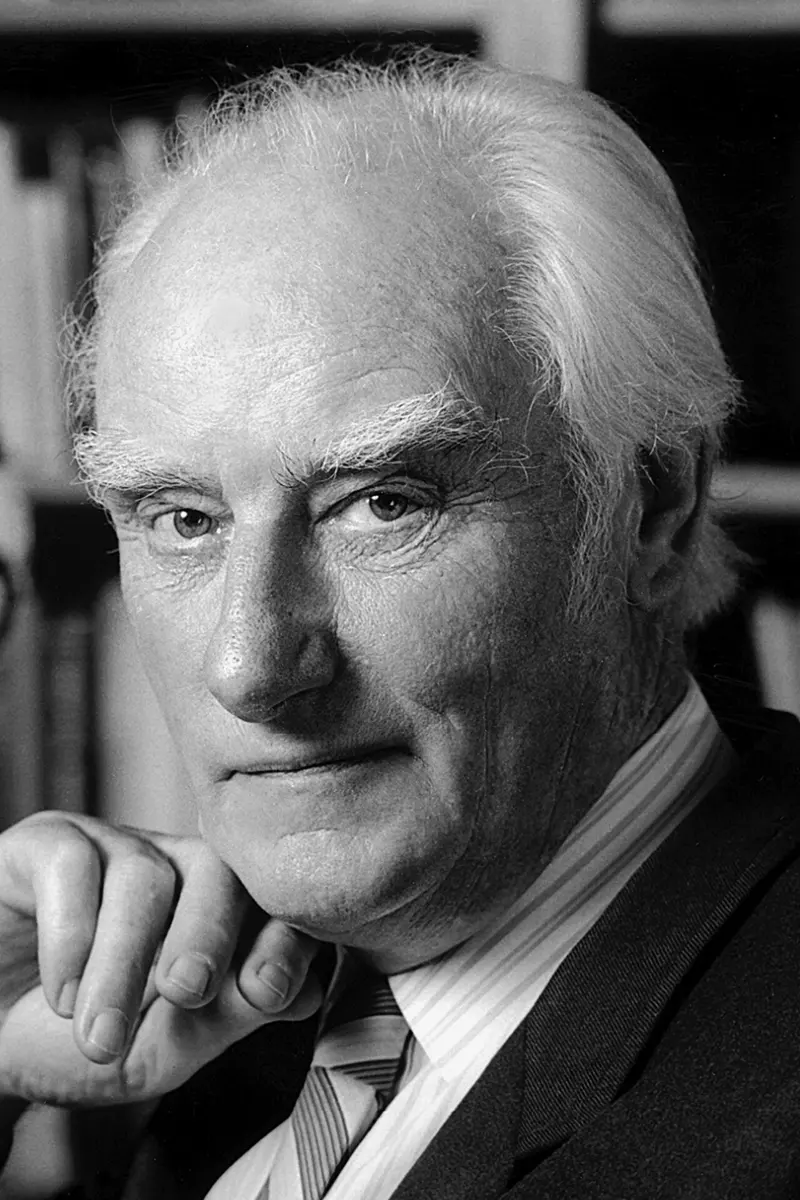
Francis Crick
1916–2004, born in England
A physicist who switched to biology after the Second World War, and loved to talk ideas through out loud.
Photo: Marc Lieberman, CC BY 2.5
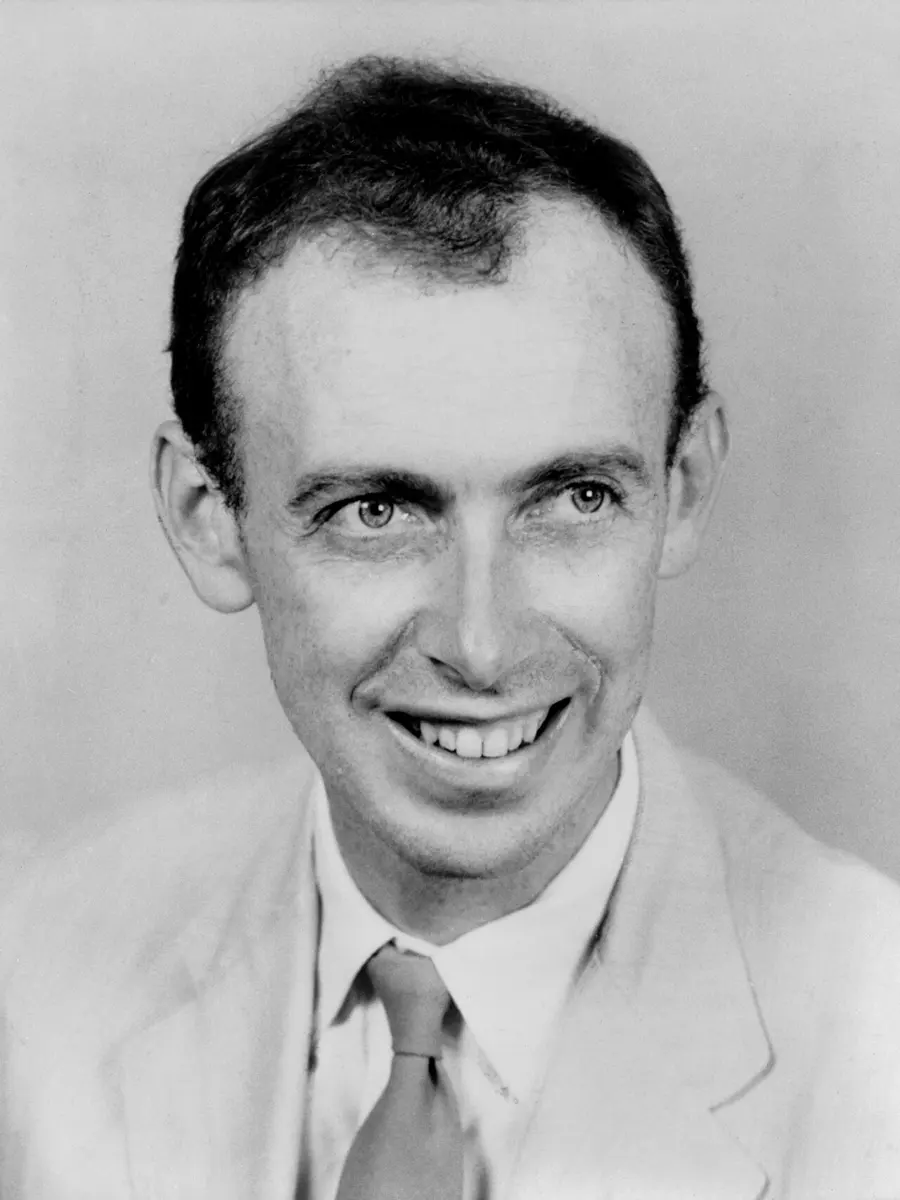
James Watson
1928–2025, born in the United States
A young American biologist who came to Cambridge at 23, determined to find the shape of DNA.
Photo: Newspaper Enterprise Association, Public domain
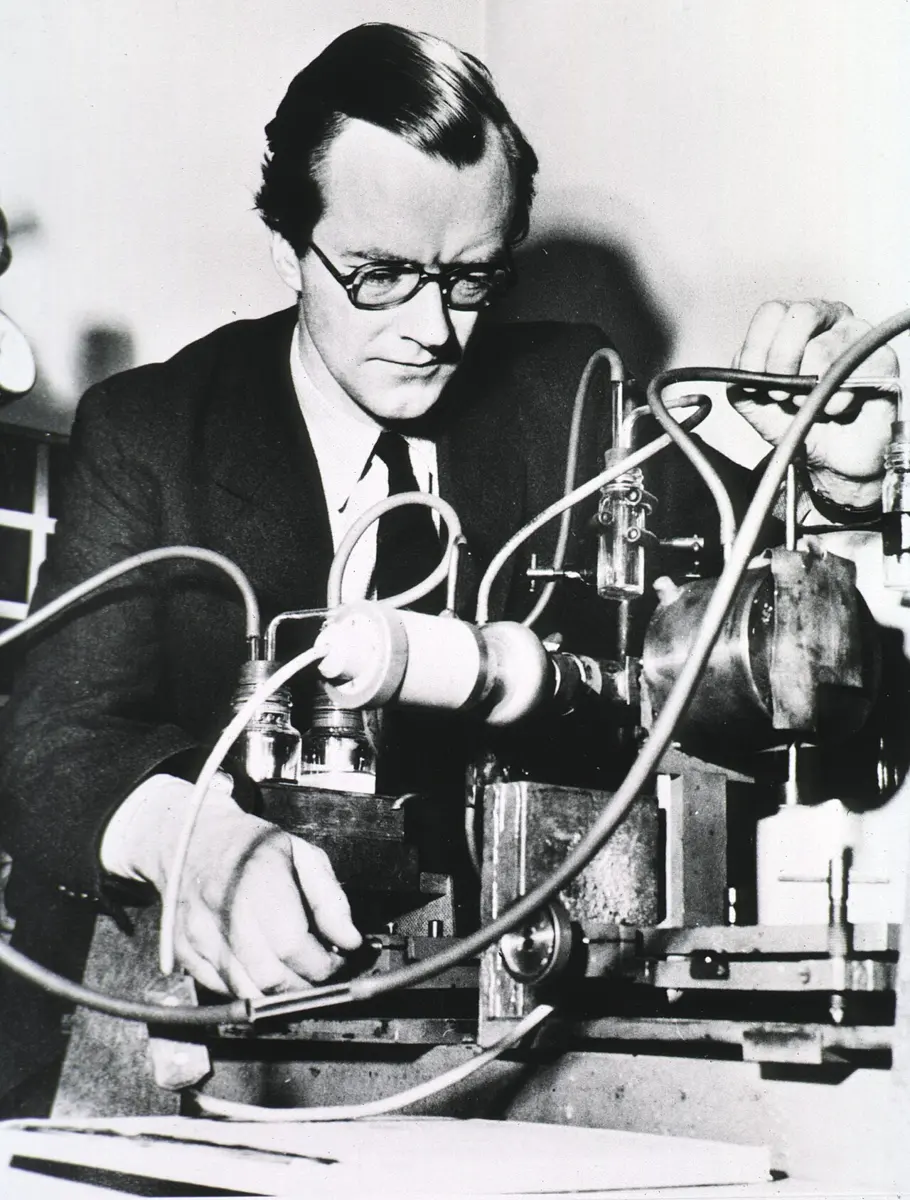
Maurice Wilkins
1916–2004, born in New Zealand
A physicist in London who first took clear X-ray pictures of DNA.
Photo: Wikimedia Commons, Public domain
Why do you look like your parents? Why does a mango seed grow into a mango tree and never into a rice plant? Every living thing passes on a set of instructions to its young, and those instructions are written in a substance called DNA.
By 1950, scientists were fairly sure DNA carried the instructions. But nobody knew what a DNA molecule looked like, so nobody could see how a molecule could store a message, or copy it. In 1953 that changed, when two young scientists in Cambridge worked out its shape: the double helix. In 1962 they and a scientist in London who photographed DNA with X-rays shared the Nobel Prize in Physiology or Medicine.
The problem: a message nobody could read
Inside almost every cell of your body is a nucleus, and inside it are long threads called chromosomes Grade 10: Chromosome. They are made of DNA and proteins. When a cell divides, it first copies its chromosomes, so that each new cell gets a full set Grade 10: Cell division.
DNA had been known since 1869, when a Swiss doctor, Friedrich Miescher, found a new substance in the nuclei of cells. For a long time people thought it was too simple to carry instructions. Proteins seemed a better guess, because they are built from 20 different pieces and DNA from only 4. Then two discoveries pointed to DNA:
- 1944: Oswald Avery and his team in New York showed that DNA taken from one strain of bacteria could pass its features on to another strain.
- 1950: Erwin Chargaff found a strange pattern. In DNA from any living thing, the amount of the base A always equals the amount of T, and G always equals C. Nobody knew why.
To understand how DNA works, scientists needed to know where its atoms are. A molecule is far too small to see with any microscope of the time, so that seemed impossible.
What DNA is made of
A DNA molecule is a very long chain built from small units called nucleotides Grade 10: DNA. Each nucleotide has three parts:
- a sugar (deoxyribose),
- a phosphate group,
- a base: one of four, adenine (A), thymine (T), guanine (G) or cytosine (C).
The sugars and phosphates join in a long chain, the backbone, with a base sticking out from every sugar. The order of the bases along the chain, for example ATTGCAG…, is the message, just as the order of letters on this page is a message. But how were the chains arranged in space? One chain, two, or three? Bases inside or outside?
Seeing the shape with X-rays
You cannot see a molecule, but you can shine X-rays through a sample of it. X-rays have a very short wavelength, about the size of the gaps between atoms Grade 9: X-rays. When they pass through a regular arrangement of atoms, they are scattered in some directions more than others, and they make a pattern of spots on a photographic film. This is called X-ray diffraction. The pattern is not a picture of the molecule, but with careful mathematics it tells you how the atoms are arranged.
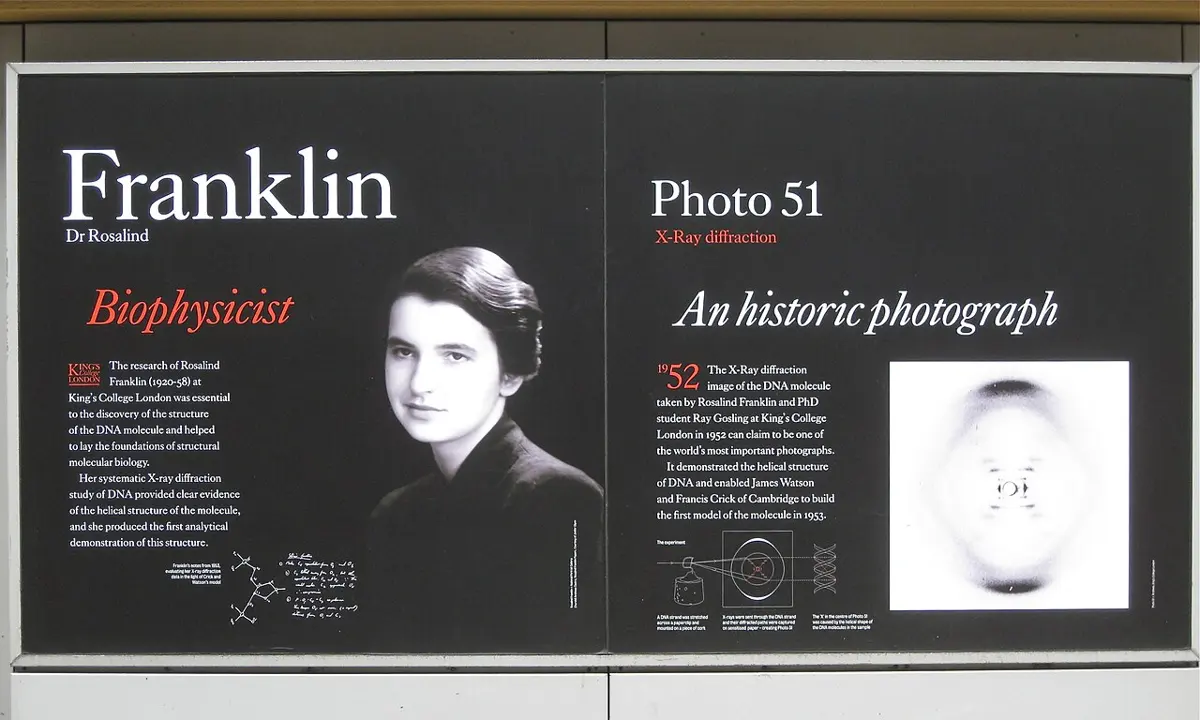
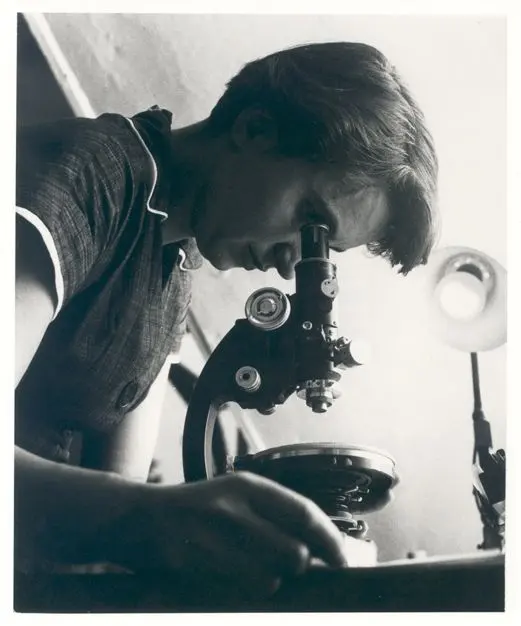
At King’s College London, Maurice Wilkins and his student Raymond Gosling pulled DNA into fibers finer than a hair and photographed them with X-rays. They got sharp patterns, which showed that DNA has a regular structure. In 1951 the chemist Rosalind Franklin joined King’s. She was an expert in X-ray diffraction. She found that DNA takes two forms, a dry one and a wet one, and took far better photographs of each.
In May 1952 Franklin and Gosling took their most famous picture of the wet form, Photo 51. It showed a clear X.
Why it was so hard
- The photo is a puzzle, not a picture. An X-ray pattern gives the spacings in a molecule, but not where each atom is. Many different shapes had to be tried and checked against it.
- The chemistry had to fit too. Every bond had to have the right length and angle, and the bases had to fit. Watson and Crick’s first model, in 1951, put the backbones in the middle; Franklin pointed out at once that it could not fit her data. Linus Pauling, one of the greatest chemists in the world, published a model with three chains in early 1953. It was wrong too.
- People did not work well together. At King’s, Wilkins and Franklin did not get on, and each worked mostly alone.
What they did, step by step
Wilkins and Franklin in London: the measurements (1950–1953)
The X-ray work at King’s gave the facts any model had to match: DNA is a helix, about 2 nm wide, and it makes one full turn every 3.4 nm. Franklin’s careful measurements also showed that the phosphates are on the outside of the helix, where they can take up water.
Watson and Crick in Cambridge: building a model (1951–1953)
James Watson, a 23-year-old American, came to the Cavendish Laboratory in Cambridge in 1951. There he met Francis Crick, a 35-year-old physicist still working on his doctorate. Both were sure that knowing DNA’s shape would explain how genes work. Instead of doing new experiments, they built models, like a 3D puzzle, out of metal plates and rods, and checked them against everything known.
- January 1953. Wilkins showed Watson Photo 51, without Franklin knowing. Watson saw the X at once and knew it meant a helix.
- February 1953. Crick saw a report of Franklin’s results, passed on by a senior scientist in Cambridge. Her measurements told him that the two chains run in opposite directions, one up and one down.
- The key idea. Watson cut out cardboard shapes of the four bases and moved them around on his desk. He saw that A joined to T has exactly the same shape and width as G joined to C. So if the bases pair up A with T and G with C, every rung of the ladder is the same width, and both chains fit neatly into a smooth helix. It also explained Chargaff’s pattern: there is always as much A as T because every A has a T partner.
- 25 April 1953. Their model was published in the journal Nature, in the same issue as papers by Wilkins’s group and by Franklin and Gosling with their X-ray evidence.
Why does DNA always contain exactly as much A as T, and as much G as C?
Pick an answer to see why.
After 1953: checking the model
At first the double helix was only a model that fitted the facts. Over the next years Wilkins and his team at King’s took much better X-ray photographs and showed in detail that the model was right. That is why he shared the prize.
How DNA works
Untwist the double helix and it looks like a ladder. The two sides are the sugar–phosphate backbones. Each rung is a pair of bases, one from each chain, held together by weak bonds called hydrogen bonds: two between A and T, three between G and C.
The shape explains the two things DNA has to do.
1. It stores a message. The order of the bases along one chain can be anything at all, so DNA can store any message, like letters in a book. A gene is a stretch of DNA whose bases carry the instructions for making one protein (How does a gene make a protein?). Your DNA has about 3 billion base pairs in each set of chromosomes, and you have two sets in almost every cell. Stretched out, the DNA in one cell would be about 2 meters long.
2. It can be copied. Because A always pairs with T and G with C, each chain decides what its partner must be. To copy DNA, a cell unzips the two chains. Each chain then acts as a pattern, and new bases are fitted against it, A against T, G against C. The result is two identical molecules, each with one old chain and one new one. Watson and Crick saw this in 1953 and wrote, very coolly: “It has not escaped our notice that the specific pairing we have postulated immediately suggests a possible copying mechanism for the genetic material.” In 1958 an experiment by Matthew Meselson and Franklin Stahl showed that cells really do copy DNA this way.
One chain of DNA has the bases A T T G C. What are the bases on the matching chain, opposite them?
Pick an answer to see why.
In your life today
- DNA tests. Because everyone’s DNA (except identical twins’) is different, a small sample of blood, hair or skin can show who it came from. Police use DNA in investigations, and DNA tests can show who a child’s parents are Grade 10: DNA testing in investigations.
- Medicine. Doctors test DNA to find inherited diseases, and to choose the right medicine for some cancers. Insulin for people with diabetes is now made by bacteria that have been given the human gene for it.
- Food and farming. DNA tests help plant breeders find the varieties of rice, maize and wheat that resist disease or drought.
- Vaccines. Scientists read the genes of the virus that causes COVID-19 within weeks of finding it, and several of the vaccines were designed from them.
What came next
- The genetic code. By 1966, scientists had worked out how each group of three bases stands for one of the 20 building blocks of proteins. One of them was Har Gobind Khorana, born in a village in British India, who shared the Nobel Prize in 1968.
- Reading whole genomes. In 2003 the Human Genome Project finished reading almost all 3 billion base pairs of human DNA, and the last gaps were filled in 2022. Today a person’s whole DNA can be read in a day.
- Editing DNA. In 2020 Emmanuelle Charpentier and Jennifer Doudna won the Nobel Prize in Chemistry for CRISPR, a way to cut and change DNA at an exact place.
- An open question: Only about 1–2% of human DNA holds the instructions for proteins. Some of the rest switches genes on and off at the right time. How much of the rest has a job at all, and what is it? Scientists are still arguing.
In your science books
- Grade 10: DNA (with a DNA activity using a banana), RNA, chromosomes, cell division and DNA testing in investigations.
- Grade 9: X-rays, the rays used to see the shape.
- Going further: How does a gene make a protein?, How does DNA show that all life is related? and Why do you look like your parents, but not exactly?
Learn more
- The prize at nobelprize.org: The Nobel Prize in Physiology or Medicine 1962, with the presentation speech.
- The Nobel lectures of Francis Crick, James Watson and Maurice Wilkins.
The official reason
The prize was given “for their discoveries concerning the molecular structure of nucleic acids and its significance for information transfer in living material.”