
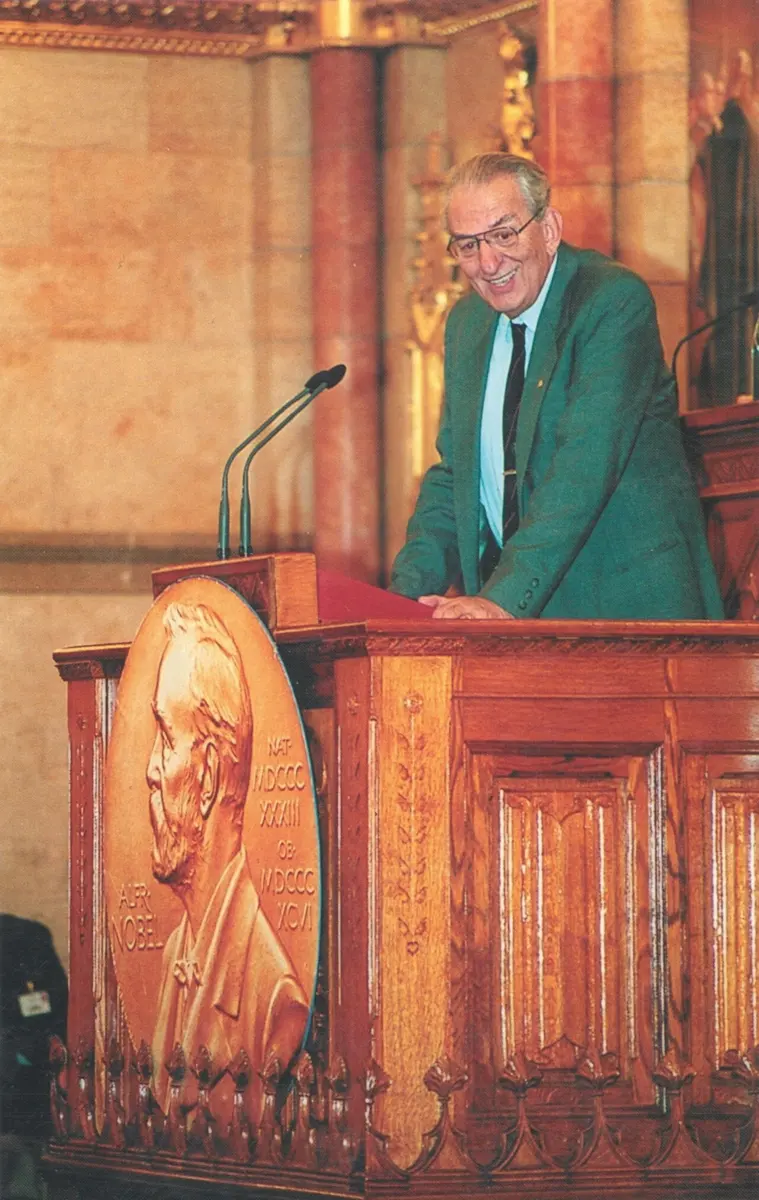
George A. Olah
1927–2017, born in Budapest, Hungary
A refugee who fled Hungary in 1956 with two boxes of belongings, and did his prize-winning work in a company laboratory in Canada.
Photo: Better Kiadó, CC BY-SA 3.0
Light a candle and watch it. The wax melts, climbs the wick and burns. Before it becomes carbon dioxide and water, the wax goes through many steps, one after another, far too fast to see. The same is true of almost every chemical change: there is a beginning, an end, and in between, a series of short-lived in-between molecules that nobody can catch.
One of the most important kinds of in-between molecule is the carbocation: a molecule in which one carbon atom carries a positive charge. Chemists believed in carbocations for forty years without ever seeing one, because each one lasts less than a millionth of a second. Then George Olah found a way to keep them alive in a bottle, long enough to be studied like any other chemical. For this he won the 1994 Nobel Prize in Chemistry, alone.
The problem: the middle of the story was missing
Think of a film where you see only the first scene and the last. A boy sets off from his village; at the end, he is a doctor in Kathmandu. You can guess what happened in between, but you can’t be sure. The chemist who presented the prize quoted his own teacher: not knowing how a reaction happens is like seeing only the first and last scenes of a play.
Chemists care about the middle because that is where they can control a reaction: make more of what they want and less of what they don’t. That is how medicines, plastics, dyes and fuels are made cheaply.
In the 1920s and 1930s, chemists in Britain (Christopher Ingold) and Germany (Hans Meerwein) studied how reactions of carbon compounds happen. They timed the reactions and looked at the shapes of the products, and the results only made sense if, in the middle, a carbon atom briefly lost a partner and became positively charged. They called these short-lived ions carbocations. But no one could show one. Were carbocations real, or only an idea in chemists’ heads?
How carbon usually behaves
A carbon atom has four electrons in its outer shell. To get a full set of eight, it shares them, making four covalent bonds Grade 9: Covalent bond in methane. Methane, CH₄, the main gas in a biogas plant, is a carbon with four hydrogen partners. Chemists say carbon is tetravalent: it has a valency of four Grade 9: Valency. Since the 1860s, this rule had been the starting point of all of organic chemistry.
Carbon compounds made only of carbon and hydrogen are called hydrocarbons Grade 10: Hydrocarbons. Petrol, diesel, kerosene, LPG and candle wax are all mixtures of hydrocarbons. And hydrocarbons, unlike table salt, are almost never made of ions. Salt is Na⁺ and Cl⁻ ions held together Grade 9: Positive ions; petrol is uncharged molecules.
A carbocation breaks this pattern. In the common kind, one carbon has only three partners instead of four, and has lost a pair of electrons with its fourth partner. It now has just six electrons in its outer shell, and a positive charge. It is flat, like a three-pointed star, and very “hungry” for electrons. It grabs the first thing that can give it a pair: a water molecule, a negative ion, almost anything nearby. That is why it lives for only a tiny fraction of a second: somewhere between about a ten-billionth and a millionth of a second.
Why does a carbocation normally last less than a millionth of a second?
Pick an answer to see why.
Why it was so hard
To study a molecule, chemists shine light or radio waves through it and measure what comes out. This is called spectroscopy, and it is like an extension of our eyes. But it needs plenty of the molecule, kept for at least a few seconds. Carbocations failed both ways:
- They didn’t last. Each one reacted almost the instant it was made.
- There were too few. At any moment, only a tiny number existed in the flask, far too few to measure.
- Everything around them was food. Water, alcohols and the usual liquids chemists dissolve things in all have electron pairs to give, so they destroyed carbocations at once.
Because no one could see them, chemists argued. One argument lasted decades: whether some carbocations, like one called the 2-norbornyl cation, had a carbon atom holding five partners at once. That would break the rule of four.
What Olah did, step by step
1. A chemist on a balcony (1950s, Budapest)
George Olah grew up in Budapest, Hungary, more interested in history and books than in science. He studied chemistry at the Technical University of Budapest after the Second World War. There he became interested in fluorine chemistry, a strange choice in a poor country after the war: he had to make even the basic chemicals himself. His professor gave him an open balcony at the back of the building, and his small group closed it in and turned it into the “balcony laboratory”.
In October 1956 the people of Hungary rose up against Soviet rule. The uprising was crushed. In December, Olah escaped with his wife Judith (also a chemist), their young son and much of his research group, and about 200,000 other Hungarians fled too.
2. A refugee in Canada (1957)
After some months in London, the family moved to Canada. In May 1957 Olah joined a new laboratory of the Dow Chemical Company in Sarnia, Ontario. The family took their worldly goods on the train in two cardboard boxes.
3. The first long-lived carbocation (late 1950s to 1962)
Olah searched through many substances that pull hard on electrons and finally found the right one: antimony pentafluoride, SbF₅. It is a fierce electron-puller. When he dissolved a compound called tert-butyl fluoride in it, the SbF₅ pulled the fluorine off, together with its pair of electrons. What was left was a carbocation, the tert-butyl cation, with a positive carbon in the middle and three CH₃ groups around it.
This time the carbocation survived, for two reasons:
- Nothing to grab. The fluorine, now part of the ion SbF₆⁻, held its electrons so tightly that it couldn’t give any back. And Olah used liquids like sulphur dioxide, which hardly react with carbocations, instead of water or alcohol.
- Bitter cold. He kept his solutions at about −78 °C, the temperature of dry ice, and later even colder, which slows every reaction down.
Now a carbocation was like a hungry person locked in a room with no food: hungry, but still alive.
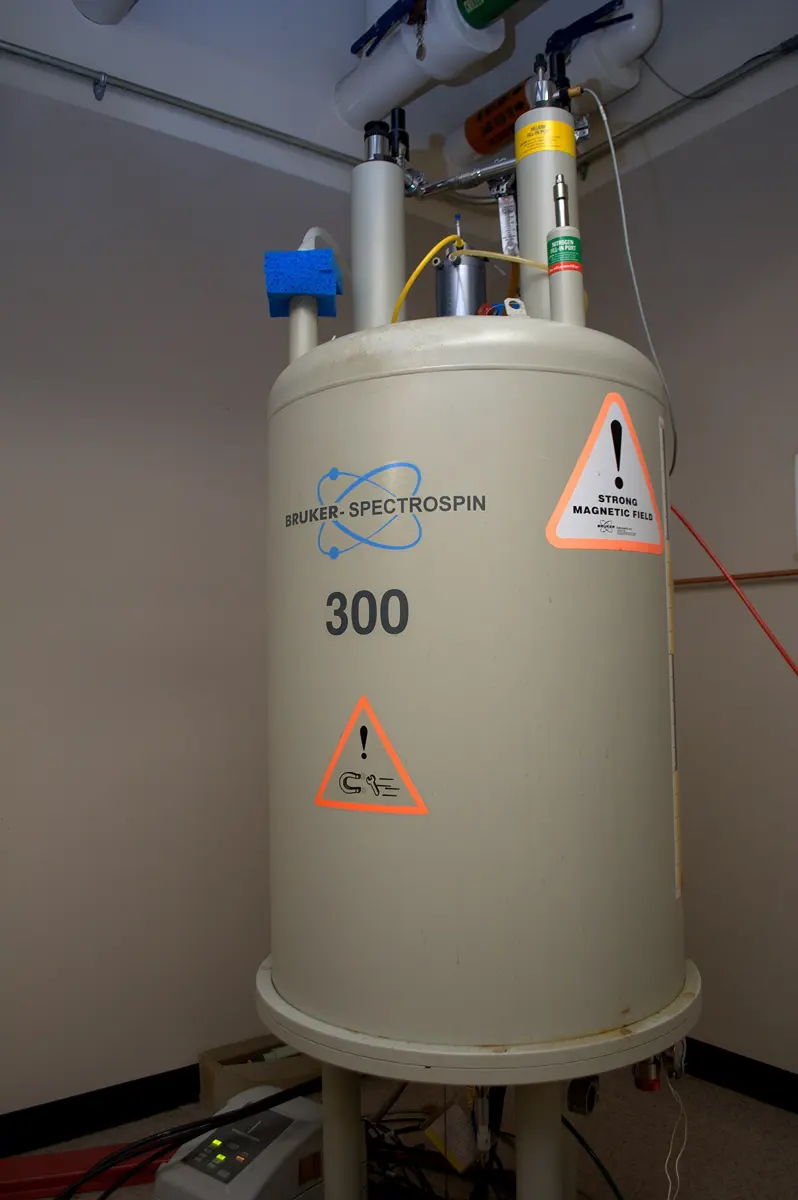
To prove he had made a carbocation, Olah needed NMR spectroscopy, a machine with a very strong magnet that “listens” to the centers of hydrogen and carbon atoms. Each atom answers at a slightly different note, depending on its neighbors. A carbon carrying a positive charge answers at a very different note from a normal carbon.
Dow’s Canadian laboratory had no NMR machine. So early in the morning, Olah and his colleagues drove their samples about 160 km (100 miles) across the border to Dow’s main laboratory in Midland, in the United States, and watched a physicist there, Ned Baker, measure them. The carbon in the middle answered far away from where any normal carbon does, just as a positive, flat carbon should. Olah published this in 1962.
That summer, Olah presented his results at a big meeting in the United States. The star speakers were Saul Winstein and Herbert C. Brown, the two sides of the argument over the 2-norbornyl cation. Both took the young man aside and warned him to be very careful: surely, they said, he must be wrong. He wasn’t.
4. Superacids (1960s)
Olah went on to use even stronger mixtures, such as SbF₅ mixed with fluorosulphuric acid or with hydrogen fluoride. Acids give hydrogen ions, H⁺ Grade 8: Acids give hydrogen ions. These mixtures give them so forcefully that they are called superacids: acids stronger than pure sulphuric acid. Some were first described by the Canadian chemist Ronald Gillespie. Measured on chemists’ scale of acid strength, the strongest are billions of times stronger than pure sulphuric acid.
A superacid can push an H⁺ onto almost anything. Add it to an alcohol or a hydrocarbon, and you get a carbocation, in large amounts, that lasts in the cold long enough to be studied. Olah and his students made and measured hundreds of different carbocations this way.
5. Carbon with five partners (1960s to 1980s)
Superacids are so strong they can push an H⁺ even onto methane, which has no spare electrons at all. Olah showed that this makes CH₅⁺: a carbon with five hydrogen partners. There are only four pairs of electrons to go round, so two of the hydrogens and the carbon share one pair between the three of them (look back at Figure 1). Olah called these five-partner ions carbonium ions, and the usual three-partner kind carbenium ions.
And the 2-norbornyl cation? Olah and his co-workers finally made it in a superacid solution at −158 °C and studied it by NMR. It had one carbon reaching out to five partners, as Winstein had said, not a three-partner ion flipping back and forth, as Brown had said. The argument, which had lasted about thirty years, was over by about 1980. Carbon could hold more than four partners: the rule of four had an exception.
How it helps make petrol
Petrol is burnt in an engine by a spark. A poor petrol catches fire on its own when it is squeezed, before the spark, with a rattling noise called knocking. Knocking wastes fuel and can damage the engine. How well a petrol resists it is its octane number: straight-chain heptane is given 0, and a branched hydrocarbon called iso-octane 100.
Hydrocarbons with the same formula can have their carbon atoms joined in different ways: in one straight chain, or with branches. These are called isomers. In petrol, the straight chains knock easily, and the branched ones burn smoothly. Branched chains are also broken down more easily by bacteria if they are spilled.
Turning straight chains into branched ones needs a carbocation. An acid catalyst makes a carbocation from a straight chain; the positive charge lets the chain rearrange into a branched shape; then the catalyst lets go of the new molecule. Olah’s work showed exactly how these steps happen and how superacids can drive them, even at low temperatures. Refineries make high-octane petrol this way, using solid acid catalysts Grade 10: Catalyst.
Two petrols have the same formula, C₆H₁₄. One is a straight chain, the other branched. Which is the better fuel for a car engine?
Pick an answer to see why.
In your life today
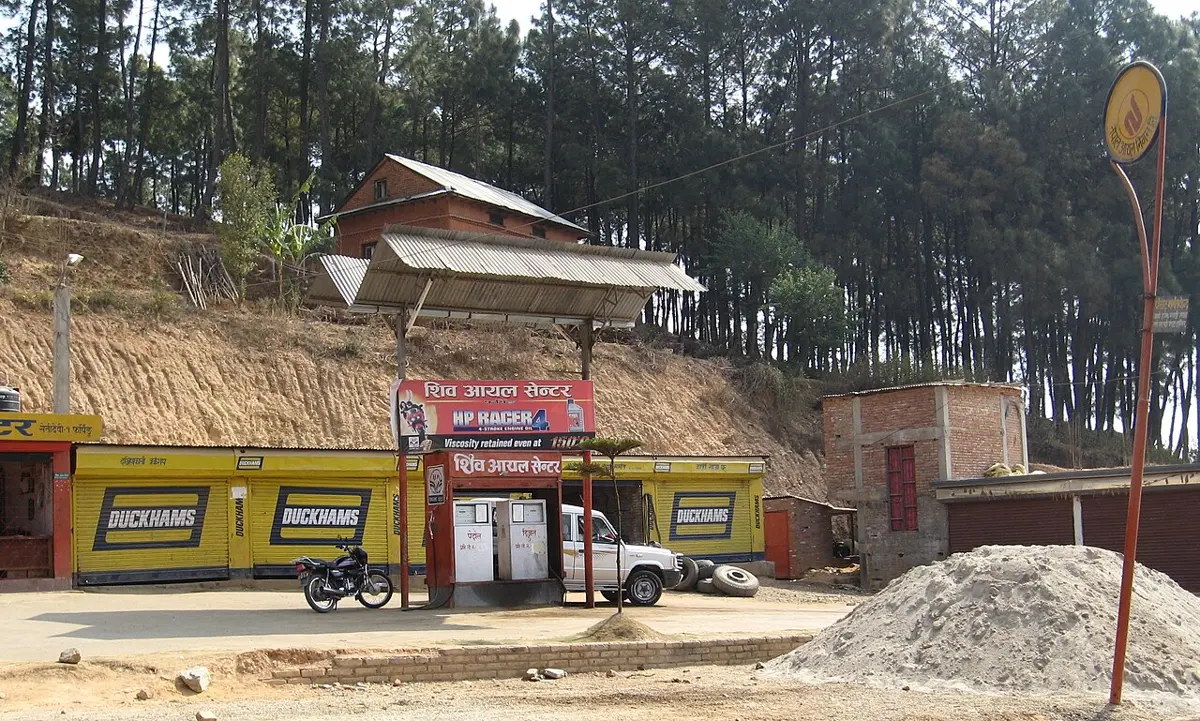
- Petrol. Nepal has no oil refinery; its petrol comes from refineries in India. Every liter of it was blended with branched hydrocarbons so that motorbikes and cars run without knocking, and carbocation chemistry is part of how those branched molecules are made.
- Plastics and medicines. Many reactions that make plastics, dyes and medicines go through carbocations, from making the building blocks of polystyrene to joining pieces of a drug molecule (From oil to a plastic bucket). Knowing what the in-between molecules look like lets chemists design these reactions instead of guessing.
- Every chemistry textbook. Carbocations now appear in every university textbook of organic chemistry.
What came next
- Methane into fuel. Olah showed that superacids could join methane molecules into bigger hydrocarbons, and crack heavy oil and turn coal into liquid fuel under surprisingly mild conditions.
- The methanol economy. In his later years Olah worried that oil and gas will run out. He proposed making methanol, CH₃OH, from carbon dioxide and hydrogen, using energy from the sun, wind or rivers, and using it as a fuel and as a starting point for plastics Grade 10: Methanol. In Iceland, a factory named after him makes methanol in just this way, from carbon dioxide and hydrogen.
- The open question. Turning carbon dioxide back into fuel takes a lot of energy. Can it be done cheaply enough, on a big enough scale, to replace oil? Chemists are still trying to find out.
In your science books
- Grade 9: valency, positive ions and the covalent bonds in methane: carbon’s four partners.
- Grade 10: hydrocarbons and alkanes, methanol, and catalysts.
- Grade 8: acids give hydrogen ions.
- Going further: lowering the hill: catalysts, how many hands an atom has, and oil is made of chains.
Learn more
- The Swedish Academy’s press release, which explains the discovery, and the presentation speech (nobelprize.org).
- Olah’s Nobel lecture, My search for carbocations and their role in chemistry, and his own life story.
The official reason
The prize was given “for his contribution to carbocation chemistry.”