
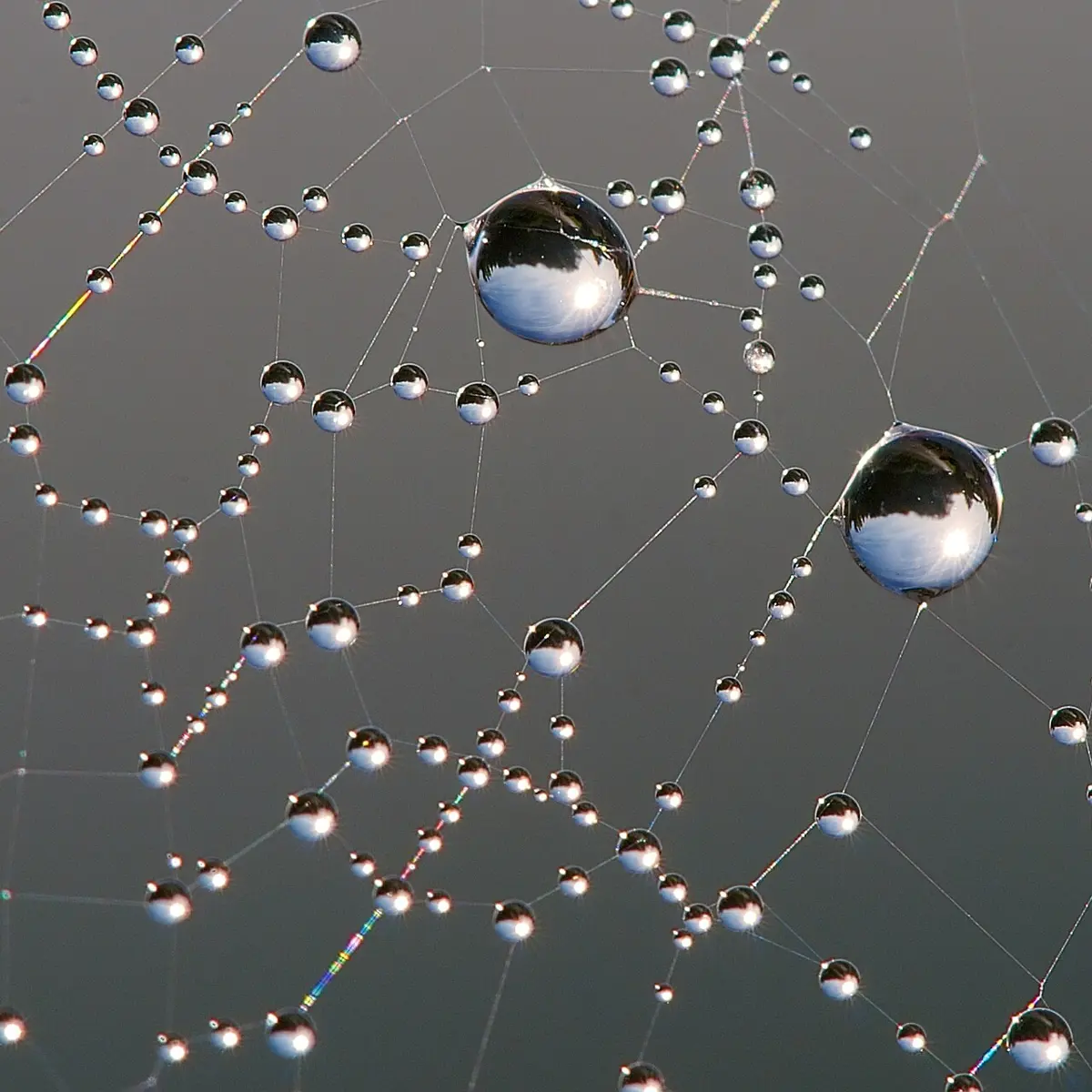
On an autumn morning in the Kathmandu valley, look between two bushes or across a window, and you may see a spider’s web picked out in dew. When it is dry you can hardly see it: its threads are only a few thousandths of a millimeter thick, about a twentieth of the width of one of your hairs. Yet a fly that crashes into it at full speed is stopped, and the web doesn’t break.
Weight for weight, the thread a spider hangs from is about four times as strong as high-tensile steel, the kind twisted into the wire ropes of Nepal’s trail bridges. It soaks up more energy before it snaps than Kevlar, the fiber in bulletproof vests. And the spider makes it at room temperature, from a protein dissolved in water.
The secret isn’t a special element. Silk is made of carbon, hydrogen, oxygen and nitrogen, like your hair and your food. The secret is the shape of its molecules and how they are arranged. This topic is about how the structure of molecules decides what a material can do, and how chemists now design materials, and even medicines, from the molecules up.
Strong, stiff, stretchy, tough
“Strong” is not one thing. Think of four things you can pull: a steel wire, a rubber band, a strip of polythene bag and a thread of glass fiber. Each one is good at something different. To compare them fairly, we need words for the differences, and ways to measure them.
Stress: force on each square millimeter
A thick rope holds more than a thin one of the same stuff. Twice the cross-sectional area holds twice the force. So to compare materials, not ropes, divide the force by the area it is spread over. This is the stress:
Its unit is N/m², the pascal (Pa), the same as for pressure Grade 10: Pressure. Materials hold enormous stresses, so they are measured in megapascals: 1 MPa = 1,000,000 Pa, which is exactly 1 N on each square millimeter. (σ is the Greek letter sigma.)
The stress at which a material breaks is its tensile strength (or just its strength). It is a property of the material: a thick wire and a thin wire of the same steel have the same strength, though the thick one needs a bigger force to break it.
Strain: how far it stretches
A 10 cm rubber band stretched by 5 cm and a 1 m rope stretched by 5 cm are not stretched equally. So we divide the extension by the original length. This is the strain:
It has no unit; we often give it as a percentage. The strain when the material breaks tells you how stretchy it is.
Stiffness is how hard you must pull to stretch a material a little: the stress needed for each bit of strain, the steepness of its stress–strain graph at the start. Steel is very stiff; rubber is not stiff at all.
Weight for weight
Steel is strong, but heavy: a cubic centimeter of it has a mass of 7.85 g, while spider silk is only 1.3 g. “Weight for weight” compares materials by how much they hold for their mass. A neat way to do it: imagine hanging a long thread from a cliff, longer and longer, until it snaps under its own weight. How long can it be?
A thread of length L, area A and density ρ has a mass ρAL, so its weight is ρALg. That weight hangs from the top of the thread, so the stress there is ρALg ÷ A = ρLg. It snaps when that reaches the strength σ. So the breaking length is
The area cancels: a thick rope and a fine thread of the same material snap at the same length. That makes it a fair, weight-for-weight test.
Toughness: the energy it takes to break
A glass rod is strong and stiff, yet you can snap it with a sharp tap. A rubber band is weak, but hard to break by jerking it. What matters when something is hit, or something falls on a rope, is toughness: how much energy a material soaks up before it breaks.
Pulling a thread is doing work on it, force × distance. Stress × strain is (force ÷ area) × (extension ÷ length) = (force × extension) ÷ (area × length): the work done on each cubic meter of the material. So the area under a stress–strain graph is the energy taken in by each cubic meter, and the area up to the break is the toughness. Its unit is J/m³. Because 1 Pa = 1 N/m² = 1 J/m³, an area measured in MPa (on the graph’s side) × strain gives MJ/m³.
To be tough, a material has to hold a big stress and stretch a long way before it breaks. That is where spider silk wins.
| Material | Strength (MPa) | Stretch when it breaks | Toughness (MJ/m³) | Density (g/cm³) | Breaking length (km) |
|---|---|---|---|---|---|
| high-tensile steel | 1,500 | 0.8% | 6 | 7.85 | 20 |
| carbon fiber | 4,000 | 1.3% | 25 | 1.8 | 230 |
| Kevlar | 3,600 | 2.7% | 50 | 1.44 | 255 |
| silkworm silk | 600 | 18% | 70 | 1.35 | 45 |
| spider dragline silk | 1,100 | 27% | 160 | 1.3 | 86 |
| synthetic rubber | 50 | 850% | 100 | about 1 | about 5 |
Data: Gosline and others (1999), for the silk of the European garden spider and the domestic silkworm; densities typical values.
A climbing rope must catch a climber who falls. Which property matters most?
Pick an answer to see why.
Long molecules
Why can silk, rubber and plastic stretch so far, when steel and glass break after stretching less than one per cent? The answer starts with carbon.
You learned in Grade 9 that carbon atoms can join to each other in long chains Grade 9: Catenation. The chains in the plastics around you are thousands of atoms long, and they are made by joining small molecules end to end, like the beads of a mala.
The small molecule is the monomer (“one part”). The long molecule made from it is a polymer (“many parts”), and joining them is polymerization. The simplest example is polythene (polyethylene), the plastic of carrier bags, milk packets and water tanks. Its monomer is ethene, C₂H₄, with a double bond between its two carbon atoms Grade 10: Alkenes. Under heat and pressure, or with a catalyst, one bond of each double bond opens, and the carbons link up with their neighbors into one long chain:
We write this as
Now here is a puzzle. Candle wax (paraffin wax) is made of exactly the same kind of molecule: chains of carbon with two hydrogens on each carbon, nothing else. But a wax molecule has only 20 to 40 carbon atoms. Wax is soft and crumbles when you bend it. A polythene bag bends, stretches and is hard to tear. The only difference is the length of the chains.
Two things change when the chains get long.
- The pulls between chains add up. Between any two molecules there are weak, flickering pulls, and the longer the molecules, the more they add up (you met them in Why Does Salt Melt at 801 °C but Ice at 0 °C?). A chain of thousands of carbons lies alongside its neighbors over its whole length, so it is held by thousands of these small pulls at once.
- The chains get tangled. Think of a plate of chau chau noodles. Pick up one long noodle and others come with it, because they are wound round each other. Short pieces of broken noodle just fall apart. Long chains in a plastic are tangled in the same way, so to pull the material apart you must drag chains out of the tangle.
These pulls between chains, and the tangles, are what hold a plastic together. The strong covalent bonds along each chain are rarely the ones that break first.
Candle wax and polythene are both made of chains of –CH₂– groups. Why does wax crumble while polythene stretches?
Pick an answer to see why.
Polymers are not only made in factories. Living things build them too: cellulose in cotton, paper and wood is a polymer of glucose; natural rubber comes from the sap of the rubber tree; and proteins, in hair, muscle, wool and silk, are chains of amino acids, often hundreds or thousands long.
How the chains are arranged
You saw in Grade 9 that diamond and graphite are both pure carbon, yet one is hard and one is soft, because their atoms are arranged differently Grade 9: Allotropes and allotropy. Polymers are the same: chains of the same kind can make very different materials, depending on how they lie and how they are joined.
Tangled. In a polythene bag the chains are tangled like noodles, held only by the weak pulls between them. Pull hard and the chains slowly slide past each other and straighten. Let go, and they stay where they are: the bag stays stretched. Heat it and the chains slide freely, so the plastic softens and melts, and can be molded again. Plastics like this are called thermoplastics.
Even the branches on the chains matter. In the soft polythene of carrier bags, the chains have many short side branches, which stop them packing closely. In the harder polythene of buckets and jerrycans, the chains are almost unbranched, so they pack neatly side by side in places, the pulls between them are stronger, and the plastic is stiffer.
Cross-linked. In a rubber band the long chains are coiled and tangled too, but here and there they are tied to each other by short bridges of strong covalent bonds, made of sulphur atoms. These are cross-links. Pull the band and the coiled chains between the cross-links straighten out, so the band stretches a long way. But the chains can’t slide away, because they are tied. Let go, and the constant jiggling of the atoms shakes the chains back into coils: the band springs back. Heat doesn’t melt it either: a car tyre doesn’t go soft on a hot road.
Raw rubber from the tree has no cross-links. It is sticky in summer and brittle in winter. In 1839 the American inventor Charles Goodyear found that heating it with sulphur made it springy and stable: the sulphur forms the cross-links. The process is called vulcanization, and almost all rubber is made this way.
Lined up. When a plastic is pulled out into a fiber, its chains are dragged into line, side by side along the fiber. Now every chain touches its neighbors along its whole length, and to pull the fiber apart you would have to break the chains themselves, with their strong covalent bonds. A fiber with lined-up chains is very strong along its length (and much weaker across it), and it hardly stretches, because the chains are already straight.
Kevlar is made of stiff, rod-like chains, with rings of carbon atoms in them, that line up almost perfectly; and between the chains there are hydrogen bonds, which are stronger than the flickering pulls. Dyneema is polythene with chains hundreds of thousands of carbons long, drawn out until nearly all of them are lined up: fibers of it are strong enough for ships’ ropes and bulletproof panels, and so light that they float.

A strip of polythene bag is pulled until it has stretched to several times its length. It is now much harder to stretch it any further. Why?
Pick an answer to see why.
Inside a spider’s thread
Silk is a protein, and a protein is a polymer too: a chain of amino acids, small molecules of about twenty kinds, joined end to end. The protein of a spider’s dragline, spidroin, is several thousand amino acids long, and its pattern repeats again and again, in two kinds of stretch.
- Runs of alanine, one of the smallest amino acids, several in a row. Where runs like these from several chains lie side by side, they pack into tiny, tightly ordered blocks a few nanometers across, held together by rows of hydrogen bonds between the chains. These blocks are crystals (chemists call them β-sheet crystals, “beta sheets”).
- Stretches rich in glycine, the smallest amino acid of all, between the runs of alanine. These don’t pack neatly. They stay coiled and loose, held to each other only by a few hydrogen bonds here and there.
So a thread of dragline silk is made of countless long chains, each passing through many hard crystal blocks, with coiled, springy stretches between them. The crystals tie the chains together, like the cross-links in rubber, but much stronger. The coiled parts give the thread its stretch.
Here is how the two parts make silk both strong and tough:
- At first, the hydrogen bonds between the coiled parts hold everything in place, so the thread is stiff for its first two per cent of stretch.
- Then those hydrogen bonds begin to break, one after another, and the coiled parts unwind. Each bond that breaks takes in a little energy, and there are billions of them, so the thread soaks up a great deal of energy as it stretches.
- By the end, the chains between the crystals are nearly straight. Now the pull is carried by the crystals and by the strong covalent bonds along the chains, which is where the thread’s strength comes from.
A thread like this stretches far and holds a big stress at the end: it is tough. And it doesn’t bounce. When an insect hits the web, about two-thirds of the energy the silk soaks up is turned into heat as the hydrogen bonds break, not stored like the energy in a stretched spring. So the web doesn’t fling the insect back out like a trampoline.
In dragline silk, what is the main job of the tiny crystal blocks?
Pick an answer to see why.
One spider, many silks
A spider makes up to seven kinds of silk, each from its own gland, each with its own protein. The two most important in an orb web are very different.
The capture spiral is made of a protein with almost no runs of alanine, so it has hardly any crystals. Its chains are springy coils all through, and it can be stretched to more than three times its length before it breaks. A flying insect hits the spiral, which gives way and slows it, while the strong, stiffer spokes carry the load to the frame. Two materials, each designed by its molecules for its job.
The silk of the silkworm, the caterpillar of the silk moth, is built the same way, with crystal blocks between looser chains, but its pattern is different and it is less tough than dragline silk. In Nepal, silkworms are raised on mulberry leaves, by farmers trained at the government’s sericulture farm at Khopasi in Kavre, set up in 1974/75. Spiders can’t be farmed like silkworms: kept together, they eat each other.
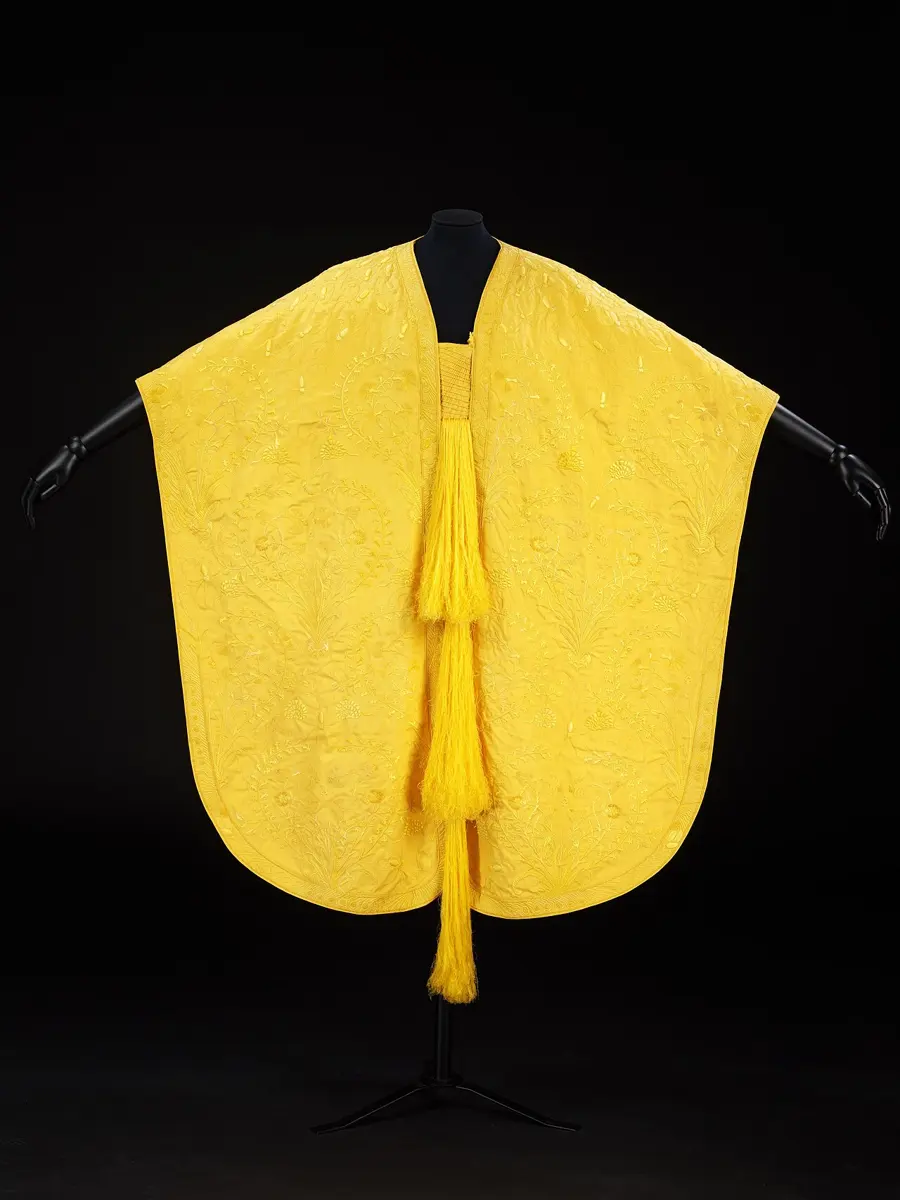
People have tried for decades to make spider silk without spiders, by putting the gene for spidroin into bacteria, yeast or silkworms, then spinning the protein they make into fibers. The hard part is that the protein must be very long, and spun the way a spider does it. In 2018 a team in the USA made bacteria produce spidroin chains of almost 200 repeats, and spun fibers that matched natural dragline in strength, stiffness, stretch and toughness. Making such fibers cheaply, in large amounts, is still a challenge (as of 2026).
Designed from the molecules up
The silk of a spider was shaped by evolution. Today chemists and engineers do the same on purpose: they choose or design a material’s molecules for the job it must do. Here are three everyday examples.
Wires: metal inside, plastic outside
Look at a piece of electric cable. Inside is copper; outside is a plastic coat, usually PVC. Each is chosen for its structure.
In a metal, the atoms let go of their outermost electrons, which wander through the whole metal Grade 9: What is inside a metal. Push on them with a voltage and they drift along the wire: a current. That is why wires are made of metal. And because the rows of metal ions can slide past each other in that sea of electrons without coming apart, copper can be drawn into thin wire and bent again and again.
In a plastic, every electron is held in a covalent bond between two particular atoms, or close to one atom. There are no free electrons to carry a current, so the plastic insulates. Its long, tangled chains also make the coat flexible and hard to tear.
Non-stick pans: a chain sheathed in fluorine
The coating of a non-stick pan is PTFE (polytetrafluoroethylene, sold as Teflon): a long carbon chain like polythene, but with a fluorine atom where each hydrogen would be. Fluorine holds on to its electrons very tightly, so the electrons around the chain hardly flicker, and the pulls between PTFE and anything touching it are among the weakest of any solid: food and water slide off. The C–F bonds are among the strongest single bonds, so the coating stands up to cooking heat and almost every chemical.
PTFE was found by accident. In 1938 Roy Plunkett, a chemist at DuPont, opened the valve of a cylinder that should have been full of the gas tetrafluoroethylene, and nothing came out. He cut the cylinder open and found a waxy white powder inside: the gas had polymerized on its own.
Medicines shaped to fit
Your body runs on proteins, and many of them work by holding other molecules in a pocket in their surface, a pocket with a particular shape, and with charged and slightly charged spots in particular places. A molecule that fits the pocket, and whose charges match the pocket’s, is held there by hydrogen bonds and by the pull between opposite charges (Coulomb’s law). A molecule of the wrong shape doesn’t fit, and is not held.
Many medicines work by fitting a protein’s pocket and blocking it, so that the molecule that is meant to go there can’t. To design such a medicine, chemists work out the pocket’s shape and charges, then build a molecule to match.
Why is the plastic coat of an electric cable an insulator, while the copper inside conducts?
Pick an answer to see why.
Questions
A steel wire and a spider’s dragline both break. The steel wire needed a much bigger force. What can you conclude?
Pick an answer to see why.
Here are the repeating units of two polymers: polythene, –CH₂–CH₂–, and a nylon whose chain contains –CO–NH– groups, where a hydrogen is joined to a nitrogen and an oxygen is joined to a carbon. Which do you expect to melt at the higher temperature?
Pick an answer to see why.
A Kevlar fiber is 12 µm thick. Kevlar’s strength is 3,600 MPa. (i) What force breaks one fiber? (ii) A rope is made of 100,000 such fibers side by side. What mass could it hold, in theory? (Take g = 9.8 m/s².)
Answer
- i.Radius 6.0 × 10⁻⁶ m, so A = πr² = 3.14 × (6.0 × 10⁻⁶)² = 1.13 × 10⁻¹⁰ m². F = σA = 3.6 × 10⁹ Pa × 1.13 × 10⁻¹⁰ m² = 0.41 N.
- ii.100,000 fibers hold 100,000 × 0.41 N = 41,000 N. The mass is m = F/g = 41,000 ÷ 9.8 ≈ 4,200 kg, about 4 tonnes. (Real ropes hold less: the fibers don’t all take the load equally, and engineers allow a safety margin.)
Silkworm silk has a strength of 600 MPa and a density of 1,350 kg/m³. Work out its breaking length, and compare it with spider dragline (86 km) and steel (20 km).
Answer
L = σ ÷ (ρg) = 6.0 × 10⁸ ÷ (1350 × 9.8) = 4.5 × 10⁴ m = 45 km. Weight for weight, silkworm silk is about twice as strong as steel, but only about half as strong as spider dragline.
Use the table in this topic to explain why a web woven from steel wire as thin as spider silk would be a poor web.
Answer
Steel is stronger than silk (1,500 MPa against 1,100 MPa), but it stretches only 0.8% before breaking, against silk’s 27%, so its toughness is only 6 MJ/m³, against silk’s 160. A web’s job is to stop a flying insect, taking in its kinetic energy. A steel web of the same thickness could take in only about a twenty-fifth as much energy before breaking, so an insect would snap its threads; and since steel springs back instead of turning the energy into heat, an insect that didn’t break it would bounce out. It would also be six times as heavy for the spider to make and carry.
Candle wax is made of molecules like C₂₅H₅₂. Polythene is made of molecules like C₂₀₀₀₀H₄₀₀₀₂. Using these molecular structures, explain why a polythene bag can be stretched and is hard to tear, but a stick of wax snaps.
Answer
Both are chains of carbon atoms with hydrogens, held to their neighbors only by weak pulls between molecules. A wax molecule is only 25 carbons long, so each one touches its neighbors over a short length, the pulls holding it are few, and the molecules are too short to tangle. When wax is bent, the molecules slip away from each other and it cracks. A polythene molecule is 20,000 carbons long: it lies alongside its neighbors over a great length, so the many small pulls add up, and the long chains are tangled together. To pull the bag apart, chains must be dragged out of the tangle, so it stretches as they slide and straighten instead of snapping.
A shopkeeper asks you why an electric cable has copper inside and plastic outside. Write a short explanation (four or five sentences) that someone without a science education would understand, using what you know about how the particles are arranged in each material.
Answer
A model answer: “Electricity in a wire is tiny charged particles, electrons, moving along it. In copper, as in every metal, some of the electrons aren’t tied to any one atom: they are free to wander through the whole wire, so they can carry the electricity. In plastic, every electron is held tightly between its atoms, so none can move along, and the electricity can’t get through. That is why the copper carries the current to your lamp, and the plastic coat stops it from reaching your hand. The plastic is also made of long, tangled molecules, which is why the coat bends without cracking.”
Explain, in terms of its molecules, why a rubber band springs back when you let go, but a stretched polythene bag doesn’t.
Answer
In both, the material is made of long chains that are coiled and tangled, and stretching straightens them out. In rubber, the chains are tied to each other at many points by cross-links, short bridges of covalent bonds (sulphur atoms), so they can straighten but can’t slide past each other. When the band is let go, the jiggling of the atoms coils the chains up again, and the cross-links pull the whole band back to its shape. Polythene has no cross-links: its chains slide past each other as it is stretched, and when it is let go there is nothing to pull them back, so it stays stretched.
How does the structure of dragline silk make it both strong and tough? Answer in three or four steps.
Answer
- Each long protein chain passes through many tiny crystal blocks, where runs of alanine from several chains are packed together and held by rows of hydrogen bonds; between the blocks, the chain is coiled.
- When the silk is pulled, the hydrogen bonds between the coiled parts break one after another and the coils unwind, so the thread stretches a long way (about 27%), and every bond broken soaks up energy.
- At the end, the chains are nearly straight and the load is carried by the crystals and the covalent bonds along the chains, so the thread also holds a large stress (about 1,100 MPa).
- Toughness needs both a large stress and a large stretch (the area under the stress–strain graph), so silk is tougher than steel or Kevlar.
Where to go next
- Why Does Salt Melt at 801 °C but Ice at 0 °C? The pulls between molecules, and hydrogen bonds, that hold plastics, rubber and silk together, measured with a thermometer.
- Why Is Gravity So Weak? Every material’s strength comes from electric forces between its particles. How strong those forces are, and the law they follow.
- Why Do Airbags Save Lives? Why a stop spread over a longer distance and time means a smaller force: the reason tough, stretchy materials protect us.