
How your nose knows: the smell receptors
Nobel Prize in Physiology or Medicine, 2004: Richard Axel and Linda Buck

Richard Axel
born 1946 in New York, USA
The son of a tailor in Brooklyn. He was such a clumsy medical student that he was allowed to graduate only if he promised never to treat living patients.
Photo: The Royal Society, CC BY-SA 4.0

Linda Buck
born 1947 in Seattle, USA
She first studied psychology, then the immune system. One scientific paper about smell, which she read in the 1980s, made her decide to find the smell receptors.
Photo: The Royal Society, CC BY-SA 4.0
Close your eyes in a kitchen. You can tell at once whether rice is cooking, onions are frying in ghee or the milk has boiled over. You know the smell of rain on dry earth, of incense at a temple, of a ripe mango. And if the gas cylinder leaks, its smell warns you before anything can go wrong.
People can tell apart thousands of different smells, and remember them for years. But until 1991 nobody knew how the nose does it. That year, Richard Axel and Linda Buck found the answer, and in 2004 they shared the Nobel Prize in Physiology or Medicine.
The problem: the most mysterious sense
What is a smell?
A smell is made of molecules. When you fry onions, tiny molecules escape from the pan, spread through the air, and some of them reach your nose when you breathe in. Each kind of smelly molecule has its own shape and size (Molecules have shapes).
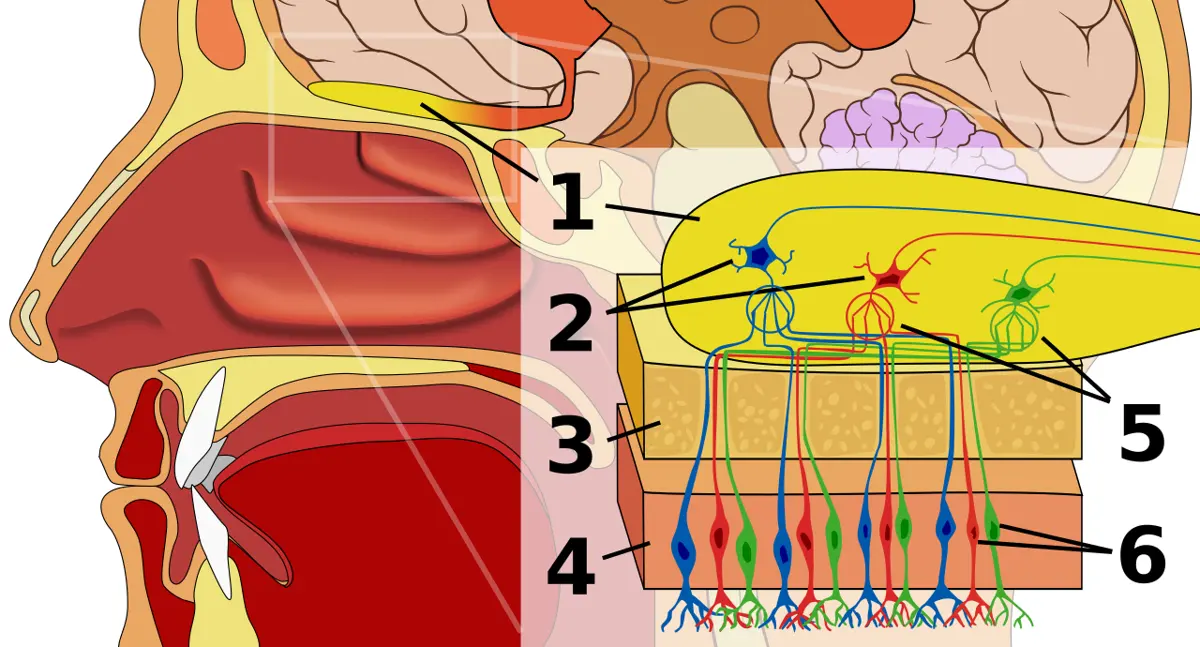
High up in the roof of each side of your nose there is a small patch of lining, about the size of a postage stamp. It holds millions of smell cells. Each is a nerve cell Grade 9: Neuron or nerve cell with tiny hairs that hang down into a thin layer of mucus, where the smell molecules dissolve. Each smell cell sends a thin nerve fiber up through a plate of bone to the brain.
The big question
But how does a smell cell tell one molecule from another? In 1985, scientists suspected that the answer lay in receptors: proteins on the surface of the smell cells’ hairs that a molecule could fit into, like a key into a lock. When the right molecule fits, the cell sends an electrical signal to the brain.
Nobody had ever found such a receptor. Nobody knew how many there were. One for every smell? Ten thousand of them? And even if they could be found, how could a few kinds of cell tell apart so many smells?
What are smell receptors?
Pick an answer to see why.
Why it was hard
Every cell in your body carries the same genes, about 20,000 of them Grade 10: DNA. Somewhere among them were the instructions for the smell receptors. But finding one kind of gene among so many, without knowing what it looked like, was like searching a whole library for a book when you know neither its title nor its language.
The smell cells are also very few, a tiny patch in the nose, and each kind of receptor, it turned out later, is found in only about one smell cell in a thousand. Several laboratories had tried and failed.
What they did, step by step
Buck and Axel at Columbia University, New York
Linda Buck was a young scientist working in Richard Axel’s laboratory at Columbia University in New York. Axel was already well known for working out ways to move genes into cells. In 1988, after reading a paper about smell, Buck set out to find the receptors.
- Three clues. Buck designed her search around three good guesses.
- Since smells are so varied, there should be many receptors, all a bit alike: a family of related genes.
- The receptors should look like a family of receptors that was already known, the G protein-coupled receptors. These are long protein chains that weave in and out of the cell’s outer skin seven times. Other work had shown that smell cells use the same kind of signal inside them.
- The genes should be switched on only in the nose, in the smell cells.
- Copying the right pieces. Using a method that makes millions of copies of chosen pieces of DNA, she copied only the genes from rats’ smell cells that looked like this receptor family. Then she checked which ones were found only in the nose.
- 1991, a huge family. It worked. The genes were all related, all coded for seven-times-crossing receptors, and were all switched on in the nose. And there were a great many of them: Buck and Axel estimated about 1,000 in a rat. Their paper appeared in April 1991 in the journal Cell.

Two laboratories, one picture
After 1991 Buck moved to Harvard University in Boston and set up her own laboratory. From then on she and Axel worked separately, often on the same questions, and their answers agreed. Both worked mostly with mice.
- One cell, one receptor. Each smell cell uses only one of the hundreds of receptor genes. So there are as many kinds of smell cell as there are kinds of receptor.
- Scattered in the nose. The cells with one kind of receptor are scattered through a broad area of the nose, mixed with all the others.
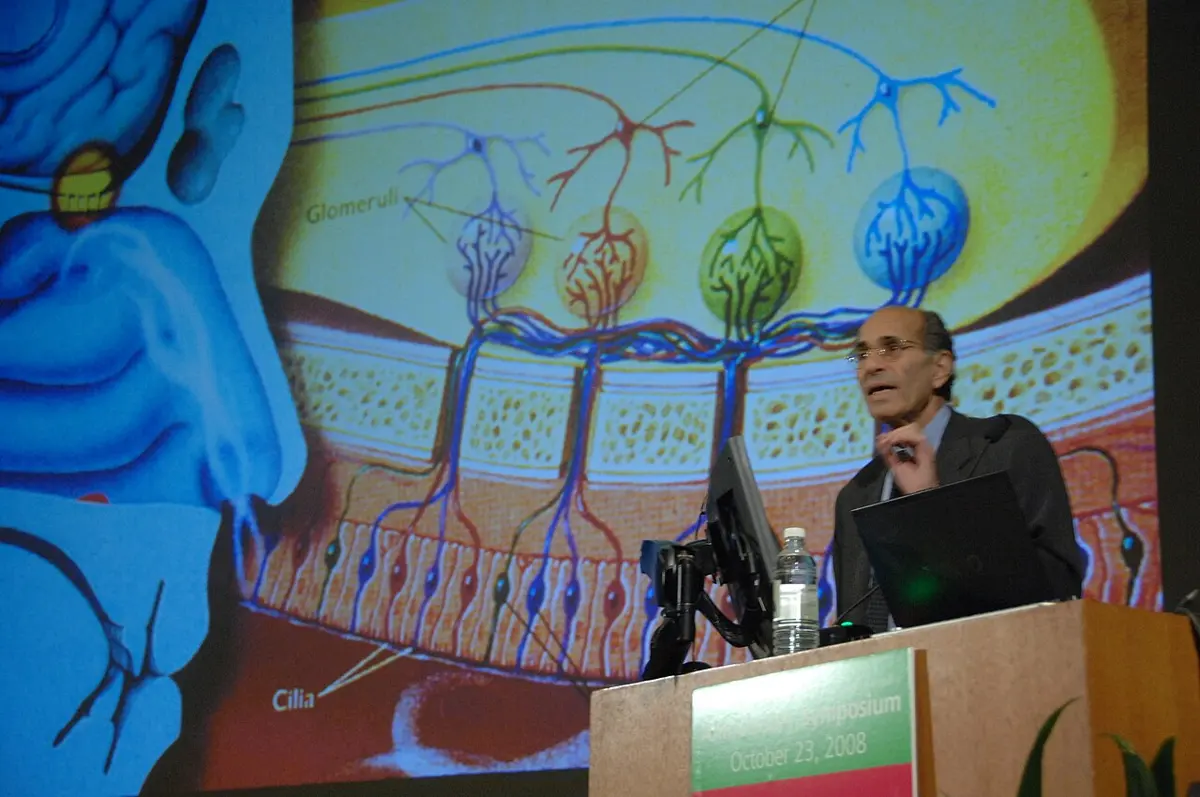
- Sorted in the brain. Yet in the olfactory bulb, the first stop in the brain, the fibers from all the cells with the same receptor come together into the same one or two small knots called glomeruli. A mouse has about 2,000 glomeruli, about two for every kind of receptor. Axel’s team proved it in 1996 with mice whose cells with one chosen receptor had their fibers colored blue: all the blue fibers ran to the same spot.
A mouse has about 1,000 kinds of smell receptor. How many kinds does one single smell cell use?
Pick an answer to see why.
How it works now
A code made of patterns
So how can about 400 kinds of receptor tell apart many thousands of smells? In 1999 Buck’s team tested single smell cells, one at a time, with different smell molecules, and then found out which receptor each cell carried.
They found that it is not one receptor for one smell. Each kind of receptor responds to several different molecules, and each molecule switches on several kinds of receptor. What the brain reads is the pattern: which receptors are switched on and which stay quiet, like the colored squares of a patchwork, or letters in a word.
A few letters can make thousands of words. In the same way, a few hundred receptors can make an enormous number of patterns. This also explains why two molecules that look almost the same can smell completely different: changing the shape a little changes which receptors it fits.
Most real smells, like coffee or a mango, are mixtures of dozens or hundreds of different molecules. Together they switch on a pattern that the brain learns to recognize.
From the nose to memory
From the glomeruli, signals go on to the part of the brain’s outer layer that handles smell, where signals from different receptors are combined again. Smell signals also go straight to the parts of the brain that deal with feelings and memory. That is why a smell can bring back a memory so suddenly: the smell of a festival, of a grandmother’s kitchen, or of food that once made you ill.
In your life today
- A safety smell. Cooking gas (LPG) has no smell of its own. A tiny amount of a strong-smelling sulphur compound is added on purpose, so that you can smell a leak Grade 10: LPG and butane. Smell is also how you notice smoke or food that has gone bad.
- Losing smell. During the COVID-19 pandemic, many people suddenly lost their sense of smell, and some took months to get it back. People who lose their smell often say that food loses its joy, and they can miss the warning signs of gas or burning.
- Dogs’ noses. A dog’s smelling lining is about forty times larger than a person’s, according to the Nobel committee. Dogs help police find explosives and drugs, and after Nepal’s 2015 earthquake rescue dogs searched the rubble for people trapped alive.
What came next
- Other senses, the same plan. Axel and Buck, separately, found two more families of receptors in the nose of mice that detect pheromones, chemical messages between animals of the same kind. Receptors of the same seven-times-crossing family were later found for bitter and sweet tastes on the tongue.
- Insects. Axel’s team and others found the smell receptors of fruit flies, and later those of mosquitoes, which use smell to find people to bite. Understanding them could lead to better repellents against the mosquitoes that spread dengue and malaria.
- Still unsolved. We still cannot look at a new molecule and say what it will smell like. Most of our 400 receptors have never been matched with the molecules that switch them on. How the brain turns a pattern into “mango” is still a mystery.
In your science books
- Grade 9: the nerve cell and the human nervous system, including the brain.
- Grade 10: DNA, where the receptor genes are kept, and butane and LPG.
- Going further: molecules have shapes, how a touch reaches your brain, the body’s other detectors, and why flowers smell sweet.
Learn more
- The Nobel Prize’s own explanation: The Nobel Prize in Physiology or Medicine 2004, press release (nobelprize.org).
- The laureates’ Nobel lectures: Axel and Buck.
The official reason
The prize was given “for their discoveries of odorant receptors and the organization of the olfactory system.”