
Scoop up a handful of sand from the bank of the Trishuli or the Narayani. Most of the grains are quartz, with flakes of shiny mica. Here and there, small enough to need a magnifying glass, is a clear or pale pinkish-brown crystal called zircon, washed out of rocks high in the Himalaya. Inside each zircon is a clock that has been ticking since the crystal formed, and many of the zircons in Nepal’s rivers are hundreds of millions of years old, some more than two billion. A grain of sand can be far older than the mountains it came from.
The Earth itself is older still: about 4.6 billion years, as you read in Grade 8 Grade 8: Origin and age of the Earth, and its oldest known crystals, zircons too, are about 4.4 billion years old Grade 9: Galaxies. Nobody was there to see it begin. So how can anyone give a number like that, and say how sure they are? This topic shows how the age is read from clocks inside atoms, in rocks from the Earth, from the Moon and from space, and what those clocks tell us about the Earth’s first billion years.
Guessing without a clock
People have tried to work out the Earth’s age for a long time, with whatever clues they had.
- In 1650 the Irish archbishop James Ussher added up the generations of people in the Bible and arrived at the year 4004 BC: an Earth about 6,000 years old.
- In the 1700s the Scottish geologist James Hutton watched how slowly rivers carry sand to the sea, how slowly that sand settles into layers, and how thick the layers of rock in the mountains are. He gave no number, but wrote in 1788 that he could see “no vestige of a beginning”. Geologists after him did the sums: layers kilometers thick, laid down a millimeter or so a year, needed many millions of years.
- In 1899 the Irish physicist John Joly estimated how fast rivers bring salt to the sea, and how much salt the sea holds. If the sea started fresh, it had taken about 90 million years to become this salty.
- From 1862 the great physicist William Thomson (Lord Kelvin) treated the Earth as a ball that started molten and has been cooling ever since. From how fast heat flows out of the ground today, he worked out that it had taken between 20 and 400 million years to cool this far; by 1897 he had narrowed it to 20 to 40 million.
All of these were clocks of a sort, but each depended on a rate that nobody could be sure had stayed the same. Salt doesn’t only pile up in the sea: it is also buried in sea-floor mud, so Joly’s clock had been running fast. Kelvin assumed that heat could only creep out through solid rock. In fact the hot rock deep inside slowly churns, which carries heat up much faster, and, as was discovered a few years later, radioactive atoms inside the Earth keep making new heat (Where the heat comes from). What was needed was a clock whose rate cannot change.
Why did Joly’s salt clock give an age for the oceans that was far too young?
Pick an answer to see why.
A clock inside the atom
You met radioactive decay in What Happens Inside a Nucleus When It Decays?: an unstable nucleus can change into another one by giving out an alpha or a beta particle. Uranium-238, after a chain of fourteen steps, ends up as lead-206, which is stable and never changes again. The atom you start with is called the parent; the one it becomes, the daughter.
Nobody can say when one particular nucleus will decay. It might be in the next second, or in ten billion years. But every nucleus of uranium-238 has exactly the same chance of decaying in any year, and a speck of rock holds billions of billions of them. So the crowd behaves with perfect regularity, just as a hundred coins tossed together always give close to fifty heads, though no one can say which coins will land heads.
The time it takes for half of the parent nuclei in a sample to decay is its half-life. In the next half-life, half of what is left decays, and so on:
| Time | Parent left | Daughter ÷ parent |
|---|---|---|
| 0 | all | 0 |
| 1 half-life | ½ | 1 |
| 2 half-lives | ¼ | 3 |
| 3 half-lives | ⅛ | 7 |
| 4 half-lives | 1⁄16 | 15 |
Each kind of nucleus has its own half-life, and nothing changes it: not heating to a thousand degrees, not crushing deep underground, not chemical reactions. That is because decay happens inside the nucleus, while heat, pressure and chemistry only shuffle the electrons around it. Physicists have tested this for over a century, and also checked it far away: the light of exploding stars, sent out long ago, shows radioactive nickel and cobalt decaying with the same half-lives they have in laboratories today.
| Parent | Daughter | Half-life |
|---|---|---|
| uranium-238 | lead-206 | 4.47 billion years |
| uranium-235 | lead-207 | 704 million years |
| potassium-40 | argon-40 (and calcium-40) | 1.25 billion years |
| carbon-14 | nitrogen-14 | 5,730 years |
So a sample containing a radioactive parent is a clock that starts with no daughter and gains daughter atoms at a known rate. Read the ratio of daughter to parent, and you can read the time. This is radiometric dating.
A rock started with 800 million atoms of uranium-235. How many are left after three half-lives?
Pick an answer to see why.
Reading the clock
The formula
When the ratio isn’t a neat 1, 3 or 7, you need a formula. After a time t, the share of the parent left is , where t½ is the half-life. Every parent atom that has gone has become a daughter atom, so
where D is the number of daughter atoms and P the number of parent atoms. Turned round to give the age, with the natural logarithm (the “ln” key on a scientific calculator):
(0.693 is ln 2.) You don’t need to count atoms one by one: an instrument called a mass spectrometer sorts the atoms in a tiny sample by their mass and counts how many of each kind there are.
Why zircon is the perfect clock
A clock only works if you know how much daughter there was at the start, and if none of the parent or daughter has leaked in or out since. The mineral zircon (zirconium silicate, ZrSiO₄) is ideal on both counts.
- When a zircon crystal grows from molten rock, uranium atoms are a good fit in its crystal and take the place of some zirconium atoms. Lead atoms are the wrong size and charge, and are kept out almost completely. So a new zircon has uranium but practically no lead: every lead atom in it was made inside it by decay.
- Zircon is very hard and tough, hardly dissolves in water, and keeps its atoms locked in even when the rock around it is heated, squeezed, weathered away and laid down as sand. A grain can survive billions of years and several trips through the rock cycle.
A zircon accidentally took in some lead when it crystallized. If a geologist didn’t know, the age they worked out would be:
Pick an answer to see why.
The oldest pieces of the Earth
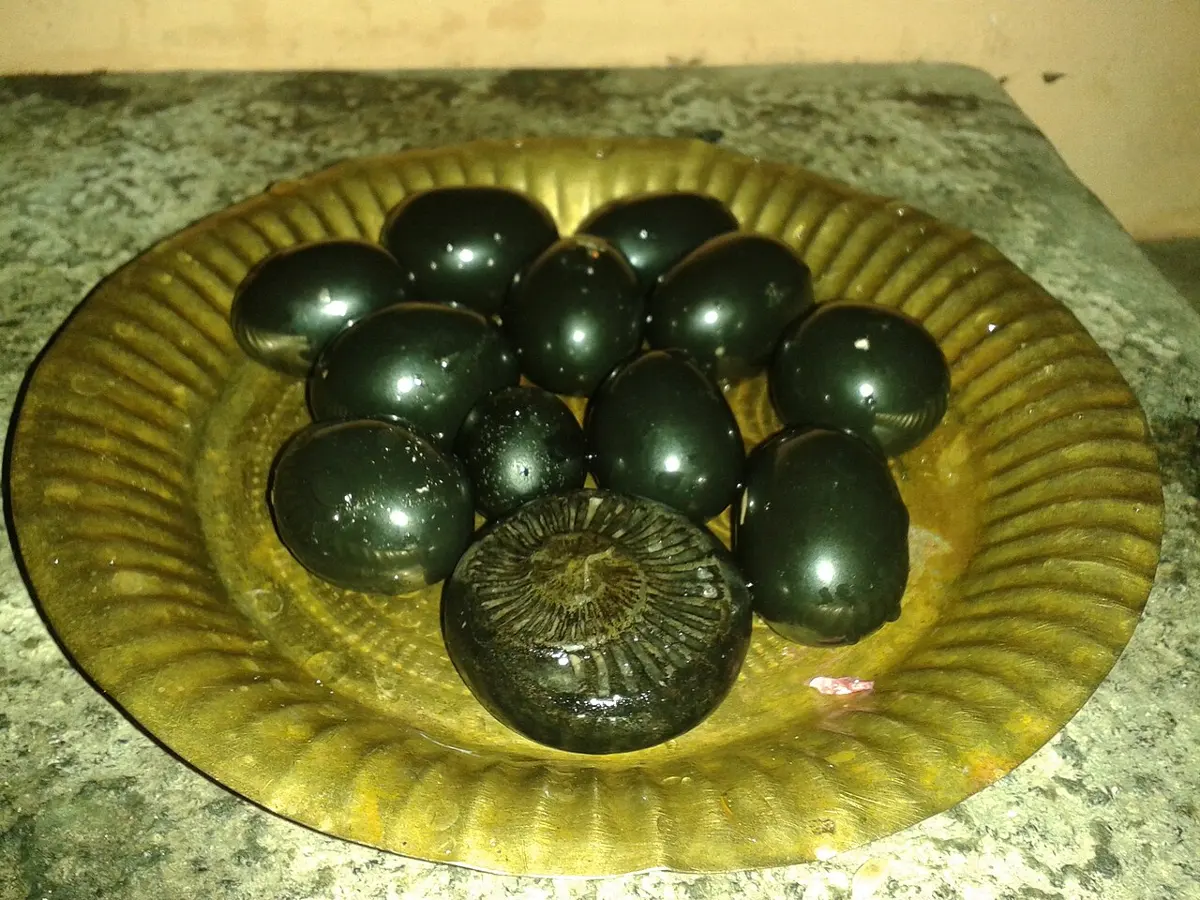
The Earth’s rocks have been dated in hundreds of thousands of samples, all over the world. Most are less than a billion years old; a few are older than 3.5 billion years; none are as old as the Earth.
- The oldest rock is the Acasta Gneiss in northern Canada, about 4.03 billion years old. (Rocks at Nuvvuagittuq, in Quebec, may be older, about 4.3 billion years, but that age is still argued over, as of 2026.)
- Older still are single crystals. The Jack Hills zircons are about 4.4 billion years old, but the rock they formed in is long gone: they were weathered out of it and later laid down in a sandstone, like grains of sand in a river.
- These zircons carry a message about the young Earth. The oxygen atoms in some of them show that they formed from rock that had been in contact with liquid water near the surface. So within about 150 million years of its birth, the Earth had cooled enough for water, perhaps oceans.
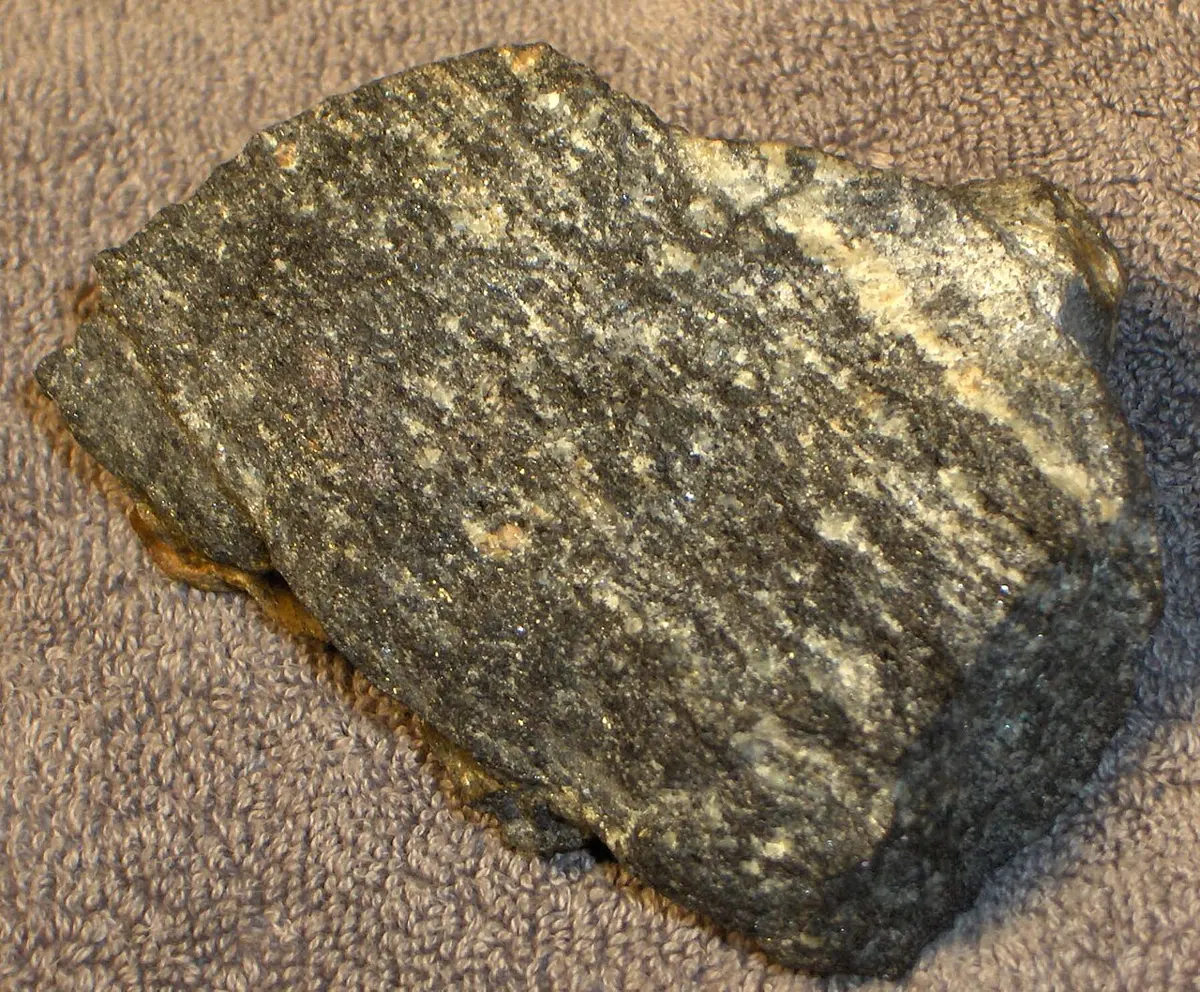
Why are there no rocks from the Earth’s first 500 million years? Because the Earth keeps remaking its surface. The sea floor sinks back into the mantle at ocean trenches, and is never more than about 200 million years old (the topic Do Continents Really Move? explains how). Continents are folded, heated and partly melted when plates collide, as in the Himalaya (Why Is Everest Still Rising?), and rain and rivers wear them down. The first crust has been recycled, melted or worn away, except for a few tough zircon grains.
So, to date the Earth’s birth, scientists have to look somewhere the clock wasn’t reset: at pieces of the Solar System that never became part of a planet that remakes itself.
The oldest rock found on Earth is about 4.03 billion years old. What does this tell us about the age of the Earth?
Pick an answer to see why.
Older than the Earth: meteorites
Meteorites are rocks that have fallen from space Grade 8: Meteoroids, meteors and meteorites. Almost all of them are pieces knocked off asteroids, the leftovers of the Solar System’s building site. Asteroids are far too small to churn and remake their rocks as the Earth does, so their rocks still keep the time they formed.
They come in two main kinds, and both tell a story.
- Stony meteorites, most of them chondrites, are full of chondrules: round grains about a millimeter across, once droplets of melted rock that froze as they floated in space. The elements in the most primitive chondrites are in almost exactly the same proportions as in the Sun (leaving out the gases hydrogen and helium), as measured from the dark lines in sunlight (What Are Stars Made Of?). They are samples of the cloud the Sun and the planets formed from.
- Iron meteorites are almost pure iron and nickel. They are the cores of small planets that grew hot enough to melt, let their iron sink to the middle, and were later smashed apart by collisions. They suggest that the Earth’s heavy iron core formed the same way Grade 8: A young, violent Earth.
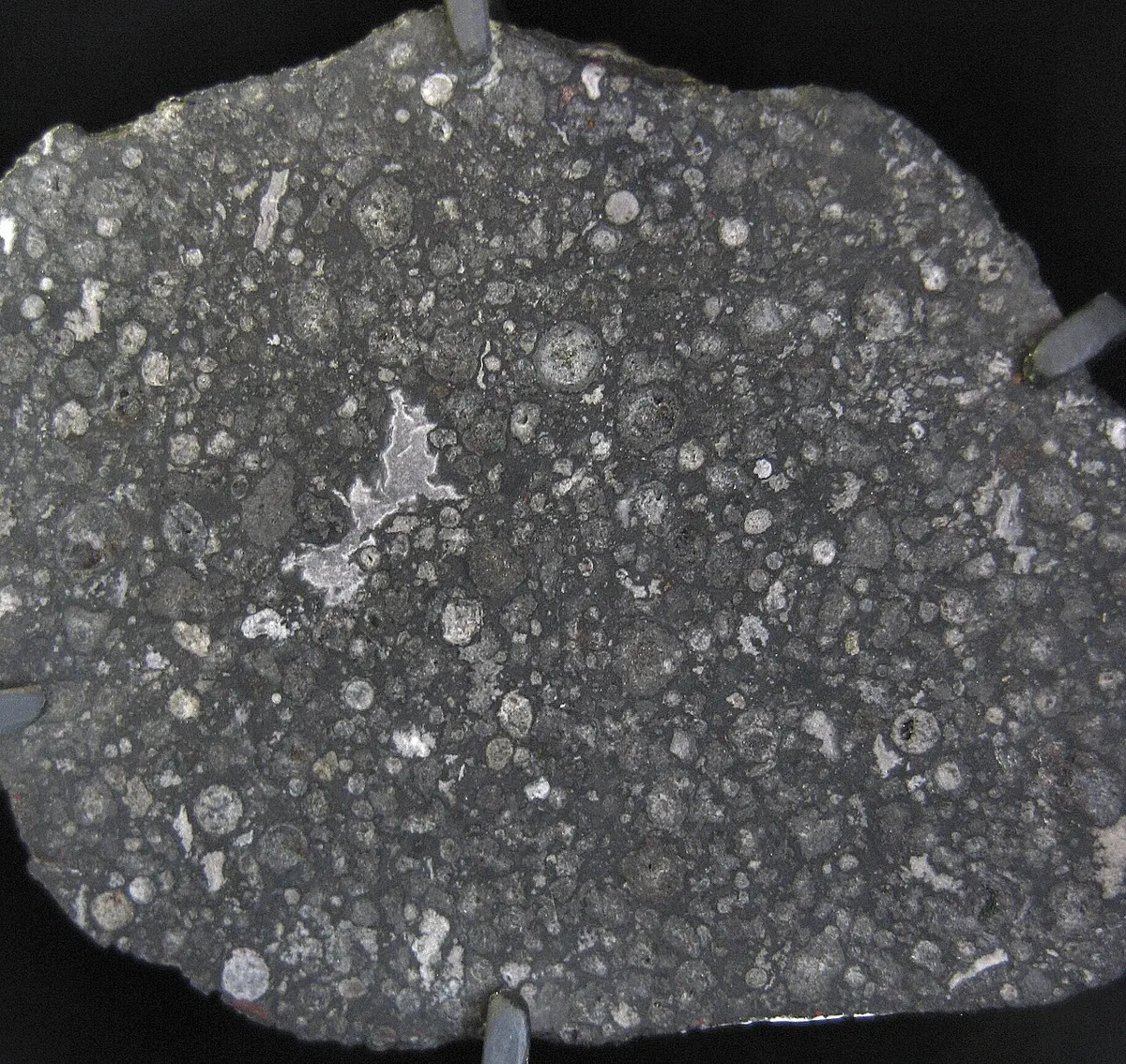
The oldest things ever dated are the white, calcium- and aluminium-rich grains in meteorites like Allende, which formed in the hottest part of the young disc of gas and dust around the Sun. Their uranium and lead give an age of 4.567 billion years, to within about two hundred thousand years. That is the Solar System’s birthday. The chondrules formed in the next few million years.
Why are meteorites used to find the age of the Earth, rather than the Earth’s own oldest rocks?
Pick an answer to see why.
The Moon: a record the Earth erased
The six Apollo landings from 1969 to 1972 brought back 382 kg of Moon rocks; the Soviet Luna probes and China’s Chang’e 5 and Chang’e 6 (the first from the far side, in 2024) brought back a few kilograms more. Dated in laboratories, they tell a story the Earth’s own rocks have lost.
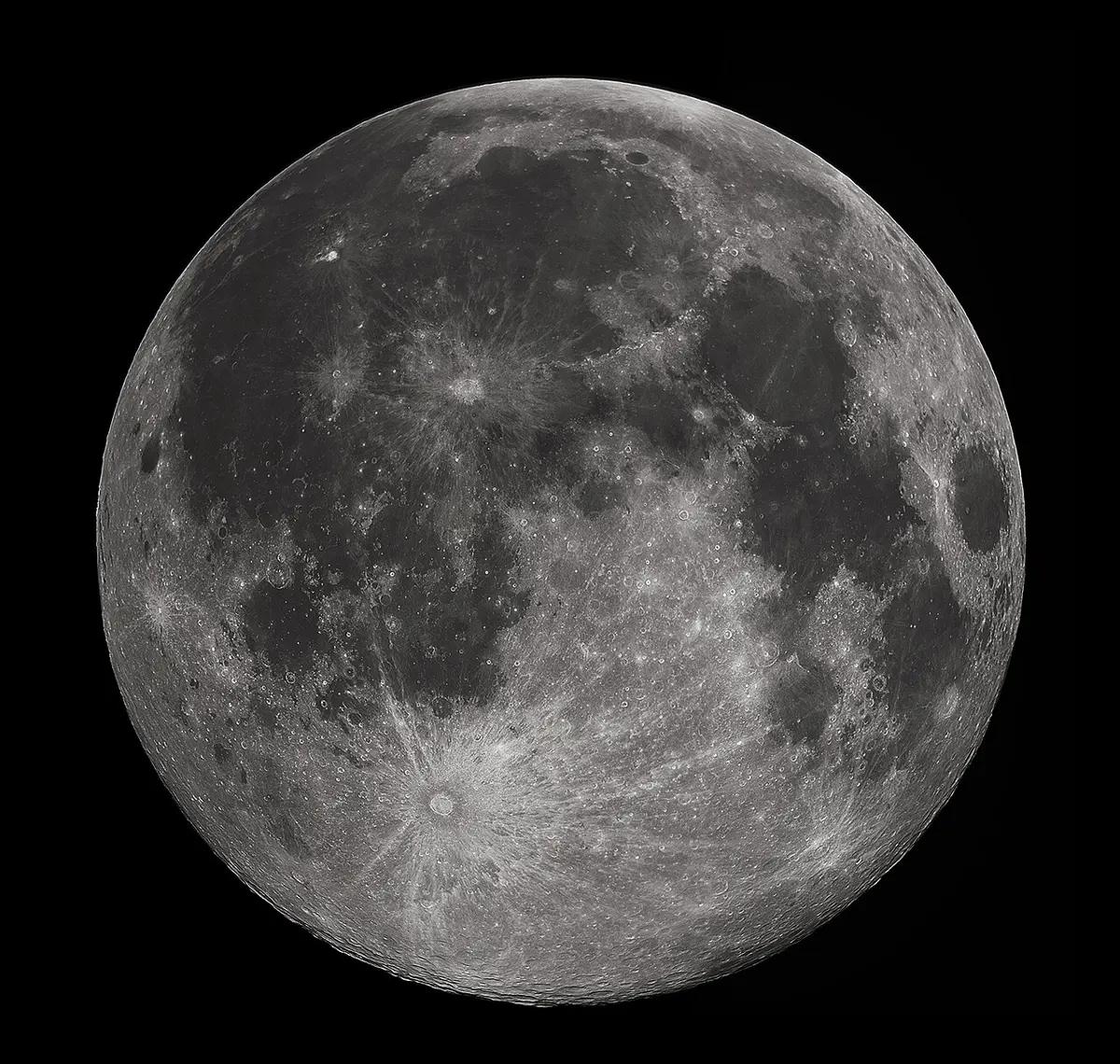
- The bright, rugged highlands are made of a pale rock rich in a mineral called plagioclase (feldspar), which floats in molten rock. So the young Moon was covered in a magma ocean, hundreds of kilometers deep, and the light crystals floated to the top and formed the first crust. Its rocks have been dated to about 4.3 to 4.4 billion years, and the oldest crystal found in any Moon rock, a tiny zircon, is about 4.46 billion years old.
- The dark, smooth maria (Latin for “seas”, mare for one) are lava plains, made later when molten rock from deep inside welled up and flooded the great low basins. Their basalts are mostly 3.1 to 3.9 billion years old, a few younger.
Moon rocks also show where the Moon came from. Their oxygen atoms have exactly the same mix of isotopes as the Earth’s, and different from those of Mars and of most meteorites. And the Moon has only a small iron core: its average density is 3.3 g/cm³, against the Earth’s 5.5 g/cm³. The best explanation is the giant impact: soon after the Earth formed, a body about the size of Mars hit it a glancing blow, and a ring of molten rock thrown out, mostly from the two bodies’ outer layers, gathered into the Moon. The Moon’s oldest crystals show that this happened within the first 110 million years; clues in them suggest within about 60 million, though some scientists argue for a later date (as of 2026).
Craters as a clock
Look at the Moon through binoculars and you see that the highlands are covered in craters, crowded on top of each other, while the maria have only a few. A surface collects craters as long as it lies open to the sky, so the more craters a surface has, the older it is. Lava that floods a basin wipes its craters away and starts its count again from zero.
Counting gives only a relative age: this surface is older than that one. The Moon rocks turned it into a clock. Scientists counted the craters around each Apollo, Luna and Chang’e landing site and dated the rocks collected there. Together they show how fast craters have piled up over time. Hits were far more frequent before about 3.8 billion years ago, when the young Solar System was still full of leftover rocks; since then the rate has been low and roughly steady.
The same crater clock, set by the Moon’s rocks, is used to date the surfaces of planets nobody has brought rocks back from. On Mars, crater counts show that the southern highlands are about 4 billion years old, while some lava flows on its giant volcanoes are only a few hundred million years old or even younger.
And the Earth? It has been hit as often as the Moon, more often in fact, because it is bigger. But only about 200 impact craters are known on Earth (as of 2026). Our air burns up the small rocks, and erosion and moving plates have erased all but the youngest big craters. The largest known, Vredefort in South Africa, is about 2 billion years old, and the oldest, Yarrabubba in Australia, about 2.2 billion; only their worn-down roots are left. The Moon, with no air, water or moving plates, has kept the record of the impacts the Earth received too.
Two regions on Mars are the same size. Region A has 400 craters wider than 1 km; region B has 40. What can you conclude?
Pick an answer to see why.
The story of the Earth’s first billion years
Now put the evidence together.
- 4.567 billion years ago: in the disc of gas and dust around the young Sun, the first solid grains form; meteorites still carry them.
- Within a few tens of millions of years: dust and pebbles build planetesimals, and planetesimals crash together into planets. The growing Earth is melted again and again by the collisions; its iron sinks to make the core, just as in the small planets that iron meteorites come from.
- About 4.5 billion years ago (the exact date is still argued over): a Mars-sized body hits the Earth, and the Moon forms from the debris, covered in a magma ocean.
- By 4.4 billion years ago: the Earth’s surface has cooled; zircons form in rocks that met liquid water.
- About 4.2 to 3.8 billion years ago: many great impacts scar the Moon (and the Earth); the oldest surviving Earth rocks, from 4.03 billion years.
- From about 3.9 billion years ago: lava floods the Moon’s basins, making the maria.
- By 3.5 billion years ago: living things, as mats of microbes that left layered mounds called stromatolites, the oldest widely accepted fossils (3.48 billion years, Western Australia).
From all this, the age of the Earth is about 4.54 billion years, give or take about 50 million, a little younger than the first solids because the Earth took time to grow. Rounded, it is the 4.6 billion of your Grade 8 book. The Sun is the same age: computer models of how it burns, matched to what we measure of it today, give about 4.6 billion years too (How Long Will the Sun Shine?).
That settles the old argument between the hypotheses you met in Grade 8 Grade 8: Which idea is right?. The comet, partner-star and passing-star ideas all needed a Sun that was already there, long before the planets were torn out of it. The clocks say the Sun, the meteorites, the Earth and the Moon all began within a few tens of millions of years of each other, a blink in 4.6 billion years: they formed together, from one disc, as the nebular theory says. The planets fit too: near the Sun, where the disc was hot, only rock and metal could stay solid, and the planets there are small and rocky; farther out, where ice could freeze, the planets grew into giants of ice and gas.
Questions
After two half-lives, what fraction of a radioactive parent is left?
Pick an answer to see why.
Which would be the best thing to date with carbon-14?
Pick an answer to see why.
A mineral grain contains 7 atoms of lead-206 for every atom of uranium-238. a. How many half-lives has the uranium-238 been through? b. What age would this give? c. Why must something be wrong with this result, and what might it be?
Answer
- a.Daughter ÷ parent = 7, so ⅛ of the parent is left (1 out of 1 + 7 = 8): 3 half-lives.
- b.Age = 3 × 4.47 = 13.4 billion years.
- c.That is about as old as the universe (13.8 billion years) and three times as old as the oldest meteorites (4.567 billion years), so it can’t be right. The most likely reason is that the grain took in lead when it formed, or gained lead later, so not all the lead-206 came from decay. A second clock (uranium-235 → lead-207) would disagree and show it.
The oldest rocks found on the Earth are 4.03 billion years old, but the Earth is said to be about 4.54 billion years old. Explain what evidence the larger number is based on, and why the Earth’s own rocks give a smaller one.
Answer
The Earth’s surface keeps being remade: sea floor sinks back into the mantle, continents are folded, melted and worn away. So the Earth’s first rocks have been destroyed, and the oldest that survive only give a lower limit; a few zircon grains, 4.4 billion years old, are older than any whole rock.
The larger number comes from material that was never recycled. Meteorites, leftovers from asteroids that never became part of a planet like the Earth, give 4.567 billion years for the first solids of the Solar System. Lead from the Earth fits the same pattern as meteorite lead, so the Earth formed from the same material at the same time, taking some tens of millions of years to grow. Moon rocks, up to 4.46 billion years old, show the Earth–Moon system was there by then. Together these give 4.54 billion years.
Basalt from the Moon’s Mare Tranquillitatis is 3.7 billion years old; rock from the nearby highlands is about 4.4 billion years old. a. Which area would you expect to have more craters, and why? b. Why can’t you find the same pattern of craters on the Earth?
Answer
- a.The highlands. They have been open to impacts for longer, through the time before 3.8 billion years ago when impacts were far more frequent. The mare lava buried the older craters in its basin 3.7 billion years ago, so it has collected craters only since then, when the rate was low.
- b.The Earth has been hit at least as often, but its air burns up small rocks before they land, and weathering, erosion, sediment and moving plates have erased or buried almost all old craters. Only about 200 are known, and the oldest is about 2.2 billion years old.
A volcanic rock contains potassium-40 (half-life 1.25 billion years). About one in nine of its decays makes argon-40, a gas; the rest make calcium-40. When lava is molten, any argon in it bubbles out. a. Why does this make the clock start when the lava cools? b. If the rock was later heated enough to let some argon escape, would its age come out too old or too young?
Answer
- a.In molten lava, argon gas escapes, so when the rock solidifies it has no argon-40 to begin with. From then on, argon made by decay is trapped in the crystals, so the argon-40 measured has all been made since the rock cooled.
- b.Too young. Losing argon makes the daughter ÷ parent ratio smaller, as if less time had passed.
The Jack Hills zircons are 4.4 billion years old, and the oxygen atoms in some of them show that they formed from rock that had been in contact with liquid water near the surface. Use this, and other evidence from this topic, to describe what the Earth was like 4.4 billion years ago, and how its surface had changed since 4.567 billion years ago.
Answer
At 4.567 billion years ago the Solar System’s first solids were forming in a disc of gas and dust; the Earth did not yet exist. Over the next few tens of millions of years it grew by collisions, which kept it hot and partly molten, so its iron sank to form the core (as in the small planets that iron meteorites come from). By about 4.5 billion years ago a giant impact had made the Moon, and would have melted much of the Earth again.
The 4.4-billion-year-old zircons show that by then the surface had cooled and hardened into crust, and that liquid water, perhaps oceans, already existed: so within about 150 million years the Earth went from a molten ball to a planet with a solid crust and water. It was still being hit far more often than today, as the Moon’s crowded highland craters show, and no rocks of that age survive, because the Earth has recycled its early crust.
A student says: “Nobody saw the Earth form, so its age is just a guess.” Write a reply, using at least three independent kinds of evidence.
Answer
It isn’t a guess, because several different clocks, measured on different materials by different methods, agree.
- Meteorites, leftovers from when the planets formed, give 4.567 billion years for the first solids, using uranium–lead and other clocks that agree with each other.
- Moon rocks brought back by Apollo and Chang’e give ages up to 4.46 billion years, so the Earth–Moon system existed by then.
- Zircons from the Earth itself are up to 4.4 billion years old, and in the best crystals the two uranium clocks agree.
- The Sun, whose age is worked out from how it burns, comes out at about 4.6 billion years too.
The half-lives these clocks use have been measured in laboratories and checked in the light of distant exploding stars. Independent methods that all give the same answer are how science knows things nobody saw.
Where to go next
- Why Is Everest Still Rising? The heat that radioactive atoms make inside the Earth drives the moving plates that recycle its surface.
- Why Is the Sea Floor So Young? Almost no sea floor is over 200 million years old, though some continental rock is 4 billion. How plates are made and destroyed.
- Where Did the Atoms in Your Body Come From? The uranium in a zircon was made in exploding and colliding stars before the Sun was born.