
Crown ethers: molecules that pick one ion
Nobel Prize in Chemistry, 1987: Charles J. Pedersen, Donald J. Cram, and Jean-Marie Lehn
-
Charles J. Pedersen
1904–1989, born in Busan, Korea
Son of a Norwegian engineer and a Japanese mother. He never did a PhD, worked 42 years for one company, and found the first crown ether in a sticky mess he could have thrown away.
-
Donald J. Cram
1919–2001, born in Chester, Vermont, USA
His father died when he was four. By sixteen he had worked for eighteen different employers, picking apples and delivering newspapers.
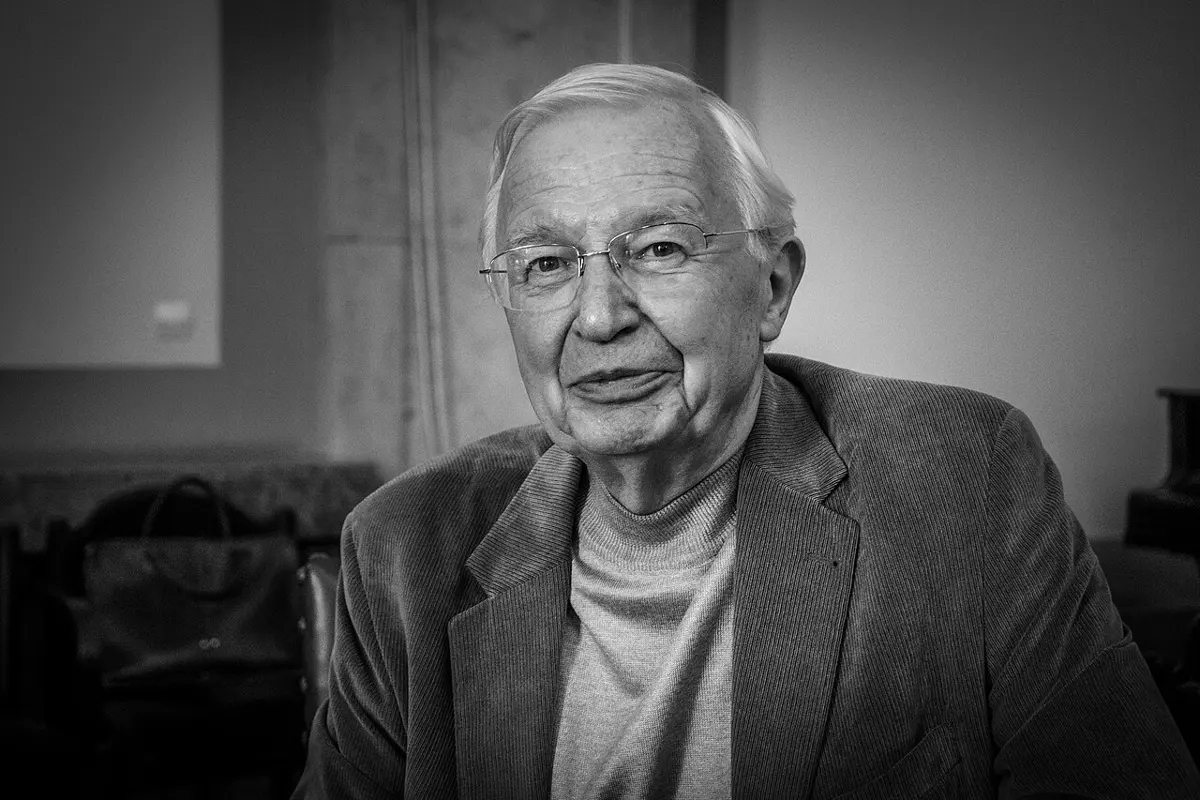
Jean-Marie Lehn
born 1939 in Rosheim, France
A baker’s son who nearly studied philosophy instead. He still plays the organ, like his father.
Photo: Photo Claude TRUONG-NGOC, CC BY-SA 4.0
Open a packet of Jeevan Jal, the oral rehydration salts given for diarrhea, and read the label. It contains sodium chloride and potassium chloride. Your body needs both, but it must never mix them up. Your nerve cells work by keeping potassium inside and sodium outside, and the proteins that do this can tell the two apart, even though sodium and potassium ions are very much alike.
How can a molecule tell one ion from another? In 1987 the Nobel Prize in Chemistry went to three chemists who made the first small, man-made molecules that could do it: rings and cages that grab one kind of ion and leave the others alone.
The problem: ions that nothing could hold
Sodium and potassium are alkali metals, in group 1 of the periodic table Grade 8: Groups. Each atom easily loses its one outer electron and becomes a positive ion: Na⁺ or K⁺ Grade 9: Cations.
Chemists had many molecules that could grab and hold metal ions such as copper or iron. But the ions of the alkali metals were different. Almost nothing could hold them tightly. In water they are surrounded by water molecules, and they just float around freely. Sodium and potassium ions also behave so much alike that it was very hard to separate them by chemistry.
Living things manage it all the time. In your body, some proteins hold on to potassium and not to sodium. Some fungi and bacteria make small ring-shaped molecules, such as valinomycin, that carry potassium ions through the oily wall of a cell. These molecules showed it could be done, but they are large and complicated.
This is the same puzzle as an enzyme and the food it digests (Taking food apart). In 1894 the German chemist Emil Fischer said that an enzyme and the molecule it works on must fit together like a lock and a key. But the “locks” in living things are huge proteins with thousands of atoms. Chemists wondered: could a small molecule, made in a flask, act as a lock too?
Why was it hard for chemists to make a molecule that holds sodium ions but not potassium ions?
Pick an answer to see why.
How a molecule can hold an ion
First, think about why salt dissolves in water. A water molecule is bent, with an oxygen atom in the middle. The oxygen end is slightly negative and the hydrogen ends are slightly positive. So when a sodium or potassium ion is in water, the water molecules turn their oxygen side towards it, because opposite charges attract. Each ion is wrapped in a little coat of water molecules.
Now imagine a ring-shaped molecule with several oxygen atoms pointing into the middle. If an ion fits in the hole, the oxygen atoms of the ring can do the job of the water molecules, all at once. The ion is held by the ring instead. A molecule that holds another one like this is called a host; the ion or molecule held is its guest.
The fit matters. Ions of different elements have different sizes. Going down group 1, each atom has one more shell of electrons, so the ions get bigger: lithium is the smallest, then sodium, potassium, rubidium and cesium Grade 10: Atomic size. A potassium ion is only about 0.27 nanometers across (a nanometer is a millionth of a millimeter). An ion that is too small for the hole rattles about and is held weakly. An ion that is too big can’t get in. Only one that fits well is held tightly.
Why it was hard
- Nobody knew such a ring could exist. Before 1967, no man-made molecule was known that held sodium or potassium ions firmly.
- Big rings are hard to make. In ordinary reactions, chains of atoms close easily into rings of 5, 6 or 7 atoms. A ring of 18 atoms is floppy. Its two ends rarely meet, so usually the chain links to other chains instead of closing into a ring.
- Shape is everything, and you can’t see it. Molecules are far too small to see. To design a host, chemists had to work out its shape in three dimensions, and predict whether a guest would fit, before spending months making it.
What they did, step by step
Pedersen: a sticky mess with a surprise inside
Charles Pedersen worked for Du Pont, a large American chemical company, from 1927 until 1969. For years he made chemicals that stop petrol and rubber from slowly going bad in air.
- 1960s, a failed recipe. He was trying to make a molecule to hold vanadium, a metal that speeds up this spoiling. He knew that one of his starting chemicals contained about 10% of another substance, catechol, as an impurity, but he decided to use it anyway and clean up at the end. The product was, in his words, “an unattractive goo”.
- A few white crystals. From the goo came a pinch of silky white crystals: a yield of only about 0.4%, far too little to be the product he was making. They were not what he was trying to make. Many chemists would have thrown them away. Pedersen, out of curiosity, studied them.
- The sodium clue. The crystals hardly dissolved in methanol, a kind of alcohol. But they dissolved easily when he added sodium hydroxide. That was strange, because the crystals had nothing in them that reacts with an alkali. Then he found that any sodium salt made them dissolve. It was the sodium ions, not the alkali, that did it.
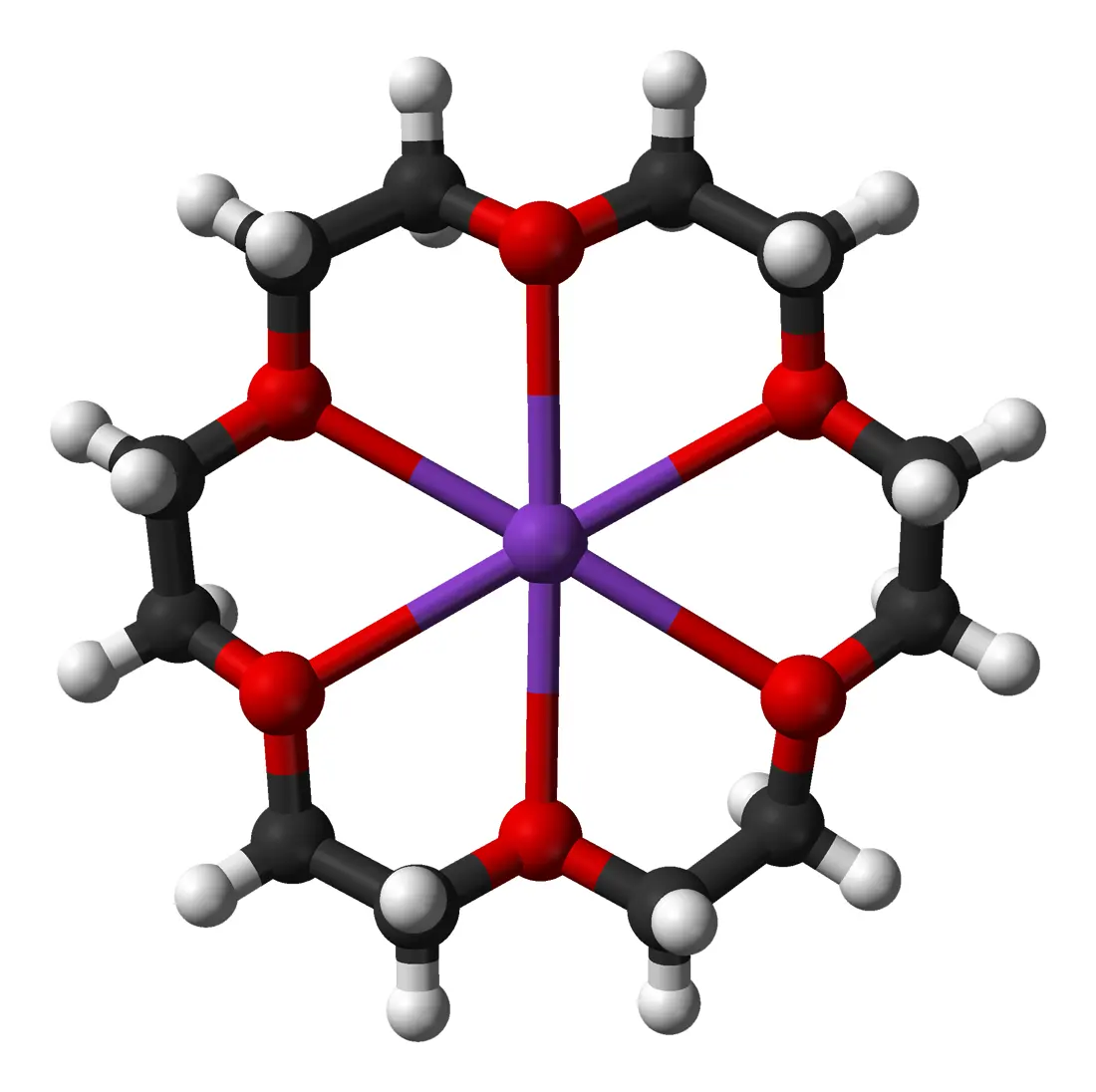
- A ring of 18 atoms. He measured the mass of one molecule. It was exactly twice what he expected. The two catechol molecules from the impurity had joined with two other molecules to make one big ring of 18 atoms: 12 carbon atoms and 6 oxygen atoms, with two benzene rings on the side. The sodium ion, he realized, had “fallen into the hole in the centre” and was held by the six oxygen atoms.
- The name. A model of the molecule looked to him like a crown, and an ion could be “crowned and uncrowned”, so he called the family crown ethers. (An ether is a compound with an oxygen atom joined to two carbon atoms.) His first one was dibenzo-18-crown-6: 18 atoms in the ring, 6 of them oxygen. He made his short names because the official chemical names were too hard for him to remember.
- 1967, about 60 crowns. Working with one technician, he made about 60 of these rings, of many sizes. He showed that each ion has a best ring size: potassium fits the 18-atom ring, and the smaller sodium prefers smaller rings. In 1967 he published his results.
Lehn: from nerve cells to cages
Jean-Marie Lehn, a young chemist at the University of Strasbourg in France, was interested in how nerve cells work. A nerve signal depends on sodium and potassium ions moving through the cell’s outer layer, the membrane (Messages along nerves). He had read that natural molecules like valinomycin can carry these ions through membranes. Could a chemist make molecules that do the same?
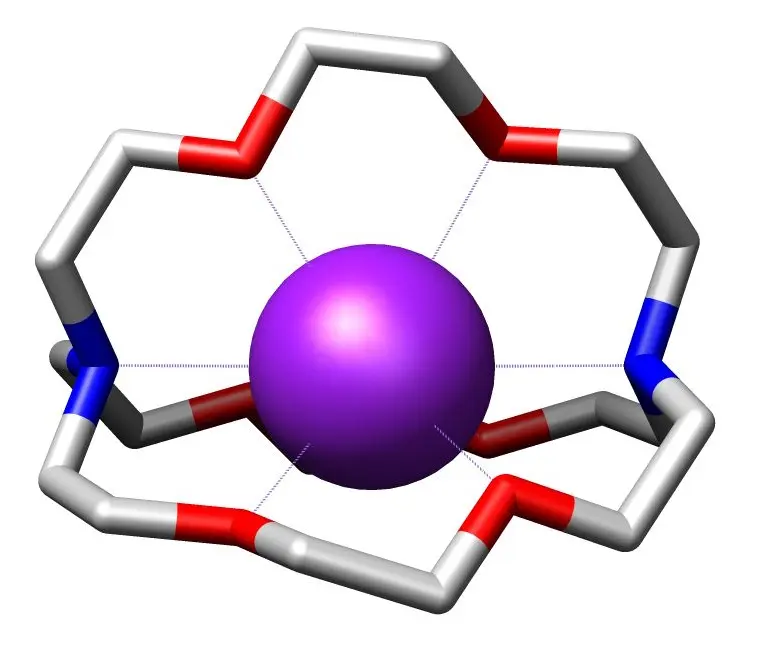
- October 1967. Lehn’s group began work on such molecules. Pedersen’s crowns were flat rings, open on two sides. Lehn wanted a cage that would close the ion in on every side.
- 1969, cryptands. His group made molecules with two nitrogen atoms, one at the top and one at the bottom, joined by three bridges of carbon and oxygen atoms. He called them cryptands, from the Greek word for hidden, because the ion is hidden inside. They hold ions far more tightly than crowns, and they choose between them even more sharply.
- More guests. Lehn then made hosts for other guests: negative ions, and even acetylcholine, a substance that nerve cells use to pass messages. He gave the whole field a name: supramolecular chemistry, “chemistry beyond the molecule”, about molecules that hold on to each other without forming ordinary chemical bonds.
Cram: designing hosts on a model kit
Donald Cram, at the University of California, Los Angeles (UCLA), in the USA, asked a new question: could he design a host for a guest in advance, and then make it?
- Models first. Cram’s group built every planned molecule first from space-filling models: plastic balls in the true sizes of atoms, which snap together. They checked by hand whether a guest would fit, and only then spent months making the real molecule.
- 1974, host-guest chemistry. With Jane Cram, he named the field host-guest chemistry.
- Ready-made shapes. Cram found the main rule for a strong host. A long open chain with six oxygen atoms can bend into more than a thousand shapes, and only two of them can hold an ion. Most of the time it is the wrong shape, so it holds ions weakly. Cram built a stiff host called a spherand, already in the right shape, with its six oxygen atoms pointing inwards before any ion arrives. It held lithium and sodium ions enormously more strongly than the floppy chain, and refused other ions completely. Cram called this rule preorganization: a good lock is built ready for its key.
- Left-hand and right-hand guests. Many molecules of life, such as amino acids, come in two forms that are mirror images of each other, like your left and right hands. Cram made hosts that hold one form better than the other, and built a small machine that used them to separate the two forms.
Cram’s floppy chain and his stiff spherand had the same six oxygen atoms. Why did the spherand hold ions far more strongly?
Pick an answer to see why.
In your life today
Crown ethers and cryptands are not things you buy in a shop. They work out of sight, in factories, laboratories and hospitals.
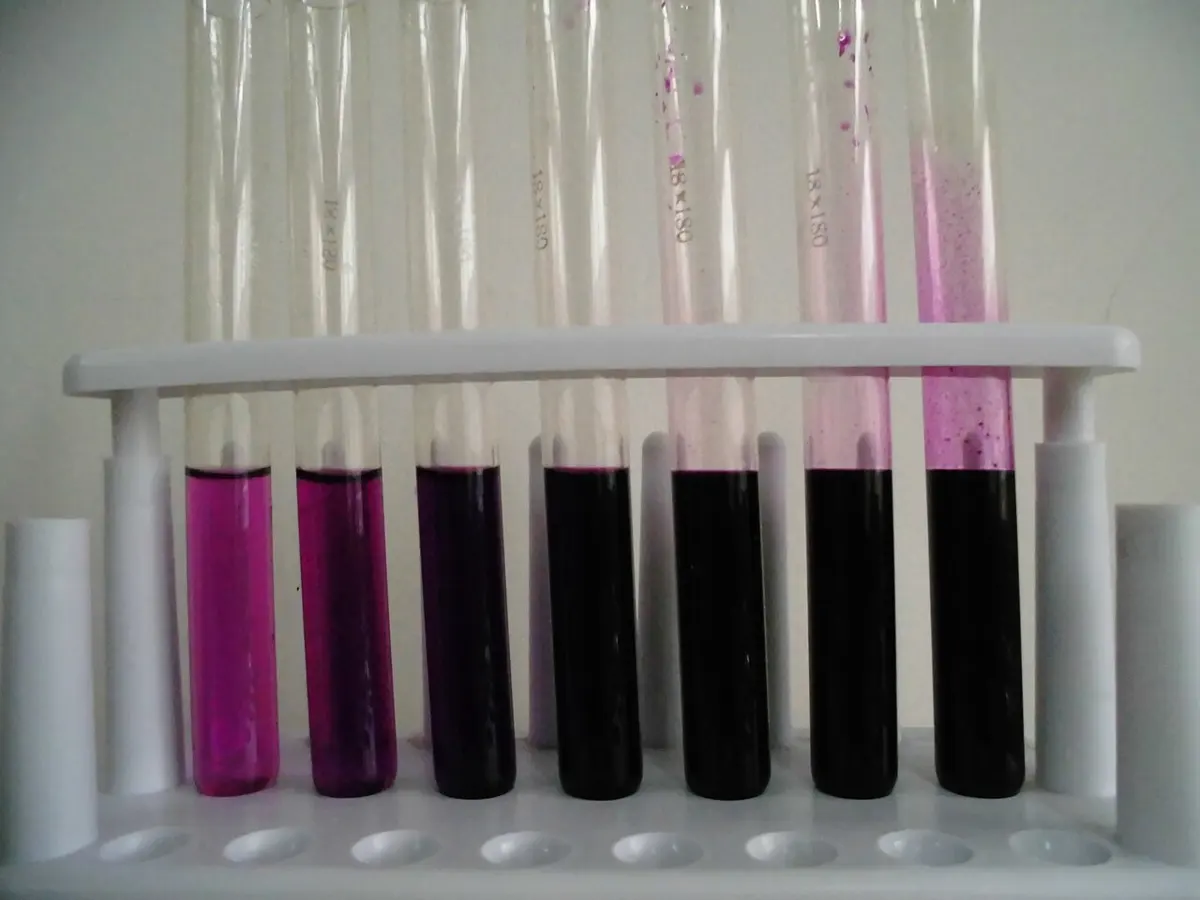
- Making medicines and other chemicals. The “purple benzene” trick lets salts react in oily liquids. Factories use crown ethers and similar molecules to help such reactions along.
- Measuring ions in blood. In hospital laboratories, the sodium and potassium in a blood test are measured by sensors that each respond to only one kind of ion. These sensors are built on the same idea of a host that fits one ion. The potassium sensor often uses valinomycin, nature’s own ring for potassium.
- Cleaning up dangerous waste. Crown ethers can pull one kind of ion out of a mixture. They are used to take radioactive strontium and cesium out of nuclear waste, so the most dangerous part can be stored in a small volume.
- Understanding your own body. Hosts like these helped scientists understand how the proteins in nerve cells choose potassium over sodium. In 2003 a Nobel Prize went to Roderick MacKinnon, who showed the real potassium channel of a nerve cell, and found that it picks potassium by surrounding it with oxygen atoms, just as a crown does (Water channels and salt gates).
A crown ether helps potassium permanganate dissolve in an oily liquid. How?
Pick an answer to see why.
What came next
- Molecular machines. One of Lehn’s students in Strasbourg, Jean-Pierre Sauvage, went on to link molecular rings like a chain. That led to molecules that move like tiny machines, and to the Nobel Prize in Chemistry in 2016 (The world’s smallest machines).
- Molecules in prison. In 1985 Cram made carcerands, closed hollow molecules that trap a small molecule inside for good, like a prisoner in a cell (“carcer” is Latin for prison).
- Molecules that build themselves. Lehn went on to study molecules that recognize each other and fit together on their own into larger structures, such as double and triple twists. Living things are built this way: proteins and DNA fold and join because their shapes and charges fit.
- An open question. Enzymes in your body speed up reactions millions of times, and each one picks out its own molecule from thousands of others. The 1987 prize was given partly for the dream of making small, man-made hosts that work as well as enzymes. Chemists have made hosts that speed up reactions a little, but none yet as good as nature’s best enzymes. Can it be done?
In your science books
- Grade 8: groups in the periodic table, where sodium and potassium sit together in group 1.
- Grade 9: ions, positive ions and the electrovalent bond in sodium chloride.
- Grade 10: how atomic size changes down a group, which is why each ion fits a different ring.
- Going Further: enzymes that take food apart, messages along nerves and catalysts.
Learn more
- The Nobel Prize’s short explanation: Getting chemistry into shape (nobelprize.org), and the press release.
- The laureates’ Nobel lectures: Pedersen (the story of the discovery, in his own words), Cram and Lehn.
The official reason
The prize was given “for their development and use of molecules with structure-specific interactions of high selectivity.”