
Right now, while you read this, thousands of atoms in your body are turning into atoms of a different element, every second: about 4,000 a second in a grown-up. They are atoms of potassium-40, a rare, radioactive kind of potassium. It is in every banana, every bowl of dal and every cell of you: about one potassium atom in 8,500 is this kind. Most of them, when they change, become calcium. A few become argon, a gas.
The alchemists of old spent their lives trying to turn one element into another, and failed. Your body does it thousands of times a second, and you feel nothing, because each change happens to one single nucleus, far too small to notice.
In Grade 9 you met the three kinds of radiation that unstable nuclei give out, alpha, beta and gamma Grade 9: Radioactive elements and radioactive emission. This topic opens up the nucleus and watches what happens inside it: what leaves, what changes into what, what always stays the same, and why splitting a uranium nucleus or joining hydrogen nuclei gives out millions of times more energy than burning anything.
Counting what is inside a nucleus
You know from Grade 9 that a nucleus is made of protons and neutrons Grade 9: Structure of an atom, together called nucleons. Three numbers describe it:
- the atomic number, Z: the number of protons. It decides which element the atom is: every atom with 6 protons is carbon, every atom with 92 is uranium;
- the neutron number, N: the number of neutrons;
- the mass number, A: the number of nucleons, protons and neutrons together, so A = Z + N.
A nucleus is written with its mass number at the top left of the element’s symbol and its atomic number at the bottom left, or in words, with its mass number after the name:
| Written | In words | Protons, Z | Neutrons, N | Mass number, A |
|---|---|---|---|---|
| carbon-12 | 6 | 6 | 12 | |
| carbon-14 | 6 | 8 | 14 | |
| potassium-40 | 19 | 21 | 40 | |
| uranium-238 | 92 | 146 | 238 |
Carbon-12 and carbon-14 are isotopes of carbon: the same number of protons, different numbers of neutrons.
You also met in Grade 9 why some nuclei are unstable Grade 9: Nuclear stability: a nucleus with too many or too few neutrons for its protons, or simply too big (more than 83 protons), sooner or later changes into a more stable one. That change is radioactive decay. There are three main ways it happens, and each one does something different to the nucleus.
How many neutrons are there in a nucleus of radium-226, ?
Pick an answer to see why.
Alpha decay: losing a helium nucleus
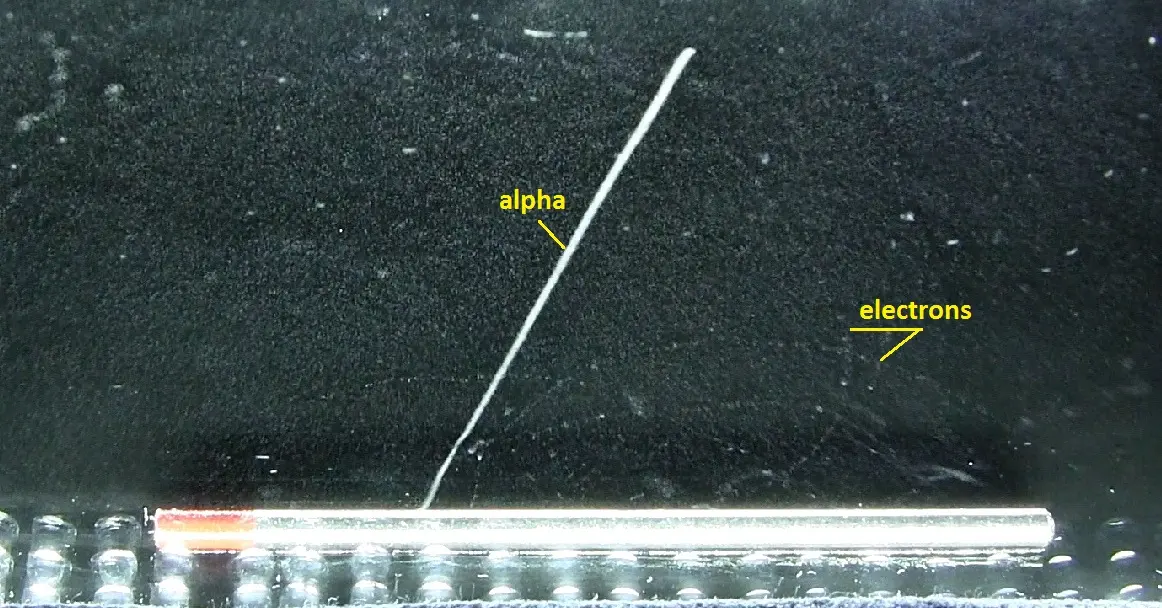
A very heavy nucleus, like uranium’s, has so many protons pushing one another apart that the nuclear force can only just hold it together. One way it becomes smaller and more stable is to throw out a small, very tightly bound bundle of 2 protons and 2 neutrons. That bundle is an alpha particle: the same as the nucleus of a helium atom. Throwing it out is alpha decay.
What is left behind has lost 2 protons and 2 neutrons. So:
- its atomic number goes down by 2: it is now a different element, two places earlier in the periodic table;
- its mass number goes down by 4.
Uranium-238 becomes thorium-234:
Check the top numbers: 238 = 234 + 4. Check the bottom numbers: 92 = 90 + 2. Nothing is lost or created; the nucleons are just shared out differently.
Turning one element into another like this is called transmutation. The alpha particle leaves at about 15,000 km per second, a twentieth of the speed of light, but because it is big and charged, it crashes into the air’s molecules and stops within a few centimeters.
After a nucleus gives out an alpha particle, the new nucleus has:
Pick an answer to see why.
Beta decay: a neutron becomes a proton
Carbon-14 has 6 protons and 8 neutrons: two neutrons more than a light nucleus is happy with. It can’t simply throw a neutron out. Instead, something stranger happens: one of its neutrons turns into a proton. To keep the charge balanced, an electron is made at the same moment, and it shoots out of the nucleus at a large fraction of the speed of light. That fast electron is the beta particle, and the change is beta decay.
So in beta decay:
- the number of protons goes up by 1, so the atom becomes the next element in the periodic table;
- the number of neutrons goes down by 1;
- the mass number stays the same: one nucleon has changed kind, but none has left.
The electron is written : mass number 0, because it is not a nucleon, and charge −1. Check: top, 14 = 14 + 0; bottom, 6 = 7 + (−1). Carbon-14 has become nitrogen-14, the ordinary nitrogen of the air.
The antineutrino in that equation is a tiny particle with no charge and almost no mass, which flies off with part of the energy. It hardly ever touches anything, so it is left out of most equations at this level. But it was the key to a mystery.
In beta decay, which number stays the same?
Pick an answer to see why.
Gamma rays: the nucleus settles down
After an alpha or beta decay, the new nucleus is often left with extra energy, its nucleons not yet settled into their lowest arrangement. It is excited. A moment later it settles down, and gives out the extra energy as a gamma ray: a packet of electromagnetic waves, like light or X-rays, but carrying far more energy.
It is just like the light an atom gives out when an electron drops to a lower energy level (What Are Stars Made Of?). In an atom, a drop gives out a few electronvolts, as visible light; in a nucleus, the levels are about a million times farther apart, and a drop gives out a gamma ray.
Nothing leaves the nucleus but energy. So in gamma decay the number of protons, the number of neutrons and the mass number all stay the same; the element doesn’t change. An excited nucleus is marked with a star:
This one comes from cobalt-60, which gives out a beta particle and becomes nickel-60, left excited; the nickel then gives out two gamma rays. Cobalt-60 machines have long been used in hospitals to aim gamma rays at cancers, and to kill the germs on syringes and bandages.
| Decay | What leaves the nucleus | Protons, Z | Neutrons, N | Mass number, A | Element |
|---|---|---|---|---|---|
| alpha | 2 protons + 2 neutrons, together | − 2 | − 2 | − 4 | changes: 2 places back |
| beta | an electron (and an antineutrino), made as a neutron turns into a proton | + 1 | − 1 | no change | changes: 1 place on |
| gamma | energy only, as a gamma ray | no change | no change | no change | same |
Which kind of decay leaves the element unchanged?
Pick an answer to see why.
What always stays the same
Every nuclear change you have seen follows the same two rules:
- The nucleons are conserved: the mass numbers (top numbers) add up to the same total on both sides.
- Charge is conserved: the atomic numbers (bottom numbers, the charges) add up to the same total on both sides.
The nucleons change partners, and in beta decay a neutron changes into a proton, but none is ever created or destroyed. So if you know all but one thing in a nuclear equation, you can always work out the missing one.
From uranium to lead
Many heavy nuclei don’t reach a stable nucleus in one step. Uranium-238 gives out an alpha particle and becomes thorium-234, which is also unstable; it gives out a beta particle and becomes protactinium-234, which is also unstable; and so on, through fourteen decays, a decay chain, until it reaches lead-206, which is stable.
Some steps happen in a moment, others take ages. The half-life of a radioactive substance is the time it takes for half of its nuclei to decay: 4.5 billion years for uranium-238, about as old as the Earth, but less than a thousandth of a second for polonium-214.
Fission: splitting a heavy nucleus
You saw in Grade 9 how a slow neutron can split a uranium-235 nucleus Grade 9: Nuclear fission:
The same two rules hold: top, 235 + 1 = 141 + 92 + 3; bottom, 92 + 0 = 56 + 36 + 0. But fission is not like alpha decay. The nucleus doesn’t lose a little piece: it splits into two middle-sized nuclei, the fission fragments, and they are not always the same two. Barium and krypton is only one of many ways it can split; strontium and xenon, cesium and rubidium and dozens of other pairs happen too, usually one bigger than the other. On average, each fission throws out about 2.4 neutrons.
The fragments are themselves unstable. Uranium has about 1.55 neutrons per proton; a stable nucleus the size of barium needs only about 1.46. So barium-141, with 85 neutrons for 56 protons, has too many neutrons: it and the other fragments decay by beta decay, one after another (barium-141 → lanthanum-141 → cerium-141 → praseodymium-141, which is stable). That is why the used fuel from a reactor is so dangerously radioactive.
Where fission’s energy goes
One fission gives out about 200 MeV of energy (1 MeV, a million electronvolts, is 1.60 × 10⁻¹³ J). Where does it go?
The two fragments are both positively charged, with 56 and 36 protons, and the moment they are apart they push each other away hard. They fly off at a few per cent of the speed of light. Most of the energy is simply their kinetic energy. Within a fraction of a millimeter of the fuel, they crash into the atoms around them and their speed becomes heat: the heat that boils water in a nuclear power station.
Where does most of the energy released in fission end up first?
Pick an answer to see why.
Fusion: joining light nuclei
You saw in Grade 9 how, in the Sun’s core, four hydrogen nuclei end up, step by step, as one helium nucleus Grade 9: Nuclear reaction in the Sun. That is nuclear fusion: light nuclei joining to make a heavier one.
On Earth, scientists use the fusion that happens most easily: deuterium (hydrogen-2) and tritium (hydrogen-3), two heavy kinds of hydrogen:
Check: top, 2 + 3 = 4 + 1; bottom, 1 + 1 = 2 + 0. Most of the energy, 14.1 MeV, goes into the speed of the neutron.
The hard part is getting them together. Both nuclei are positive and repel each other; only when they rush at each other fast enough do they get close enough for the nuclear force to grab them. That needs a temperature of over 100 million °C, much hotter than the Sun’s core (about 15 million °C), because a fusion machine can’t use the Sun’s enormous squeeze. In December 2022 the National Ignition Facility in the USA, by squeezing a pellet of deuterium and tritium with lasers, for the first time got more energy out of fusion (3.15 MJ) than its lasers put in (2.05 MJ); by 2025 it had reached 8.6 MJ from about 2 MJ. A huge fusion reactor, ITER, is being built in France, planned to start its experiments in 2034 and to fuse deuterium and tritium from 2039 (as of 2026). A fusion power station is still many years away.
In the fusion of deuterium and tritium, what else comes out besides a helium-4 nucleus?
Pick an answer to see why.
Why both splitting and joining give out energy
Splitting a heavy nucleus gives out energy. Joining light nuclei gives out energy. How can both be true? Shouldn’t one be the reverse of the other?
Think of how hard it is to pull a nucleus completely apart into separate protons and neutrons. The energy you would need is the nucleus’s binding energy. Divide it by the number of nucleons and you get the binding energy per nucleon: how tightly, on average, each nucleon is held.
When nucleons end up more tightly held, energy comes out, just as a ball rolling down into a deeper hollow gives out energy as it falls. On the graph, “more tightly held” is higher. So:
- joining two very light nuclei into a heavier one moves up the steep left side of the curve: fusion gives out energy;
- splitting a very heavy nucleus into two middle-sized ones moves up from the right end to the middle: fission gives out energy.
Both are heading for the peak, around iron-56 and nickel-62, the most tightly held nuclei of all, with about 8.8 MeV per nucleon. Nothing gives out energy by moving away from the peak: you can’t get energy by splitting iron, or by fusing it.
How much energy? Mass into energy
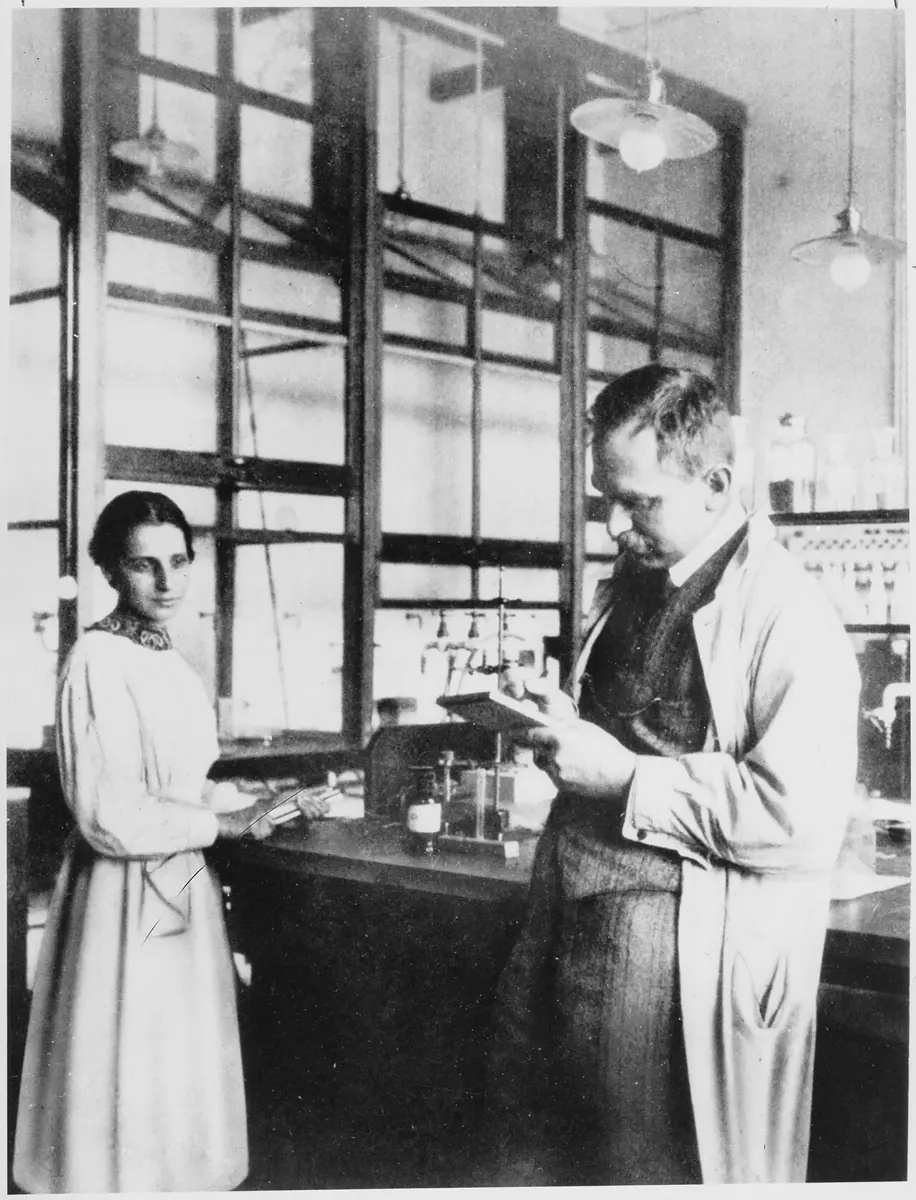
You met Einstein’s E = mc² in Grade 9 Grade 9: Nuclear fission: whenever energy is given out, a little mass disappears. Weigh everything after a nuclear change, and it is a little lighter than before. The mass defect is that missing mass, and the energy given out is
where c = 3.00 × 10⁸ m/s. Masses of nuclei are measured in unified atomic mass units, u: 1 u = 1.661 × 10⁻²⁷ kg, about the mass of one nucleon. A useful shortcut: a mass of 1 u turned into energy gives 931.5 MeV.
This is true of every reaction that gives out energy, even burning. But in a chemical reaction, only the electrons on the outside of the atoms rearrange, and they give out a few electronvolts (eV) per atom (Why Do Some Reactions Get Hot?). Nuclear changes give out millions of electronvolts per nucleus, because the nuclear force holding nucleons together is so much stronger than the electric pull holding electrons in their shells.
Questions
A nucleus gives out an alpha particle, then two beta particles, one after the other. Compared with where it started, the final nucleus is:
Pick an answer to see why.
Which particle is never found inside a nucleus before a decay, but comes out of it?
Pick an answer to see why.
Complete these equations, and name the kind of decay in each.
- i.
- ii.
- iii.
Hint
Make the top numbers and the bottom numbers add up on both sides. Elements: 84 polonium, 54 xenon, 43 technetium.
Answer
- i.Alpha decay. Top: 222 − 4 = 218; bottom: 86 − 2 = 84, polonium. X is , polonium-218.
- ii.Beta decay. Top: 131 − 0 = 131; bottom: 53 + 1 = 54, xenon. Y is , xenon-131.
- iii.Gamma decay. Nothing changes but the energy: Z is , technetium-99. (Excited technetium-99 is the most used radioactive substance in hospitals: its gamma rays let doctors see bones and organs from outside the body.)
Draw a model, with circles for protons and neutrons, of what happens to a carbon-14 nucleus in beta decay. Use your model to explain why the mass number stays the same but the element changes, and how charge is conserved.
Answer
The drawing: a heap of 6 proton circles and 8 neutron circles; an arrow; a heap of 7 protons and 7 neutrons, with one circle marked “was a neutron”; a small electron (and an antineutrino) leaving.
- Mass number: there are 14 nucleons before and 14 after. One has changed from a neutron into a proton, but none has left, so the mass number stays 14.
- Element: the number of protons has gone from 6 to 7, and the number of protons decides the element: carbon has become nitrogen.
- Charge: before, the charge is +6. After, the nucleus has +7, and the electron −1: +7 − 1 = +6. The electron is made exactly to keep the charge the same.
Neptunium-237, , decays in a chain to bismuth-209, . How many alpha and beta decays are in the chain?
Answer
Mass number falls by 237 − 209 = 28: 28 ÷ 4 = 7 alpha decays.
7 alphas take the atomic number down by 14, from 93 to 79. Bismuth is 83, 4 more: 4 beta decays.
Check: 93 − 14 + 4 = 83.
The fragments of a uranium fission, like barium-141 and krypton-92, are radioactive and give out beta particles. Explain why they decay by beta and not by alpha.
Answer
Uranium-235 has about 1.55 neutrons for each proton, and the fragments get roughly the same share: barium-141 has 85 neutrons for 56 protons, about 1.52. But a stable nucleus of barium’s size needs only about 1.46 neutrons per proton (stable barium-138 has 82 neutrons). So the fragments have too many neutrons. Beta decay turns a neutron into a proton, which brings the ratio down step by step, until a stable nucleus is reached. Alpha decay removes neutrons and protons equally, which wouldn’t fix the excess, and is the way out for very heavy nuclei, not middle-sized ones.
Use the curve of binding energy per nucleon (Figure 6.5) to explain why
- i.splitting a uranium nucleus gives out energy,
- ii.splitting an iron nucleus into two smaller ones would not.
Answer
- i.Uranium is at the right-hand end of the curve, with about 7.6 MeV per nucleon. The middle-sized fragments are higher on the curve, about 8.3 to 8.5 MeV per nucleon. After the split the nucleons are more tightly held, by about 0.7 MeV each on average, and the difference, about 174 MeV for the whole nucleus, is given out.
- ii.Iron is at the peak. Any smaller nuclei are lower on the curve, less tightly held. Splitting iron would leave its nucleons less tightly held, so it would take in energy instead of giving it out.
Radium-226 (226.025408 u) gives out an alpha particle (4.002603 u) and becomes radon-222 (222.017576 u). (i) Find the mass lost, and the energy given out in MeV. (ii) The alpha particle carries away almost all of this energy. Why does the radon nucleus get so little?
Answer
- i.Mass lost = 226.025408 − (222.017576 + 4.002603) = 0.005229 u. Energy = 0.005229 × 931.5 MeV = 4.87 MeV.
- ii.The two pieces push off each other with equal and opposite momentum, like a gun and its bullet. The radon is about 55 times heavier than the alpha particle, so it moves about 55 times more slowly, and its kinetic energy (½mv²) is only about a fifty-fifth of the alpha particle’s. So the alpha particle takes about 98 % of the energy (4.78 MeV), and the radon recoils with the rest.
A cylinder of cooking gas (LPG) in Nepal holds 14.2 kg of gas, and burning 1 kg of it gives out about 46 MJ. (i) How much energy is in a full cylinder? (ii) Fusing 1 kg of deuterium and tritium gives out about 3.4 × 10¹⁴ J. What mass of fusion fuel gives out as much energy as the whole cylinder?
Answer
- i.14.2 kg × 46 MJ/kg = 653 MJ = 6.5 × 10⁸ J.
- ii.Mass = 6.5 × 10⁸ J ÷ 3.4 × 10¹⁴ J/kg = 1.9 × 10⁻⁶ kg, about 2 milligrams: less than a tenth of the mass of one grain of rice, for a family’s whole cylinder of cooking gas.
Where to go next
- How Long Will the Sun Shine? The Sun turns 4 million tonnes of mass into energy every second by fusion. How much fuel does it have left, and what happens when it runs out?
- How Old Is the Earth? Every radioactive substance decays at its own steady rate, its half-life. That makes uranium and its lead a clock, and rocks tell their age by it.
- Where Did the Atoms in Your Body Come From? Fusion in stars made the carbon and oxygen in you; exploding stars made much of the iron, and colliding neutron stars much of the gold.