
Rutherford: elements that transform
Nobel Prize in Chemistry, 1908: Ernest Rutherford
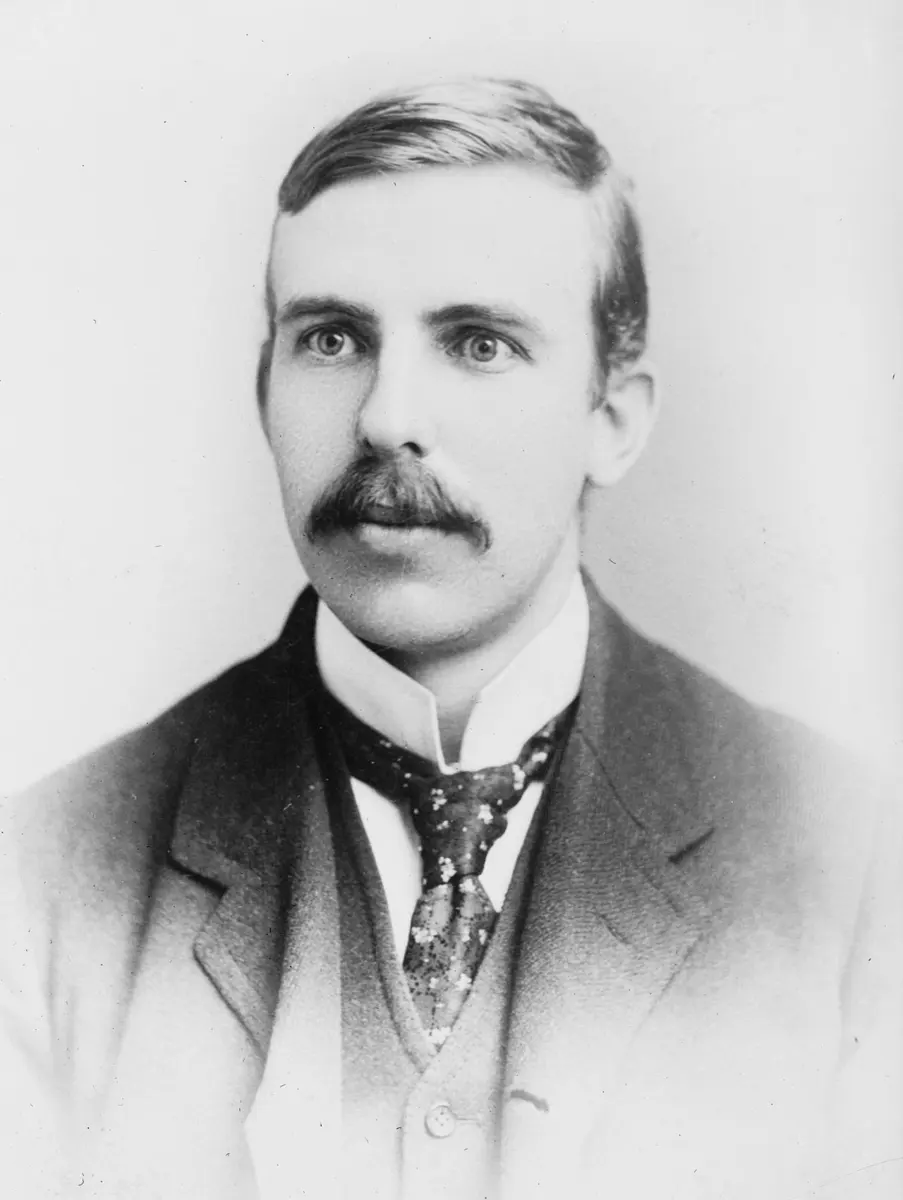
Ernest Rutherford
1871–1937, born in New Zealand
A wheelwright’s son, the fourth of twelve children, who won a scholarship to Cambridge and became the greatest experimenter of his time.
Photo: Bain News Service, publisher, Public domain
Iron rusts, wood burns and dal cooks, but in every one of these changes the atoms stay the same. Rust is still made of iron atoms and oxygen atoms, only joined in a new way. For a hundred years chemists had been sure of one thing above all: an atom of one element can never become an atom of another. Turning lead into gold, the dream of the old alchemists, was impossible.
Then, between 1899 and 1903, a young physicist in Canada showed that some atoms do change into other elements, all by themselves. In 1908 Ernest Rutherford won the Nobel Prize in Chemistry for it. He was a physicist, and he joked at the prize dinner that the quickest transformation he had ever seen was his own, from a physicist into a chemist.
The problem: rays that came from nowhere
In 1896 Henri Becquerel found that uranium gives off invisible rays all by itself, day and night, without being heated or lit. In 1898 Marie and Pierre Curie found two new elements that did the same far more strongly, polonium and radium (Radium: hunting elements by their rays). Marie Curie called this radioactivity.
Nobody knew what the rays were, or where their energy came from. Radium even stays a little warmer than the air around it, year after year, as if it had a fire inside that never goes out.
How the rays were measured
The rays could not be seen, so Rutherford used the same trick as the Curies. Air is normally an insulator: electric charge cannot flow through it. But the rays knock electrons off the molecules of the air, filling it with charged particles called ions, and then it can carry a little charge away.
So Rutherford charged an electroscope, an instrument with a thin metal leaf that stands out when it is charged, and put it near the radioactive substance. The stronger the rays, the faster the leaf fell. This could follow changes far too small to show up on any balance.
Why it was so hard
- The amounts were far too small. The new substances were made a few atoms at a time, much too little to weigh or see. Only their rays showed they were there.
- Everything kept changing. A sample’s rays could grow stronger or weaker over minutes or days, and nobody knew why.
- Nobody wanted to believe it. Every chemist had learned that elements never change. An idea that broke this rule needed very strong proof.
Two kinds of rays (1899)
In 1898, aged 27, Rutherford was working at Cambridge under J. J. Thomson, just before he became a professor at McGill University in Montreal, Canada. He spread uranium oxide on a plate and covered it with very thin sheets of aluminium foil, one after another, measuring the rays each time.
The first few sheets cut the rays down sharply. After that, adding more sheets made only a small difference. So there had to be two kinds of rays. One kind is stopped by a very thin layer of metal, or by a sheet of paper. The other gets through much more. In 1899 he named them after the first two letters of the Greek alphabet: alpha (α) rays and beta (β) rays. A third, even more penetrating kind, gamma (γ) rays, was found from radium by Paul Villard in 1900.
Adding the first few sheets of foil cut the rays down a lot, but adding more sheets after that made little difference. What did this tell Rutherford?
Pick an answer to see why.
Beta rays turned out to be fast electrons. Alpha rays were a puzzle for years. A magnet bends a beam of charged particles; it bent beta rays easily, but alpha rays hardly at all. Only in 1902, with a strong radium sample, did Rutherford bend them a little, the opposite way to electrons. So alpha rays are positively charged particles, much heavier than electrons.
The surprise: a gas that loses its power
At McGill, Rutherford noticed that thorium, another radioactive element, gives off something that drifts away in the air, a radioactive gas. He called it thorium emanation (today it is called thoron, a form of the element radon). He found that its rays fall to half their strength in about a minute, then to half of that in another minute, and so on.
In 1900 a young English chemist, Frederick Soddy, joined him. Rutherford knew how to measure the rays; Soddy knew how to separate substances by chemistry. Together they studied the emanation and found it was a noble gas, like argon: it would not react with anything. Where could a new gas be coming from, out of a solid metal?
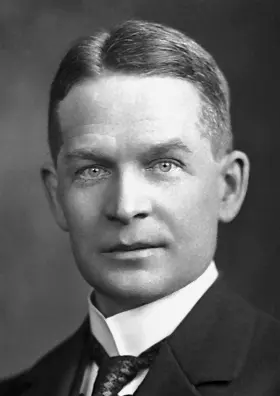
Thorium X (1902)
Rutherford and Soddy dissolved a thorium compound and added ammonia. The thorium came out of the solution as a solid, but a tiny, invisible part stayed behind in the liquid. When they dried the liquid, what was left was far more radioactive than the same weight of thorium. They called it thorium X, and measured both, day after day.
- The thorium X grew weaker. Its rays fell to half in about four days, and kept on halving.
- The thorium, which had lost most of its rays when the thorium X was taken out, grew stronger again. It took about four days to get back half of what it had lost.
- The two curves were mirror images. Whatever the thorium X lost, the thorium gained back.
The only explanation was astonishing. The thorium was making new thorium X all the time, and each bit of thorium X was breaking down as it went. And thorium X is a different element from thorium: it behaves differently in chemical reactions (we now know it is a form of radium). Atoms of one element were turning into atoms of another.
The disintegration theory (1902–1903)
In 1902 and 1903 Rutherford and Soddy put it all together. Their idea is called the disintegration theory.
- The atoms of a radioactive element are unstable. Now and then one of them suddenly breaks up.
- When it breaks up, it shoots out a ray (an alpha or a beta particle), and what is left is an atom of a new element.
- The new atom may be unstable too, and break up in its turn, and so on, step by step, until a stable atom is reached that does not change any more.
- In every second, the same fraction of the atoms that are left breaks up. Nothing changes this rate: not heating, cooling or dissolving, nor joining the atom to others in a compound. So the change happens inside the atom, not between atoms as in an ordinary chemical reaction.
Because the same fraction breaks up in every second, there is always a fixed time in which half of the atoms break up. Today we call it the half-life. Each radioactive element has its own: about a minute for thoron, about four days for thorium X, about 1,600 years for radium, and about 4.5 billion years for the commonest kind of uranium. In the ceremony speech, this time was called as important for telling radioactive elements apart as atomic weight is for ordinary ones.
A radioactive substance has a half-life of 4 days. You start with 80 grams. How much of it is left after 12 days?
Pick an answer to see why.
This also explained the heat of radium. Each atom that breaks up throws out its alpha particle at enormous speed, and the particle crashes into the radium around it and warms it. The energy was stored inside the atoms all along, and comes out a little at a time.
What is an alpha particle? (1903–1908)
There was one more question: what exactly are alpha particles? Rutherford and Soddy had a clue. The gas helium was found on Earth only in rocks that contain uranium or thorium. Perhaps helium was made by radioactivity.
- 1903: radium makes helium. Soddy, now in London, and William Ramsay sealed some radium and found that, after a while, helium appeared next to it. Radium, a metal, was making a gas.
- 1903–1906: a mass of 4. By bending alpha particles with magnets and electric charges, Rutherford measured how much charge each one carried for its mass. The answer fitted a helium atom carrying two positive charges.
- 1908: counting them one by one. In 1907 Rutherford moved to the University of Manchester in England. There, with the German physicist Hans Geiger, he built a counter in which each alpha particle set off a burst of ions big enough to make a needle jump. For the first time, scientists could detect a single atom. One gram of radium, they found, shoots out about 34 billion alpha particles every second. Measuring the total charge they carried showed that each alpha particle carries two units of positive charge.
- 1908: the final proof. With Thomas Royds, Rutherford sealed radium emanation into a tiny glass tube with walls less than 1/100 of a millimeter thick, so thin that alpha particles shot straight through them, while the gas inside could not leak out. Around it was a second tube, emptied of air. After two days, the light from a spark in the outer tube showed a faint yellow line: the color of helium. After six days, every bright line of helium was there. The alpha particles had picked up electrons and become helium gas. Then they filled the inner tube with helium itself instead. No helium appeared outside, even after eight days.
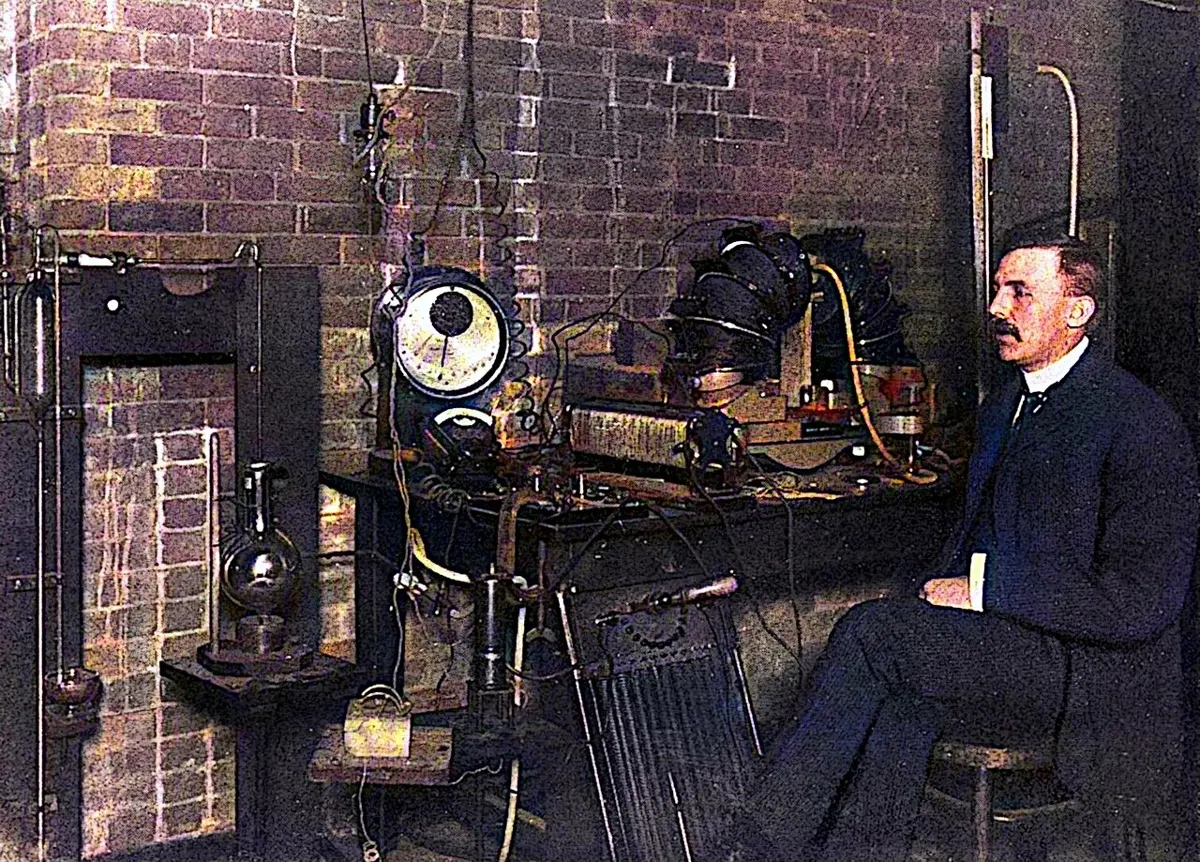
So an alpha particle is a helium atom without its two electrons: today we say it is a helium nucleus, two protons and two neutrons Grade 9: Radioactive elements and radioactive emission. Rutherford gave his Nobel lecture on this result, on 11 December 1908.
How radioactive decay works now
When Rutherford won the prize, nobody knew what was inside an atom. Now we know that an atom has a tiny nucleus of protons and neutrons, with electrons around it, and that the number of protons, the atomic number, decides which element it is Grade 9: Structure of an atom. In alpha decay the nucleus throws out 2 protons and 2 neutrons, so it becomes a different element with a mass 4 less. In beta decay a neutron turns into a proton and shoots out an electron, so the atomic number goes up by 1: again a new element.
In his Nobel lecture Rutherford pointed out that uranium (atomic weight about 238) shoots out eight alpha particles on its way to becoming stable. That leaves 238 − 8 × 4 = 206, close to the atomic weight of lead, which is always found in old uranium rocks. He suggested that the uranium chain ends at lead, and he was right (From uranium to lead).
A radium atom (atomic number 88) shoots out one alpha particle. What happens to it?
Pick an answer to see why.
In your life today
- The age of rocks and of the Earth. Because half-lives never change, radioactive atoms are clocks. In 1905 Rutherford used the helium trapped in a uranium mineral to estimate its age: about 500 million years, far older than most scientists then believed the Earth to be. Using uranium and lead, geologists now date the oldest rocks and the Earth itself, about 4.5 billion years old (How old is the Earth?). The same idea with radioactive carbon dates old bones, wood and cloth.
- Radon in houses. Radium in the ground keeps making radon, Rutherford’s “radium emanation”. It can collect in closed rooms and basements, and breathing it for years raises the risk of lung cancer. Airing rooms keeps it low.
- Smoke alarms. Many contain a speck of americium, which gives off alpha particles. They make the air in a small chamber conduct, as in Rutherford’s electroscope. Smoke gets in the way, the current drops, and the alarm sounds.
- Measuring radioactivity. The Geiger counter that clicks near radioactive things grew out of the counter Rutherford and Geiger built in 1908.
What came next
- The nucleus (1911). In Rutherford’s laboratory, Hans Geiger and a student, Ernest Marsden, fired alpha particles like tiny bullets at a very thin sheet of gold. A very few bounced straight back. From this Rutherford worked out that almost all the mass of an atom is packed into a tiny, positive nucleus at its center. Many think this was his greatest discovery, made after his Nobel Prize (Bohr’s atom).
- Isotopes. Soddy found that some of the “new elements” in the chains were the same element with different masses. He called them isotopes, and won the Nobel Prize in Chemistry in 1921.
- Changing elements on purpose (1919). Rutherford fired alpha particles into nitrogen and knocked protons out of its nuclei. The nitrogen had become oxygen (this was proved a few years later): the first time anyone had changed one element into another on purpose.
- An open question. We can say exactly what fraction of a sample will break up in the next hour, but not which atom will go next. Two radium atoms that are exactly alike may break up a second apart or thousands of years apart. Physicists have searched for a hidden clock inside the atom and found none: it seems to be pure chance. What “pure chance” really means in nature is still argued about.
In your science books
- Grade 8: Structure of an atom, the protons, neutrons and electrons Rutherford helped to find.
- Grade 9: Structure of an atom, Nuclear stability, and Radioactive elements and radioactive emission (alpha, beta and gamma rays).
- Going further: What happens inside a nucleus when it decays? and How old is the Earth?
Learn more
- The prize at nobelprize.org: The Nobel Prize in Chemistry 1908, with the presentation speech.
- Rutherford’s own Nobel lecture, “The chemical nature of the alpha particles from radioactive substances”.
The official reason
The prize was given “for his investigations into the disintegration of the elements, and the chemistry of radioactive substances.”