
Wireless telegraphy: messages without wires
Nobel Prize in Physics, 1909: Guglielmo Marconi and Ferdinand Braun
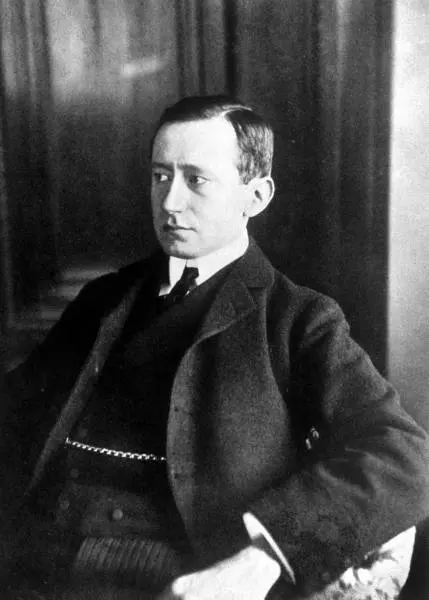
Guglielmo Marconi
1874–1937, born in Italy
He never took a university course in physics. He started in the attic of his parents’ house at the age of twenty.
Photo: Published on LIFE, Public domain
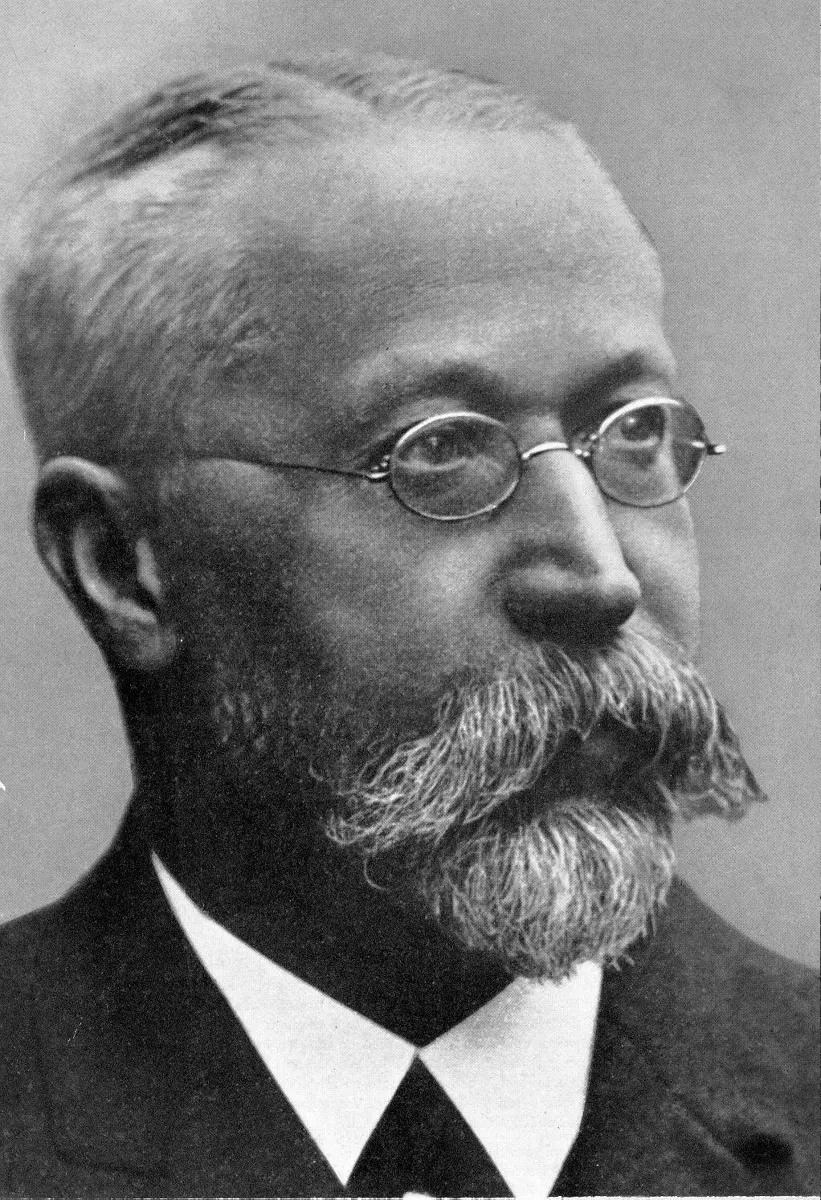
Ferdinand Braun
1850–1918, born in Germany
A physics professor who liked to understand exactly why a machine worked. He also invented the tube inside old box TVs.
Photo: Wikimedia Commons, Public domain
Turn on an FM radio in a bus on the Prithvi Highway, and you hear a station from Kathmandu. Call a relative working in Qatar, and your voice crosses thousands of kilometers. Your phone connects to Wi-Fi from the next room. None of these signals travels along a wire. They travel through the air as radio waves.
In 1900 this seemed almost like magic. The 1909 Nobel Prize in Physics went to the two men who did most to turn a laboratory experiment into wireless telegraphy: sending messages through the air, with no wires at all.
The problem: messages tied to wires
By 1900 the fastest way to send a message was the telegraph. An operator pressed a key to switch an electric current on and off. Short and long pulses, dots and dashes, stood for letters. This is Morse code: the letter S is three dots (· · ·), and O is three dashes (– – –). The pulses traveled along a wire, and at the other end a machine clicked or printed them on a paper tape.
Wires crossed whole countries, and cables lay on the bottom of the sea. But a wire only reaches where it is laid. A ship at sea was cut off from the world the moment it left port; if it was sinking, it could only fire rockets and hope another ship saw them. An island or a lighthouse needed a cable of its own, and a cable under the sea cost a fortune.
The idea: waves through space
In the 1860s the Scottish physicist James Clerk Maxwell worked out, on paper, that electric charges moving rapidly back and forth should send out waves into space, waves of electricity and magnetism. He calculated their speed, and it came out as the speed of light: about 300,000 km every second. He concluded that light itself is one of these electromagnetic waves.
In 1888 the German physicist Heinrich Hertz made these waves in his laboratory. He made a spark jump between two metal balls; each spark made the electric charge rush back and forth very fast, which sent out waves. A few meters away, a tiny spark appeared in the gap of a simple ring of wire, although nothing connected the two. The waves had crossed the room.
Today we call them radio waves. They are the same kind of wave as light, but their wavelength (the distance from one crest to the next) is much longer: from about 30 cm to many kilometers, instead of less than a thousandth of a millimeter Grade 9: Electromagnetic spectrum.
Hertz’s radio waves and ordinary light are the same kind of wave. What is different about them?
Pick an answer to see why.
Why it was hard
Hertz had shown that the waves exist. Using them was another matter.
- The waves were weak. Hertz’s waves could be detected only a few meters away.
- The Earth is round. Radio waves, like light, travel in straight lines. Scientists expected them to fly off into space instead of following the curve of the Earth, so they should never reach far beyond the horizon. To send a wave in a straight line between two places 300 km apart, the stations would need to be more than 1,600 m high.
- All the waves would mix. A spark sends out waves of many wavelengths at once. If several stations worked at the same time, every receiver would pick up all of them, and the messages would be a jumble.
Marconi solved most of the first two problems; Braun solved the third, and made the waves much stronger.
What they did, step by step
Marconi: from the attic to the Atlantic
Guglielmo Marconi was the son of a wealthy family near Bologna, in Italy. He never studied physics at a university, but he read about Hertz’s experiments, and he was sure the waves could carry messages.
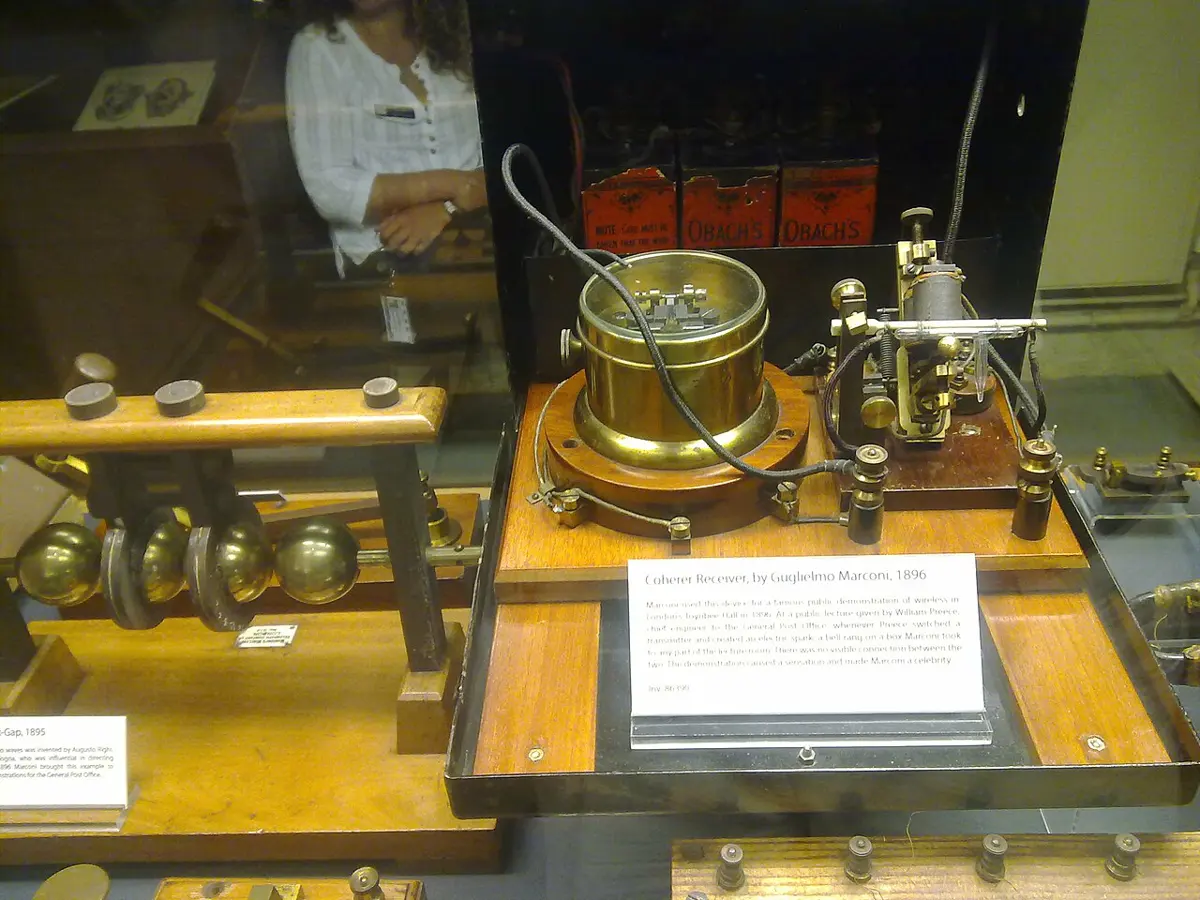
- Early 1895, the attic. At home, Marconi built a spark transmitter with a Morse key: pressing the key sent out a burst of waves. His detector was a coherer, a small glass tube of metal filings. Loose filings conduct badly, but when radio waves arrive they cling together and conduct, so a battery’s current can ring a bell or work a printer. A small hammer, the tapper, then knocks them loose for the next signal.
- August 1895, the aerial. Marconi’s big discovery was simple. He joined one side of his spark gap to a metal plate buried in the ground (an earth), and the other to a metal sheet high up on a pole (an aerial), and did the same at the receiver. The higher the aerial, the further the signal went. Tin cubes on poles 2 m high reached 30 m; on poles 8 m high, 400 m; with bigger cubes at 8 m, he received signals about 2.4 km away, with a hill in between.
- 1896, England. He took his apparatus to London, aged 21. The British Post Office was interested, and in 1896 he was granted the world’s first patent for wireless telegraphy (a patent is a legal right to an invention for some years).
- 1897–1901, further and further. In 1897 his signals crossed the Bristol Channel, about 15 km; he started a company and fitted wireless to ships and lighthouses. In 1899 they crossed the English Channel to France, and in January 1901 they went 300 km along the coast of England, beyond the curve of the Earth. Marconi decided to try the Atlantic.
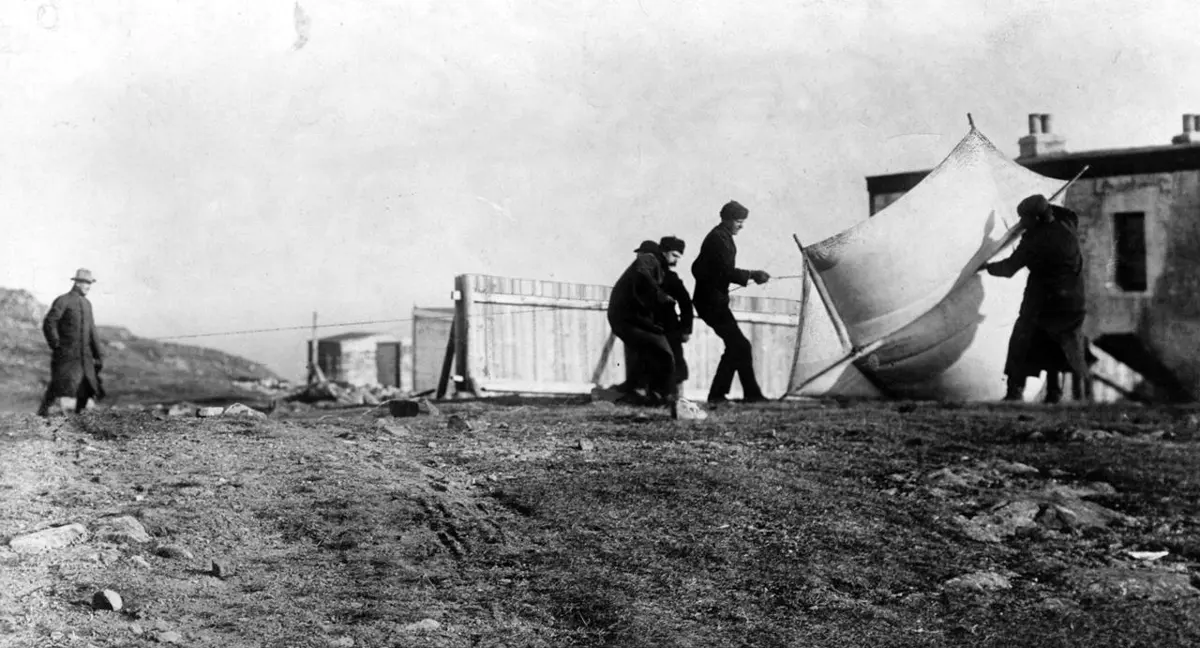
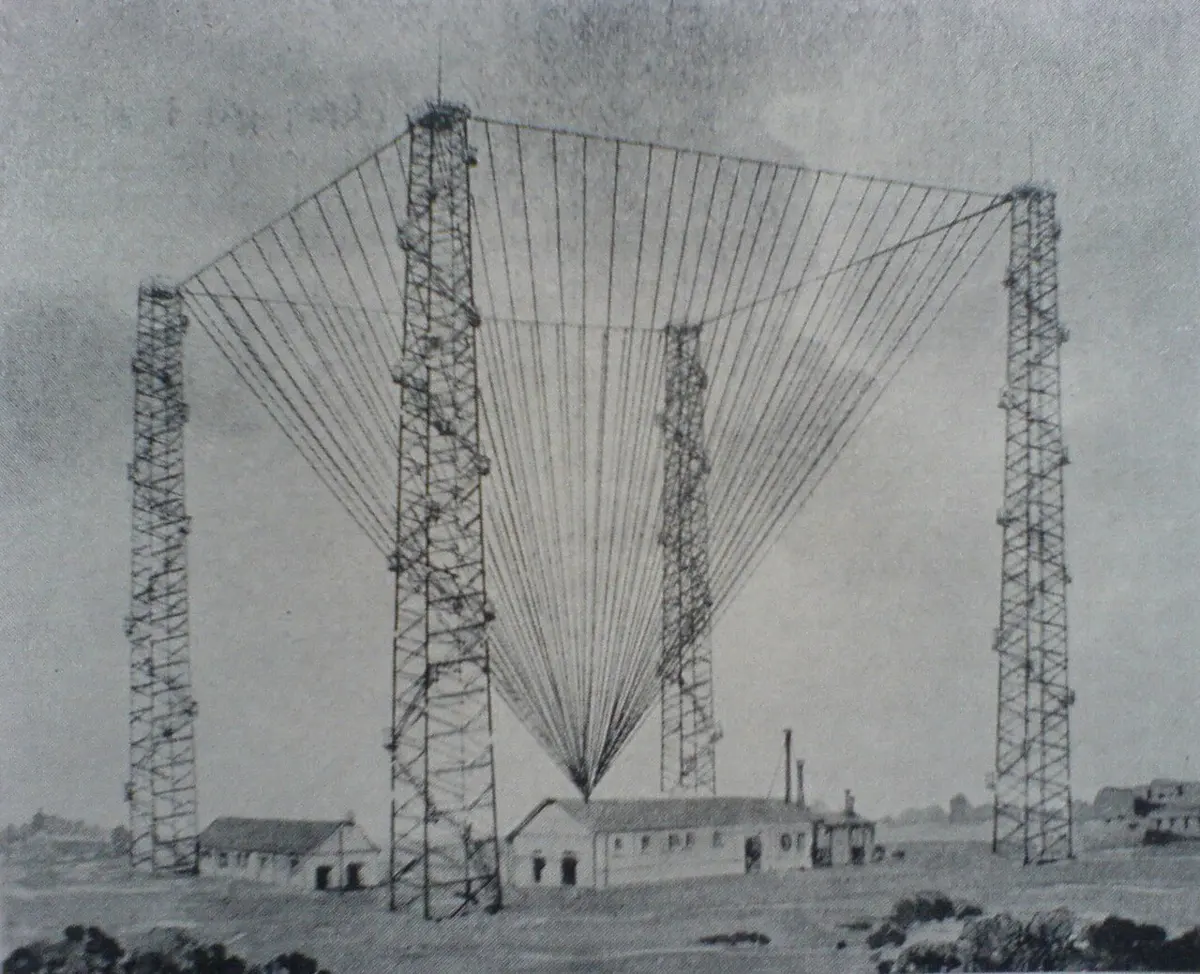
- 12 December 1901, across the Atlantic. He built a huge station at Poldhu, in Cornwall, at the south-western tip of England, with a fan of wires hung from tall masts and about 25 kilowatts of power. Then he crossed to St. John’s, Newfoundland, in Canada, more than 3,000 km away. There, on Signal Hill, in wind and rain, his team flew a kite to hold up a receiving wire. Poldhu sent the letter S, three dots, again and again. Listening with an earphone, Marconi and his assistant said they heard it.
- 1902 and after, proof. No paper record was made in Newfoundland, and some people doubted him. So in February 1902 he sailed on the ship Philadelphia with a receiver that printed on tape. Readable messages arrived from Poldhu up to about 2,500 km away, and single letters up to about 3,400 km. In 1907 a regular wireless message service began across the Atlantic, between Ireland and Canada.
Braun: stronger waves, at one wavelength
Ferdinand Braun was a physics professor in Strasbourg (then in Germany). In 1874 he had found that some crystals, such as galena (a shiny gray ore of lead), let electric current pass easily one way and hardly at all the other way. In 1897 he built the first cathode-ray tube, which draws a line of light on a screen with a beam of electrons. It was later used in every box-shaped TV and computer screen, and in German it is still called a Braun tube.
In 1898 Braun asked why Marconi’s range could not simply be doubled by using more power. He found the answer in the spark itself.
- The problem: waves that die out at once. In Marconi’s first transmitter the spark gap was in the aerial itself, which can hold only a little charge. After each spark the charge rushed up and down a few times and the swings died out: damped waves. Like the dull “thunk” of a wooden plank, not a clear note, such a burst is a smear of many wavelengths, so it can’t be tuned.
- The fix: a closed circuit (1898–1899). Braun put the spark in a separate, closed circuit: a loop with Leyden jars (early capacitors: metal-coated glass jars that store electric charge) and a coil of wire. The jars store far more energy than an aerial, and after each spark the charge swings round the loop many times at one steady frequency, like a bell that rings on after it is struck.
- Coupling. The closed circuit’s coil was wound next to a second coil joined to the aerial, without touching it, like the two coils of a transformer Grade 10: Transformer. The energy passed steadily into the aerial, which sent out a long train of strong waves, all of one wavelength.
- Tuning. A receiver built with a matching circuit responds strongly to that one frequency and hardly at all to others. This is resonance: like pushing a child on a swing in time with its swing, so small pushes add up to big ones. Now several stations could work at once, each on its own wavelength.
- 1905, pointing the waves. With three aerials whose waves were timed one after another, Braun could send a beam in one direction. This phased array now steers the beams of radars and of some mobile phone towers.
Marconi soon used tuned, coupled circuits too, in his patent number 7777 of 1900 (Oliver Lodge in England had similar ideas). Without them, the Atlantic stations could not have worked.
What was the main advantage of Braun’s closed circuit?
Pick an answer to see why.
Across the curve of the Earth
How did Marconi’s waves get around the round Earth? He did not know, and he said so in his Nobel lecture. In 1902 he had noticed something strange: at night, his signals reached more than twice as far as in daytime.
The answer came later. High in the air, from about 60 km up to several hundred kilometers, sunlight knocks electrons out of the thin air. This layer of charged air, the ionosphere, works for radio waves somewhat like a mirror: waves sent up at a slant bounce back down far beyond the horizon. In daytime its lowest part also soaks up waves, which is why signals go further at night. (You can still hear this: at night an AM radio picks up far-away stations.) Two scientists suggested the layer in 1902; the British physicist Edward Appleton proved it in 1924, and won the Physics Prize for 1947.
How it works now
Spark transmitters, which disturb every receiver nearby, are long gone. Their place was taken by electronic circuits that make a smooth, steady wave at one exact frequency, the carrier wave. Your voice, music or data is added to the carrier by changing its height or frequency: this is modulation Grade 9: Modulation and demodulation.
But the winners’ ideas are still in every radio:
- Aerials, from the mast of an FM station to the metal strip hidden inside your phone.
- Tuned circuits, descendants of Braun’s, that pick out one station from all the waves arriving at once.
- Braun’s crystal that conducts one way only: from about 1906, cheap radios used a galena crystal as their detector. It was the start of the semiconductor diode, now in every electronic device.
In your life today
- Radio and TV. Radio Nepal began broadcasting in 1951. In 1997 Radio Sagarmatha in Kathmandu became the first independent community radio station in South Asia, and today hundreds of FM stations reach every district, often in local languages.
- Mobile phones, Wi-Fi, Bluetooth and GPS all send their signals as radio waves, at much higher frequencies than Marconi’s. A phone is a radio transmitter and receiver in one.
What came next
- Voices, not just dots. By the 1910s and 1920s, new electronic valves (vacuum tubes) made smooth waves that could carry speech and music. The first regular radio broadcasts began around 1920.
- Short waves and radar. In the 1920s Marconi found that short waves, bounced off the ionosphere, cross the world with little power. In 1935 he showed the principle of radar.
In your science books
- Grade 9: electromagnetic waves, the electromagnetic spectrum and radio waves; how telecommunication works and modulation; radio, TV and mobile phones.
- Grade 10: analog and digital signals and signal transmission; the transformer, whose two coils pass energy without touching, as in Braun’s coupled circuit.
- Going Further: Is phone radiation dangerous? (what radio waves can and can’t do to your body).
Learn more
- The presentation speech: Award ceremony speech, 1909 (nobelprize.org).
- The two laureates’ Nobel lectures: Marconi, “Wireless telegraphic communication” and Braun, “Electrical oscillations and wireless telegraphy”.
The official reason
The prize was given “in recognition of their contributions to the development of wireless telegraphy.”