
Climb to Everest Base Camp, at 5,364 m, and every breath brings in only about half as much oxygen as it does at sea level. Your head aches, and every step feels like three. Now imagine going back 2.5 billion years, to a beach on the young Earth. The air would be there, the waves and the sunshine too, but you could not breathe at all. Even at sea level the air then held less than a hundred-thousandth as much oxygen as it does today.
In Grade 8 you read, in one sentence, that tiny living things in the sea made the oxygen. That sentence hides one of the biggest stories in science. Living things didn’t only change the air: their oxygen rusted the seas, painted the rocks red, probably cooled the planet into ice ages, and built a shield against the Sun’s ultraviolet. Later, plants made soil and changed the shape of rivers, and corals built islands. And each time life changed the Earth, the changed Earth decided what could live next. This topic shows how we know, from evidence in the rocks.
The air before oxygen
You met the young Earth in Grade 8 Grade 8: A young, violent Earth: volcanoes breathed out water vapor, carbon dioxide, nitrogen and other gases, the water vapor rained down to fill the oceans, and the air that was left had almost no free oxygen. Today the air is about 78% nitrogen and 21% oxygen, with only about 0.04% carbon dioxide (as of 2026). The early air was mostly nitrogen too, but with far more carbon dioxide than today, some methane, and almost no oxygen.
Nobody was there to take a sample. So how can geologists be sure? Oxygen is a very reactive gas, and it leaves marks on the rocks it touches. Rocks from before about 2.4 billion years ago show that it wasn’t there:
- Grains that oxygen destroys. Pyrite (“fool’s gold”, iron sulphide) and uraninite (a uranium mineral) don’t last long in today’s air and water: oxygen attacks them and they dissolve. Yet in river gravels more than 2.4 billion years old, such as those of the Witwatersrand in South Africa, there are rounded grains of both, worn smooth as they tumbled along the river beds. They could only have survived that journey with almost no oxygen about. In younger river gravels they disappear.
- Soils that lost their iron. Ancient soils, preserved under later rocks, are called paleosols. In the oldest ones, rain washed the iron out of the soil, because iron without oxygen dissolves in water. In younger paleosols the iron stayed behind, rusted and red.
- No red beds. Sandstones colored red by rust, called red beds, are common in rocks younger than about 2.3 billion years, and missing from older ones.
- A fingerprint in sulphur. Sulphur atoms come in a few slightly different masses (isotopes). When ultraviolet light splits sulphur gases from volcanoes, high in an air with no oxygen, it sorts these isotopes in an unusual way, and the unusual mix ends up in the rocks. With even a little oxygen in the air, this fingerprint is wiped out. It is found in rocks older than about 2.4 to 2.3 billion years, and almost never since.
Four different kinds of evidence, from different rocks in different countries, tell the same story. That is what makes scientists confident: before about 2.4 billion years ago, the air held less than 0.001% of today’s oxygen.
In river gravels more than 2.4 billion years old there are rounded grains of pyrite, worn smooth by tumbling in a river. Why does that tell us there was almost no oxygen in the air?
Pick an answer to see why.
The oxygen makers
You know photosynthesis from Grade 9 Grade 9: Biotic components: green plants and algae use the energy of sunlight to make sugar from carbon dioxide and water, and give out oxygen.
The oxygen comes from the water: the hard part of this kind of photosynthesis is splitting water molecules, which takes a lot of energy. The first living things that could do it were bacteria, the cyanobacteria (once called blue-green algae). Older kinds of photosynthesis, which some bacteria still use, take their electrons from easier sources, such as hydrogen sulphide or dissolved iron, and give out no oxygen at all. Splitting water was a much harder trick, but water is everywhere, so the cyanobacteria could live anywhere there was light.
You have probably seen cyanobacteria. After the monsoon rains, a dark green jelly sometimes appears on damp paths and bare ground, looking like a squashed seaweed: that is Nostoc, a colony of cyanobacteria. In paddy fields, other cyanobacteria such as Anabaena take nitrogen from the air and fertilize the rice.
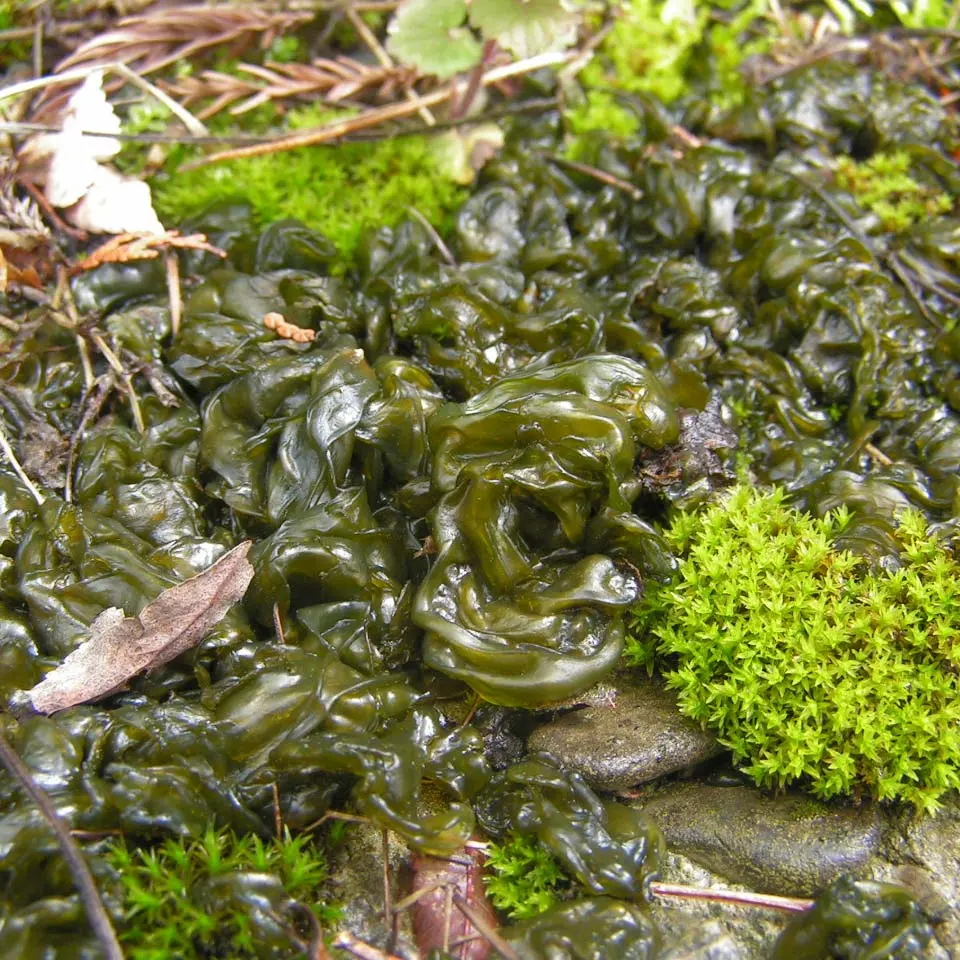
Every leaf you see is partly a cyanobacterium too. The chloroplasts inside plant cells, where photosynthesis happens, are the descendants of cyanobacteria that were swallowed by a larger cell more than a billion years ago and lived on inside it. The chloroplasts of a rice plant still have their own small loop of DNA, like a bacterium’s.
Stromatolites
In shallow, sunny seas, cyanobacteria grow as sticky mats. Sand and mud settle on a mat; the bacteria grow up through it towards the light and make a new mat on top; more sand settles. Layer by layer, they build a rocky mound called a stromatolite. Stromatolites still grow today in a few salty bays where few animals graze on them, most famously at Shark Bay in Western Australia, rising by less than a millimeter a year.
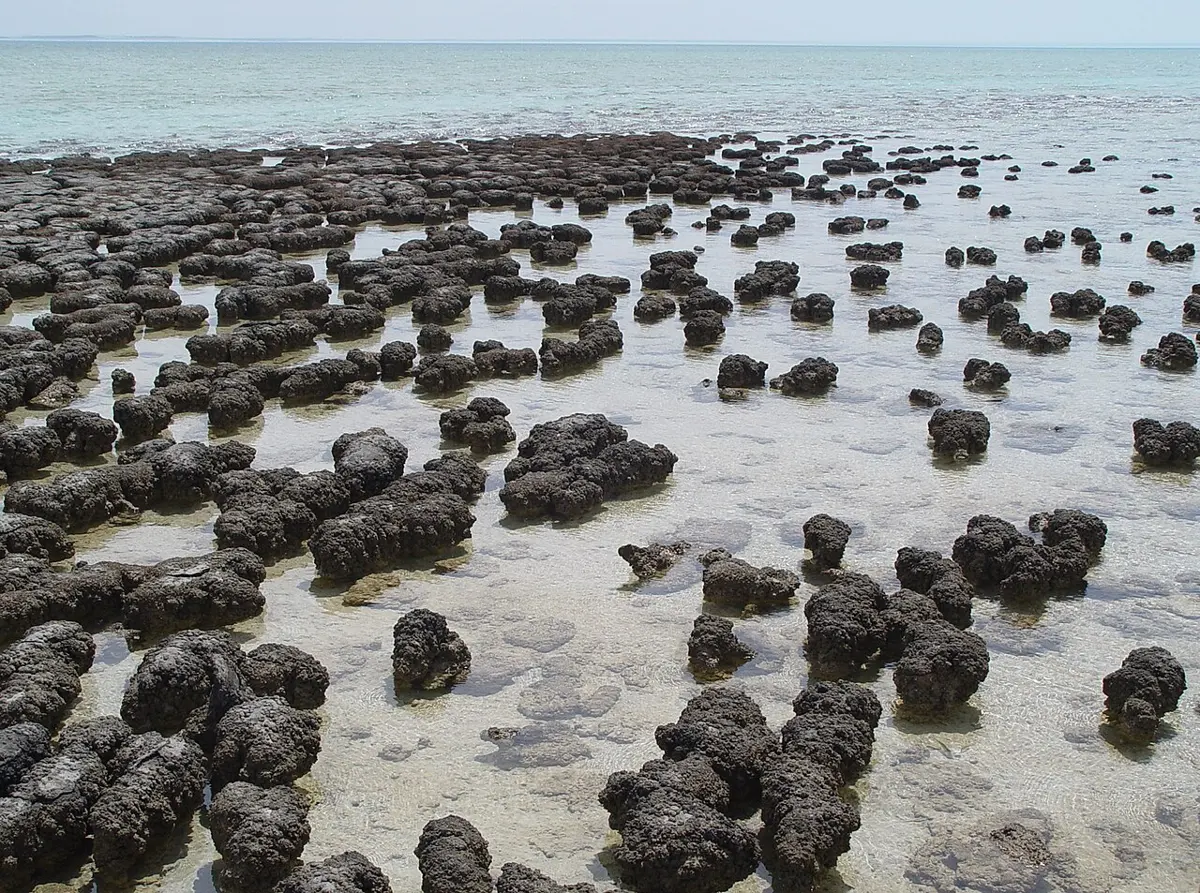
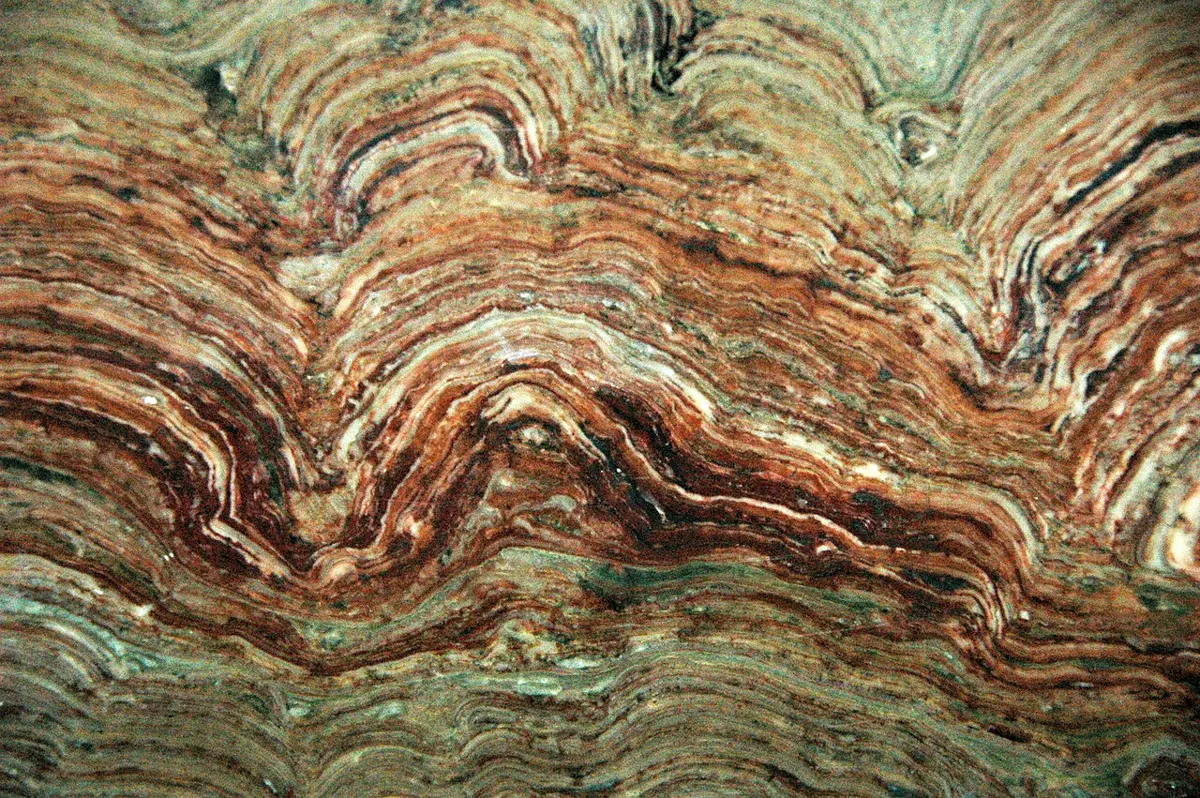
Fossil stromatolites are some of the oldest signs of life, from 3.48 billion years ago (How Old Is the Earth?), though we can’t tell whether the very oldest were built by oxygen makers. Cut one open and polish it, and you see the layers, each once the surface of a living mat. You don’t have to go to Australia to find them: the gray Dhading Dolomite, which makes hills and ridges around Dhading in Nepal’s Lesser Himalaya, has stromatolites in many of its beds. They grew in a shallow sea perhaps 1.6 billion years ago (the age is still argued over), long before the Himalaya rose.
Oxygen stays only if carbon is buried
Here is a puzzle. Photosynthesis makes oxygen, but respiration uses it, and so does decay. When a leaf falls and rots, the decomposers use up exactly as much oxygen as the leaf released while it grew (Where Does a Fallen Leaf Go?). Run the equation forwards, then backwards, and nothing is left over.
Oxygen is left in the air only when the sugar made by photosynthesis doesn’t get used again: when dead cells sink to the sea floor and are buried in mud before they rot, and the mud turns to rock. For every carbon atom buried, one molecule of oxygen, O₂, is left behind. Most of the world’s photosynthesis is undone each year by respiration and decay; only a small fraction, well under 1%, is buried. The oxygen in the air is the leftover from hundreds of millions of years of that small fraction.
Rusting the sea
If cyanobacteria make oxygen so fast, why did it take so long to build up in the air? Many geologists think oxygen makers were living by about 2.7 to 3 billion years ago, and there are signs of brief “whiffs” of oxygen before 2.4 billion years ago. The answer is that the young Earth had a huge appetite for oxygen.
The early oceans were full of dissolved iron, as Fe²⁺ ions, washed in from rocks and pouring out of hot springs on the sea floor. (Iron dissolves in water with no oxygen; that is why the oldest soils lost their iron.) Wherever oxygen met this iron, it turned it into iron oxide, rust, which doesn’t dissolve:
The rust fell to the sea floor as fine red mud. Between the layers of rust, layers of silica (which hardens into a rock called chert) and iron minerals of other kinds settled out, and the sea floor built up in stripes. Pressed into rock, they became banded iron formations: rocks of thin red, gray and black bands of iron oxide and chert. Why the bands came and went, in layers from less than a millimeter to many meters thick, is still argued over: perhaps the cyanobacteria grew in seasons, or the iron arrived in pulses.
Banded iron formations are found from 3.8 billion years ago until about 1.85 billion years ago. They are at their greatest around 2.5 billion years ago, when they were laid down in enormous amounts, before the oxygen began to fill the air. In the Hamersley Range of Western Australia, layer after layer of them makes up whole cliffs.
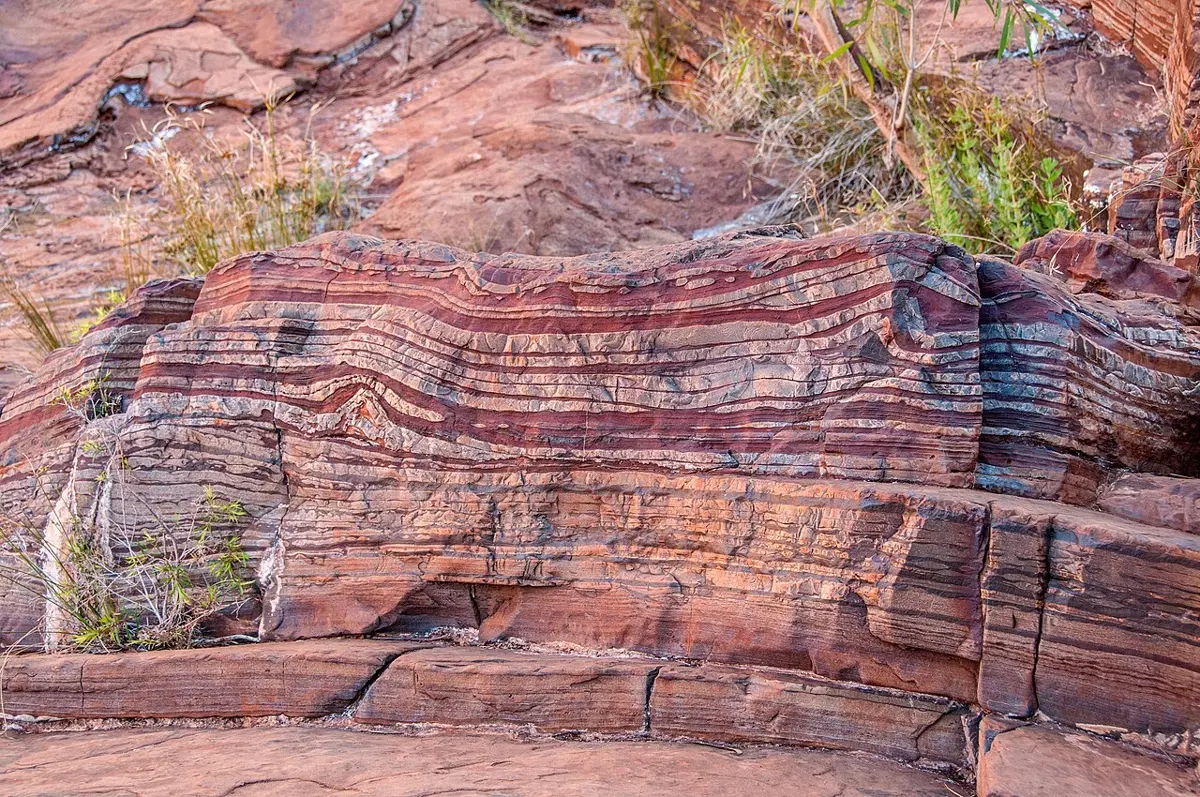
Today these rocks are where most of the world’s iron ore is mined. The steel in a bicycle, a bus or a pressure cooker very likely began as iron rusted out of the sea by oxygen from bacteria, more than 2 billion years ago.
Iron wasn’t the only thing using oxygen up. Volcanoes breathed out gases that react with oxygen, such as hydrogen and hydrogen sulphide, and the air held methane, which oxygen destroys. Anything that removes oxygen from the air or sea is called an oxygen sink. For hundreds of millions of years, the sinks took in all the oxygen the cyanobacteria could make. Oxygen could only build up once it was made faster than the sinks could take it in. One idea is that the sinks slowly shrank as the Earth’s inside cooled and its volcanoes changed, until the oxygen makers outran them.
Oxygen makers may have lived for a few hundred million years before oxygen built up in the air. What is the best explanation?
Pick an answer to see why.
The Great Oxidation Event
Between about 2.43 and 2.22 billion years ago, everything in the rocks changes. The rounded pyrite grains vanish from river gravels, the sulphur fingerprint disappears, and red beds and red paleosols appear. Oxygen was building up in the air for the first time. Geologists call this the Great Oxidation Event. It wasn’t sudden: the sulphur fingerprint comes and goes for about 200 million years, as if the oxygen rose and fell several times before it stayed (as of 2026, how and when exactly are still being argued over). Even then, oxygen probably reached only a small fraction of today’s level.
A changed air changed everything else.
- The climate. The young Sun was dimmer, and the Earth was kept warm partly by methane, a strong greenhouse gas. Oxygen destroys methane. Rocks from just this time hold signs of glaciers, three or four separate ice ages, at least one reaching close to the equator. Many geologists think the oxygen, by destroying the methane, set them off. (Why the climate changes is the topic Why Has the Climate Changed Before?)
- The ozone layer. High in the air, ultraviolet light splits some oxygen molecules, and the atoms join other oxygen molecules to make ozone, O₃, as you learned in Grade 9 Grade 9: Ozone. Even a small share of today’s oxygen makes enough ozone to block much of the Sun’s most dangerous ultraviolet. For the first time, the surface of the land and the top of the sea were shielded.
- The rocks. Rain with oxygen dissolved in it attacks rock in new ways, rusting the iron in it and turning sulphide minerals into sulphate, which rivers carried to the sea. The mineralogist Robert Hazen has estimated that about two-thirds of all the kinds of minerals known on Earth owe their existence to life, most of them to the oxygen it made: on a lifeless planet they would never have formed. The Earth’s rocks are, in a real sense, partly made by life.
- Life itself. To the microbes of the time, oxygen was a poison: it reacts with the delicate molecules inside cells. Many could only survive where oxygen didn’t reach, deep in mud and in still water, where their descendants live today: the methane makers of a paddy field, the bacteria of your gut (Can Life Run Without Oxygen?). Others evolved ways to use oxygen, and gained far more energy from their food: with oxygen, a cell gets about 30 ATP from each glucose molecule, without it only 2. Cells with a nucleus, the ancestors of all plants, fungi and animals, appear in rocks from about 1.6 billion years ago; their mitochondria, which use oxygen, are the descendants of oxygen-using bacteria swallowed by a larger cell.
Which of these would you expect to find in rocks younger than 2.2 billion years, but not in rocks older than 2.4 billion years?
Pick an answer to see why.
Oxygen and animals
After the Great Oxidation Event, oxygen didn’t simply keep rising. For more than a billion years, from about 1.8 to 0.8 billion years ago, it seems to have stayed low, perhaps between a thousandth and a tenth of today’s level (the estimates vary a lot), and the deep sea had little or none. Geologists call this long, quiet stretch the boring billion. Life stayed small and simple.
Then, from about 800 million years ago, the Earth changed again. Twice, between about 720 and 635 million years ago, ice spread from the poles nearly to the equator: the times called Snowball Earth. Banded iron formations briefly returned. Around the same time, the oxygen rose towards today’s level, and soon after the last great ice melted, the first large living things appeared in the sea: the soft, flat Ediacaran creatures, about 575 million years ago. Then, from about 539 million years ago, came the Cambrian explosion you met in Grade 8, with shells, eyes, legs, predators and burrowers.
Why would animals have to wait for oxygen? A large animal needs a lot of energy, and only respiration with oxygen gives enough. Oxygen reaches the cells inside a body by spreading through it, which is slow, so the bigger and more active an animal, the more oxygen the water around it must hold. A sponge can live on very little; a fish chasing its prey needs a lot.
Why could large, active animals only evolve after oxygen rose?
Pick an answer to see why.
Life makes the land
For more than 4 billion years, the land was almost bare: rock, sand and gravel, with perhaps a thin crust of microbes in damp places. There was no soil as we know it. Soil isn’t just crushed rock: it is broken rock mixed with the remains of living things, full of living things, held together by roots and fungal threads. Life makes it, and it takes a long time: a centimeter of topsoil can take hundreds of years to form, up to a thousand.
The first land plants, small and mossy, spread across the land about 470 million years ago, sheltered by the ozone layer, which by then had been there for nearly 2 billion years. Plants and soil then built each other up:
- Microbes, lichens and plants give out acids, and their roots grow into cracks, so rock breaks down much faster under living things than on bare ground. Plants and the microbes in the soil also fill the soil’s air with carbon dioxide, which makes rainwater a stronger acid (What Does Water Do to Rock?).
- The broken rock, mixed with dead leaves and roots, becomes deeper soil, which holds more water and food for plants. So bigger plants can grow, with deeper roots, which break more rock.
By about 385 million years ago there were the first forests, of trees with deep roots. They changed the land in ways the rocks still show:
- Rivers. Before plants, rivers spread across the land in wide, shifting sheets of gravel and sand, braided into many channels, and little mud stayed on land. After plants spread, roots held the river banks together, mud built up into plains, and rivers began to wind in single channels with steep banks: meandering rivers, like the Rapti winding through Chitwan. Most geologists think the plants caused this change; a few argue that the timing doesn’t quite fit.
- The air. Faster weathering of rock takes carbon dioxide out of the air (Why Has the Climate Changed Before?), and plants bury carbon in the ground. As forests spread, the carbon dioxide fell, and many geologists think this helped bring on a long ice age that began about 360 million years ago.
- Oxygen. In the coal swamps of the Carboniferous, so much plant matter was buried that oxygen rose higher than today: computer models suggest perhaps 30% of the air or more. Dragonfly-like insects called griffinflies flew on wings up to about 70 cm across, and part of the reason may be the extra oxygen, since insects breathe through tubes that only carry oxygen a short way.
- Fire. A fire can’t spread unless the air is at least about 15% oxygen. The oldest fossil charcoal is about 420 million years old, and there has been charcoal in the rocks of almost every age since. So, since then, the oxygen in the air has hardly ever fallen below about 15%.
Which is the best evidence that the air has had at least about 15% oxygen for most of the last 420 million years?
Pick an answer to see why.
Life builds coasts and islands
Some of the land itself is built by living things. Reef-building corals are small animals, related to sea anemones, that live in colonies in warm, clear, shallow seas. Inside their bodies live tiny algae that make food by photosynthesis and share it with the coral. With that food, each coral builds a hard skeleton of calcium carbonate, limestone, under itself, and the colony grows year after year on the skeletons of earlier ones. Together, they build a coral reef.
A reef changes the coast it grows on:
- It breaks the waves. Waves break on the reef’s outer edge, so the water behind it is calm. This sheltered water, a lagoon, is a home for fish, sea grasses and mangroves, and the shore behind it is worn away much less.
- It makes sand. Parrotfish bite off pieces of coral to eat the algae on them, grind them up, and pass out the rest as fine white sand. On one reef in the Maldives, scientists measured about 685 tonnes of new sediment a year, and found that parrotfish made more than 85% of the new sand produced each year on its outer edge. The waves pile the sand up into beaches and low islands.
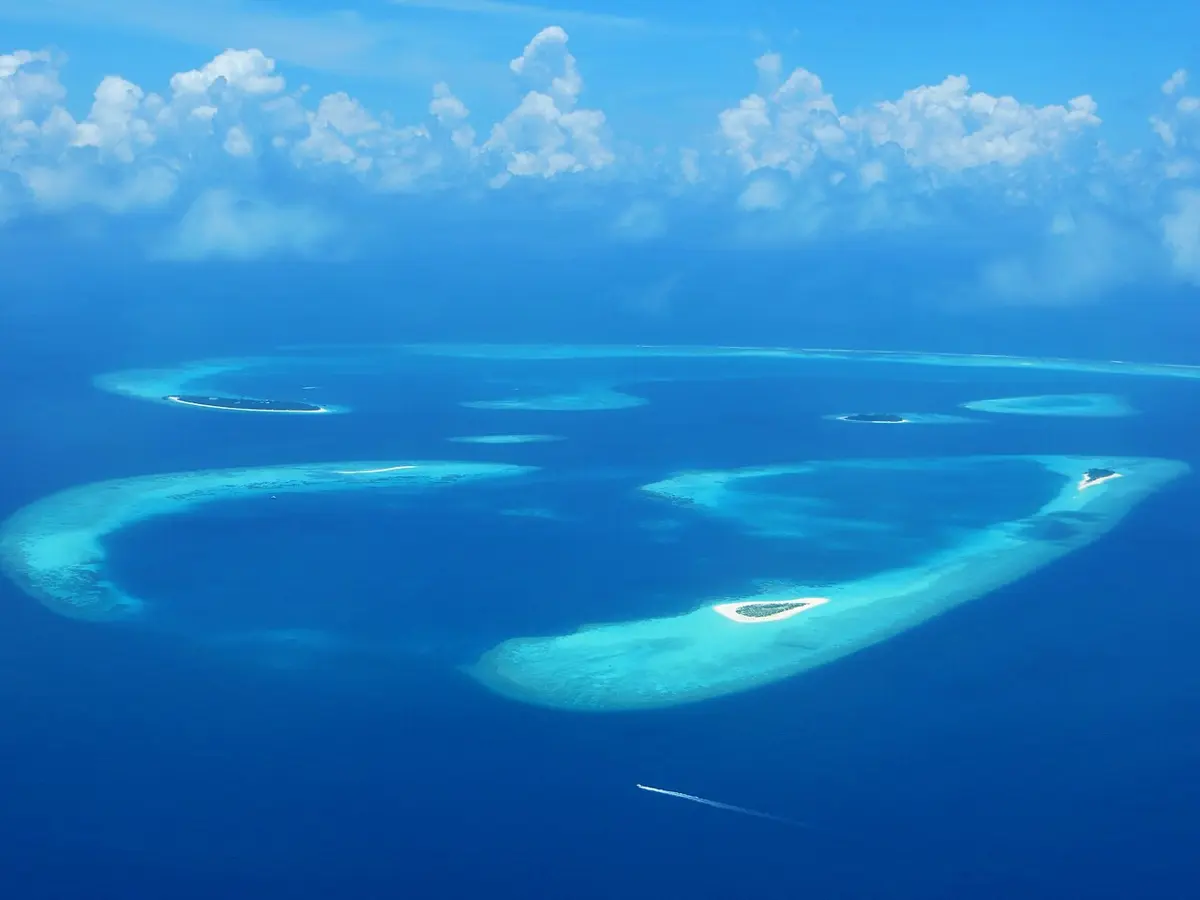
- It builds whole islands. The Maldives are about 1,190 low coral islands on reefs in 26 rings, and most of the country’s land is less than a meter or two above the sea. The Great Barrier Reef of Australia stretches for more than 2,300 km: the largest thing on Earth built by living things.
Life has built rock on a far bigger scale too. Limestone is mostly the shells and skeletons of sea creatures. The white chalk cliffs of southern England are made of the tiny plates of single-celled algae, and the rock at the summit of Everest is limestone made on a sea floor about 450 million years ago, holding fossils of sea lilies and trilobites (Why Is Everest Still Rising?). Coal, too, is buried plants. Living things have locked away so much carbon in limestone and coal that, without them, the Earth’s air would be very different.
Two stories at once
The Earth’s history is usually told one way: the Earth changed, and life evolved to fit. That is true, but it is half the story. The evidence shows that the Earth and its life have changed together, each change in one making the next change in the other possible. This is the coevolution of the Earth and life.
| Life changed the Earth | The Earth changed life |
|---|---|
| Cyanobacteria made oxygen, which rusted the sea into banded iron and filled the air. | Oxygen poisoned many microbes, and let others use it for far more energy. |
| Oxygen made the ozone layer. | The ozone shield made the land safe from ultraviolet; plants and animals spread onto it. |
| Oxygen destroyed methane, and the Earth probably froze. | Snowball Earth’s ice ages came just before the first large animals (whether one led to the other is still argued over). |
| Plants and microbes made soil, held river banks, and drew down carbon dioxide. | Soil let bigger plants grow; a cooler world with ice sheets changed where life could live. |
| Corals built reefs, lagoons and islands. | Calm lagoons and new islands made homes for fish, mangroves, birds and people. |
Investigate: how much of the air is oxygen?
Questions
Where did most of the oxygen go that the first cyanobacteria made?
Pick an answer to see why.
Which of these is an example of the Earth changing life, rather than life changing the Earth?
Pick an answer to see why.
Explain why oxygen only builds up in the air when the remains of living things are buried, and not when they rot.
Answer
Photosynthesis takes in carbon dioxide and water and gives out oxygen, storing the carbon in sugar. When the plant or microbe dies and rots, decomposers use oxygen to break the sugar back down into carbon dioxide and water, using up exactly as much oxygen as was given out. So nothing is left over. If the remains are buried in mud before they rot, their carbon is locked away in the rock, and the oxygen made when they grew stays in the air: one molecule of O₂ for each carbon atom buried.
A geologist finds a layer of rock, 2.3 billion years old, with red sandstones above it and rounded grains of pyrite in the gravels below it. a. What does each tell her about the air at the time? b. What has happened between the two?
Answer
- a.The rounded pyrite grains in the lower gravels survived a long trip along a river, so there was almost no oxygen in the air or water when they were laid down. The red sandstones above are colored by iron oxide, rust that formed where they lay, so by then there was oxygen in the air.
- b.Oxygen began to build up in the air between the two: the Great Oxidation Event, which happened between about 2.43 and 2.22 billion years ago.
How much oxygen does it take to rust 5,000 tonnes of dissolved iron into iron oxide? (4Fe²⁺ + O₂ + 4H₂O → 2Fe₂O₃ + 8H⁺; Fe = 56 g/mol, O₂ = 32 g/mol.)
Answer
Moles of iron: 5,000 × 10⁶ g ÷ 56 g/mol = 8.93 × 10⁷ mol.
Moles of O₂ (one for every 4 Fe²⁺): 8.93 × 10⁷ ÷ 4 = 2.23 × 10⁷ mol.
Mass of O₂: 2.23 × 10⁷ mol × 32 g/mol = 7.1 × 10⁸ g = 714 tonnes of oxygen (143 kg for every tonne of iron).
Large animals appear in the rocks only after about 575 million years ago, after the oxygen in the air rose. Some scientists argue that the oxygen allowed animals to evolve; others that animals helped change the oxygen. a. Give one reason for each view. b. Why can’t the timing alone settle it?
Answer
- a.For oxygen first: large, active animals need a lot of energy, which only respiration with oxygen gives, and oxygen must be plentiful in the water to spread into a large body fast enough. For animals changing the oxygen: filter-feeding animals like sponges cleared the water of particles, and burrowing animals stirred oxygen into the sea-floor mud, both of which changed where and how oxygen was used up and carbon buried.
- b.When two things happen at about the same time, either could have caused the other, both could have been caused by something else (such as the Snowball Earth ice ages and the changes after them), or each could have pushed the other along. To decide, scientists need evidence of which changed first, and by how much, in many places.
The Maldives are low coral islands. Explain how living things built them, and why the health of the reef matters to the people who live there.
Answer
Reef-building corals, with the algae living inside them, build skeletons of calcium carbonate that pile up, colony on colony, into reefs. The reefs grew on the tops of old, slowly sinking volcanoes, staying at the surface as the volcanoes sank, so they now stand on thick caps of their own limestone. Parrotfish and other living things grind the coral into sand, and waves pile the sand up into islands. The reef also breaks the waves before they reach the islands. So the people need a living reef: it makes the sand that keeps their islands built up, and it protects them from storms. If the corals die, less sand is made and the waves reach the shore with more force, and the islands, most of which are less than a meter or two high, wear away.
Choose one chain of changes from this topic, with at least four steps, in which life and the Earth take turns to change each other. For each step, say whether it is life or the Earth that changes, and give the evidence for it.
Answer
There are many good answers. One example:
- Life: cyanobacteria evolve photosynthesis that splits water and gives out oxygen. Evidence: stromatolites, and cyanobacteria alive today.
- Earth: the oxygen rusts the iron dissolved in the sea; once the iron and volcanic gases can’t take it all in, oxygen builds up in the air and the ozone layer forms. Evidence: banded iron formations, mostly 3.8 to 1.85 billion years old; then pyrite grains and the sulphur fingerprint disappear and red beds appear, about 2.4 to 2.2 billion years ago.
- Life: shielded from ultraviolet, with oxygen to breathe, larger living things evolve, and later plants spread onto land. Evidence: fossils of the first large animals (575 million years) and land plants (470 million years).
- Earth: plants make soil, hold river banks and draw carbon dioxide out of the air. Evidence: old soils, the change to meandering rivers, and the ice age that began about 360 million years ago.
Where to go next
- Where Does the Carbon Go? Following carbon between the air, the sea, the rocks and living things, and why buried carbon matters so much.
- Can Life Run Without Oxygen? The microbes that live as all life did before the oxygen came, and how your muscles manage without it for a while.
- Why Has the Climate Changed Before? How carbon dioxide, ice and the Earth’s orbit have changed the climate, from the ice ages to the times when crocodiles lived in the Arctic.