
Giant magnetoresistance: reading hard disks
Nobel Prize in Physics, 2007: Albert Fert and Peter Grünberg

Albert Fert
born 1938 in Carcassonne, France
A physicist at Orsay, near Paris, who had spent his student years studying how an electron’s own magnetism changes the way it moves through iron.
Photo: Jevillegas, CC BY-SA 4.0

Peter Grünberg
1939–2018, born in Pilsen, Czechoslovakia (now the Czech Republic)
A physicist at the research center in Jülich, Germany, who liked to explain every new effect with a simple picture.
Photo: Kuebi = Armin Kübelbeck, CC BY-SA 3.0
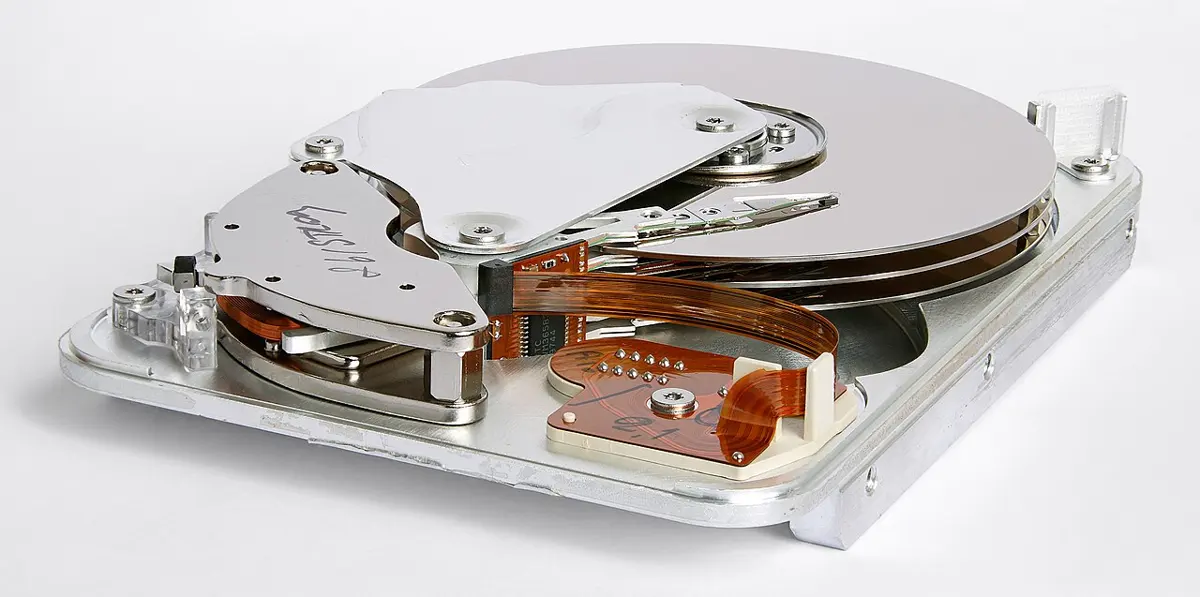
Every photo you upload, every video you watch online and every message you send is kept somewhere. Much of it sits in huge buildings called data centers, on hard disks: spinning metal plates covered with billions of tiny magnets.
In 1997 a hard disk for a home computer held about 16 GB. Today the biggest hold more than a thousand times as much, in a box of about the same size. That jump was only possible because of a discovery made in 1988 by two physicists, one in France and one in Germany, working separately. They found that a stack of metal layers, each only a few atoms thick, changes its electrical resistance a great deal when a magnet comes near. They called it giant magnetoresistance, and in 2007 it won them the Nobel Prize in Physics.
The problem: reading smaller and smaller magnets
A hard disk stores information as bits, the 1s and 0s of computer code Grade 10: Binary numbers. Each bit is a tiny area of the disk’s magnetic coating, magnetized in one direction or the other. A read head floats just above the spinning disk and feels which way each area points.
To fit more on a disk, each magnetic area must be made smaller. But a smaller magnet is a weaker magnet. Its field is so faint that the read head must be extremely sensitive to notice it at all.
The first read heads used a small coil of wire. As the magnetized areas passed under the coil, they made a tiny current flow in it: this is electromagnetic induction, which you meet in Grade 10 Grade 10: Electromagnetic induction. As the areas got smaller, the current got too weak to be read reliably.
The next idea was to use magnetoresistance: the way a magnet changes the resistance of a metal. Remember that resistance is how much a material holds back an electric current Grade 9: Electric resistance. As early as 1857, the British physicist Lord Kelvin had shown that the resistance of iron changes a little when it is put near a magnet. In the early 1990s read heads began to use this effect. But the change is small: at most a few per cent. Most physicists believed it could not be made much bigger. A new kind of read head was needed, or disks would stop growing.
Why does a hard disk that holds more need a more sensitive read head?
Pick an answer to see why.
How it works: electrons are tiny magnets
To understand giant magnetoresistance, you need two ideas.
First, what resistance is. A current in a metal is a flow of electrons. On their way, the electrons bump into atoms that are out of place, impurities and the edges between materials. Each bump knocks an electron off its straight path. The more an electron is knocked about, the higher the resistance.
Second, every electron is a tiny magnet. Besides its negative charge, each electron behaves like a very small bar magnet, because of a property called spin. Its little magnet can point only one of two ways, which we can call “up” and “down”. In Grade 8 you met the idea that iron is made of many tiny magnets Grade 8: Molecular theory of magnetism; the spins of electrons are where that magnetism comes from.
Now the key fact. In a magnetized piece of iron, the two kinds of electrons are not treated the same. Electrons whose tiny magnet points the same way as the iron’s magnetism pass through fairly easily. Electrons pointing the other way bump much more. (In some materials it is the other way round; what matters is that the two kinds are treated differently.)
Think of a road through a market with a crowd walking one way. If you walk with the crowd, you move easily. If you walk against it, you keep bumping into people.
Why it was hard
Inside a thick piece of iron, this difference is mostly hidden. An electron travels only a very short way before something flips its spin, so the two kinds get mixed up and the effect almost disappears. To use it, everything must happen within a few nanometers. A nanometer is a billionth of a meter: a human hair is tens of thousands of nanometers thick.
So the experiment needed layers of metal only a few atoms thick, smooth and clean. That was impossible until the 1970s and 80s, when new machines made it possible to build metals up one layer of atoms at a time. In a very good vacuum, a little iron or chromium is heated until its atoms fly off and settle on a clean, flat crystal, a few at a time. This is called epitaxy. Albert Fert had wanted to do this kind of experiment since his student thesis in 1970; he had to wait fifteen years for the machines.
What they did, step by step
Both teams used the same two metals: iron, which is magnetic, and chromium, which is not.
Grünberg: the iron layers that point opposite ways
- 1986, a strange pairing. Peter Grünberg’s group at Jülich made a sandwich: a thin layer of iron, then about a nanometer of chromium, then iron again. They found that the chromium made the two iron layers point in opposite directions by themselves, with no outside magnet.
- A magnet can line them up. Put the sandwich near a strong magnet, and both iron layers turn to point the same way as the magnet.
- 1988, the resistance. His student Gaby Binasch set up the equipment to measure the resistance of the sandwich as the outside magnet was made stronger. When the iron layers turned from opposite to the same direction, the resistance dropped. At room temperature the change was small; cooled, with three iron layers, it reached about 10%, many times more than ordinary magnetoresistance.
- A patent. Grünberg saw at once that this could be useful, and he applied for a patent while he was still writing up the experiment.
Fert: many layers, and a giant change
- 1985, a plan made beside a pool. At a meeting in San Diego, Albert Fert agreed with a former student, Alain Friederich, who worked at the French company Thomson-CSF and had a machine for epitaxy, to grow magnetic layers together.
- 1988, dozens of layers. Fert’s team grew stacks of iron and chromium, layer on layer, with the chromium only about 1 nanometer thick, a handful of atoms. They cooled them in liquid helium to −269 °C and measured the resistance in a magnetic field.
- A giant drop. They measured stacks with thick chromium first, then thinner and thinner. The thinner the chromium, the bigger the effect. With the thinnest, the resistance fell by almost half when the magnet lined up the iron layers. Fert named it giant magnetoresistance, GMR for short, and wrote that it could lead to important uses.
The two scientists met in July 1988 at a conference in Le Creusot, in France. They compared their results, agreed that they had found the same effect, and celebrated with a glass of red wine.
Why the resistance changes
Here is the simplest picture, with two iron layers and one chromium layer between them.
- Iron layers pointing the same way. Electrons whose tiny magnet matches the iron pass through both layers easily. They form a fast lane for the current, so the total resistance is low.
- Iron layers pointing opposite ways. Now every electron, of either kind, matches one iron layer but not the other. Every electron gets knocked about in one of the two layers. There is no fast lane, so the resistance is high.
The chromium does two jobs. It keeps the iron layers apart, so that each can point its own way. And because it is so thin, an electron crosses from one iron layer to the next before its spin has time to flip.
In a GMR sandwich, when is the resistance highest?
Pick an answer to see why.
From a laboratory to every computer
Epitaxy was slow and expensive, fine for a laboratory but not for a factory. In 1990 Stuart Parkin, an English physicist working for IBM in the United States, showed that GMR also works in layers made by sputtering, a much quicker method in which atoms are knocked off a block of metal and sprayed onto a surface. The layers did not have to be perfect after all.
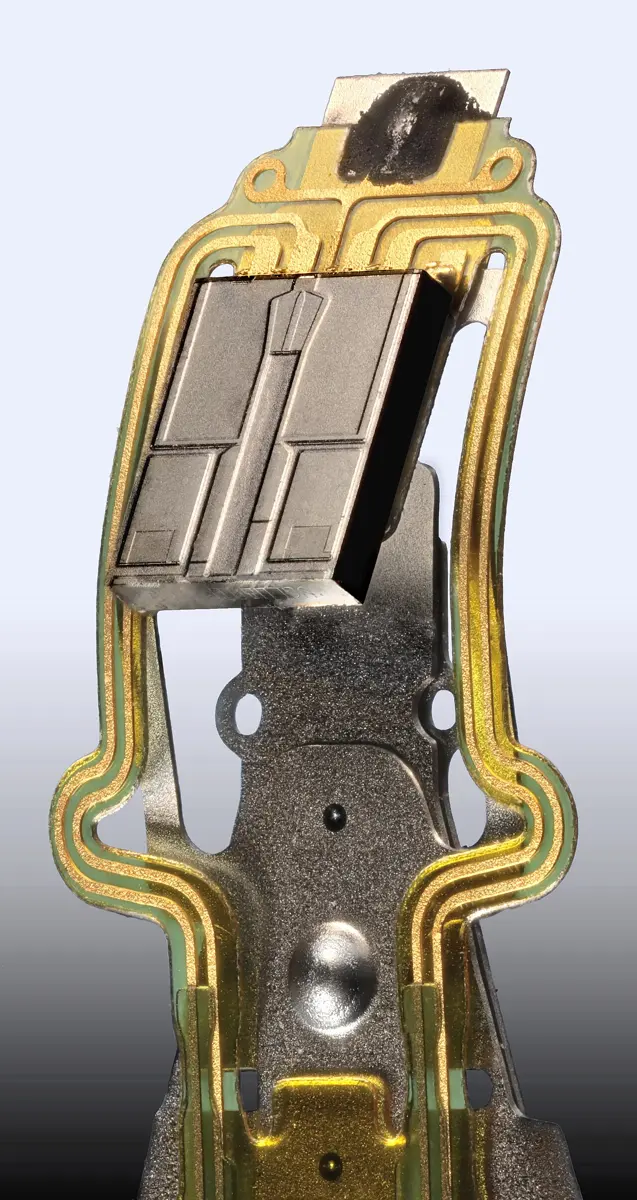
IBM’s engineers then designed a read head on this idea, called a spin valve. It has two magnetic layers with a thin non-magnetic layer between them:
- the bottom layer’s magnetism is pinned: fixed in one direction for good;
- the top layer is free: its magnetism turns to follow the tiny magnet passing underneath it on the disk.
When the free layer points the same way as the pinned one, the resistance is low and a large current flows. When it points the other way, the resistance is high and a smaller current flows. The changing current is the signal, and the computer turns it into 1s and 0s.
The first hard disk with a GMR read head went on sale in 1997: it held about 16.8 GB. Within a few years GMR heads were in almost every hard disk made.
In your life today
- Photos and videos in the cloud. Your phone stores its own photos in flash memory, which has no magnets. But when you back them up, or watch a video online, the data usually sits on hard disks in a data center far away Grade 8: Cloud computing. Hard disks are still the cheapest way to keep huge amounts of data.
- Laptops and desktop computers used hard disks with GMR heads for years; many still do.
- Magnetic sensors. GMR sensors measure very weak magnetic fields. They are used in some cars, for example to measure how fast the wheels are turning.
What came next
- Tunneling heads. If the middle layer is made of a thin insulator instead of a metal, electrons can still slip through it by a quantum effect called tunneling. This gives an even bigger change in resistance, called tunneling magnetoresistance (TMR). The read heads of hard disks made today use it.
- Memory that remembers. A computer’s working memory (RAM) forgets everything when the power goes off; that is why unsaved work is lost in a power cut. MRAM stores bits in tiny magnetic layers, so it keeps them with no power. It is already used in some machines, but it is still more expensive than ordinary memory.
- The open question: could one kind of memory one day be as fast as RAM, keep data without power like a hard disk, and be cheap enough to replace both? Engineers are still trying.
What is the main difference between “electronics” and “spintronics”?
Pick an answer to see why.
In your science books
- Grade 8: the molecular theory of magnetism (the tiny magnets inside iron), the electron and cloud computing.
- Grade 9: electric resistance and the factors that affect it, and Ohm’s law.
- Grade 10: electromagnetic induction (how the first read heads worked), binary numbers and bits and bytes.
- Going further: How do magnets push without touching?
Learn more
- The Nobel Prize’s own explanation: Better read-out heads for pocket-size devices (nobelprize.org).
- The two laureates’ Nobel lectures: Fert and Grünberg.
The official reason
The prize was given “for the discovery of Giant Magnetoresistance.”