
It is a January morning in Kathmandu, and the air outside is close to freezing. At the bus stop your fingers are so cold they hurt. Your friend takes a small paper packet out of her pocket, shakes it, and gives it to you. In a few minutes it is warm, and it stays warm all morning. There is no fire in it, no battery and no wire.
Now think of a football match. A player twists his ankle. The coach takes out a plastic pack, squeezes it hard, and lays it on the ankle. Within a minute the pack is ice cold, though it came out of a warm bag, not a freezer.
Neither pack has a battery or a freezer. The heat comes from the substances inside them. Some changes give out heat, and others take it in. In this topic you will find out which, and where the heat comes from. Then you will do what engineers do: set a goal, design a hand warmer, test it, and make it better.
Changes that give out heat, and changes that take it in
You already know many changes that give out heat. A gas stove burns gas and heats your pan. Your body “burns” its food slowly, and that keeps you warm. When builders put chuna (quicklime) into water to make whitewash, the water gets so hot that it can boil.
A change that gives out heat to its surroundings is exothermic (exo means “out”, thermic means “heat”). A change that takes in heat from its surroundings is endothermic (endo means “in”). You will meet these words again in Grade 9 (Exothermic reaction and Endothermic reaction).
Here is how to tell them apart. Put a thermometer in the mixture, and watch it.
- If the thermometer goes up, the change is giving out heat: it is exothermic.
- If the thermometer goes down, the change is taking in heat: it is endothermic. The heat it needs comes from the nearest things: the water, the container, and your hand. That is why the cold pack feels cold.
| Change | Heat | What you notice |
|---|---|---|
| gas burning on a stove | given out | the flame is hot |
| quicklime (chuna) in water | given out | the water gets very hot |
| iron rusting | given out | usually too slowly to notice |
| baking soda in vinegar | taken in | the glass gets a little cooler |
| urea fertilizer dissolving in water | taken in | the water gets cold |
| water freezing | given out | (see Taking the heat away) |
| ice melting | taken in | your drink gets cold |
Some of these are chemical reactions: new substances are made (rust from iron, carbon dioxide from gas). Others are not: when salt or urea dissolves, it is still salt or urea, only spread through the water; when water freezes, it is still water. Heat goes in or out in all of them, and all of them can be used to make a pack hot or cold.
A student dissolves a spoonful of a white powder in a glass of water. The thermometer falls from 25 °C to 17 °C. What can she say?
Pick an answer to see why.
A hand warmer must make your hands warm. Which kind of change could you use in it?
Pick an answer to see why.
Where does the heat come from?
The heat is not made from nothing. It was stored in the substances all along. To see where, think about what holds particles together.
In What Does a Molecule Look Like? you saw that atoms hold on to each other with bonds. In Where Does the Heat Go When Ice Melts? you saw that pulling particles apart against their pull takes energy, like lifting a bag of rice onto a shelf. Now put these together into two rules:
- Pulling particles apart takes in energy.
- Particles coming together and holding on gives out energy.
Every reaction does both. Atoms let go of their old partners (energy in), and join new ones (energy out). Which is bigger decides what you feel:
- If more energy comes out when the new partners join than went in to pull the old ones apart, the extra comes out as heat. The change is exothermic.
- If more energy goes in than comes out, the change takes the difference from its surroundings. It is endothermic.
Dissolving works the same way. The particles of the solid must be pulled out of their crystal (energy in). Then water molecules crowd round each one and cling to it (energy out).
The two amounts can be very close. For calcium chloride, the energy given out when the water clings on is only a few per cent bigger than the energy needed to pull the crystal apart. But a few per cent of a large amount is still plenty to make the water hot.
In a reaction, the energy needed to pull the old particles apart is more than the energy given out when they join up in new ways. What happens to the temperature of the mixture?
Pick an answer to see why.
How much heat?
To design a pack, you need numbers. Chemists have measured how much heat each substance gives out or takes in. Here are some, for each gram dissolved in plenty of water at 25 °C, and for iron as it rusts.
| Substance | Heat for each gram | Where you meet it |
|---|---|---|
| calcium chloride, dissolving | gives out about 730 J | hot packs; it is also spread on icy roads, and is the white powder in damp-absorbing boxes |
| ammonium nitrate, dissolving | takes in about 320 J | instant cold packs |
| urea, dissolving | takes in about 240 J | fertilizer; some cold packs |
| table salt, dissolving | takes in about 66 J | hardly noticed in cooking |
| iron, rusting | gives out about 7,400 J | air-activated hand warmers |
The calcium chloride number is for the dry powder. Calcium chloride that has already soaked up water from damp air gives out less.
From Where Does the Heat Go When Ice Melts? you know that it takes 4.2 J to warm 1 g of water by 1 °C. (In Grade 10 you will meet this as water’s specific heat capacity.) So if a pack gives its heat to the water in it:
This is only roughly right. Some heat warms the bag and the dissolved solid, and some escapes into the air while it dissolves, so a real pack comes out a few degrees cooler. It is good enough to plan with.
That last answer is the key to designing a pack. What matters for how hot it gets is not the amount of powder alone, but how much powder there is for each gram of water: its concentration. Double the powder in the same water, and the rise doubles. Double the water as well, and the rise stays the same.
Design a hand warmer
Engineers don’t just build something and hope. They follow a loop of steps, and go round it as many times as they need.
Step 1: Set the goal
Write down exactly what “a good hand warmer” means, so that you can test it with a thermometer and a clock. The things it must do are its criteria. The limits you must work within are its constraints.
Criteria (for a pack that is held in the hand, in a room at 10 °C):
- a.It must get to 40 °C or more: warm enough to feel good.
- b.It must never go over 50 °C, so that it can’t burn.
- c.It must stay between 40 °C and 50 °C for at least 20 minutes.
Constraints: it must fit in a hand (no more than 200 g of water); it must use a substance that is safe to handle in a sealed bag; it must be cheap.
Why stop at 50 °C? Skin can be burned by things that don’t feel very hot, if they touch it for long enough. In experiments in the 1940s, skin kept at 44 °C for six hours was burned. Each degree hotter roughly halved the time, and at 54 °C about half a minute was enough. Bought hand warmers get hotter than our target (the one in the photo below says 55–70 °C on its back), and that is why they say: keep it in a pocket or a glove, never against bare skin for long, and never on a baby.
Steps 2 and 3: Plan and build, then test
You can change four things: which substance, how much of it, how much water, and what is round the pack. A thin plastic bag lets heat escape quickly; a thick cloth pouch traps a layer of still air around the pack and slows the heat’s escape, as a sweater does for you.
Try it in the widget before you try it for real. It works out the temperature with the formula above, and lets the pack lose heat to the room as a real one does (how fast it loses heat is made up, but realistic).
In the widget, you test 20 g of calcium chloride in 100 g of water, in a thin bag. Then you change to 40 g of calcium chloride, keeping everything else the same. What happens?
Pick an answer to see why.
Two packs have the same concentration: 20 g of calcium chloride in 100 g of water, and 40 g in 200 g. Both are in thin bags. How do they compare?
Pick an answer to see why.
Testing fairly
When you test for real, change one thing at a time. If you change the amount of powder and the cover together, and the pack gets better, you can’t tell which change helped. Keep everything else the same: the water’s starting temperature, the kind of bag, how long you shake it, and where you put the thermometer.
Here are the results of one student’s tests, with a real pack, a thermometer and a clock. (Made up for this book, but typical of what you would get.)
| Test | What she used | Highest temperature | Minutes between 40 °C and 50 °C |
|---|---|---|---|
| 1 | 10 g calcium chloride, 100 g water, thin bag | 26 °C | 0 |
| 2 | 20 g calcium chloride, 100 g water, thin bag | 43 °C | 5 |
| 3 | 20 g calcium chloride, 100 g water, cloth pouch | 44 °C | 11 |
| 4 | 30 g calcium chloride, 150 g water, cloth pouch | 44 °C | 13 |
| 5 | 35 g calcium chloride, 150 g water, cloth pouch | 50 °C | 27 |
Test 1 was too cool. In test 2 she doubled the powder, and the pack got past 40 °C, but cooled too quickly. In test 3 she changed only the cover, and the pack stayed warm about twice as long. In test 4 she made the whole pack bigger with the same concentration: it got just as hot, and stayed warm only a little longer. In test 5 she kept the bigger pack and added a little more powder to the same water: it got hotter, up to 50 °C but not over, so it started higher and took 27 minutes to cool to 40 °C. Test 5 meets all three criteria.
Step 4: Improve
A design that passes can still be made better. Is it too heavy? Does it cost too much? Could it be used again? Each answer sends you round the loop again. That is how bought hand warmers were designed, as you will see next.
Hand warmers you can buy
The packet that rusts
The packet at the bus stop is an air-activated hand warmer. Inside is a damp mixture of iron powder, salt water, activated charcoal and vermiculite. It gets warm because the iron rusts.
You have seen iron rust: a bicycle left out in the monsoon, a nail in a puddle. Rusting gives out a lot of heat, about 7,400 J for each gram of iron, about ten times as much as calcium chloride. But a rusty nail never feels warm, because it rusts over weeks and its heat leaks away as fast as it is made. The hand warmer makes the iron rust fast:
- The iron is a fine powder, so a huge surface is open to the air.
- The salt water makes iron rust faster, as the salty sea air rusts cars in towns by the sea.
- The activated charcoal is full of tiny holes that hold air and water close to the iron.
- The vermiculite, a light mineral, soaks up the water so the powder stays damp but not wet.
It must not rust too fast, though, or it would be too hot and used up in minutes. So the mixture is sealed in an inner bag with tiny holes, which let air in slowly. The whole thing is sold in an airtight wrapper. Until you open it, no air gets in, and nothing happens. Seal a half-used warmer in an airtight bag, and it stops, to be used later.
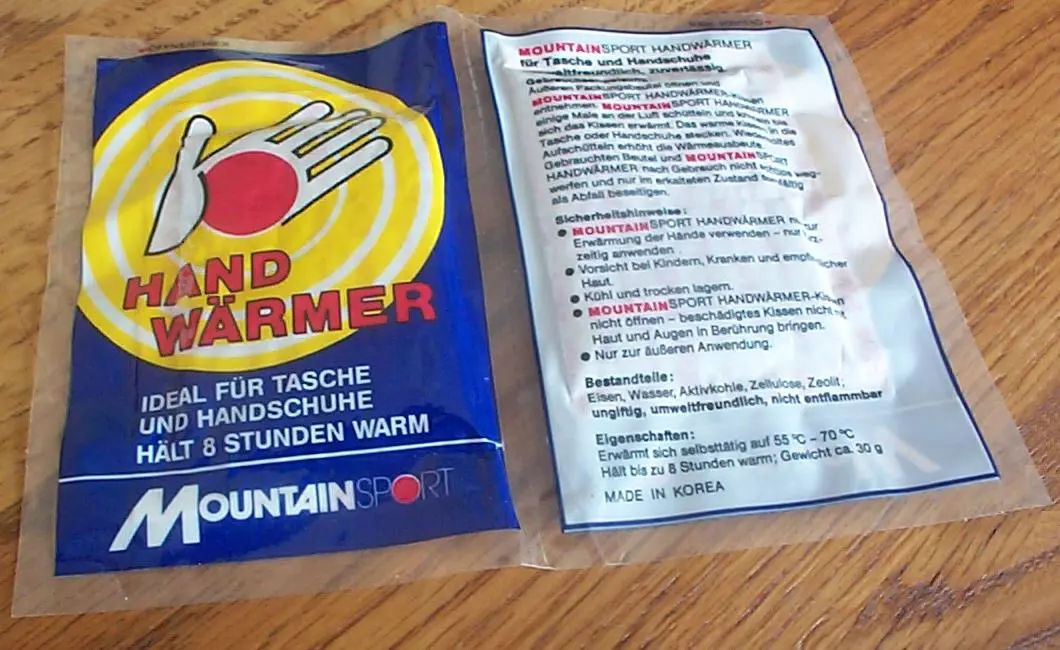
The holes control how fast the iron rusts, and so how hot the pack gets. The amount of iron controls how much heat it can give altogether, and so how long it lasts.
In the widget, you give a hand warmer more air holes but the same iron. What happens?
Pick an answer to see why.
The pack you can use again
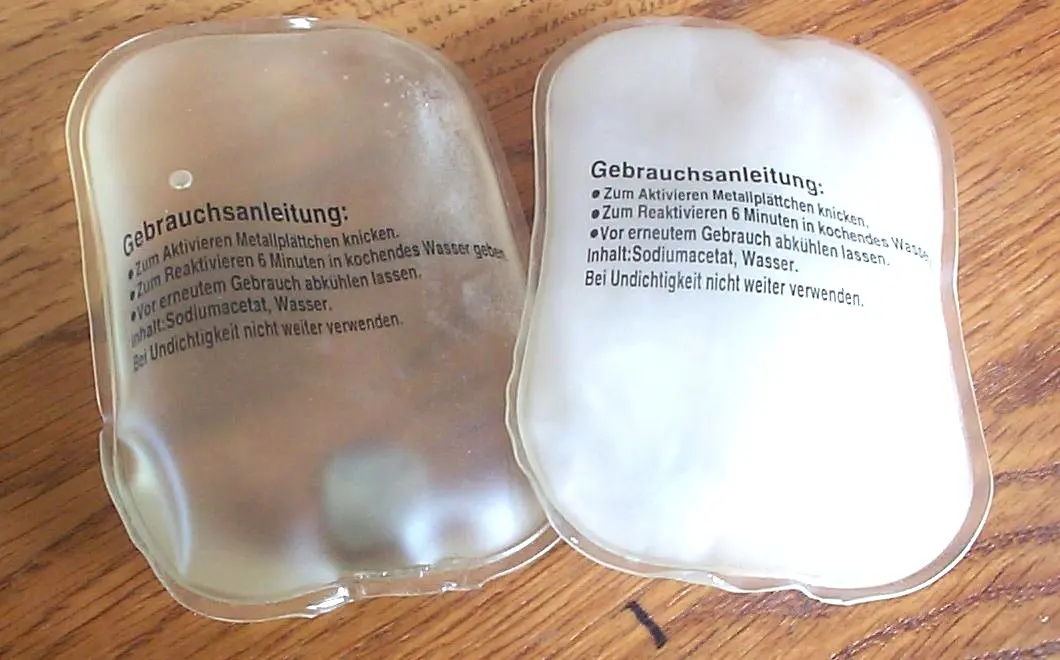
Another kind of hand warmer is a clear plastic pouch of liquid with a small metal disc inside. Bend the disc with a click, and white crystals spread through the liquid in a few seconds. The pack warms to about 50–55 °C, and stays warm for a while as it goes solid.
The liquid is a solution of sodium acetate (the salt you get from baking soda and vinegar). Its crystals melt at about 58 °C. Melted, and then cooled very gently, it can stay liquid far below that temperature, at room temperature, waiting. The click of the disc starts the first crystals, and then the whole pack crystallizes at once. As it goes solid, it gives out the heat it took in when it melted, just as freezing water gives out its latent heat (Taking the heat away). No new substance is made: it is a change of state, not a chemical reaction.
To use it again, put the pack in boiling water until all the crystals melt, then let it cool. It is ready for next time.
Cold packs
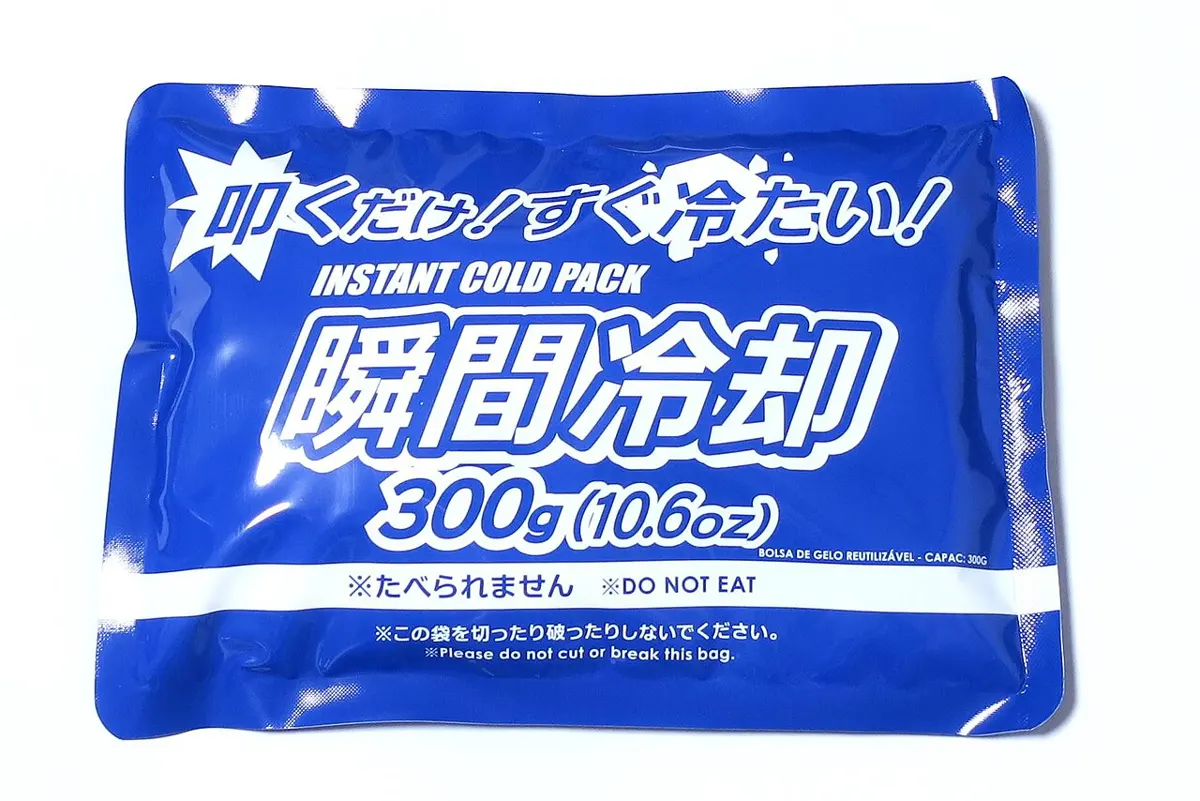
An instant cold pack has a small inner bag of water inside a bag of dry powder, usually ammonium nitrate or urea. Squeeze the pack hard, and the inner bag bursts. The powder dissolves, taking in heat, and the pack can get close to 0 °C. It is used once, on a sprain or a bump, when there is no freezer nearby.
Investigate it yourself
Questions
Which of these is an endothermic change?
Pick an answer to see why.
A student is testing heat packs. In her second test she uses more calcium chloride and a cloth pouch instead of a thin bag. The pack stays warm much longer. What is wrong with her test?
Pick an answer to see why.
Which pack would get the hottest?
Pick an answer to see why.
A pack holds 15 g of calcium chloride and 100 g of water, both at 10 °C.
- a.How much heat does the calcium chloride give out as it dissolves?
- b.About how hot does the water get?
- c.Does it meet the criterion of reaching at least 40 °C?
- d.Without changing the water, how much calcium chloride would you need to reach 45 °C?
Answer
- a.Heat = 15 g × 730 J per g = 10,950 J.
- b.Rise = 10,950 ÷ (100 × 4.2) = 10,950 ÷ 420 = 26.1 °C. The water gets to about 10 + 26 = 36 °C.
- c.No: 36 °C is below 40 °C (and a real pack, losing some heat, would be a little cooler still).
- d.A rise of 35 °C needs 100 × 4.2 × 35 = 14,700 J, and 14,700 ÷ 730 ≈ 20 g.
Use the idea of pulling apart and joining up to explain why:
- a.dissolving calcium chloride makes water hot;
- b.dissolving urea makes water cold.
Answer
When any solid dissolves, its particles are pulled out of the crystal, which takes in energy, and then water molecules crowd round each particle and cling to it, which gives out energy.
- a.For calcium chloride, the energy given out as the water clings on is more than the energy taken in to pull the crystal apart. The extra energy comes out as heat, and the water gets hotter: exothermic.
- b.For urea, the energy given out is less than the energy taken in. The difference is taken from the water itself, whose molecules slow down, so the water gets colder: endothermic.
A student tested three cold packs, each in a thin bag, starting at 25 °C. (Made-up results.)
| Pack | Urea | Water | Coldest temperature | Minutes below 15 °C |
|---|---|---|---|---|
| A | 15 g | 100 g | 17 °C | 0 |
| B | 30 g | 100 g | 9 °C | 9 |
| C | 60 g | 200 g | 9 °C | 15 |
- a.Which two packs show the effect of the amount of urea in the same water? What is the effect?
- b.Why do packs B and C reach the same coldest temperature?
- c.Why does C stay cold longer?
- d.A coach wants a cold pack that stays below 15 °C for at least 20 minutes and weighs less than 300 g. Suggest a change to pack B or C, and say how you would test it.
Answer
- a.A and B: both have 100 g of water, and B has twice the urea. Twice the urea took in twice the heat, so B cooled about twice as much (16 °C instead of 8 °C).
- b.B and C have the same concentration: 30 g for every 100 g of water. So each gram of water gives up the same heat, and cools by the same amount.
- c.C is twice as big. To warm up again it must take in twice as much heat from the room, but its surface is less than twice as big, so heat gets in more slowly compared with what it needs. It stays cold longer.
- d.Good answers: put pack C (260 g, under 300 g) in a cloth pouch or a foam sleeve, to slow the heat coming in from the room; or use a little more urea for each gram of water so it starts colder. Test it by changing only that one thing from pack C, starting at the same temperature, reading the thermometer every minute, and counting the minutes below 15 °C. Repeat to make sure the result is reliable.
Ramesh says, “Iron rusting can’t be used for a hand warmer: my bicycle rusts, and it never gets warm.” Explain why his bicycle doesn’t feel warm, and how a hand warmer makes the same reaction useful.
Answer
Rusting does give out a lot of heat, about 7,400 J for each gram of iron, but a bicycle rusts very slowly, over months, only on its surface. The heat comes out so slowly that it leaks into the air as fast as it is made, and the bicycle never warms up.
A hand warmer makes the iron rust much faster: the iron is a fine powder with a huge surface, it is kept damp with salt water, which speeds up rusting, and charcoal holds air and water close to it. But it is sealed in a bag with tiny holes, so air gets in only slowly, and the heat comes out gently over hours instead of all at once. It stays in an airtight wrapper until it is needed.
Design a cold pack for a school’s first-aid box.
- a.Write two criteria and two constraints for it.
- b.Which substance would you use, and why?
- c.Describe how you would test it, and what you would measure.
Answer
- a.Criteria, for example: it must get to 10 °C or below within 2 minutes of squeezing; it must stay below 15 °C for at least 15 minutes. Constraints, for example: it must be safe if it leaks, cost little, weigh under 300 g, and keep for a year in the box without going off.
- b.Urea is a good choice: it takes in heat as it dissolves (about 240 J for each gram), it is cheap, easy to buy in Nepal, and much safer to handle than ammonium nitrate. (Ammonium nitrate takes in more heat, but it is harder to buy and must be handled with care.)
- c.Build the pack with the water in a small inner bag that bursts when squeezed. Start every test at the same room temperature. Squeeze it, put a thermometer against or inside it, and read the temperature every minute. Record the coldest temperature and how many minutes it stays below 15 °C. Then change one thing at a time (the amount of urea, the amount of water, a cloth cover), test again, and keep the change if it helps. Test each design more than once.
Where to go next
- Where Does the Heat Go When Ice Melts? Melting and freezing take in and give out heat too, without any chemistry. The reusable hand warmer uses this. Where Does the Heat Go When Ice Melts?
- Can You Build a Box That Keeps Ice Frozen All Day? The other half of the problem: slowing the flow of heat, with a whole design project.
- What Happens to the Dal Bhat You Eat? Your body is a slow exothermic reaction: it “burns” food with oxygen to keep you warm and moving.