
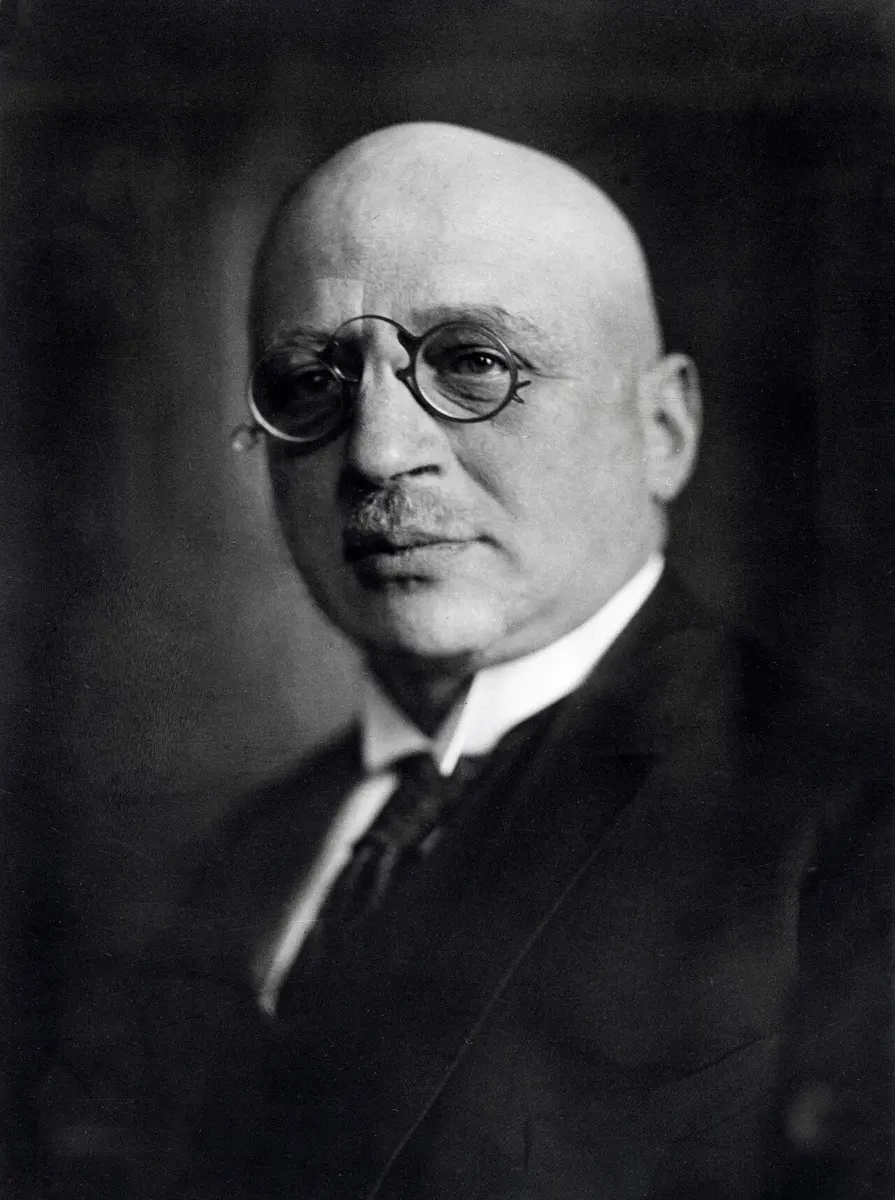
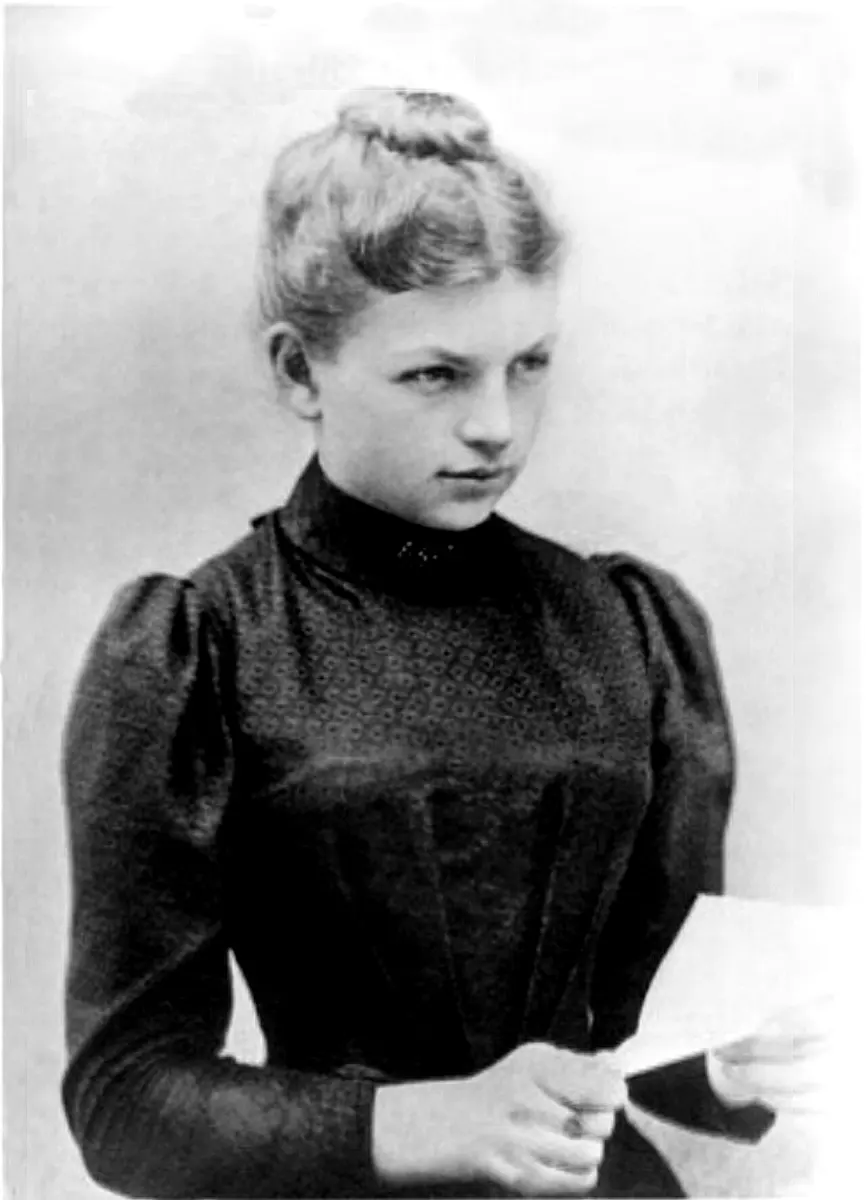
Fritz Haber
1868–1934, born in Breslau, Germany (now Wrocław, Poland)
A brilliant chemist whose work fed the world, and who also led his country’s poison-gas attacks in the First World War.
Photo: Unknown author, Public domain
Look at a rice field in the Terai at planting time. Farmers scatter small white grains of urea between the plants, and within days the leaves turn a deep, healthy green. That urea was made from ammonia, and the nitrogen in it came out of the air.
Turning air into fertilizer sounds like magic. It became possible because of one reaction, worked out by the German chemist Fritz Haber in 1909. For it he received the Nobel Prize in Chemistry for 1918. Today about half the people on Earth eat food grown with its help. But Haber’s story also has a very dark side, and both parts are worth knowing.
The problem: the world was running out of nitrogen
Plants need nitrogen to grow. It is part of every protein and of chlorophyll, the green substance that captures sunlight Grade 9: Nitrogenous fertilizers. A plant short of nitrogen grows slowly and its older leaves turn pale yellow.
There is a strange puzzle here. The air around you is about 78% nitrogen. Every plant is bathed in it. Yet plants can’t use it, because nitrogen in air is in the form of N₂ molecules, and N₂ is one of the most unreactive substances there is Grade 9: Nitrogen gas. Plants can only take in nitrogen that is joined to other elements, as nitrates or ammonium compounds in the soil.
For thousands of years, farmers put nitrogen back into their fields with manure and compost, or by growing beans and lentils, whose root nodules hold bacteria that can use N₂. But by 1900 the world’s population was growing fast, and that was no longer enough.
So farmers in Europe and America began buying nitrogen. It came from two far-away places:
- Guano: thick layers of seabird droppings, dug from dry islands off the coast of Peru.
- Chile saltpeter (sodium nitrate, NaNO₃): dug from the dry Atacama Desert in Chile. By the time of Haber’s prize, the world was using Chile saltpeter containing about 500,000 tonnes of nitrogen every year.
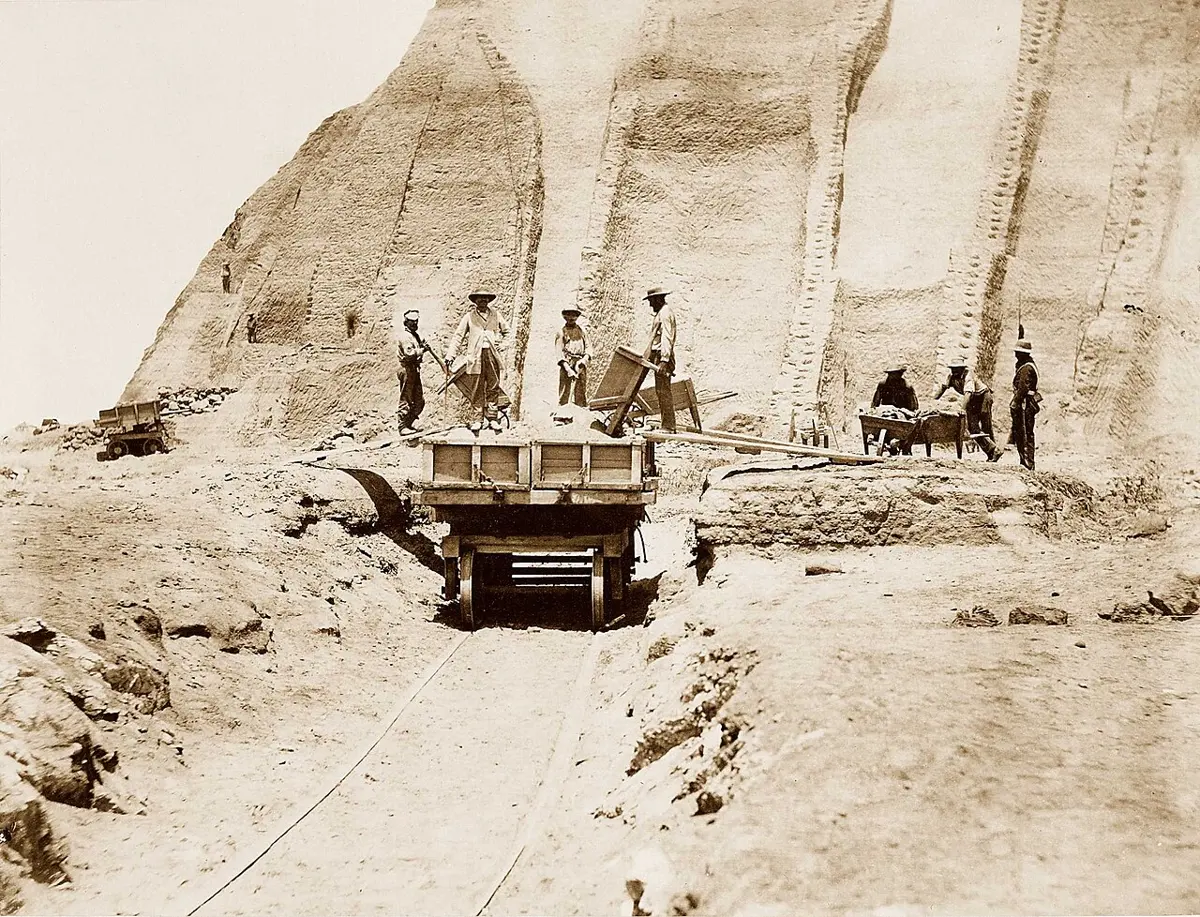
Both would run out one day. In 1898 the British chemist William Crookes gave a famous warning: unless chemists found a way to “fix” the nitrogen of the air (join it to other elements), the world would soon be short of wheat. Nitrate was also needed to make explosives, so every country wanted a supply of its own.
How to join nitrogen and hydrogen
The idea was simple. Ammonia (NH₃) is nitrogen joined to hydrogen. If nitrogen from the air and hydrogen could be made to react, the ammonia could be turned into any fertilizer you like:
One nitrogen molecule and three hydrogen molecules make two ammonia molecules. The reaction gives out heat. So why had nobody done it?
The strongest bond
In an N₂ molecule, the two nitrogen atoms share three pairs of electrons: a triple bond Grade 9: Covalent bond. It is one of the strongest bonds in chemistry. To make ammonia, this bond must be broken, and at room temperature the molecules simply bounce off each other, never reacting.
Heat helps, and heat hurts
You know that heating makes reactions faster Grade 10: Factors affecting the rate of reaction. So heat the gases? The trouble is that this reaction can also run backwards: ammonia can break down into nitrogen and hydrogen again. In a closed container, both happen at once, and the mixture settles at a balance called equilibrium, where ammonia is made as fast as it breaks down (Two-way traffic).
And here is the catch. Because making ammonia gives out heat, a hot mixture settles with very little ammonia in it. At about 1,000 °C, the balance is almost all nitrogen and hydrogen. At a low temperature the balance favors ammonia, but the reaction is so slow that you would wait for ever.
Why couldn’t chemists make ammonia simply by heating nitrogen and hydrogen to a very high temperature?
Pick an answer to see why.
What Haber did, step by step
1. Measuring the balance (1904–1907)
In 1904 Haber, then a professor in Karlsruhe, Germany, began to study the reaction with his student Gabriel van Oordt. At about 1,000 °C, at ordinary pressure, with an iron catalyst, they found only traces of ammonia. They were the first to show by experiment that the reaction really does settle at an equilibrium, and to measure where. Heat alone would never work.
2. Squeezing the gas
Haber saw another way to push the balance. Look at the equation again: four molecules of gas (1 N₂ + 3 H₂) become two molecules of ammonia. Squeezing a gas into a smaller space favors the side with fewer molecules. So at high pressure, more of the mixture should be ammonia. High pressure also crowds the molecules together, so they collide more often and react faster.
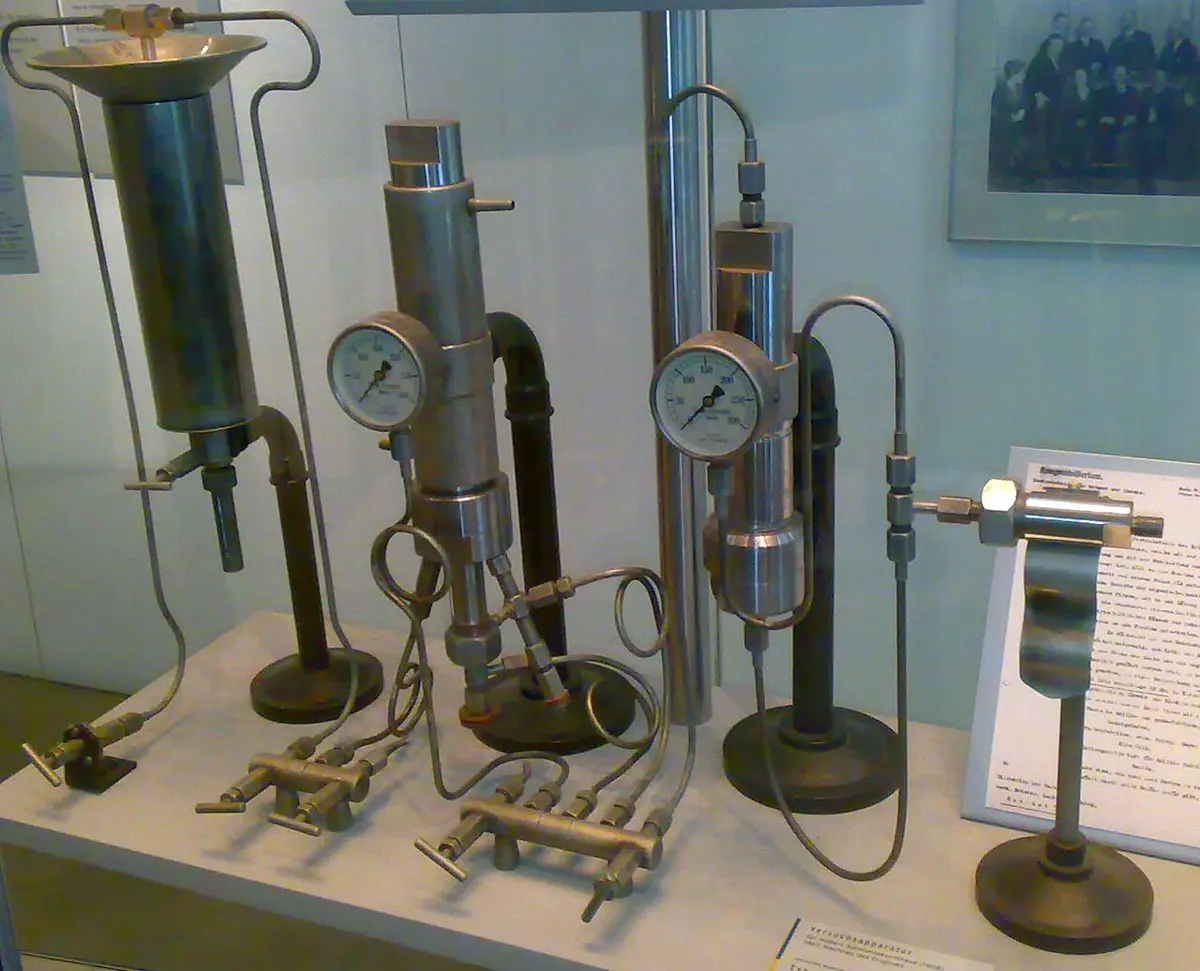
He and his assistant, the English chemist Robert Le Rossignol, built a small machine that held the gases at about 200 times the pressure of the air, at about 500 °C. Nobody had ever run a stream of hot gas round and round at such a pressure; the steel had to be thick enough not to burst, and the joints not to leak.
3. A better catalyst
A catalyst speeds up a reaction without being used up (Catalysts). Haber tried many metals. The best he found was osmium, a rare, heavy metal; uranium also worked well.
4. Recycling the gas
Even at 200 atmospheres and 500 °C, only a part of the gas turns into ammonia each time it passes over the catalyst. Haber’s cleverest idea was not to waste the rest. The gas leaving the catalyst was cooled, so the ammonia turned into a liquid and could be drained off. The leftover nitrogen and hydrogen were pumped back round to the catalyst, again and again. The heat from the hot gas leaving was used to warm the cold gas coming in.
5. It drips! (1909)
In the summer of 1909, liquid ammonia began to drip out of the tabletop machine: about 125 milliliters an hour, roughly half a cup. It was not much, but it was steady, and air never runs out. The chemical company BASF, which had paid for the research, sent its chemists to see.
From a tabletop to giant factories
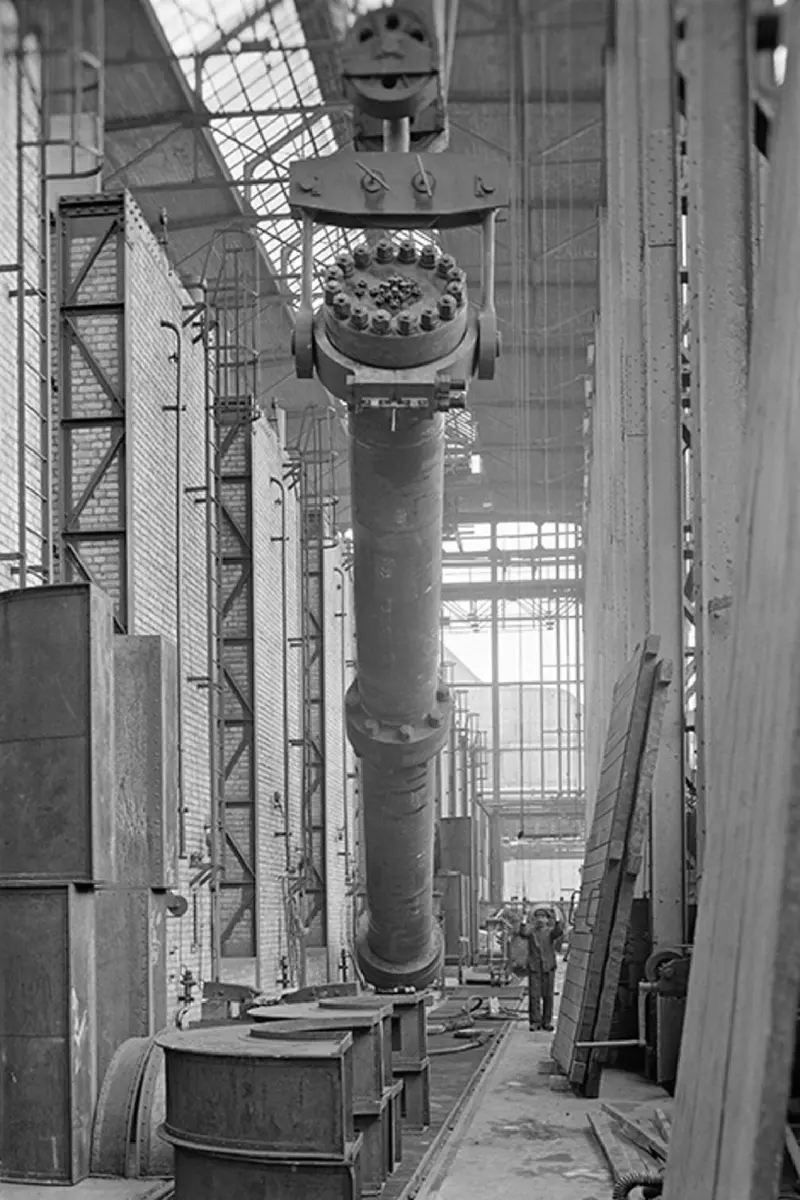
Turning half a cup an hour into millions of tonnes a year was a huge job, led at BASF by the engineer Carl Bosch. That is why the method is called the Haber–Bosch process. Three problems had to be solved:
- A cheap catalyst. Osmium was far too rare. BASF’s chemist Alwin Mittasch tested thousands of different mixtures and found that iron, with small amounts of other substances added, worked almost as well. Iron catalysts are still used today.
- Steel that didn’t crack. Hot hydrogen under pressure soaked into the steel walls and made them brittle, and the first reactors burst. Bosch’s team put a soft iron lining inside a strong steel tube, with small holes in the tube to let escaping hydrogen out.
- Huge amounts of pure nitrogen and hydrogen. Nitrogen came from air; hydrogen, at first, from coal and steam.
The first factory, at Oppau in Germany, began making ammonia in 1913. Bosch was later given a Nobel Prize of his own, in 1931, for high-pressure chemistry.
How the Haber–Bosch process works now
A modern ammonia plant still follows Haber’s plan:
- Nitrogen comes from the air. Hydrogen comes mostly from natural gas (methane) reacting with steam.
- The gases are mixed, one volume of nitrogen to three of hydrogen, and squeezed to about 150–300 times the pressure of the air.
- The mixture passes over an iron catalyst at about 400–500 °C.
- About 15% of the gas leaving the catalyst is ammonia. It is cooled; the ammonia turns to liquid and is drained off.
- The unreacted nitrogen and hydrogen go back round. In the end, about 97% of them become ammonia.
The temperature is a compromise. A lower temperature would give more ammonia at equilibrium, but even with a catalyst the reaction would be far too slow. A higher temperature would be faster, but would give too little ammonia. Try it yourself:
In an ammonia plant, about 15% of the gas leaving the catalyst is ammonia. What happens to the other 85%?
Pick an answer to see why.
In your life today
From the plant, the ammonia is made into fertilizers such as urea (46% nitrogen), ammonium sulphate and ammonium nitrate, and also into nitric acid, nylon, medicines and cleaning products Grade 10: Uses of ammonia. The world now makes about 190 million tonnes of ammonia a year (as of 2025), mostly for fertilizer.
Scientists estimate that without fertilizer made this way, the world’s farms could feed only around half of the people alive today. By one estimate, about half the nitrogen atoms in your body have passed through a Haber–Bosch factory.
In Nepal, almost every bag of urea is imported: Nepal has no fertilizer factory of its own, because making ammonia needs a great deal of cheap energy (natural gas, or a lot of electricity). At rice-planting time, the news often reports long queues and shortages. Some people suggest using Nepal’s hydroelectric power to make hydrogen from water, and with it “green” ammonia.
There is a cost. Making ammonia uses about 1–2% of all the energy the world uses, mostly natural gas, and releases a lot of carbon dioxide. And fertilizer that crops don’t take up washes into rivers and lakes, where it harms the water Grade 9: Disadvantages of chemical fertilizers.
The dark side of the story
When the First World War began in 1914, Britain’s navy stopped ships carrying Chile saltpeter to Germany. Ammonia from the new factories was turned into nitric acid and then into explosives, which helped Germany to keep fighting for years.
Haber went further. He led Germany’s work on poison gas. On 22 April 1915, near the town of Ypres in Belgium, the German army released clouds of chlorine gas over the enemy trenches, with Haber there to direct it. Thousands of soldiers were killed or injured. Soon both sides were using poison gas.
When Haber’s prize was announced, in November 1919, many scientists were angry that a man who had led gas warfare was being honored.
Haber’s own country turned against him in the end. He was born into a Jewish family. In 1933, when the Nazis came to power and ordered Jewish scientists out of their jobs, Haber resigned rather than dismiss the Jewish members of his institute. He left Germany and died in Basel, Switzerland, on 29 January 1934.
What came next
- Better catalysts. In 2007 the German chemist Gerhard Ertl won the Nobel Prize in Chemistry partly for showing, step by step, what happens to nitrogen and hydrogen on the surface of the iron catalyst.
- The open question: bacteria in the root nodules of beans fix nitrogen at ordinary temperature and pressure, using an enzyme called nitrogenase. How exactly they break the triple bond so gently is still being worked out. Could scientists one day give wheat and rice the same ability, so that they need much less fertilizer?
In your science books
- Grade 9: Nitrogen gas and its chemical properties, including the Haber process; uses of hydrogen gas; the formation of ammonia by covalent bonds; nitrogenous fertilizers.
- Grade 10: Ammonia gas and its uses; what speeds up a reaction.
- Going further: Why do some reactions stop halfway?, with designing an ammonia factory.
Learn more
- The prize at nobelprize.org: The Nobel Prize in Chemistry 1918, with the presentation speech of June 1920.
- Haber’s own Nobel lecture, “The synthesis of ammonia from its elements”.
The official reason
The prize was given “for the synthesis of ammonia from its elements.”