
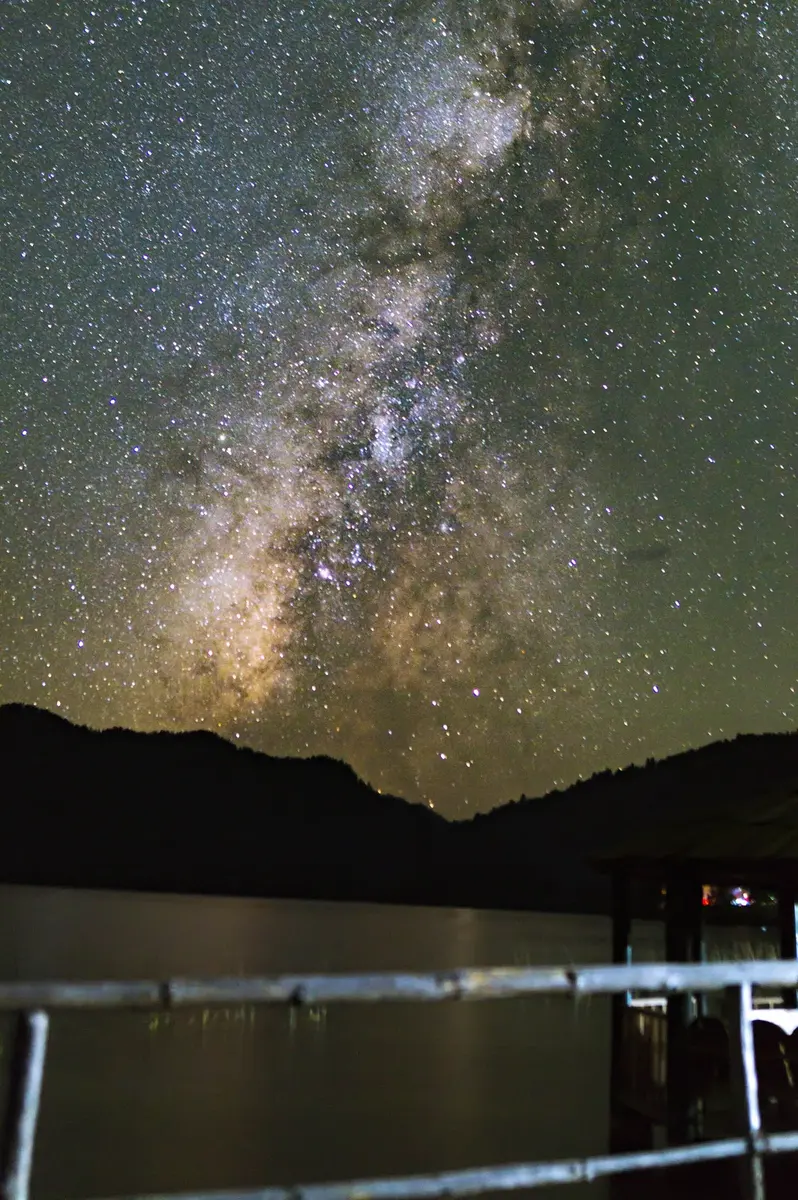
On a moonless night far from city lights, at Rara Lake or in Upper Mustang, look up. Across the sky runs a pale, glowing band, like a long cloud that never moves. In Nepali it is the Akashganga, the river of the sky. Through binoculars, the “cloud” breaks up into thousands upon thousands of stars. You are looking edge-on into our own galaxy, the Milky Way: a spinning disc of hundreds of billions of suns, with you inside it.
Where did all of it come from? What holds it together? Is it changing? And how will it end? This unit is about the biggest questions there are, and about the surprising ways scientists have found answers by looking at faint smudges of light.
Think about these questions. You will find the answers as you read.
- What kinds of objects are there in space?
- How do they all stay where they are, instead of falling together?
- How did the universe, with all these objects, begin?
- Is everything in the universe moving?
What the universe is made of
The universe is everything there is: all of space, and everything in it. You met many of the objects in it in earlier grades. Objects in space are called celestial bodies (or heavenly bodies):
| Celestial body | What it is | Example |
|---|---|---|
| Star | a huge ball of hot gas that makes its own light and heat by nuclear fusion | the Sun, Sirius, Polaris |
| Planet | a large, round body that goes round a star and shines only by reflected light | the Earth, Mars, Jupiter |
| Satellite (moon) | a body that goes round a planet | the Moon; Jupiter’s moon Ganymede |
| Baby planet | a small, planet-like body going round the Sun (scientists say minor planet: the dwarf planets, such as Pluto, and the rocky asteroids) | Pluto, Ceres, the asteroid Vesta |
| Comet | a lump of ice and dust that grows a glowing tail when it comes near the Sun | Halley’s Comet |
| Meteor | a streak of light, a “shooting star”: a grain of space rock burning up in our air | the Perseid meteors every August |
| Meteorite | a piece of space rock that survives the fall and lands on the ground | |
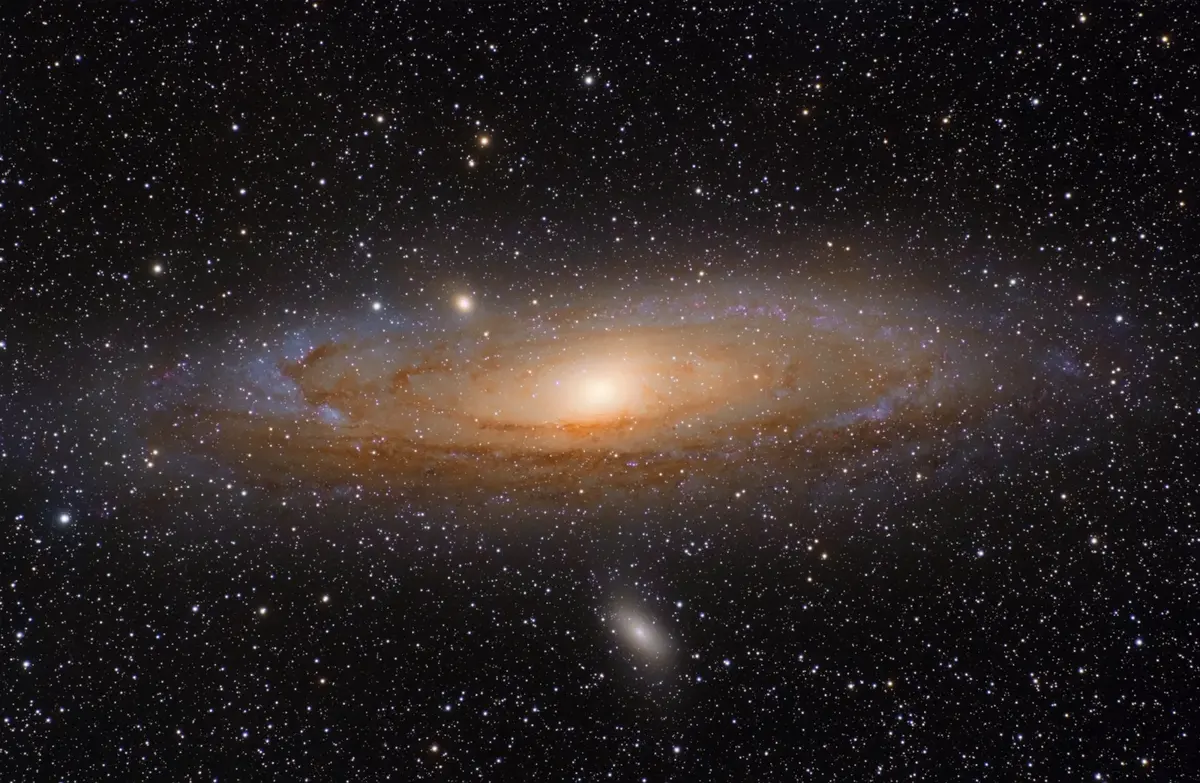
| Galaxy | a huge group of billions of stars, gas and dust, held together by gravity | the Milky Way, the Andromeda Galaxy |
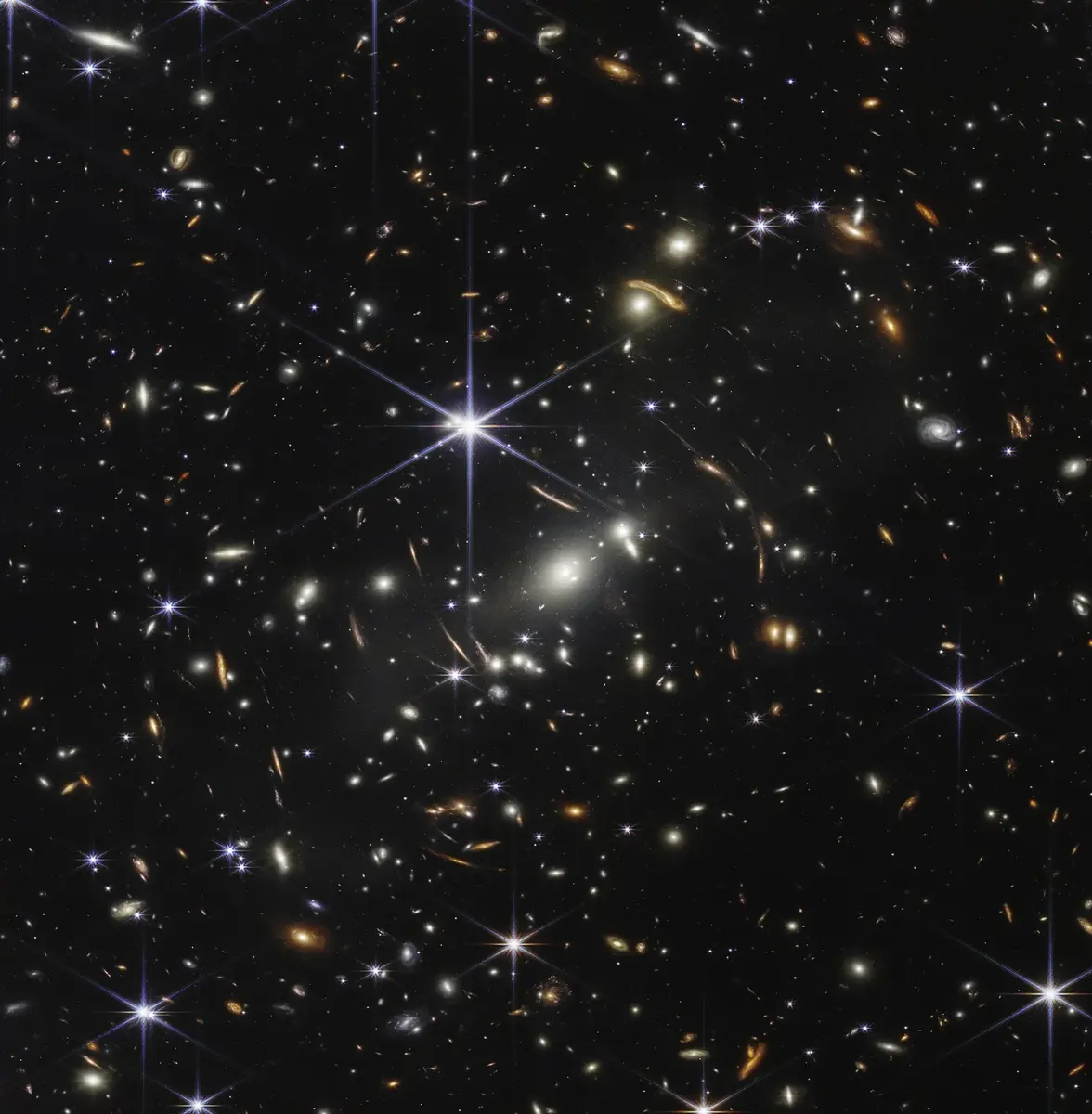
Some celestial bodies are enormous and very massive; others are tiny. Some, like stars, are made of gas; others, like the Earth and the asteroids, are solid. Our Solar System (the Sun with its planets, moons, asteroids and comets) is a very small part of the Milky Way galaxy, and the Milky Way is just one of hundreds of billions of galaxies in the part of the universe we can see.
Gravity holds every one of these bodies in its place, and keeps them moving in their paths. Scientists have proposed many ideas about how the universe began; the one with the strongest evidence by far is the Big Bang theory. According to it, the universe is expanding: the galaxies are moving apart. Edwin Hubble’s study of their motion was the key. And the tug-of-war between this motion and gravity gives three possible futures for the universe: open, flat and closed. This unit takes these ideas one at a time.
Which of these makes its own light?
Pick an answer to see why.
How big is the universe?
The distances in space are so huge that kilometers become useless. The nearest star after the Sun, Proxima Centauri, is about 40,000,000,000,000 km away. So astronomers measure distances by how long light takes to cover them.
Light is the fastest thing there is: 300,000 km every second. It could go round the Earth seven and a half times in one second.
- Light from the Moon reaches us in about 1.3 seconds.
- Light from the Sun takes about 8 minutes 20 seconds. You always see the Sun as it was 8 minutes ago.
A light-year is the distance light travels in one year:
That is nearly ten trillion kilometers. A light-year is a distance, not a time.
Use the slider to travel outwards and feel how fast the distances grow.
12.1 Importance of gravitational force in the universe
Look at Figure 12.2 and think about these questions.
The Earth has mass, so it has gravity. So do the Sun and the Moon. As Figure 12.2 shows, they all pull one another:
- the Sun pulls the Earth towards its center, and the Earth pulls the Sun towards its center, with an equal force;
- the Earth pulls the Moon, and the Moon pulls the Earth;
- the Sun pulls the Moon, and the Moon pulls the Sun.
Every celestial body in space attracts every other one in this way. This mutual force of attraction is gravitation (Unit 7). Because of it, the Earth revolves in its orbit around the Sun, and the Moon revolves around the Earth. Every body in the Solar System revolves around the Sun, and gravity keeps the planets in their orbits.
Gravity does even more. It built these objects in the first place. The Sun and the planets formed 4.6 billion years ago from a huge, slowly spinning cloud of gas and dust: gravity pulled the cloud together, most of it into the Sun at the center, and the rest into a flat disc that clumped into the planets. That is why the planets all go round the Sun in the same direction and in nearly the same plane. On a larger scale, gravity holds the hundreds of billions of stars of a galaxy together, and holds galaxies together in groups.
Why doesn’t the Moon fall onto the Earth?
Pick an answer to see why.
12.2 Study of the universe
How did the universe begin? What shape is it? How big is it? Scientists have studied these questions for centuries. The branch of science that studies the universe as a whole, its history and its future, is called cosmology. A closely related branch, astrophysics, uses physics to study the stars, galaxies and the universe: how they are made, how they work, and how they change.
Our galaxy, the Milky Way
Our Solar System is in a spiral galaxy called the Milky Way. It is a flat, spinning disc about 100,000 light-years across, with a bulge of old stars in the middle and long spiral arms full of young stars, gas and dust. The Sun is in one of the arms, about 26,000 light-years from the center.
The Milky Way has somewhere between 100 billion and 400 billion stars. The Sun, carrying the Earth with it, goes round the center of the galaxy at about 230 km/s, and even so, one trip round takes about 230 million years. The last time the Sun was where it is now in its orbit, the first dinosaurs were appearing.
A light-year is a unit of
Pick an answer to see why.
The Big Bang theory
The Big Bang theory grew out of one astonishing observation: all the distant galaxies are moving away from us, and from one another, at tremendous speed. If they are all moving apart now, then in the past they were closer together. Run the film backwards far enough, and everything was packed together in one tiny, unimaginably hot and dense state.
This is what the theory says:
- About 13.8 billion years ago, the universe was in an extremely hot, dense and compressed state, full of energy: everything we can see today was packed into a space smaller than an atom.
- At that time, the four fundamental forces of nature, gravitational force, electromagnetic force, the strong nuclear force and the weak nuclear force, are thought to have been joined as a single force.
- Then the universe began to expand, very fast, and as it expanded it cooled. The forces separated. The energy turned into particles, the particles into atoms (mainly hydrogen and helium), and over hundreds of millions of years gravity pulled the gas together into stars and galaxies. All the celestial bodies came from it.
- The galaxies are still moving apart, so the universe is still growing. For a long time, astronomers expected gravity to be gradually slowing them down; you’ll see below what they found when they checked.
Many books describe the beginning as the explosion of a single “atom”, flinging matter outwards like the pieces of a bursting firecracker. That picture is easy to remember, but it is misleading in two ways. (In an exam, write that the universe began with the sudden expansion, the “explosion”, of an extremely hot, dense state smaller than an atom: that is right whichever book your teacher uses.)
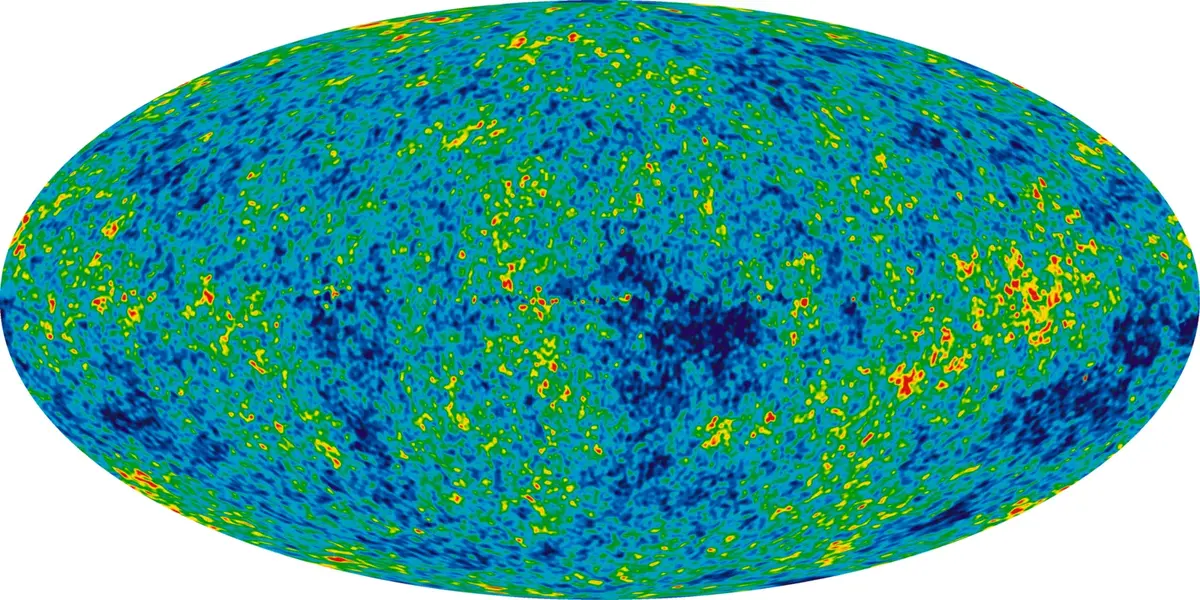
So the Big Bang theory rests on three main pieces of evidence:
- The galaxies are moving apart (Hubble’s law, below).
- The cosmic microwave background, the afterglow, fills the whole sky.
- The universe’s ordinary matter is about three-quarters hydrogen and one-quarter helium, just what the theory predicts the early hot universe would have made.
| Time after the Big Bang | What happened |
|---|---|
| a tiny fraction of a second | the forces separate; space expands extremely fast |
| about 3 minutes | the first nuclei of hydrogen and helium form |
| about 380,000 years | the first atoms form; light can travel freely (the afterglow we see today) |
| about 200 million years | the first stars light up |
| a few hundred million years | the first galaxies; the oldest stars of the Milky Way form soon after |
| 9.2 billion years (4.6 billion years ago) | the Sun and the Earth form |
| 13.8 billion years | today |
What is the strongest reason to think the universe began in a hot, dense state?
Pick an answer to see why.
Activity 12.3: an expanding balloon
Hubble’s study
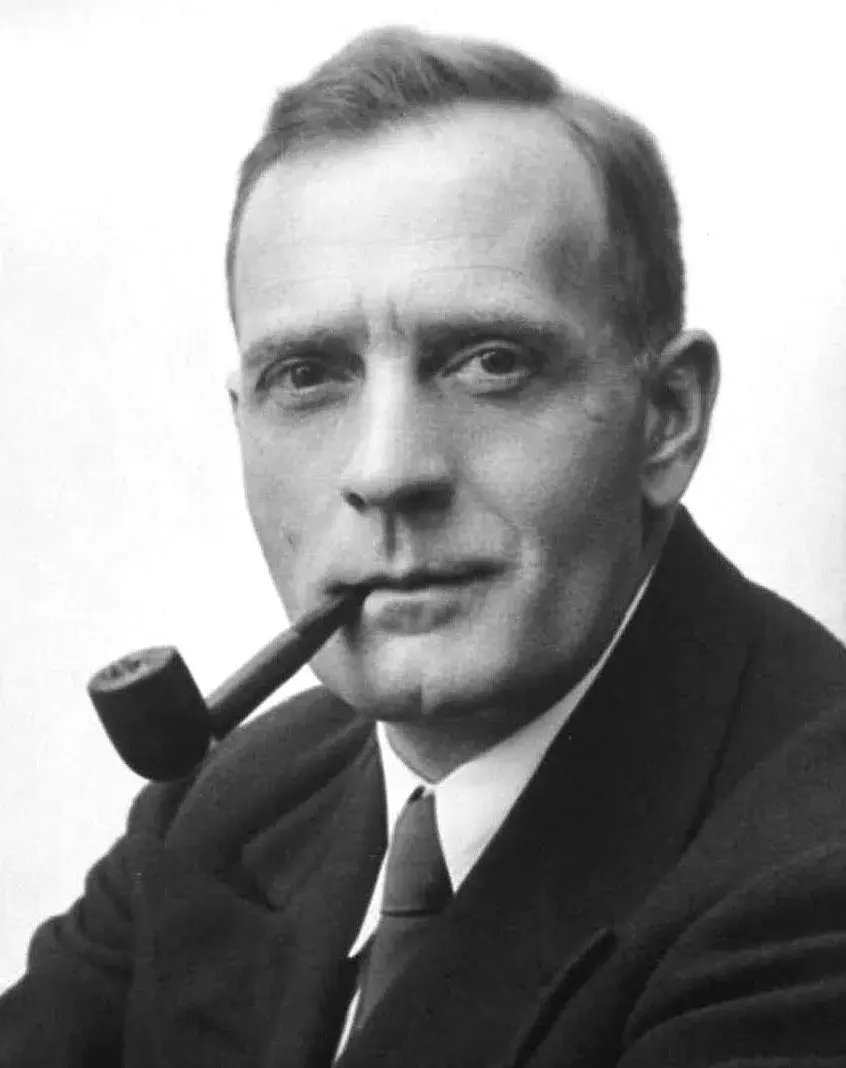
In the 1920s, the American astronomer Edwin Hubble used the 100-inch Hooker telescope on Mount Wilson in California, then the biggest telescope in the world, to measure how far away various galaxies are. Other astronomers, especially Vesto Slipher, had already measured how fast they were moving, from the color of their light: light from a galaxy moving away is stretched to longer, redder wavelengths, an effect called redshift, like the falling pitch of a bus’s horn as it drives away.
In 1929, Hubble plotted each galaxy’s speed against its distance and found a simple pattern: galaxies are moving away from us, and the farther away a galaxy is, the faster it is moving away. (Farther galaxies also look smaller and fainter, which helped him judge their distances.)
This relation is Hubble’s law:
where v is the speed at which a galaxy is moving away (its recession velocity), d is its distance, and H is Hubble’s constant. On a graph of speed against distance, the galaxies lie close to a straight line through zero (Figure 12.6): twice as far, twice as fast. H is the slope of that line.
Distances between galaxies are measured in megaparsecs (Mpc). A parsec is an astronomer’s unit of distance, about 3.26 light-years, and a megaparsec is a million parsecs, about 3.26 million light-years. Measuring nearby galaxies gives H = 73 km/s per Mpc. That means two galaxies one megaparsec apart are moving apart at 73 km/s; two galaxies 10 Mpc apart, at 730 km/s; and so on.
Hubble’s law says that the farther the galaxies are, the faster they separate, exactly like the dots on the balloon. The whole universe is getting bigger. So the galaxies must have been closer together in the past, and long ago, all at the same place. In this way, Hubble’s study supports the Big Bang theory.
The life of a star
The universe has a history, and so does every star: stars, too, are born, live and die. Here is the life cycle of a star.
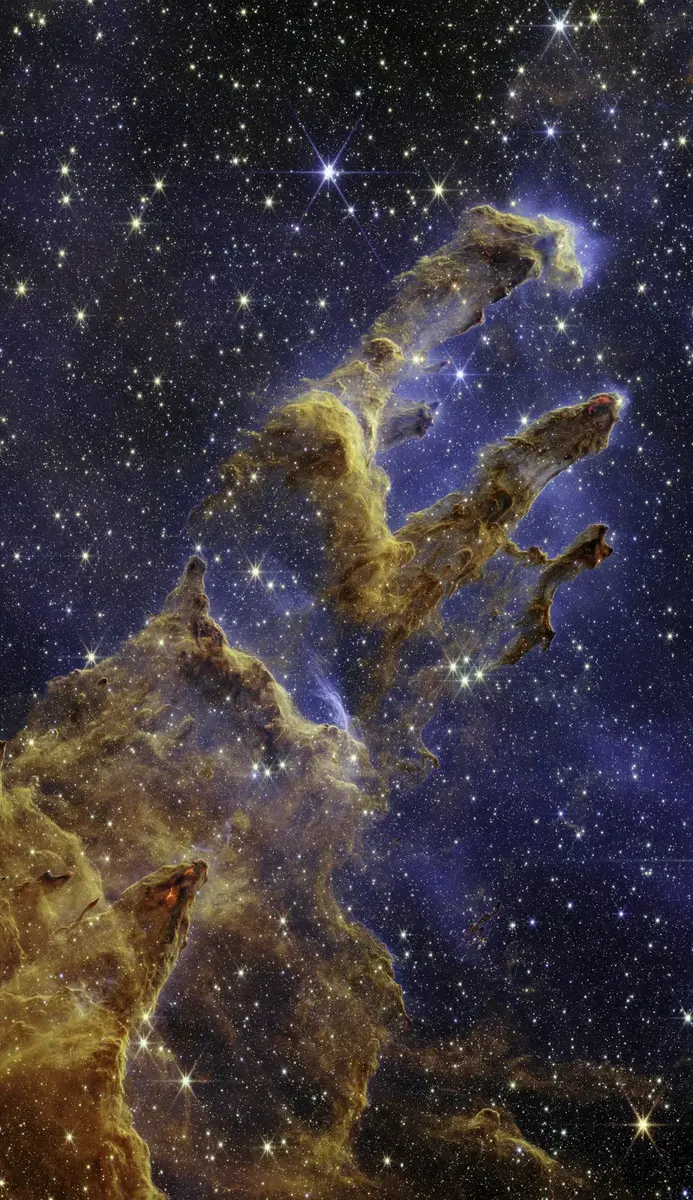
A star is born in a cold, dark cloud of gas and dust called a nebula. Gravity pulls a clump of the cloud together; as it shrinks, it heats up, until its center reaches about 10 million °C. There, hydrogen nuclei start fusing into helium, releasing enormous energy: a star has switched on. It shines steadily for most of its life, its gravity squeezing in and the heat of fusion pushing out, perfectly balanced.
What happens when the hydrogen in the core runs out depends on the star’s mass:
- A star like the Sun swells into a red giant, then gently puffs off its outer layers as a glowing shell called a planetary nebula. The core left behind is a white dwarf: about as big as the Earth but as heavy as the Sun, a teaspoon of it weighing tonnes. It slowly cools and fades.
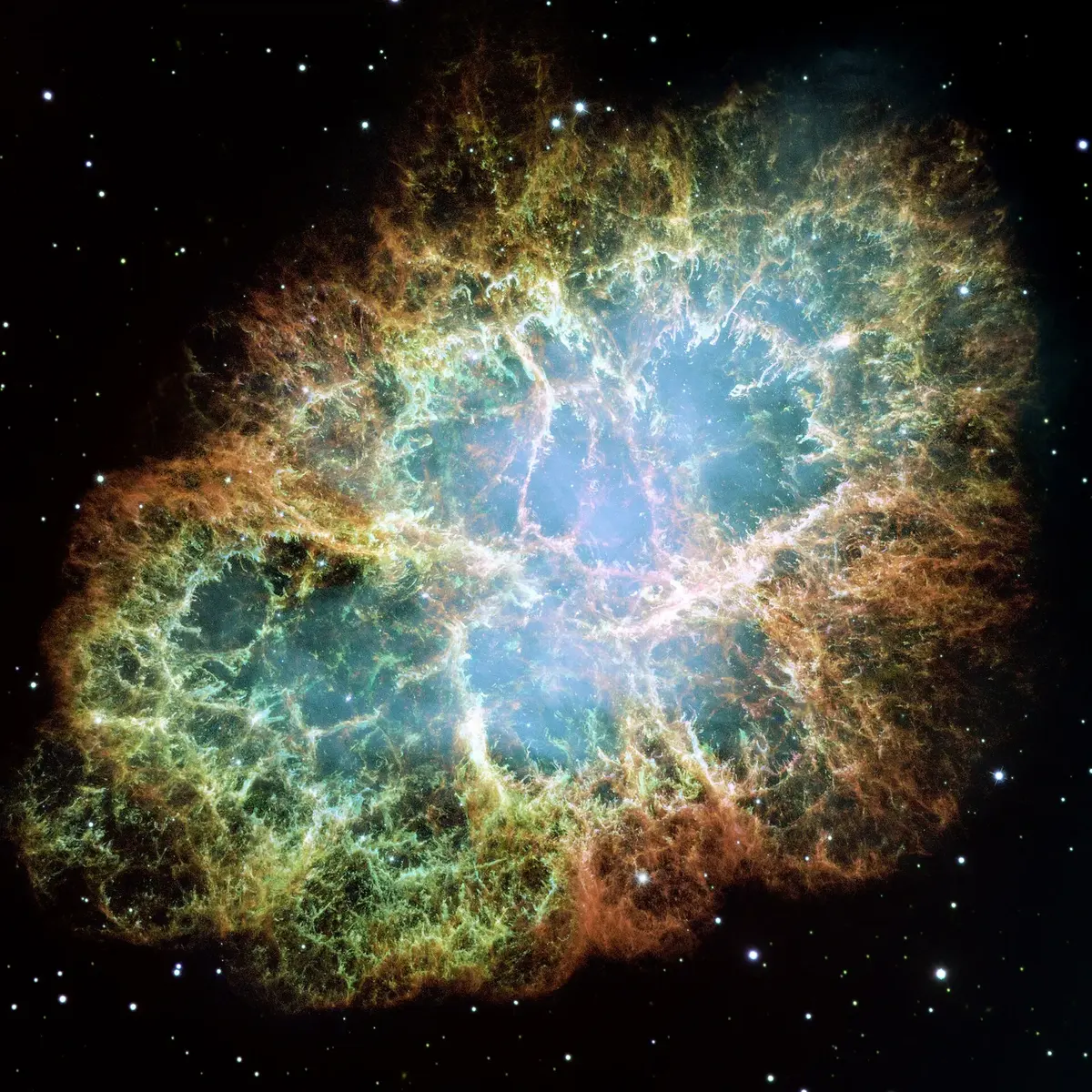
- A star much more massive than the Sun (over about 8 times) swells into a red supergiant, then its core collapses in a fraction of a second and the star blows apart in a supernova, which can outshine a whole galaxy for weeks. What remains is a neutron star (a city-sized ball so dense that a teaspoon would weigh a billion tonnes) or, for the very biggest stars, a black hole, whose gravity is so strong that not even light escapes.
The Sun is about halfway through its life: 4.6 billion years old, with about 5 billion years to go before it becomes a red giant.
12.3 Future of the universe
The galaxies are moving apart, but gravity is pulling them all back towards one another. Which will win? To think about it, start with something smaller: a rocket.
The universe is in the same situation. All the galaxies are moving apart, and the universe is getting bigger, but the gravitational pull of all the matter in the universe slows them down. As the galaxies get farther apart, that pull gets weaker. Does their speed run out first, or does the pull fade first? That decides the future of the universe.
Critical density
By Newton’s law, every mass pulls every other mass, with a force proportional to the product of their masses and inversely proportional to the square of the distance between them. So how strongly the universe pulls itself back depends on how much mass there is and how spread out it is: in other words, on its average density (mass ÷ volume).
The average density the universe would need for gravity to just stop its expansion (after an infinitely long time) is called the critical density. It is incredibly small: about the mass of five or six hydrogen atoms in every cubic meter of space. (The air in your room has about 10²⁵ molecules in each cubic meter.)
Comparing the real density with the critical density gives three possible futures:
a. Open universe
If the average density is less than the critical density, gravity is too weak to stop the expansion. When gravity’s effect has faded away, the galaxies still have some speed left, so they keep moving apart forever, and the universe keeps growing. This is an open universe, like a rocket launched faster than the escape velocity.
b. Flat universe
If the average density is exactly equal to the critical density, the expansion keeps slowing down, and the galaxies’ speed and gravity’s effect both reach zero together, only after an infinitely long time, when the galaxies are infinitely far apart. The universe then stops growing and stays as it is. This is a flat universe, like a rocket launched at exactly the escape velocity. (Flat doesn’t mean like a pancake: it means space isn’t curved, so that the angles of a triangle drawn between three faraway galaxies would add up to exactly 180°.)
c. Closed universe
If the average density is more than the critical density, gravity wins. The expansion slows, stops, and turns into a collapse: the galaxies fall back together, and the universe shrinks back to a single point. This end is called the Big Crunch. Some scientists imagined that the crunch could be followed by a new Big Bang, and a new universe, again and again, so that the universe would have a life cycle of its own, like a star. This is a closed universe, like a rocket launched too slowly, which falls back.
| Open | Flat | Closed | |
|---|---|---|---|
| Average density | less than critical | equal to critical | more than critical |
| Expansion | forever | slows, stops only after infinite time | stops, then reverses |
| End | galaxies spread apart forever | galaxies infinitely far apart, at rest | the Big Crunch |
| Like a rocket launched | faster than escape velocity | at exactly escape velocity | slower than escape velocity |
The main thing that decides the future of the universe is gravity, and the strength of gravity depends on the mass and size of the universe, that is, on its density. Astronomers estimate the density by weighing everything they can see in space, and many things they can’t.
What do we know now (as of 2026)? Measurements of the Big Bang’s afterglow show that space is flat, to within less than half a percent: the total density is equal to the critical density. But the ordinary matter that stars, planets and people are made of makes up only about 5% of it. About 27% is dark matter, which we know from its gravity but can’t see, and about 68% is dark energy. If dark energy stays as it is, the universe will expand faster and faster forever: no Big Crunch, but a slow, cold fading, as the stars burn out one by one, sometimes called the Big Freeze. In 2025, a large survey of galaxies (DESI) found hints that dark energy may be weakening over time; if that is confirmed, the story could change again. That is how science works: the question isn’t closed.
If the average density of the universe is greater than the critical density, the universe is
Pick an answer to see why.
Exercise
1. Choose the correct option
a. Which force keeps the celestial bodies of the universe in their positions?
Pick an answer to see why.
b. Which theory is considered the most realistic about the origin of the universe?
Pick an answer to see why.
c. According to the Big Bang theory, how did the universe originate?
Pick an answer to see why.
d. According to Hubble’s study, which of these is correct?
Pick an answer to see why.
e. Under what condition can an open universe be expected?
Pick an answer to see why.
f. What does H stand for in Hubble’s law, v = Hd?
Pick an answer to see why.
2. Differentiate between
Closed universe and open universe
Answer
| Closed universe | Open universe |
|---|---|
| The average density of the universe is greater than the critical density. | The average density is less than the critical density. |
| Gravity is strong enough to stop the expansion. | Gravity is too weak to stop the expansion. |
| The galaxies’ speed becomes zero while gravity still acts, so they start coming closer. | The galaxies still have some speed when gravity’s effect becomes negligible. |
| The universe shrinks to a point in the end: the Big Crunch. | The universe keeps expanding forever. |
| The universe may go through repeated Big Bangs and Big Crunches. | The universe has no end to its expansion. |
Flat universe and closed universe
Answer
| Flat universe | Closed universe |
|---|---|
| The average density equals the critical density. | The average density is greater than the critical density. |
| Gravity’s effect and the galaxies’ speed become zero at the same time. | The galaxies’ speed becomes zero while gravity is still acting. |
| The expansion slows and stops only after infinite time; the universe then stays as it is. | The expansion stops and reverses; the universe contracts. |
| No collapse. | Ends in the Big Crunch. |
3. Give reasons
The farther apart two celestial bodies (galaxies) are, the faster they move apart.
Answer
The universe is expanding: the space between galaxies is stretching everywhere, at the same rate. Two galaxies far apart have more stretching space between them than two galaxies close together, so the distance between them grows faster, just as dots far apart on an inflating balloon separate faster than dots close together. This is Hubble’s law, v = Hd.
Celestial bodies remain in their own places (orbits).
Answer
Every celestial body is pulled by the gravity of the bodies around it, especially the large one it orbits (a planet by the Sun, a moon by its planet). But each also moves sideways along its orbit at high speed. Gravity bends its path into a curve around the bigger body instead of pulling it in, so it keeps going round in its orbit. The balance between gravity and its motion keeps it in its place.
4. Answer these questions
What is the universe?
Answer
The universe is the whole of space and everything in it: all the matter and energy, including the stars, planets, satellites, comets, asteroids, meteors, galaxies, gas and dust, and the light and radiation between them.
State the Big Bang theory.
Answer
The Big Bang theory says that the universe began about 13.8 billion years ago from an extremely hot, dense and compressed state, smaller than an atom, in which the four fundamental forces (gravitational, electromagnetic, strong nuclear and weak nuclear) were united as one. A sudden huge expansion (the “explosion”) began, and the universe has been expanding and cooling ever since; the matter formed in it became the stars and galaxies, which are still moving apart.
Write the conclusion of Hubble’s study.
Answer
- All distant galaxies are moving away from us and from one another.
- The farther a galaxy is, the faster it is moving away: its speed is proportional to its distance, v = Hd (Hubble’s law), with H, Hubble’s constant, about 70 km/s/Mpc (measurements give 67 to 73).
- So the universe is expanding, and its galaxies must have been together long ago: this supports the Big Bang theory.
According to the Big Bang theory, the universe is continuously expanding. Is there no limit to its expansion? Give your arguments.
Answer
Whether there is a limit depends on the average density of the universe compared with the critical density, because gravity, which depends on the density, slows the expansion:
- If the density is more than critical, gravity will stop the expansion and the universe will collapse (closed universe): there is a limit.
- If it is equal, the expansion slows and stops only after infinite time (flat universe).
- If it is less, there is no limit; the universe expands forever (open universe).
Today’s measurements show that the universe is flat, but that dark energy is making its expansion speed up, not slow down. So, as far as we know now, there is no limit: the universe will most likely keep expanding forever. (This could change if dark energy turns out to change over time, which some 2025 results hint at.)
Write the importance of the gravitational force for the positions of celestial bodies in the universe.
Answer
- It keeps the planets revolving around the Sun and the moons around their planets, each in its own orbit.
- It holds the stars of a galaxy together, and galaxies together in groups and clusters.
- It pulled clouds of gas and dust together to form the stars, the Sun and the planets in the first place.
- It keeps the planets round, and holds their atmospheres.
- It slows the expansion of the universe, and its strength (the density of the universe) decides the universe’s future.
The Earth revolves around the Sun and the Moon around the Earth. They all have their own gravity and attract one another, but they never collide. Explain why.
Answer
Each body is moving sideways along its orbit at high speed: the Earth at about 30 km/s around the Sun, the Moon at about 1 km/s around the Earth. Gravity pulls each towards the body it orbits, but instead of falling straight in, the moving body’s path is bent into a near-circle around it: it is always falling and always missing, as in Newton’s cannon. The pull of gravity provides just the force needed to keep it on its curved path. Also, the orbits are at different distances and don’t cross, so the bodies never meet.
Explain the concept of a flat universe.
Answer
In a flat universe, the average density of the universe is exactly equal to the critical density. The galaxies keep moving apart, but gravity slows them down, and both their speed and gravity’s effect reach zero at the same time, after an infinitely long time, when the galaxies are infinitely far apart. The expansion then stops, and the universe stays as it is, neither growing nor collapsing. It is like a rocket launched at exactly the escape velocity. (“Flat” also means that space is not curved. Measurements show our universe is indeed flat, though dark energy is making it expand faster.)
In your opinion, what might the future of the universe be: open, flat or closed? Explain with arguments.
One answer
This asks for your opinion, so any answer with good reasons can earn marks. Here is one based on today’s evidence:
The universe is most likely to expand forever.
- The afterglow of the Big Bang shows that space is flat: the total density is equal to the critical density.
- But most of that density is dark energy, which pushes space apart. Since 1998, measurements of distant supernovae have shown that the expansion is speeding up, not slowing down.
- So gravity will not stop the expansion, and there will be no Big Crunch. The galaxies will keep moving apart, the stars will slowly burn out, and the universe will grow ever colder and darker.
- Scientists are still not sure what dark energy is, and new results (2025) hint it may be changing. If it weakened and reversed, the universe could still slow down, or even collapse. So the question isn’t completely settled.
Practice every question in the book, and keep track of the ones you miss →