
On a clear night from a hill above Nagarkot, with a good telescope, you could find dozens of galaxies: smudges of light from billions of stars, millions of light-years away. Almost every one of them is moving away from us, many at thousands of kilometers per second.
Nobody has ever seen a galaxy move. A galaxy 300 million light-years away, flying off at about 6,500 km/s, gets farther away by less than one part in a hundred million in your whole lifetime. Its picture in a telescope never changes. So how can anyone know that it is moving, how fast, and that all of space is growing? And how can anyone claim to know what happened 13.8 billion years ago, when there was nobody there to see it?
You met the answer’s outline in Grade 10: Hubble’s study and the Big Bang theory. This topic shows the evidence itself: three kinds of clue, in the light that reaches us, that all tell the same story. You will measure some of it yourself.
Light that has been stretched
Lines that move
You know from What Are Stars Made Of? that every element takes its own colors out of light, so a star’s or a galaxy’s spectrum is crossed by dark lines at exact wavelengths, like a barcode (The barcode in sunlight). Calcium’s two strongest lines are at 393.4 and 396.8 nm, hydrogen’s red line at 656.3 nm, sodium’s yellow pair at 589.0 and 589.6 nm. These numbers are measured in laboratories on Earth, and they are the same in every atom of that element, anywhere.
A galaxy is a crowd of billions of stars, so its light carries the same barcodes. But when astronomers spread out a distant galaxy’s light, they find the pattern in the wrong place. The lines are spaced exactly as they should be for calcium, hydrogen, sodium, but every one of them sits at a longer wavelength than in the lab: shifted towards the red end of the spectrum. This is a redshift.
You hear the same thing happen to sound. A bus sounding its horn as it comes towards you is higher-pitched than one driving away: the waves reaching you from a source that moves away are stretched out, and stretched sound waves sound lower. Light from a source that moves away is stretched the same way, to longer, redder wavelengths. Light from a source coming towards you is squeezed to shorter, bluer wavelengths, a blueshift. This change in the wavelength of waves because the source is moving is the Doppler effect.
Measuring the shift
Astronomers describe a shift by a single number, the redshift, z: how much longer the wavelength has become, as a fraction of the wavelength in the lab.
The key fact: in any one galaxy, every line has the same z. A long-wavelength line moves farther, in nanometers, than a short one, but every line gets longer by the same fraction, as if the whole spectrum had been printed on rubber and stretched. That is how astronomers know the shift is real, and not a mistake in one line: the whole barcode moves together.
For a galaxy that is not too far away (z less than about 0.1), the speed at which it is moving away, v, is simply
where c is the speed of light, 3.00 × 10⁵ km/s. A redshift of 0.01 means a speed of 3,000 km/s.
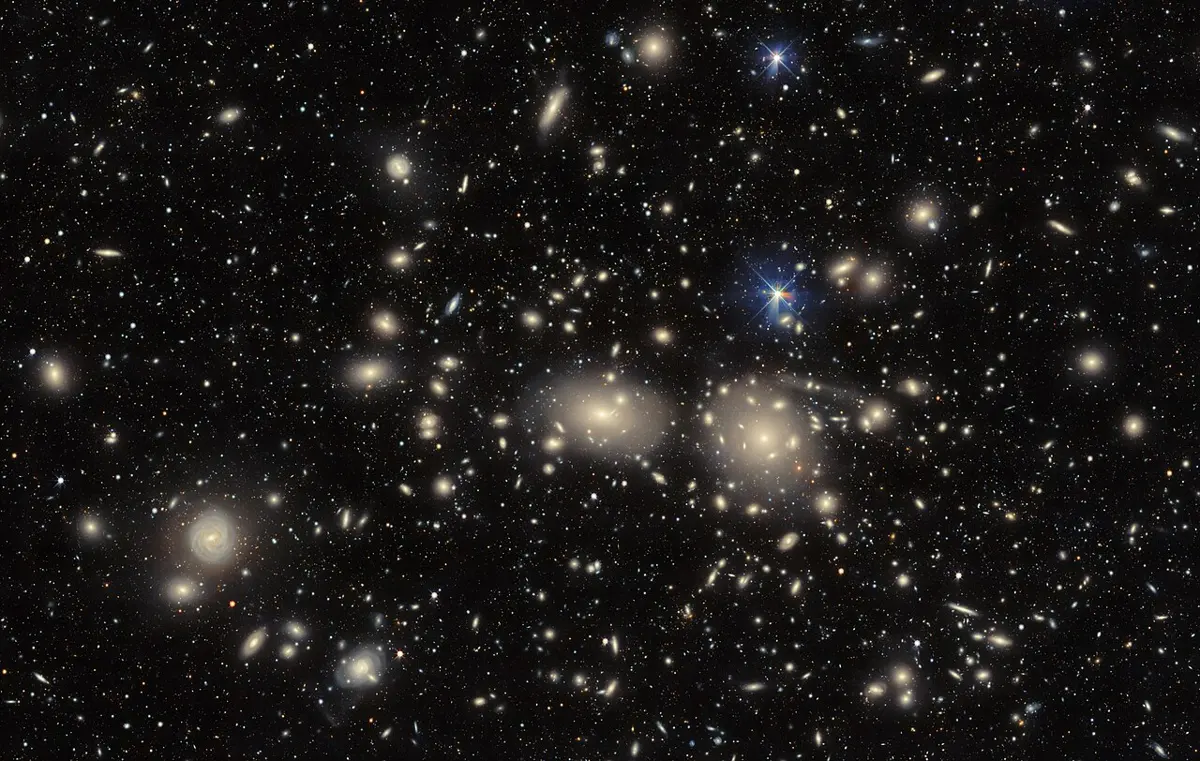
Now measure some real galaxies. Each spectrum below shows the strongest lines of a real galaxy, at the wavelengths astronomers have measured. Your job is to find how much the lab’s lines must be stretched to fit.
In a galaxy’s spectrum, hydrogen’s line at 486.1 nm has moved 10 nm towards the red. What about its line at 656.3 nm?
Pick an answer to see why.
How far away is a galaxy?
A redshift gives a galaxy’s speed. To find a pattern, Hubble also needed its distance, and that is much harder: nothing in a galaxy’s light says how far it has come. The trick is to find an object whose true brightness you know. Then how bright it looks tells you how far away it is.
A torch looks fainter the farther away it is, because its light spreads out over a bigger and bigger sphere. At twice the distance, the same light is spread over four times the area, so it looks a quarter as bright. At ten times the distance, a hundredth. How bright it looks falls with the square of the distance:
An object of known true brightness, used to measure distances this way, is a standard candle.

Cepheids can be seen only in fairly nearby galaxies. For distant ones, astronomers use brighter candles. The best are type Ia supernovae: exploding white dwarf stars that, at their brightest, outshine billions of Suns, and are nearly all equally bright. Their true brightness is set by measuring supernovae in nearby galaxies whose Cepheids give the distance. Each step of this distance ladder sets the next.
Two type Ia supernovae have the same true brightness. One looks 9 times fainter than the other. What can you say about their distances?
Pick an answer to see why.
Hubble’s law, from real data
Put the two measurements together, speed from the redshift and distance from a standard candle, and you get the graph that Hubble drew in 1929 with 24 galaxies Grade 10: Hubble’s study: the farther away a galaxy is, the faster it is moving away, v = H₀d. You have also seen in Grade 10 why that is exactly what an expanding universe looks like from inside: on a growing balloon, every dot sees every other dot moving away, faster the farther it is Grade 10: an expanding balloon.
Hubble’s own data were scattered, and his galaxies were all close by. Here are much better measurements, made in the 1990s with the Hubble Space Telescope: 36 type Ia supernovae and 21 clusters of galaxies (their distances from another standard candle: how fast a spiral galaxy spins tells how bright it really is), out to nearly 500 megaparsecs (about 1.5 billion light-years). (1 Mpc is about 3.26 million light-years.)
In Grade 10 you used 1 ÷ H₀ to estimate the age of the universe, and read about the Hubble tension: as of 2026, measurements of the early universe give H₀ ≈ 67–68 km/s per Mpc, while Cepheids and supernovae give about 73, and some other nearby methods about 70. Nobody yet knows why they disagree. But every measurement, by every method, finds a straight line through zero: the universe is expanding.
Stretching space, stretching light
Not flying apart, but growing apart
The Doppler effect is about a source moving through space. But the Big Bang theory says something different: the galaxies are not flying apart through space; space itself is stretching Grade 10: the Big Bang theory. Then the redshift has a simpler meaning.
Light travels to us across space, and while it travels, space stretches. Every wave of the light is stretched with it. If the universe has doubled in size while the light was on its way, every wavelength has doubled.
So redshift measures how much the universe has stretched while the light was traveling:
For nearby galaxies, this gives the same answer as the Doppler formula v = cz. For distant ones, it is the right way to think. There, z can be much bigger than 1, and v = cz would give a speed faster than light, a sign that the formula no longer applies: what z measures is how much space has stretched.
A galaxy has a redshift of z = 2. What does this tell you?
Pick an answer to see why.
The afterglow
A prediction
If the universe has been stretching for billions of years, then in the past it was smaller, denser and hotter: squeeze a gas and it heats up. Run the film back far enough, and the whole universe was a hot, glowing gas, hotter than the surface of the Sun. In 1948, the American physicists Ralph Alpher and Robert Herman, working with George Gamow, saw what this meant. Light from that hot early universe must still be everywhere, stretched by the expansion into long, cold waves. They estimated its temperature today: about 5 K, five degrees above absolute zero. Hardly anyone took notice.
Here is what we now understand. For its first few hundred thousand years, the universe was so hot that atoms couldn’t hold on to their electrons. Light kept bumping into the free electrons and couldn’t travel far, as in a thick fog. At about 370,000 years (you will often read 380,000, as in Grade 10: the fog cleared gradually, so the number depends on which moment you count), the universe had cooled to about 3,000 K, and electrons joined the nuclei to make atoms. Suddenly, the fog cleared. The light set free then has been traveling ever since, and it fills all of space, coming at us from every direction. It is the cosmic microwave background (CMB), the afterglow of the Big Bang.
How does light cool? A hot object glows brightest at a wavelength that depends on its temperature (Wien’s law):
At 3,000 K, a glow is brightest at about 1 µm, in the near infrared, with enough red, orange and yellow to glow orange: the color of the filament of an old light bulb. Stretch every wavelength 1,000 times, and the brightest wavelength becomes about 1 mm, the glow of something 1,000 times colder.
Found by accident, measured perfectly
In 1964, Arno Penzias and Robert Wilson found the afterglow by accident, as a hiss in their radio antenna at 7.35 cm that came from every direction Grade 10: the story in Grade 10. They measured a temperature of about 3.5 K, uncertain by 1 K, close to what Alpher and Herman had predicted.
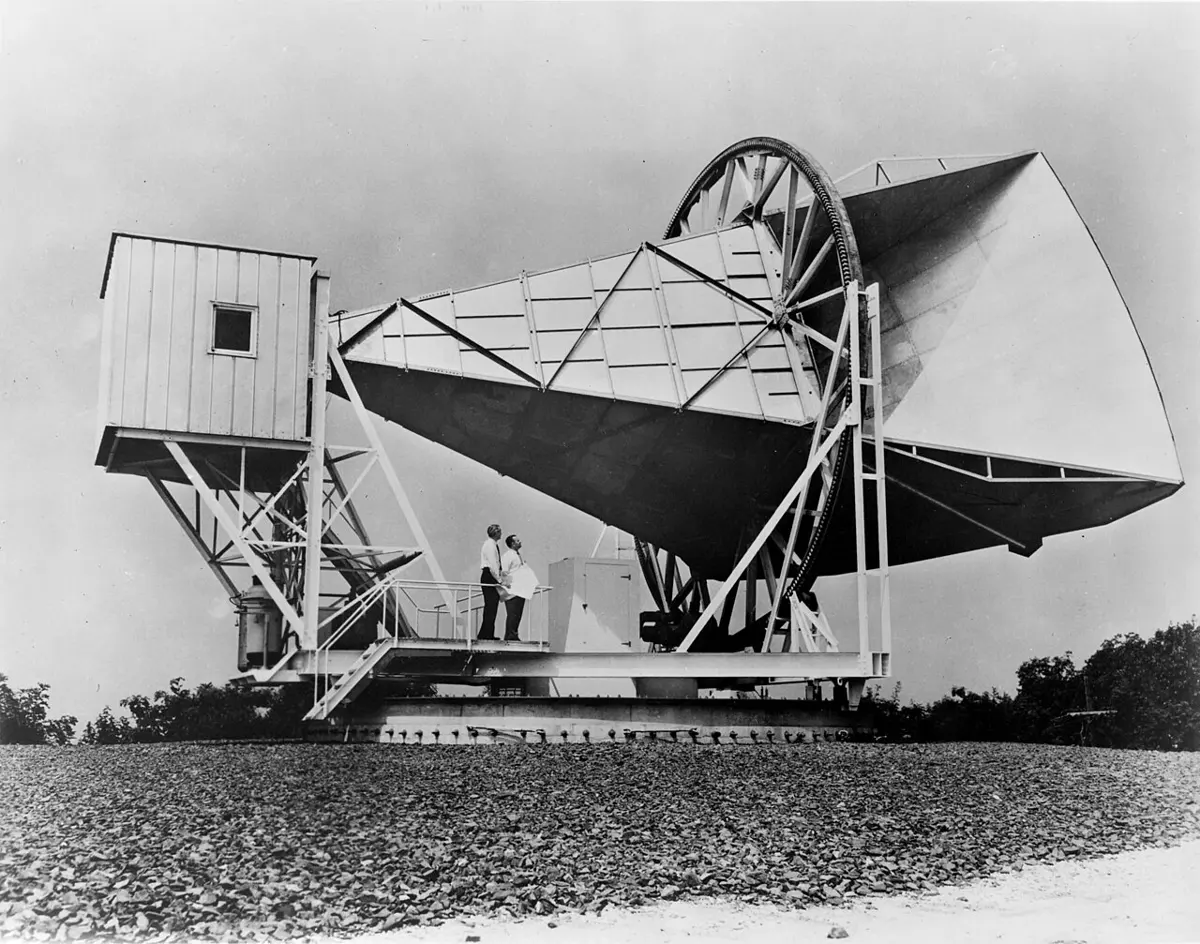
One measurement at one wavelength doesn’t prove much: lots of things give out a little radio hiss. The real test was the shape of the spectrum. A glow left over from a hot, dense gas that filled the whole universe should have exactly the spectrum of a perfect glowing body, a black body, at one temperature: Planck’s curve. Nothing else in the universe gives a spectrum that perfect.
In November 1989, NASA launched the COBE satellite. In January 1990, its scientists showed their first results to a meeting of astronomers: the spectrum, measured by its instrument FIRAS, lay exactly on the curve of a black body. The audience stood up and applauded.
COBE’s measurements, refined since, give the temperature today as 2.7255 K (as of 2026, unchanged since 2009). Two leaders of COBE’s work, John Mather (for FIRAS) and George Smoot (for mapping the afterglow’s tiny ripples), were given the Nobel Prize in Physics in 2006.
Why is the afterglow’s black-body shape such strong evidence for the Big Bang?
Pick an answer to see why.
The first three minutes: hydrogen and helium
What the hot universe made
The third clue is what the universe is made of. In the first second after the Big Bang, it was far too hot for any atom, or even any nucleus, to exist. There were only separate particles, among them protons and neutrons, the particles that atomic nuclei are made of. At first there were about as many neutrons as protons. But a neutron is slightly heavier than a proton, and as the universe cooled, it became easier to turn neutrons into protons than the other way round. By the time the universe was about one second old, there was about one neutron for every six protons.
A free neutron doesn’t last: on its own it changes into a proton, with a half-life of about 10 minutes. So the neutrons kept slowly turning into protons. Meanwhile, the universe was still too hot for neutrons and protons to stick together: every time a pair joined, a high-energy photon knocked them apart again. Only after about 3 minutes, when the temperature had fallen to about a billion kelvin, could nuclei survive. By then there was about one neutron for every seven protons.
In the next few minutes nearly every neutron that was left ended up inside the most tightly bound light nucleus, helium-4, two protons and two neutrons. The protons left over stayed on their own: hydrogen nuclei. By about 20 minutes, the universe had cooled and thinned too much for any more nuclei to form. The recipe was fixed.
Checking the recipe
Can we check what was made in the first minutes, 13.8 billion years ago? Cecilia Payne found in 1925 that the stars are mostly hydrogen and helium (Reading the stars). But stars make helium too, by fusing hydrogen in their cores (A tank of hydrogen), so how can we tell which helium came from the Big Bang?
The answer: stars that make helium also make heavier elements, carbon, oxygen, iron, and over billions of years these build up in a galaxy. So astronomers look for the places where stars have done the least work: small galaxies whose gas has only a tiny fraction of the Sun’s heavy elements. Even there, the helium is nearly a quarter of the mass.
| Where | Helium, by mass |
|---|---|
| Predicted by the Big Bang (calculated) | 24.7 % |
| Gas in small galaxies with hardly any heavy elements (measured) | 24.6 % |
| The gas the Sun formed from, 4.6 billion years ago (from models of the Sun) | about 27 % |
(The first two numbers are as of 2026.) The Sun has a little more helium than the universe began with, because it formed from gas that earlier stars had already worked on. But no place has been found with much less than about a quarter helium: everywhere started with a quarter, as the Big Bang predicts.
Why do astronomers measure helium in small galaxies with hardly any heavy elements, to test the Big Bang?
Pick an answer to see why.
Putting the case together
A scientific theory is believed not because someone famous said it, but because its predictions keep coming true. Here is the case for the Big Bang, in the three kinds of evidence NGSS asks you to explain: the light spectra, the motion of distant galaxies, and the composition of matter.
| Evidence | What is observed | Why the Big Bang explains it |
|---|---|---|
| Motion of galaxies | Galaxies’ spectra are redshifted; the farther away, the bigger the redshift (Hubble’s law) | Space is stretching; light that has traveled longer has been stretched more |
| Light spectra: the afterglow | A glow at 2.725 K from every direction, with a perfect black-body spectrum; warmer in the distant past | Light from the hot, dense early universe, stretched 1,091 times since it set out |
| Composition of matter | Everywhere, at least about 24–25 % of the mass is helium; deuterium at 1 in 40,000 | Made in the first minutes, when the whole universe was hot enough for fusion |
Each clue on its own could perhaps be explained some other way. All three together, measured by different people with different instruments, and each predicted before it was measured in detail, are very hard to explain any other way.
Questions
In a galaxy’s spectrum, calcium’s line at 393.4 nm appears at 413.1 nm. What is the galaxy’s redshift, and how fast is it moving away?
Pick an answer to see why.
What happened about 370,000 years after the Big Bang that let the afterglow travel freely?
Pick an answer to see why.
Explain why astronomers are sure that a galaxy’s redshift is caused by the galaxy itself moving away (or space stretching), and not by some fault in their instruments or by a different element.
Answer
The lines appear in the same pattern as an element’s lines in the lab, spaced in the same way, with every line moved by the same fraction, z. A different element would give a different pattern, not the same pattern stretched. An instrument fault would affect nearby stars’ spectra too; yet nearby stars show only small shifts, some red, some blue, while distant galaxies are all redshifted, more the farther away they are. And many different instruments, on many different telescopes, measure the same z for the same galaxy.
A galaxy’s hydrogen line, 656.3 nm in the lab, is observed at 682.5 nm.
- a.Find its redshift and its speed.
- b.Using H₀ = 70 km/s per Mpc, estimate its distance in Mpc and in light-years (1 Mpc = 3.26 million light-years).
Answer
- a.Δλ = 682.5 − 656.3 = 26.2 nm; z = 26.2 ÷ 656.3 = 0.0399. v = cz = 3.00 × 10⁵ × 0.0399 = 12,000 km/s (to 3 significant figures).
- b.d = v ÷ H₀ = 12,000 ÷ 70 = 171 Mpc ≈ 171 × 3.26 million ≈ 560 million light-years.
The afterglow was set free when the universe was at about 3,000 K, and it is 2.725 K today.
- a.By how many times has the universe stretched since then?
- b.At about 3,000 K, the afterglow was brightest at about 1 µm. Where is it brightest today?
Answer
- a.The temperature falls in proportion to the stretching, so the universe has stretched about 3,000 ÷ 2.725 ≈ 1,100 times (1 + z ≈ 1,100).
- b.Every wavelength has stretched the same 1,100 times: 1 µm × 1,100 ≈ 1.1 mm. (Wien’s law gives 2.9 mm K ÷ 2.725 K = 1.06 mm.) So it is brightest at about 1 mm, in the microwaves.
Some people think the helium in the universe was all made by stars. Using the evidence in this topic, explain why most of it must have been made in the first minutes after the Big Bang.
Answer
- Stars that make helium also make heavier elements (carbon, oxygen, iron), so where stars have made a lot of helium, there should also be a lot of heavy elements.
- Small galaxies whose gas has hardly any heavy elements, where stars have done very little, still have about 24.6 % helium by mass.
- So nearly a quarter of the mass was already helium before stars added any.
- The Big Bang theory predicts exactly this: with 1 neutron for every 7 protons when nuclei could first form, about 25 % of the mass became helium (24.7 % by the detailed calculation).
(You could add: the stars in a galaxy shine far too weakly to have made so much helium in the time there has been, and deuterium, which stars destroy, is present in the amount the same calculation predicts.)
Construct an explanation of the Big Bang theory, using three kinds of evidence: light spectra, the motion of distant galaxies, and the composition of matter in the universe. Say for each what is observed and how the theory explains it.
Answer
Claim: the universe began about 13.8 billion years ago in a hot, dense state and has been expanding and cooling ever since.
Motion of distant galaxies: the lines in galaxies’ spectra are shifted to longer wavelengths by the same fraction, so the galaxies are moving away; their distances, from standard candles, show that the farther a galaxy is, the faster it moves away (Hubble’s law). This is what happens if space is expanding everywhere: so in the past everything was closer together.
Light spectra, the afterglow: a faint microwave glow comes from every direction, with the perfect black-body spectrum of something at 2.725 K. A hot, dense early universe would have been filled with light at one temperature; when atoms formed at about 3,000 K, that light was set free, and the expansion has since stretched it about 1,100 times, cooling it to 2.7 K. Distant gas clouds, seen in the past, are bathed in a warmer glow, as the theory predicts.
Composition of matter: ordinary matter is about 75 % hydrogen and 25 % helium by mass, even in galaxies where stars have hardly worked. In the first minutes, the hot universe could fuse nuclei for only a short time, with 1 neutron for every 7 protons, which makes 25 % helium.
Reasoning: each observation was predicted by the theory, the three come from completely different measurements, and they agree with each other; a universe that had always been the same (the steady state theory) predicts none of them.
Where to go next
- Where did the atoms in your body come from? The Big Bang made hydrogen and helium. So where did the carbon, oxygen and calcium in you come from?
- How long will the Sun shine? How stars turn hydrogen into helium, and how long the fuel lasts.
- How old is the Earth? The universe is 13.8 billion years old; the Earth, about 4.6 billion. How radioactive rocks tell its age.