
Look around your home this morning. The clothes on the roof are drying in the sun. Someone is cooking dal on an LPG stove, or on a fire of wood or dung cakes. A neighbor rides past on an electric scooter, charged last night from the wall socket, and the socket gets its electricity from a river high in the hills. The street lamp that was glowing at night has a small blue panel on top and no wire at all.
Every one of these runs on energy, and almost every one of them, if you follow it back far enough, runs on sunlight. This unit follows energy to where it comes from: to the Sun, where hydrogen turns into helium at fifteen million degrees, and back down to the solar dryers, dung cakes, biogas plants and power houses of Nepal.
Energy all around you
Look at the four everyday scenes below and think about the questions.
- Wet clothes hang on a line in the sunshine. Which form of energy dries them?
- An electric scooter stands charged. Which form of energy makes it go?
- A family cooks on an LPG stove, and on a mud stove burning wood. Which sources of energy can we cook with?
- A house has a solar panel on its roof, a battery inside, and lights that glow at night. Into which forms of energy can we change solar energy?
The Sun is the main source of energy for the Earth. Without it there would be no life. We use its energy directly in the water cycle, in photosynthesis, and in drying wood, grain and clothes. Petroleum, natural gas and hydroelectricity are solar energy too, stored up and changed into another form: they are indirect forms of solar energy. So almost all the energy we use comes, directly or indirectly, from the Sun.
Sources of energy
Activity 9.1: sources of energy in Nepal
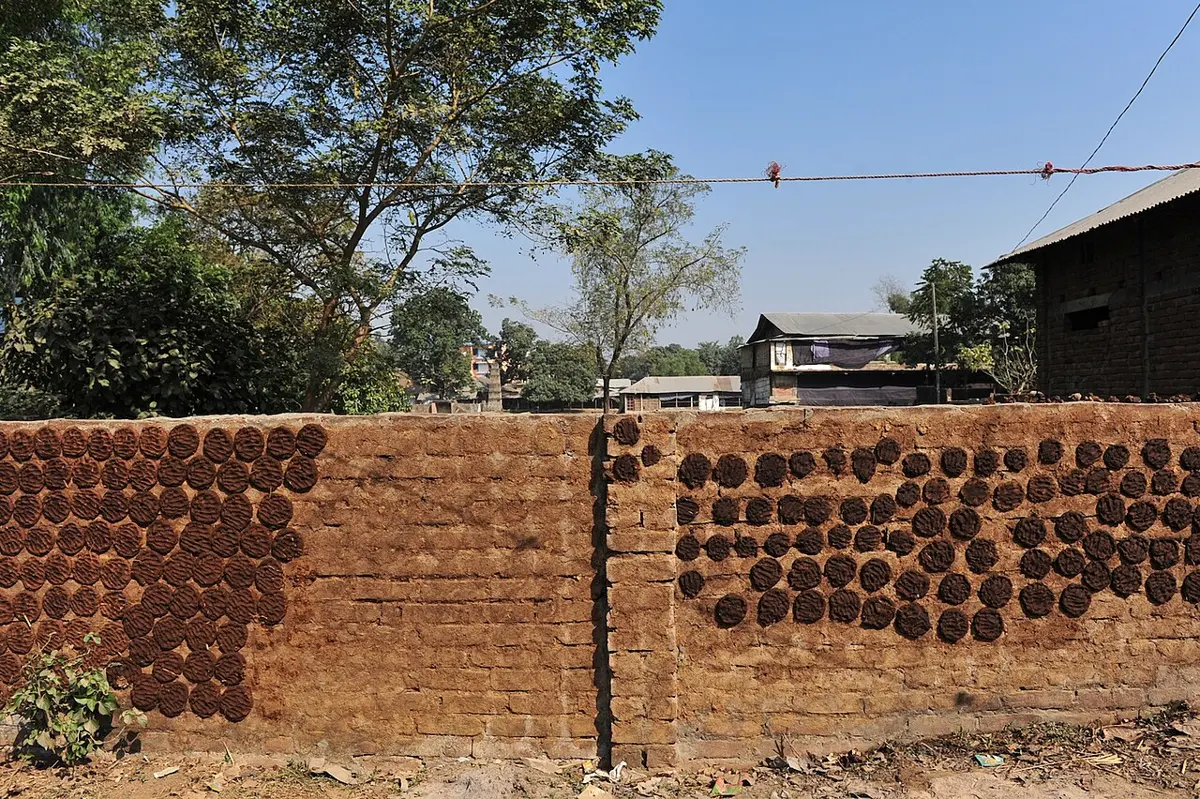
We use many sources of energy, depending on what we need. Any object or substance that can give us a useful form of energy is a source of energy. Coal, diesel, kerosene, natural gas, firewood, dung cake, sunlight and the water of a river (for hydroelectricity) are all sources of energy. Different parts of Nepal depend on different ones: an LPG cylinder in Kathmandu, firewood in a hill village, dung cakes in the Tarai, the sun and yak dung in Dolpa.
The sources of energy are sorted into two main types.
Non-renewable sources of energy
Coal, crude oil (mineral oil) and natural gas formed underground from the remains of plants and animals over millions of years. Once we burn them, they are gone, and we can’t make more in a human lifetime. So they can’t be used for ever.
Non-renewable sources of energy are those that run out with use and can’t be replaced when needed. Examples: coal, mineral oil (petrol, diesel, kerosene, LPG) and natural gas.
Renewable sources of energy
Sunlight comes back every morning. Rivers keep flowing as rain keeps falling. A new tree grows where one was cut. These sources are replaced by nature in a short time, so they don’t run out even if we keep using them.
Renewable sources of energy are those that nature keeps producing and that can be replaced quickly. Examples: solar energy, wind energy, hydroelectricity, wood, dung cake and biogas.
Which of these is a non-renewable source of energy?
Pick an answer to see why.
Solar energy
The heat and light the Earth receives from the Sun are called solar energy. We use it directly, to dry and warm things, and with the help of technology we change it into other forms, such as electricity.
The Earth receives an enormous amount of energy from the Sun every day. Where does the Sun get it? From nuclear fusion: deep inside the Sun, hydrogen atoms join to make helium, and this releases energy.
Some facts about the Sun
| Fact | Value |
|---|---|
| mass of the Sun | 2 × 10³⁰ kg (about 330,000 Earths) |
| average distance from the Earth | 1.5 × 10⁸ km (150 million km) |
| temperature of the core | about 15,000,000 K (15 million kelvin) |
| temperature of the surface | 5,778 K (about 5,500 °C) |
| energy given out every second | 3.8 × 10²⁶ J (so its power is 3.8 × 10²⁶ W) |
| solar energy reaching each square meter facing the Sun, at the top of the Earth’s air | about 1.4 kW (1,361 W) |
About a quarter of that last figure is soaked up or reflected by the air on the way down, so on a clear day at noon, a square meter of ground facing the Sun receives about 1 kW: as much as a small electric heater.
Nuclear reaction in the Sun
The Sun is a medium-sized star made mostly of hydrogen. Its core is at about 15 million kelvin. At that temperature, atoms move so fast and crash so hard that hydrogen atoms lose their electrons. What is left are bare hydrogen nuclei: protons, or H⁺ ions.
Protons all carry a positive charge, so they repel one another strongly. Normally two protons can never get close enough to join. But in the Sun’s core, the temperature makes them move extremely fast, and the pressure of the whole Sun pressing down crowds them together, so now and then two of them collide hard enough to fuse.
The joining of light nuclei, such as hydrogen, into a heavier nucleus, such as helium, at very high temperature and pressure, is called thermonuclear fusion. It releases a huge amount of energy as radiation. (“Thermo” means heat: it is the heat that makes the fusion possible.)
In the Sun, fusion happens in three steps:
- Two protons (¹₁H) fuse to form a deuterium nucleus (²₁H) and a positron (⁰₊₁e, a particle like an electron but with a positive charge).
2. A third proton collides with the deuterium nucleus and forms a light isotope of helium, helium-3 (³₂He), giving out a gamma ray (γ).
3. Two helium-3 nuclei (each made by steps 1 and 2) collide, forming an ordinary helium nucleus, helium-4 (⁴₂He), and setting two protons free again.
Overall, four hydrogen nuclei fuse to form one helium nucleus, and a large amount of energy is released:
Conditions needed for thermonuclear fusion in the Sun
- A huge amount of hydrogen: the Sun is about three-quarters hydrogen, enough fuel to keep fusion going for billions of years.
- Very high temperature (about 15 million K): it strips the electrons off the atoms, leaving free protons, and makes them move fast enough to collide hard.
- Very high pressure: the weight of the Sun’s outer layers squeezes the core, crowding the protons close together so that they collide often enough to fuse.
Why can’t hydrogen fuse into helium on the Earth, say in a tank of hydrogen gas?
Pick an answer to see why.
The Sun: the ultimate source of energy
Activity 9.2: following the arrows back to the Sun
Hydroelectricity, wind energy, bioenergy and fossil fuels are all solar energy that has been changed into another form. So the Sun is called the ultimate source of energy. Here is how.
Water energy
In the water cycle (also called the hydrological cycle), the Sun’s heat melts snow and ice, which fill rivers and lakes. It also evaporates water from seas, lakes, rivers and ponds. The water vapor rises, cools and condenses into clouds, and falls as rain or snow, much of it high up in the mountains. The rainwater flows down rivers or collects in reservoirs, and the water collected in reservoirs is used to make hydroelectricity. Without the Sun lifting the water up, no river would flow downhill. So hydroelectricity is an indirect form of solar energy.
Fossil fuels
During photosynthesis, green plants take in a small part of the solar energy reaching the Earth and use it to turn carbon dioxide and water into food (glucose, stored as starch). Solar energy becomes chemical energy stored in the leaves, stems, roots and seeds. Animals eat plants and get that stored energy; so the energy in all our food is an indirect form of solar energy.
Plants and animals that died millions of years ago were buried under mud and rock. Heat and pressure slowly turned them into fossil fuels: coal, petroleum (from which petrol, diesel and kerosene are made) and natural gas. So fossil fuels are ancient sunlight. Wood, crop waste and other plant matter that we burn as fuel are products of solar energy too, only much younger.
Wind energy
The Sun heats the ground, and the ground heats the air just above it. The warm air becomes lighter (less dense) and rises; cooler air from somewhere else moves in to take its place. This moving air is wind. We can use its energy to turn windmills and wind turbines. So wind energy is also a product of solar energy.
How is the energy in a lump of coal related to the Sun?
Pick an answer to see why.
Solar energy harvesting technology
Technology lets us change solar energy into other useful forms. A solar panel turns sunlight into electricity. A solar water heater on a rooftop heats water. Solar lamps, solar street lamps, solar dryers and solar cookers are other technologies that harvest solar energy in daily life.
Solar electricity
A solar panel is made of many photovoltaic cells (“photo” means light, “voltaic” means electricity), also called solar cells. They are made of a semiconductor, mainly silicon. When sunlight strikes the silicon atoms in the cell, it knocks electrons free. These free electrons collect on one side of the cell, which creates an electric potential difference (a voltage) between the cell’s two terminals. Connect a bulb or a fan across the terminals, and a current flows.
One small cell gives only about half a volt. So cells are joined:
- in series (one after another) to give a higher voltage;
- side by side (in parallel) to give a larger current.
A panel combines both. The brighter the light, the more current flows. For the most electricity, a panel should face the Sun directly, with sunlight falling straight onto it.
Solar lamps and solar street lamps
Solar lamps and solar street lamps also use photovoltaic cells. They use LED lamps, which glow brightly with only a small current. A solar street lamp has four main parts, shown in Figure 9.3:
- a solar panel on top;
- a battery;
- an LED lamp;
- a controller, the little box that decides where the current goes.
During the day, the controller sends the current from the panel to charge the battery. At night, when the panel stops giving current, the controller switches the battery on to the LED, and the lamp glows.
Solar dryer
Potatoes, radish, carrots, tomatoes, brinjal, cauliflower, gundruk and masyaura have always been dried in the open sun in Nepal. That is slow, and dust, flies and birds get at the food. A solar dryer dries it faster and more cleanly.
A solar dryer is a box (look at Figure 9.4):
- three sides are lined with a heat insulator, so heat doesn’t escape;
- the top is a sheet of transparent glass, sloping to face the Sun, which lets sunlight in;
- the inside is painted black, to absorb as much heat as possible;
- a hole low down at the front lets cool air in, and a hole high up at the back lets hot, moist air out.
The air inside heats up, becomes lighter and rises out of the top hole, carrying the water vapor from the food with it. Fresh, dry air is pulled in at the bottom to replace it. This flow keeps going all day, on its own.
Solar water heater
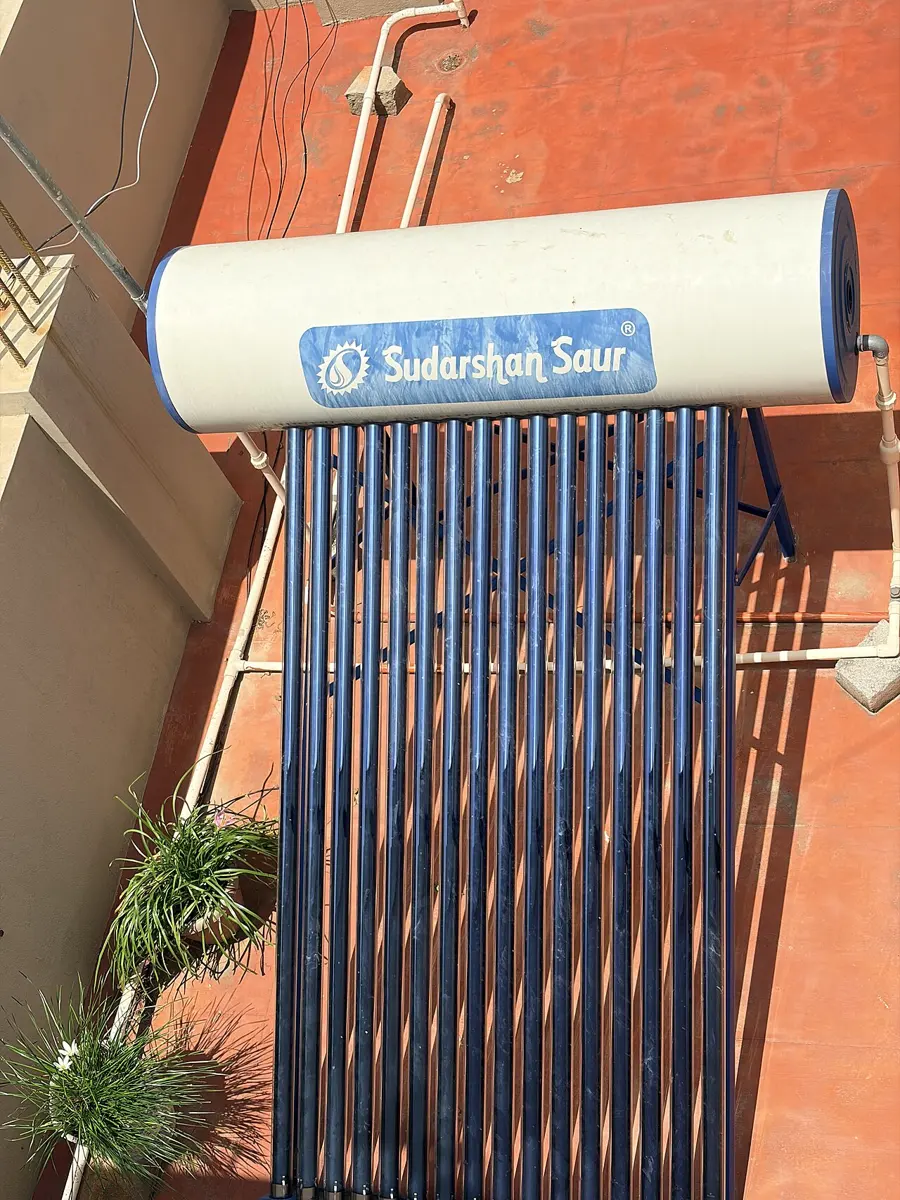
Look at the roofs of any town in Nepal: the rows of black or glass tubes beside a drum are solar water heaters. In the common kind, evacuated tubes (glass tubes with a vacuum between two walls, like a thermos flask) are fixed side by side to a water tank, sloping up into it.
- Cold water from the tank fills the tubes from the lower part of the tank.
- In the day, sunlight heats the water in the tubes. Hot water is less dense, so it rises into the tank.
- Colder, denser water sinks down into the tubes to take its place, and is heated in turn.
- So hot water collects in the upper part of the tank, where the tap to the house is. The tank is wrapped in a heat insulator, so the water stays hot even at night.
No pump is needed: the hot water rises by itself. This is convection.
Solar cooker
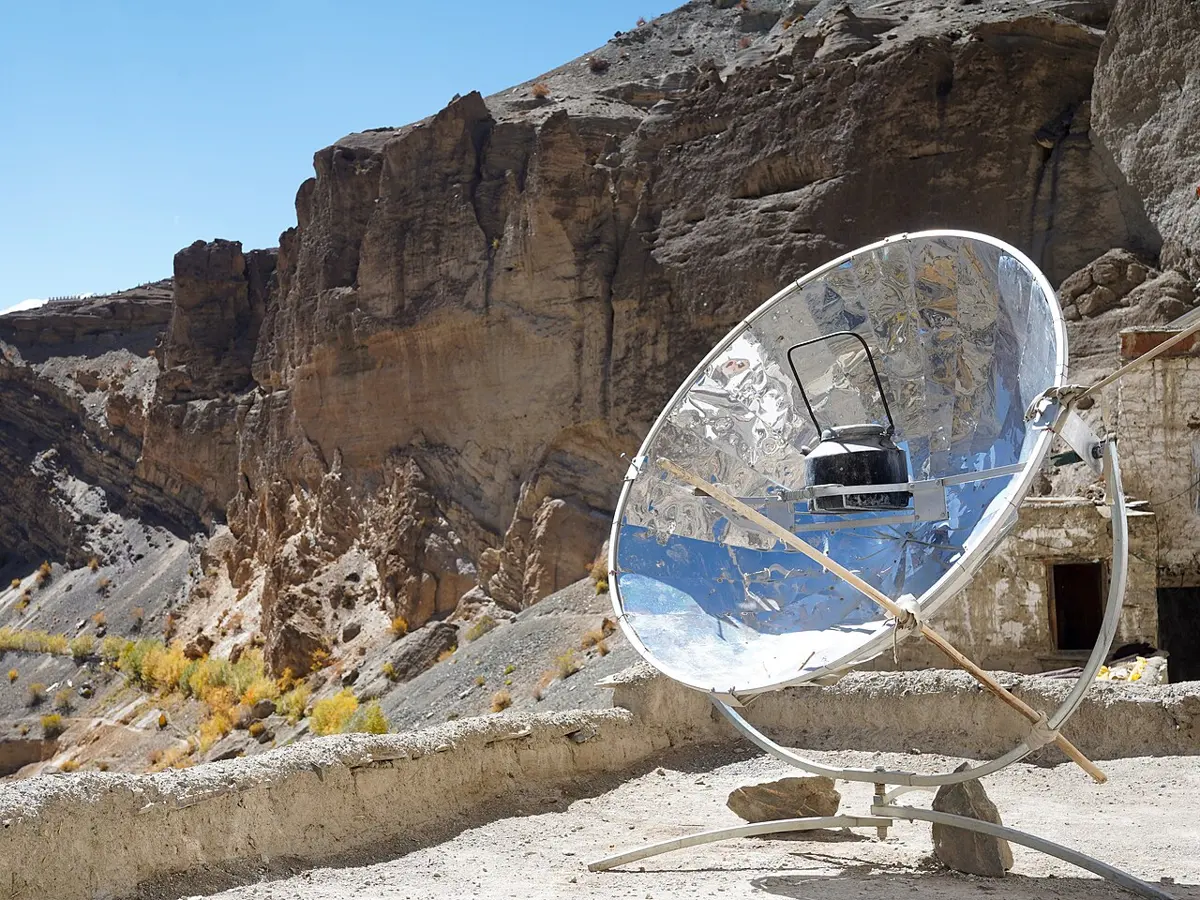
A solar cooker of the dish type uses a large, smooth concave mirror (a dish curved like the inside of a bowl). The mirror reflects the sunlight falling on all of it to one small spot, where the light and heat converge. The cooking pot sits at that spot. The outside of the pot is painted black to absorb more heat. With a 1.5 m dish, water boils in about half an hour on a sunny day.
There is a simpler kind too: the box cooker, an insulated box painted black inside, with a glass lid and a shiny reflector to throw in more light. It cooks more slowly but needs no turning to follow the Sun.
Bioenergy
Plants and animals are made of organic materials (compounds of carbon). These store energy that came, through photosynthesis, from the Sun. When the materials burn, or rot, that energy is released. The energy obtained from plant parts and animal wastes is called bioenergy. The energy from firewood, dung cakes, straw and husks is bioenergy. It is a renewable source of energy. Bioenergy is used as fuel for heating, cooking, transport and making electricity.
A fuel made from living things is called a biofuel. Some are solids (firewood, dung cakes, crop waste, briquettes), some are gases (biogas), and some are liquids: alcohol (ethanol, made by fermenting sugarcane or maize) and biodiesel (made from plant oils). In many countries petrol is mixed with ethanol made from crops; Nepal has tested biodiesel from the seeds of jatropha (sajiwan).
Biomass energy
Biomass is dry organic material obtained from living beings. Dry weeds, leaves, rice husk, sawdust, crop residue (the stalks and husks left after a harvest) and dung cakes are examples of biomass.
Traditionally, we get heat by burning biomass in the open. But loose (non-compressed) biomass has problems:
- it is bulky, so it is hard to store and carry;
- it doesn’t burn completely, so it gives more smoke and less heat.
Both problems can be solved by compressing the biomass into blocks.
Briquettes
A briquette is a compressed block of combustible biomass, used to give heat in homes and industries. There are two main types.
a. Carbonized briquette
A carbonized briquette is a pressed block of charcoal.
- Charring: firewood, husk, weeds or other carbon-rich material is burnt with too little oxygen, so instead of burning away to ash it turns into charcoal.
- The charcoal is crushed into dust.
- The dust is mixed with a binder (clay, molasses, or plant starch, such as the starch of yams) and water, and kneaded into a thick paste.
- The paste is put into a mold and pressed into a fixed shape (in Nepal, often a round block with holes, so air can flow up through it).
- The blocks are dried in the sun.
b. Non-carbonized briquette
A non-carbonized briquette is made from biomass that hasn’t been charred.
- In villages, a mixture of dung and husk is pressed by hand into a cake and dried in the sun: a dung cake is a non-carbonized briquette, made with low pressure.
- In factories, sawdust, paper, husk and crop waste (sugarcane waste, peanut shells, coconut shells, sunflower stalks) are pressed by machines at high pressure, sometimes with heat and a binder. The machines are the piston press, the screw press and the roller press.
Uses of briquettes
- To heat rooms in winter.
- To cook food and boil water.
- To keep a new mother and her baby warm by the fire.
- To keep baby chicks warm in poultry farms.
- To dry vegetables, mushrooms, wool and so on in industries.
Advantages of briquettes
Briquettes are a renewable source of energy, and:
- they give less smoke, so they reduce air pollution;
- many kinds of agricultural waste can be used up;
- they reduce the use of firewood, and so save forests;
- they can be a source of income: briquettes can be made and sold;
- they give more heat and are easy to store, carry and use, which saves time.
Their disadvantages: making them in a factory is costly, and they can spoil in the rainy season if they are not stored where they stay dry.
Precautions while using briquettes
- Never use a briquette in a closed room without ventilation. Burning charcoal makes carbon monoxide, a poisonous gas with no color or smell. Every winter in Nepal, people die in their sleep from stoves and heaters left burning in closed rooms.
- Keep burning briquettes out of the reach of children.
- Burn a briquette on bricks or in a metal container, not directly on the ground or a wooden floor.
How is a carbonized briquette different from a dung cake?
Pick an answer to see why.
Biogas
Leave dung, kitchen waste or dead leaves in a closed place without air, and bacteria slowly break them down. As they do, they give off gas. Biogas is the mixture of gases formed when organic matter decomposes in the absence of oxygen. In Nepal’s villages it is made mostly from cattle dung (gobar), so it is also called gobar gas.
Biogas is mainly methane (CH₄, about 50–70 %, the gas that burns) and carbon dioxide (about 30–40 %), with small amounts of water vapor, nitrogen, hydrogen and hydrogen sulphide (H₂S, which gives raw biogas a rotten-egg smell).
Construction of a biogas plant
A household biogas plant in Nepal is built mostly underground. Its main parts are the mixing tank (with the inlet), the digester with its dome, and the outlet chamber (look at Figure 9.10).
- Mixing tank: dung is mixed with about the same amount of water, stirred with a churner, to make a thin paste called slurry.
- Inlet pipe: the slurry flows down this pipe into the digester.
- Digester: a large underground tank. Here bacteria decompose the organic matter without oxygen, making biogas.
- Dome (gas holder): the top of the digester, where the gas collects.
- Gas pipe and valve: from the top of the dome, a pipe takes the gas to the kitchen. Open the valve and the gas flows to the stove or lamp.
- Outlet chamber: as gas collects, its pressure pushes the spent slurry down in the digester and up into the outlet chamber. When the outlet chamber is full, the slurry overflows into the compost pit.
The spent slurry is an excellent fertilizer.
Advantages of biogas
- Biogas burns with a clean blue flame and no smoke, so it reduces air pollution, especially the smoke in kitchens that harms the lungs and eyes of women and children.
- Building a plant costs a lot at first, but after that it is a free source of energy for many years.
- Biogas can be used to light lamps as well as to cook.
- It replaces firewood, and so saves forests (and the hours spent collecting wood).
- The spent slurry is a good fertilizer. It should be left in the open for some days before it is used.
Hydroelectricity
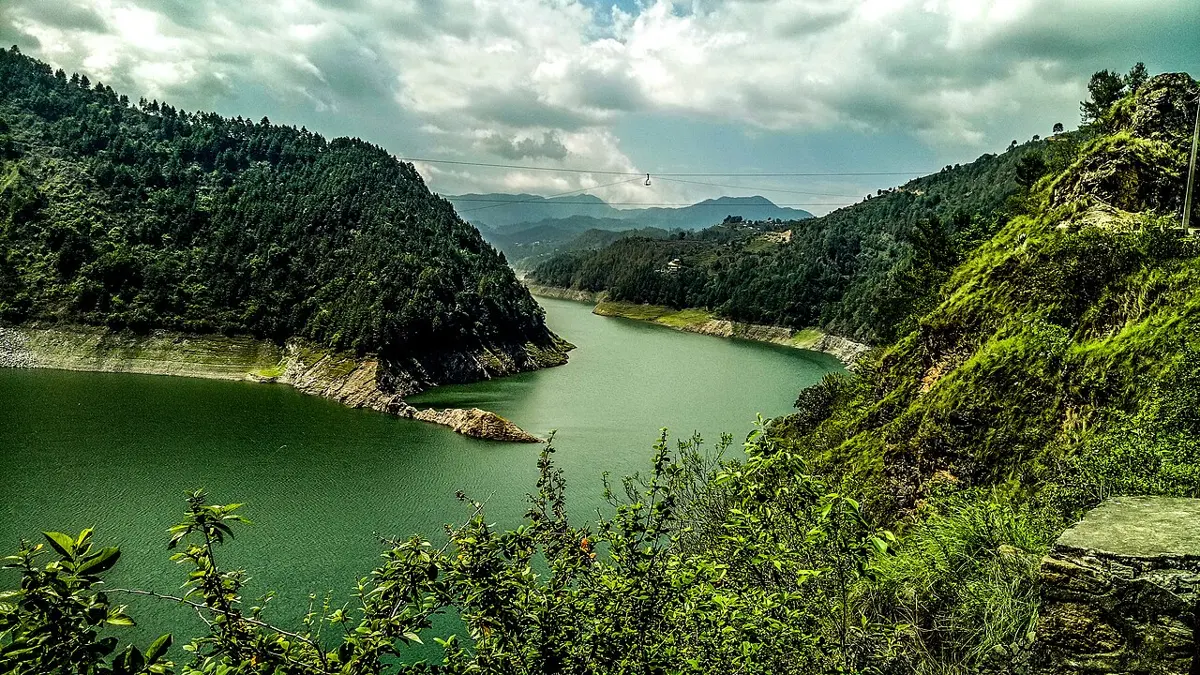
Water high up has energy because of its height. When it falls, that energy turns into the energy of motion. Electricity made from the energy of flowing water is hydroelectricity.
- Water is collected behind a dam in a reservoir (or taken from a river at an intake).
- It flows down, at high speed, through a tunnel or a big pipe called the penstock.
- At the bottom, the fast water strikes the blades of a turbine and spins it.
- The turbine turns a generator on the same shaft. In the generator, a coil spins in a magnetic field, which produces an electric potential difference between the ends of the coil: electricity.
- A transformer raises the voltage, and transmission lines carry the electricity to substations, which send it on to houses, offices and industries.
- The water, its work done, flows out through the tailrace back into the river.
The higher the water falls, and the more water flows, the more electricity is made.
Advantages of hydroelectricity
- A hydropower plant costs a lot to build, but the water is free, so in the long run its electricity is cheap.
- It burns nothing, so it gives no smoke and no greenhouse gases while it runs.
- It is renewable: as long as rain and snow keep falling, it won’t run out.
- Using more of it in cooking (induction stoves), transport (electric vehicles) and industry reduces the import of petroleum, which reduces Nepal’s trade deficit (the gap between what we buy from abroad and what we sell). It also creates jobs and helps the country’s economy grow.
Hydropower isn’t completely free of harm: a big dam floods valleys and villages, and a river with too little water left below the dam harms fish. Building it carefully keeps the harm small.
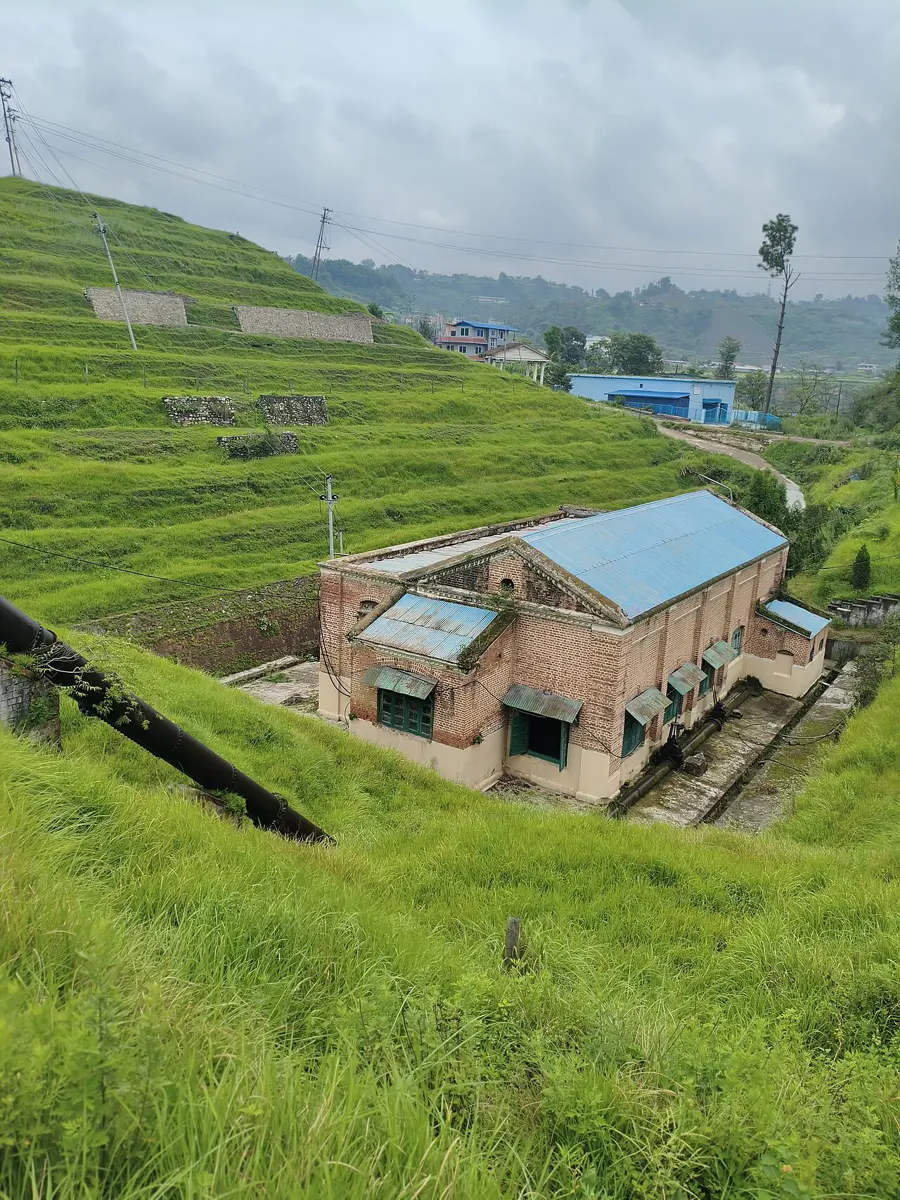
In a hydropower station, which part changes the energy of motion into electrical energy?
Pick an answer to see why.
Alternative sources of energy in Nepal
Different parts of Nepal get their energy from different sources. Today, hydroelectricity is more and more replacing petroleum products. Sources of energy that can be used instead of the traditional ones (firewood and petroleum) are called alternative sources of energy. Bioenergy (biogas, briquettes), wind energy and solar energy are alternative sources.
The Alternative Energy Promotion Centre (AEPC) was set up on 3 November 1996 to develop and promote renewable and alternative sources of energy in Nepal. It supports biogas plants, solar panels, solar dryers, solar cookers, wind turbines, micro hydropower and improved cooking stoves.
Briquettes
As an alternative source of energy, briquettes are used mainly to heat rooms and cook food. Government, non-government, private and professional organizations, including AEPC, are working to produce bio-briquettes and spread their use, and AEPC gives training in making them.
Biogas
The Government of Nepal began promoting biogas in 2030 BS (1973–74). Under the Biogas Support Programme it gives farmers a subsidy (financial help) to build gobar gas plants, and they have now been built in the villages of almost every district.
For towns and cities, biogas technology has been redesigned to suit their way of life: small plastic or fiberglass tank plants that fit on a rooftop or in a yard and run on kitchen waste. In them too, the waste decomposes without oxygen.
AEPC’s policy is to build large biogas plants that run on the cities’ biodegradable waste, in partnership with the municipalities, and private companies run large plants as well. The plant at Sukrauli in Nawalparasi was the first large plant in Nepal to make compressed biogas: biogas cleaned of its carbon dioxide and hydrogen sulphide, leaving nearly pure methane, then squeezed into cylinders like CNG (compressed natural gas). It can be used instead of LPG.
Wind energy
Wind energy is a renewable source of energy. Wind turbines use it to make electricity: the wind spins the blades, which turn a generator. How much electricity a turbine makes depends on the speed of the wind, its direction, and how steadily it blows. (Doubling the wind speed gives about eight times as much power, so windy places matter a lot.)
Small wind energy plants have been set up in the villages of Nepal: for example, wind turbines at Hariharpur Gadhi in Sindhuli that make 20 kW together, working alongside solar panels. Very strong winds can damage the turbines. There is a good chance of making electricity from wind in windy areas of Nepal like Mustang.
Solar dryers
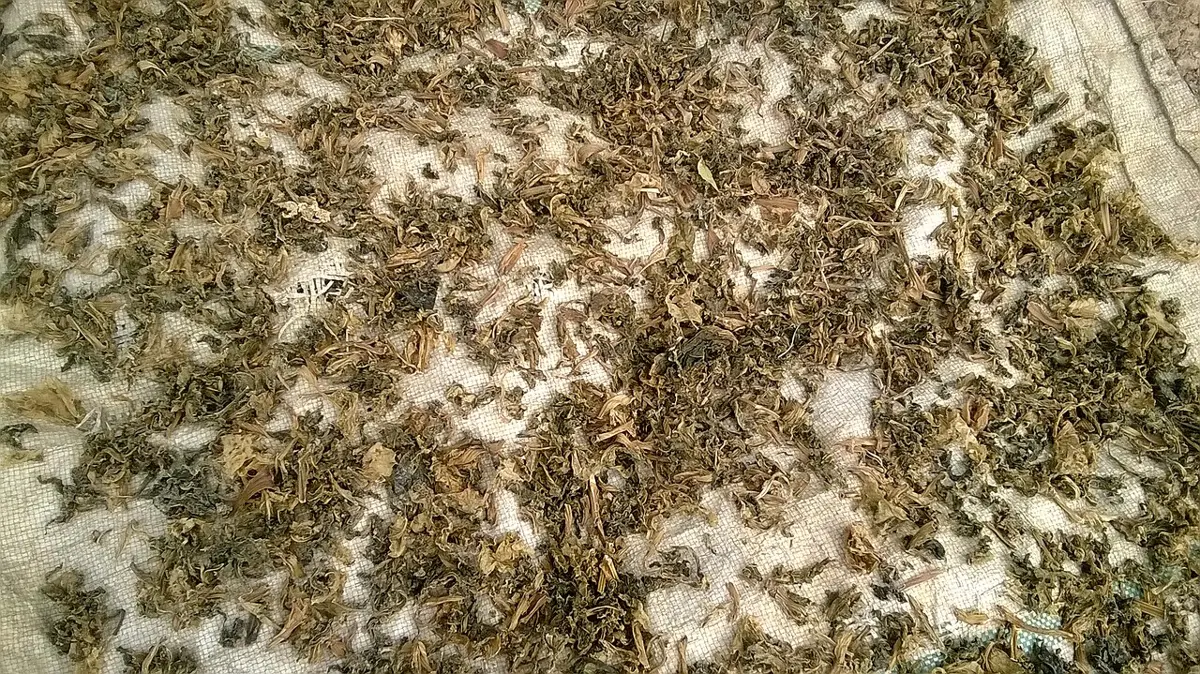
Farmers use solar dryers to dry vegetables, fruits and fish, for their own use and to sell: mango, orange, kiwi, gundruk, masyaura, mushroom and chilli, among others. Dried products such as gundruk, sinki (dried fermented radish), dried bamboo shoots (tama) and mushrooms are in demand in Nepal and abroad, and dried herbs, ginger, tea, turmeric and cardamom are exported to India.
Exercise
1. Select the best answer
a. Which is a non-renewable source of energy?
Pick an answer to see why.
b. Four pictures are shown: (i) a small lamp with a solar cell on top; (ii) a calculator with a solar strip above its screen; (iii) a satellite with long solar panels; (iv) a drawing of the water cycle (the Sun, clouds, rain and a lake). Which of these is not a solar technology?
Pick an answer to see why.
c. Which group contains only bioenergy sources?
Pick an answer to see why.
d. Which of these groups lists the gases found in biogas?
Pick an answer to see why.
2. Give differences
Renewable and non-renewable sources of energy
Answer
| Renewable sources of energy | Non-renewable sources of energy |
|---|---|
| Nature replaces them quickly. | They took millions of years to form and can’t be replaced quickly. |
| They don’t run out with use. | They run out with use. |
| Most pollute little. | Burning them pollutes the air and causes global warming. |
| e.g. solar energy, wind, hydroelectricity, biogas | e.g. coal, petroleum, natural gas |
Solar energy and bioenergy
Answer
| Solar energy | Bioenergy |
|---|---|
| The heat and light that come straight from the Sun. | The energy stored in plant parts and animal wastes. |
| Used directly, or through technology (panels, heaters). | Released by burning or decomposing the material. |
| Available only by day and in clear weather. | Can be stored and used at any time. |
| Gives no smoke. | Burning it (wood, dung) can give smoke. |
| e.g. a solar cooker, a solar panel | e.g. firewood, dung cake, biogas |
Carbonized briquette and non-carbonized briquette
Answer
| Carbonized briquette | Non-carbonized briquette |
|---|---|
| Made from charcoal: the biomass is charred first. | Made from biomass that is not charred. |
| The charcoal dust is mixed with a binder and molded. | The biomass is pressed by hand or machine, with or without a binder. |
| Gives very little smoke. | Gives more smoke. |
| e.g. the round charcoal briquette with holes | e.g. dung cake, sawdust briquette |
Natural gas and biogas
Answer
| Natural gas | Biogas |
|---|---|
| Formed underground from ancient living things over millions of years. | Made in days or weeks from dung and other organic waste. |
| Non-renewable. | Renewable. |
| Mostly methane (often over 90 %). | About 50–70 % methane, the rest mostly carbon dioxide. |
| Taken from gas wells deep underground. | Made in a biogas plant at home or in a town. |
3. Give reasons
The Sun is the ultimate source of energy.
Answer
Almost every source of energy we use comes from the Sun. Its heat drives the water cycle, which fills the rivers used for hydroelectricity, and heats the air unevenly, which makes the wind. Its light is stored by plants in photosynthesis, which gives our food, firewood and biomass, and, over millions of years, fossil fuels. So in the end nearly all our energy is solar energy.
The use of renewable sources of energy must be increased.
Answer
Non-renewable sources (coal, oil, gas) will run out, and burning them pollutes the air and causes global warming. Renewable sources (sun, water, wind, biomass) don’t run out and pollute far less. For Nepal, which imports all its petroleum, they also save money and make the country less dependent on others.
Solar vehicles are a better alternative in the context of Nepal.
Answer
Nepal gets strong sunshine on about 300 days a year, so solar energy is plentiful and free. Vehicles running on solar electricity give no smoke, which would clean the polluted air of Kathmandu and other cities, and they need no imported petrol or diesel, so they reduce the money Nepal spends abroad. (In practice, most “solar” vehicles are electric vehicles whose batteries are charged from solar panels or from hydroelectricity.)
Hydroelectricity is the most appropriate source of energy for Nepal.
Answer
Nepal has many rivers fed by Himalayan snow and monsoon rain, falling steeply from great heights: ideal for hydropower (its potential is often put at over 40,000 MW that is economically usable). Hydroelectricity is renewable, makes no smoke, is cheap in the long run, and can replace imported petroleum, reducing the trade deficit. Nepal can even sell its extra electricity to neighboring countries.
Biogas is the most suitable alternative energy source in our rural village.
Answer
Most village families keep cattle, so dung, the raw material for biogas, is available free every day. Biogas cooks food and lights lamps without smoke, so it protects health, and it replaces firewood, which saves forests and the time spent collecting wood. The spent slurry is a good fertilizer for the fields. And the Government gives help to build the plants.
4. Answer the following questions
Define a source of energy, with examples.
Answer
Any object or substance that can give us a useful form of energy is a source of energy. Examples: the Sun, flowing water, wind, firewood, dung cake, biogas, coal, petrol, kerosene and natural gas.
What is thermonuclear fusion?
Answer
Thermonuclear fusion is the joining of light nuclei (such as hydrogen) to form a heavier nucleus (such as helium) at very high temperature and pressure, releasing a huge amount of energy. In the Sun, four hydrogen nuclei fuse to form one helium nucleus:
Write the necessary conditions for nuclear fusion in the Sun.
Answer
- A huge amount of hydrogen, the fuel, to keep the fusion going.
- A very high temperature (about 15 million K), which strips electrons from the atoms, leaving free protons moving very fast.
- A very high pressure, which crowds the protons together so they collide often enough to fuse, in spite of their repulsion.
Justify that the following sources of energy are products of solar energy: (i) hydroelectricity, (ii) fossil fuel, (iii) wind energy.
Answer
- i.Hydroelectricity: the Sun’s heat evaporates water from seas, lakes and rivers and melts snow; the vapor forms clouds and falls as rain and snow, high in the hills; that water flows down rivers and turns turbines. Without the Sun, there would be no water cycle and no river.
- ii.Fossil fuel: plants stored the Sun’s energy as chemical energy by photosynthesis; animals ate the plants. Their remains, buried for millions of years, turned into coal, petroleum and natural gas. So fossil fuels are stored solar energy.
- iii.Wind energy: the Sun heats the ground and the air above it unevenly. Warm air becomes lighter and rises, and cooler air moves in to replace it. This moving air is wind, so wind energy is made by the Sun.
Describe the process of energy production in the Sun.
Answer
The Sun’s core is at about 15 million K and under enormous pressure. There, hydrogen atoms lose their electrons, leaving protons, which move so fast and are so crowded that they fuse, in spite of repelling one another. This thermonuclear fusion happens in three steps:
- Two protons fuse into a deuterium nucleus and a positron: ¹₁H + ¹₁H → ²₁H + ⁰₊₁e + energy.
- Deuterium fuses with another proton to make helium-3 and a gamma ray: ²₁H + ¹₁H → ³₂He + γ.
- Two helium-3 nuclei fuse into helium-4, freeing two protons: ³₂He + ³₂He → ⁴₂He + 2 ¹₁H + energy.
Overall, four hydrogen nuclei become one helium nucleus: 4 ¹₁H → ⁴₂He + 2 ⁰₊₁e + energy. The helium is slightly lighter than the four hydrogen nuclei; the lost mass becomes the energy that the Sun gives out as heat and light.
Describe, with a diagram, the working principle of any two pieces of equipment based on solar technology.
Answer
Solar water heater (diagram as in Figure 9.6): evacuated glass tubes slope up into an insulated tank. Sunlight heats the water in the tubes; hot water is less dense and rises into the tank, while colder, denser water sinks into the tubes to be heated in turn (convection). Hot water collects at the top of the tank, and the insulation keeps it hot at night.
Solar dryer (diagram as in Figure 9.4): an insulated box, black inside, with a sloping glass top. Sunlight passes through the glass and is absorbed by the black surface, heating the air inside. Hot air rises, takes up moisture from the food and leaves through a hole high at the back, while cool air enters through a hole low at the front. The food dries quickly and stays clean.
(Other good answers: the solar cooker, Figure 9.7, and the solar street lamp, Figure 9.3.)
What is an alternative source of energy? Give any two examples.
Answer
A source of energy that can be used instead of the traditional sources (firewood and petroleum) is an alternative source of energy. Examples: biogas, solar energy, wind energy, briquettes, micro hydropower.
Three pictures are given: (A) a box with a sloping glass lid and food spread inside; (B) a large shiny dish-shaped mirror with a pot at its center; (C) a street lamp with two solar panels on top. Identify each piece of equipment and give its working principle.
Answer
(A) Solar dryer: sunlight through the glass is absorbed by the black inner surface; the heated air rises and carries the food’s moisture out through a hole at the top, while cool air enters below.
(B) Solar cooker (dish type): the concave mirror reflects the parallel rays of sunlight to one spot, its focus, where the black pot absorbs the concentrated heat.
(C) Solar street lamp: by day the panel’s photovoltaic cells turn sunlight into electricity, which the controller stores in a battery; at night the controller connects the battery to the LED lamp.
What is biofuel?
Answer
A biofuel is a fuel made from living things or their wastes: plants, crop residue and animal dung. Its energy came from the Sun through photosynthesis, and it is renewable.
Give any four examples of biofuel.
Answer
Firewood, dung cake, biogas, alcohol (ethanol), biodiesel, briquettes, husk.
Why are briquettes used? Write any two advantages.
Answer
Briquettes are used to heat rooms, cook food and boil water, keep a new mother and her baby warm, keep chicks warm in poultry farms, and dry vegetables, mushrooms and wool in industries.
Advantages (any two): they give less smoke than loose biomass, so less air pollution; they use up agricultural waste; they save firewood and so forests; they give more heat and are easy to store and carry; they can be made and sold for income.
How is biogas produced? Explain the construction of a biogas plant with a suitable diagram.
Answer
Biogas is produced when bacteria decompose organic matter (dung, kitchen waste) in the absence of oxygen.
Construction (diagram as in Figure 9.10):
- Mixing tank: dung and water are mixed into slurry.
- Inlet pipe: carries the slurry into the digester.
- Digester: an airtight underground tank where the slurry decomposes and makes biogas.
- Dome: the top of the digester, where the gas collects.
- Gas pipe with valve: takes the gas to the stove or lamp.
- Outlet chamber: the gas pressure pushes spent slurry into it; from there it overflows into the compost pit, and is used as fertilizer.
Write any two advantages of biogas as a source of energy.
Answer
Any two: it burns without smoke, so it reduces indoor air pollution; after the plant is built, the energy is free for years; it can be used for both cooking and lighting; it replaces firewood and saves forests; its spent slurry is a good fertilizer.
Describe any two alternative sources of energy used in your surroundings.
Answer
Your answer depends on where you live. For example:
Solar energy: many houses have solar water heaters on the roof, and solar panels with batteries for when the power goes off; solar street lamps light the roads.
Biogas: farming families feed dung into a biogas plant, cook on its smokeless flame, and use the slurry on their fields.
(Other possibilities: briquettes for heating in winter, micro hydropower in hill villages, improved cooking stoves, electric (induction) cooking instead of LPG.)
Write an essay on “The potential for developing alternative energy in Nepal”.
Hint
Cover: why Nepal needs alternatives (all petroleum is imported; air pollution; forests); each source and how much Nepal has of it (rivers, sunshine, cattle and waste, windy valleys); what has been done (AEPC, biogas plants, solar, micro hydro, electricity exports); problems (cost, transmission lines, storage, earthquakes and floods); and what you would do next.
Answer
The potential for developing alternative energy in Nepal
Nepal has no oil, coal or gas of its own worth mining. Every liter of petrol and every cylinder of cooking gas is imported, so energy costs the country huge sums every year, and the smoke from vehicles and from wood fires harms our health and our forests. Yet nature has given Nepal plenty of energy of other kinds.
Water. Rivers fed by Himalayan snow and monsoon rain fall thousands of meters in a short distance. Hydroelectricity is already Nepal’s main source of electricity, over 3,000 MW today, and the economically usable potential is many times that. Small and micro hydropower plants light villages far from the national grid.
Sun. Nepal gets strong sunshine on about 300 days a year. Solar panels, solar water heaters, dryers and cookers are already common, and solar power is cheap to install in remote places where no line can reach.
Biomass. Most families keep cattle, and every town makes tonnes of kitchen waste. Over 400,000 household biogas plants already give smokeless cooking gas and fertilizer, and large plants can turn city waste into compressed biogas to replace LPG. Briquettes turn crop waste and forest litter into clean-burning fuel.
Wind. Valleys like the Kali Gandaki in Mustang have strong, steady winds, and small wind plants already work in places like Sindhuli.
The challenges are real: building plants costs a lot at first, lines are hard to build across mountains, and floods, landslides and earthquakes can damage power stations. But with support from AEPC, local governments and private companies, and with more people switching to electric cooking and electric vehicles, Nepal can make its energy at home, clean its air, save its forests, and even earn money by selling electricity to its neighbors. Alternative energy is not just possible for Nepal; it is Nepal’s best path.
Practice every question in the book, and keep track of the ones you miss →