
Superfluid helium-3: liquid without friction
Nobel Prize in Physics, 1996: David Lee, Douglas Osheroff, and Robert Richardson
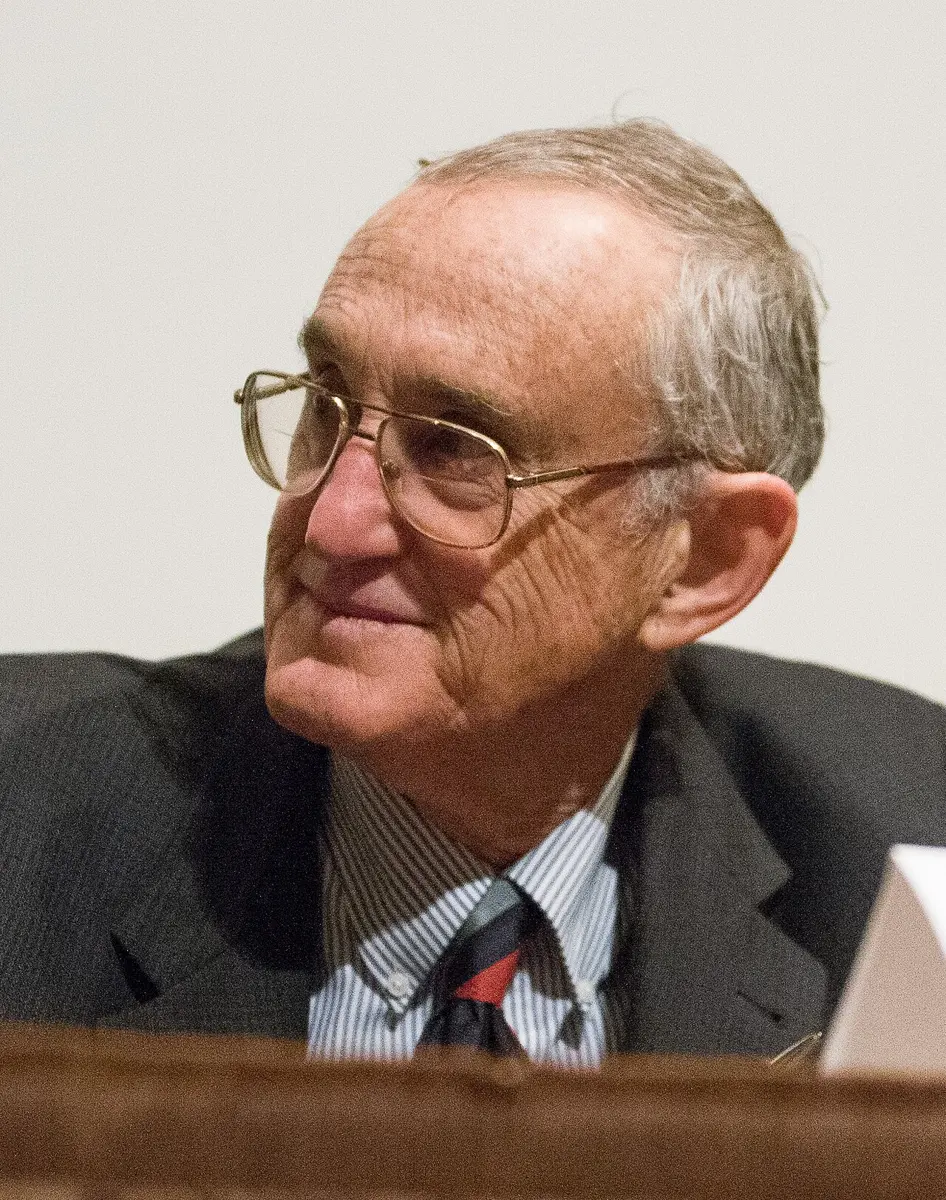
David Lee
born 1931 in the United States
Led the low-temperature laboratory at Cornell University, which built its own machines to reach the coldest temperatures.
Photo: Kenneth C. Zirkel, CC BY-SA 3.0
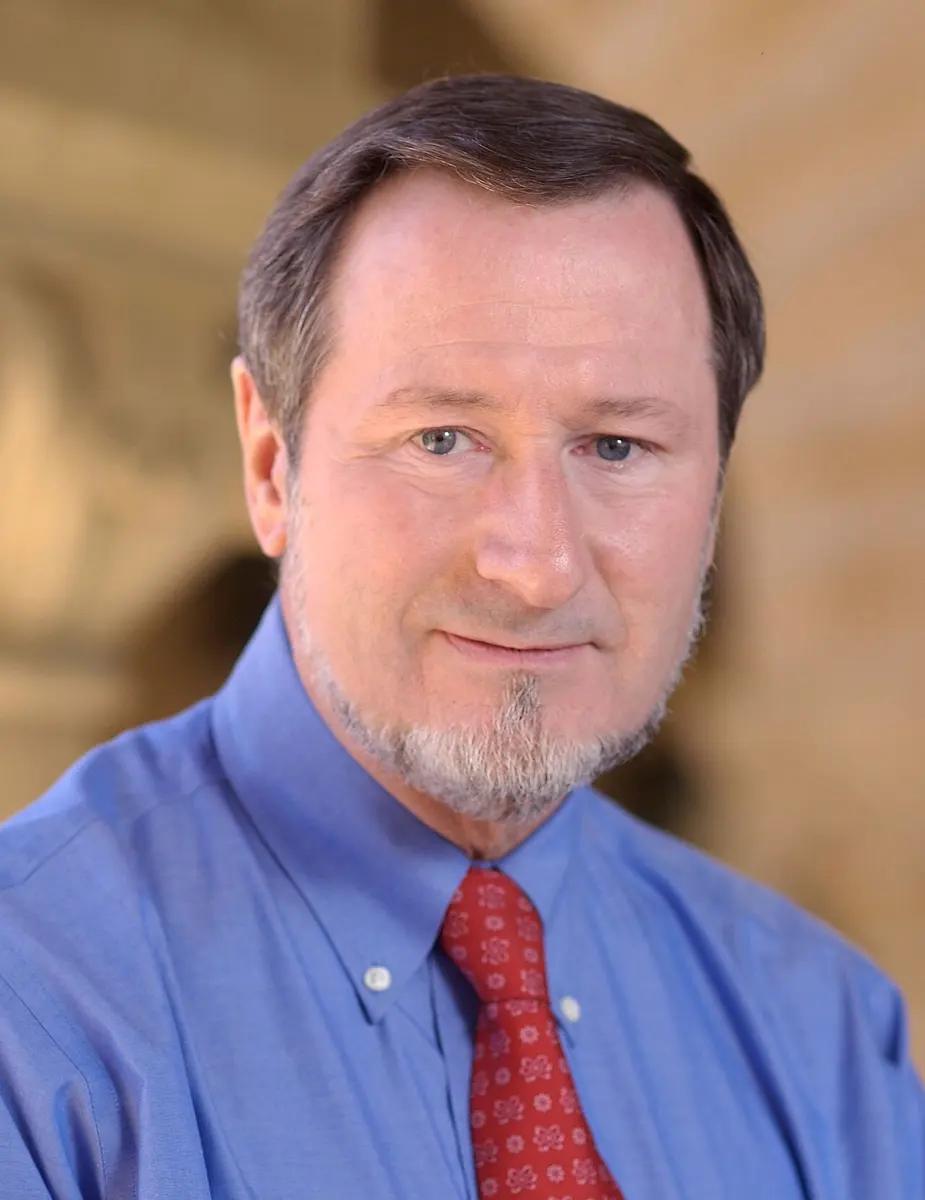
Douglas Osheroff
born 1945 in the United States
The graduate student who noticed two tiny bumps on a graph and refused to blame his apparatus. As a boy he took his toys apart to play with their motors.
Photo: NSF, Public domain
-
Robert Richardson
1937–2013, born in the United States
Co-led the Cornell laboratory, and later warned the world not to waste its helium on party balloons.
Stir a glass of water and let go of the spoon. The water keeps turning for a few seconds, then slows down and stops. Stir a pot of honey and it stops almost at once. Every liquid has some inner friction, which scientists call viscosity (say vis-KOS-i-tee): the layers of liquid rub against each other and slow each other down. Honey has a lot, water has a little.
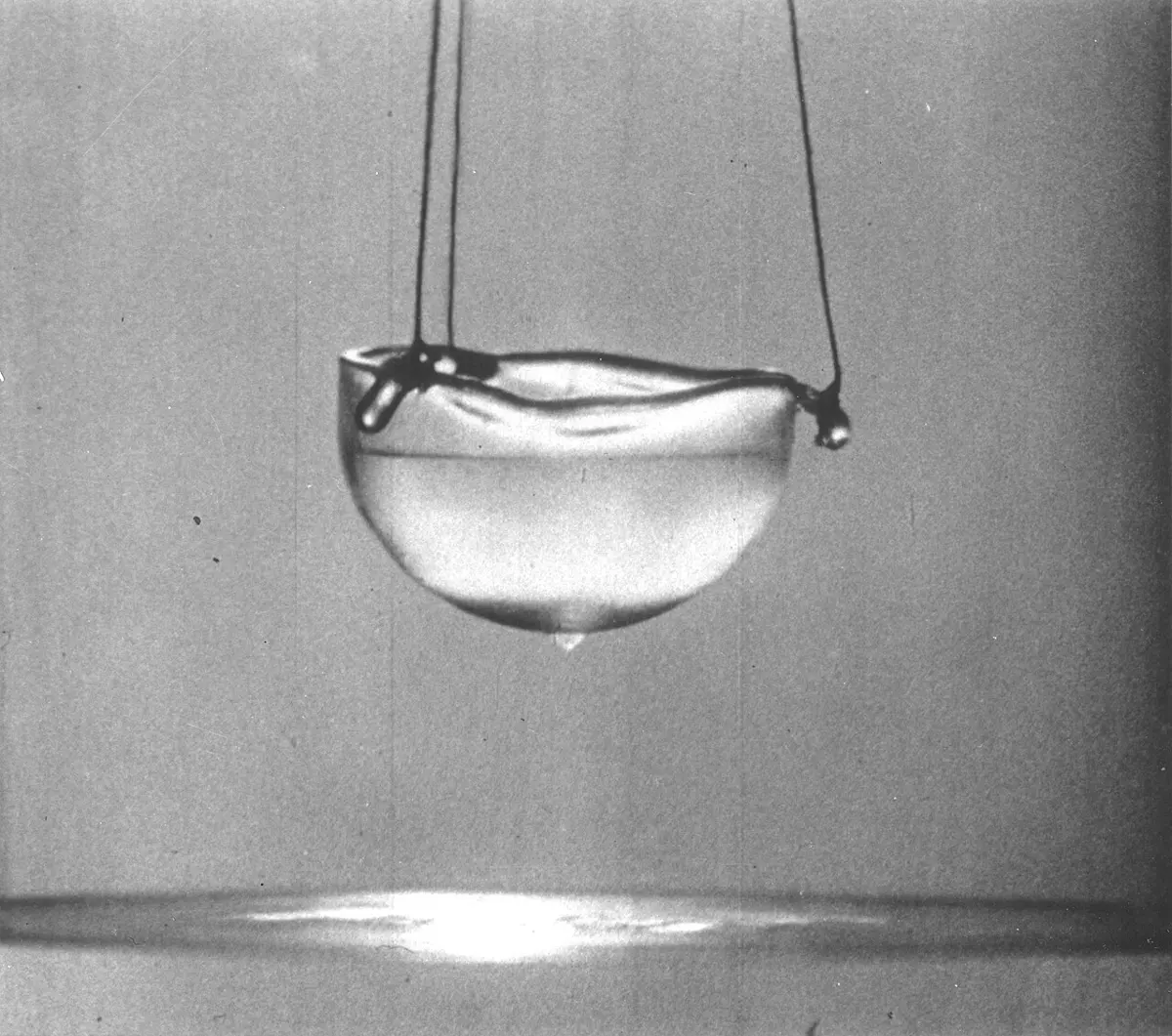
Now imagine a liquid with no friction at all. Set flowing round a ring, it would keep flowing for days, even for ever. It would climb up the inside wall of its cup and pour over the rim, and it would leak through cracks so fine that even many gases cannot pass. Such liquids are real. They are called superfluids, and they exist only at temperatures extremely close to the coldest temperature possible. In 1996 the Nobel Prize in Physics went to David Lee, Douglas Osheroff and Robert Richardson, who found that a rare kind of helium, helium-3, becomes a superfluid too.
The problem: could helium-3 ever flow freely?
How cold is cold?
When you cool something, its particles move more and more slowly. At absolute zero, −273.15 °C, they would have the least energy they possibly could. Nothing can be cooled below it Grade 10: absolute zero. Scientists measure such cold temperatures in kelvin (K), counting up from absolute zero: 0 K is absolute zero, and water freezes at 273 K.
Almost every substance turns into a solid long before absolute zero. Helium is the only exception. It is so light, and its atoms pull on each other so weakly, that it stays a liquid right down to absolute zero, unless you squeeze it hard.
A strange liquid already known
In 1908, the Dutch physicist Heike Kamerlingh Onnes became the first person to turn helium gas into a liquid, at about 4 K. At the end of the 1930s, scientists found that below 2.17 K liquid helium changes completely. It loses all its friction. The Russian physicist Pyotr Kapitsa was one of the first to show it, and won the 1978 Nobel Prize in Physics.
Two kinds of helium
Every helium atom has 2 protons in its nucleus and 2 electrons around it. But helium comes in two isotopes, forms with different numbers of neutrons Grade 9: isotopes.
- Helium-4 has 2 neutrons. Almost all helium is helium-4.
- Helium-3 has only 1 neutron. In the helium found in nature, only about one atom in a million is helium-3. It is so rare that it is made in nuclear reactors instead, and is very expensive.
That one missing neutron turns out to change everything, as you will see.
How it works: why particles crowd or keep apart
At room temperature, atoms behave like tiny balls. But very close to absolute zero, the rules of quantum physics, which govern the smallest particles, take over, and atoms start to behave as if they are spread-out waves.
Quantum physics sorts every particle into one of two families.
- Bosons (say BOH-zons) are sociable. Any number of them can share exactly the same state, doing exactly the same thing. An atom built from an even number of particles (protons, neutrons and electrons together) behaves as a boson. Helium-4 has 2 + 2 + 2 = 6 particles, so it is a boson.
- Fermions (say FER-mee-ons) are loners. No two of them can ever be in exactly the same state. An atom built from an odd number of particles behaves as a fermion. Helium-3 has 2 + 1 + 2 = 5, so it is a fermion.
When helium-4 is cooled below 2.17 K, many of its atoms drop into the very same lowest-energy state. They move together as one, like a whole crowd marching in step. A crowd marching in step doesn’t bump and jostle, so there is no friction: the liquid is a superfluid.
Helium-3 atoms, being fermions, cannot all crowd into one state. So for a long time it seemed that helium-3 could never become a superfluid.
But there was a loophole. Electrons are fermions too, and yet in some metals, cooled very far, electricity flows with no resistance at all: superconductivity. In 1957 the American physicists John Bardeen, Leon Cooper and Robert Schrieffer explained why. At very low temperatures, electrons join up in pairs. A pair of two fermions counts as a boson, so the pairs can all crowd into one state. (They won the 1972 Nobel Prize in Physics.)
Perhaps helium-3 atoms could pair up in the same way. Then the pairs could march in step, and helium-3 would become a superfluid. But nobody knew how cold it would have to be.
Why can’t helium-3 atoms simply crowd into one state the way helium-4 atoms do?
Pick an answer to see why.
Why it was hard
- Nobody knew the temperature. Through the 1960s, many laboratories cooled helium-3 further and further, looking for a superfluid, and found nothing. Some people began to think it would never happen.
- The cold was extreme. Helium-3 turned out to need about a thousand times colder than helium-4: only about two thousandths of a kelvin. That is 0.002 K, colder than anything in nature. Even deep space is at 2.7 K.
- Measuring was hard. At such temperatures, an ordinary thermometer doesn’t work, and the tiniest bit of heat leaking in from outside, from a vibration or a wire, spoils the experiment.
What they did, step by step
Cornell’s coldest fridge (1960s–1971)
David Lee and Robert Richardson ran the low-temperature laboratory at Cornell University, in New York State. Like all such laboratories, they built most of their equipment themselves. Douglas Osheroff joined them as a graduate student.
- Cooling by squeezing. To reach the lowest temperatures, they used a trick first suggested by the Russian physicist Isaak Pomeranchuk. Below about 0.3 K, helium-3 does something very odd: when you squeeze the liquid so that part of it freezes into a solid, the freezing takes in heat instead of giving it out. That heat comes from the rest of the liquid, which gets colder. The device is called a Pomeranchuk cell.
- What they were really looking for. The team was not hunting for a superfluid at all. They wanted to see the solid helium-3 in their cell become magnetic, which theory said should happen at about 0.002 K.
- Watching the pressure (1971). Because a thermometer was hard to trust so close to absolute zero, Osheroff watched something easier to measure. He squeezed the cell at a steady rate for about 40 minutes and recorded the pressure inside it. As the helium cooled, the pressure rose smoothly.
Two tiny bumps (November 1971)
- The bumps. In November 1971, Osheroff noticed two small features on his pressure graph: at one point, A, the curve suddenly changed its slope, and a little later, at B, it gave a small jump. They came back at the same places every time, while squeezing and while releasing.
- Not the apparatus. Small wiggles like these are easy to dismiss as a fault in the equipment. Osheroff and his professors became convinced they were real: something in the helium was changing at those two temperatures.
Solid or liquid? (1972)
- The wrong guess. In their first paper, early in 1972, they took the bumps to be the change they had been looking for, in the solid helium-3. But the numbers didn’t fit perfectly.
- Asking the nuclei. So they used nuclear magnetic resonance, the same method later used in hospital MRI scanners. Every helium-3 nucleus is a tiny magnet, and in a magnetic field it wobbles at a frequency that tells you about its surroundings. Their measurements showed that the change was happening in the liquid, not in the solid. Later in 1972 they published the answer: liquid helium-3 has two new phases, which they called A and B.
The British theoretical physicist Anthony Leggett soon explained their measurements: the helium-3 atoms had formed pairs, just as electrons do in a superconductor. Leggett shared the 2003 Nobel Prize in Physics for this work (the 2003 prize).
Why did Osheroff record the pressure in the cell rather than read a thermometer?
Pick an answer to see why.
Proof that it flows freely
- Were the new phases really superfluid? Soon after, a team in Helsinki, Finland, led by Olli Lounasmaa, hung a fine vibrating wire in the liquid. In ordinary liquid helium-3 the wire’s swing died away quickly, slowed by the liquid’s friction. As the liquid was cooled from above 0.002 K to 0.001 K, the slowing became about a thousand times weaker. Other experiments showed that a current of superfluid helium-3 in a ring kept flowing for days without slowing at all.
How it works now
Superfluid helium-3 is stranger than superfluid helium-4. In a helium-3 pair, the two atoms circle round each other, and their nuclei, which are tiny magnets, line up in particular directions. Because of this, the liquid has a direction inside it, a little like the grain in a piece of wood. It behaves differently along one direction than across it, something no ordinary liquid does.
There are at least three superfluid phases of helium-3. Phase A appears first as it cools, phase B at a lower temperature, and a third only in a magnetic field. Today the temperatures where these phases begin are used as fixed marks for calibrating thermometers at the very lowest temperatures, the way the freezing and boiling of water mark 0 °C and 100 °C.
In your life today
- Hospital scanners. You won’t meet superfluid helium-3 outside a laboratory. But the same science of the very cold is in every MRI scanner. Its magnet is made from superconducting wire, kept cold by liquid helium-4 at about 4 K. And MRI itself grew from nuclear magnetic resonance, the method the Cornell team used to ask the helium-3 nuclei what was happening.
- Quantum computers. Many quantum computers work only at about a hundredth of a kelvin. They are cooled in dilution refrigerators, machines that cool by mixing helium-3 into helium-4. This has made helium-3 even more in demand.
- Don’t waste helium. Helium is a non-renewable resource: the Earth’s helium comes from natural gas, built up over millions of years, and once it escapes into the air it rises and is lost to space. Robert Richardson spent his later years warning about this. In 2010 he said that if helium were priced by how rare it is, a party balloon would cost about 100 US dollars.
What came next
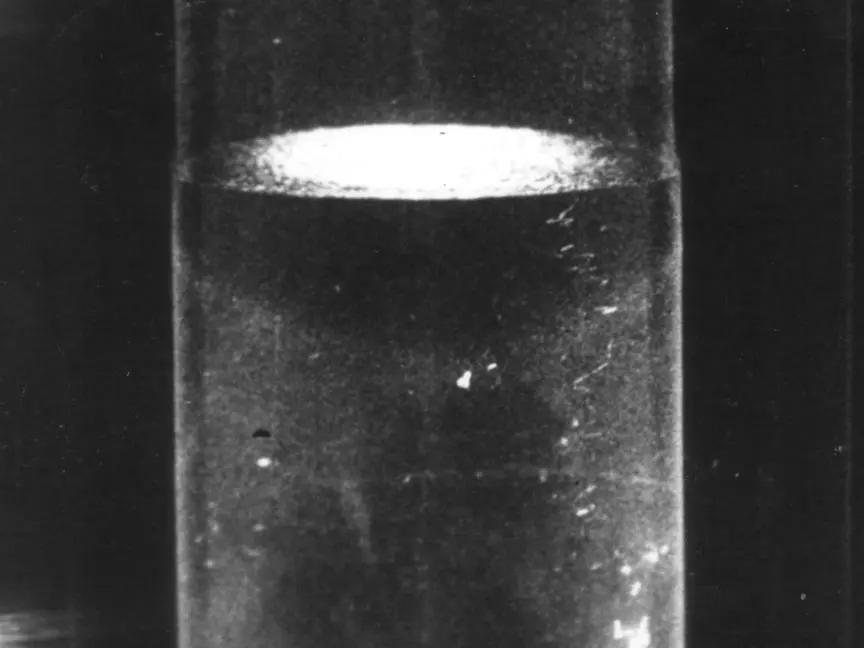
- Models of the universe. In 1996, teams in Helsinki and Grenoble, France, heated tiny spots inside superfluid helium-3 suddenly and let them cool. As the superfluid reformed, it was left full of tiny whirlpools, called vortices. Some physicists think that the early universe, cooling just after the Big Bang, may have been left with similar defects, called cosmic strings. A cup of helium-3 became a small laboratory for testing ideas about the universe.
- Understanding new superconductors. In 1986, materials were found that superconduct at much higher temperatures than anyone expected. Their electrons pair up in a more complicated way, with ideas first worked out for helium-3.
- New kinds of order. Superfluid helium-3 is still being studied. Physicists have found new phases in it when it is squeezed into very narrow spaces, and are using it to explore particles and patterns that may also exist inside materials for future quantum computers.
In your science books
- Grade 10: thermal energy, heat and temperature, with absolute zero and the kelvin scale, and measuring temperature.
- Grade 9: isotopes of hydrogen, and the structure of an atom; helium’s two electrons make it an inert gas.
- Grade 8: protons, neutrons and electrons.
- Going further: Where does the heat go when ice melts?, the heat taken in or given out when a substance freezes or melts, the idea behind the Pomeranchuk cell.
Learn more
- The prize at nobelprize.org: The Nobel Prize in Physics 1996, with the press release, the presentation speech and the advanced information.
- The three Nobel lectures: Lee, Osheroff and Richardson.
The official reason
The prize was given “for their discovery of superfluidity in helium-3.”