
A message is going round your family’s WhatsApp group: a phone company wants to put a mobile tower on a roof near your school, and the “radiation” from it, the message says, will give the children cancer. Your aunt tells you not to sleep with your phone under your pillow. Your uncle laughs and says that phones are perfectly safe.
Some radiation really is dangerous. Doctors put a lead apron on you before an X-ray, and trekkers at Everest Base Camp can get sunburnt in well under an hour. But a phone, a radio and a Wi-Fi router send out radiation too. Is it the same kind? This topic gives you the physics to answer that for yourself, then shows you what the big studies have found, and how to judge the next message that arrives.
“Radiation” is a word for many things
You learned in Grade 9 that passing energy along as electromagnetic waves is called radiation, and that radio waves, microwaves, infrared, light, ultraviolet, X-rays and gamma rays are all the same kind of wave, at different frequencies Grade 9: Electromagnetic spectrum. You also met what each is used for, and that X-rays and gamma rays can damage living cells while radio waves are used all around us Grade 9: Applications of electromagnetic waves.
So when someone says “radiation”, the word alone tells you almost nothing. The light from this screen is radiation. So is the warmth you feel from a fire, and so are the gamma rays from a radioactive source. (The word is also used for the fast particles that unstable nuclei throw out, the alpha and beta particles of What Happens Inside a Nucleus When It Decays?; those are not electromagnetic waves at all.)
The Grade 9 book lists which kinds are harmful. This topic is about why: why a little ultraviolet can burn your skin while a powerful radio transmitter can’t, and what a phone’s radio waves can and can’t do to you.
One photon at a time
Light, and every other electromagnetic wave, arrives in packets of energy called photons (Einstein’s packets of light). The energy of one photon depends only on the wave’s frequency f:
where h is Planck’s constant, 6.63 × 10⁻³⁴ J s. Double the frequency and each photon carries twice the energy. Energies this small are measured in electronvolts (eV): 1 eV = 1.60 × 10⁻¹⁹ J.
Now the key idea. When a wave is absorbed, it is absorbed one photon at a time: each photon gives all its energy to one molecule, or one electron. Photons don’t team up (only the most intense lasers can make two act together). A brighter light, or a stronger radio signal, sends more photons each second, not bigger ones.
Think of a high-jump bar set at 2 m. A thousand children who can each jump 1 m will never get anyone over it, however many of them try. One athlete who can jump 2.1 m clears it at once. Breaking a chemical bond in a molecule is like clearing the bar: it takes a certain amount of energy, all at once. Whether a photon can do it depends on its own energy, not on how many other photons there are.
Here is the whole spectrum, photon by photon. Notice that the energy axis and the frequency axis line up: E = hf means that each step of ten in frequency is a step of ten in energy.
A radio station doubles the power of its transmitter. What happens to the photons reaching your house?
Pick an answer to see why.
Three things a photon can do
What happens when a photon is absorbed depends on its energy. There are three main cases.
1. It only warms. Radio waves, microwaves and infrared have photons far too small to break a bond or move an electron to a higher level. When they are absorbed, their energy just makes molecules turn and jiggle a little faster. Faster jiggling is what we call a higher temperature. So these waves can warm you, and nothing else. In fact, the molecules in your body are already jiggling with an energy of about 0.027 eV each, just from being at 37 °C. A phone’s photon, at 3.7 × 10⁻⁶ eV, is about 7,000 times smaller than that.
2. It moves an electron, or breaks a bond. Visible light has photons of about 1.8 to 3.1 eV. That is enough to lift an electron to a higher level in some molecules, which is how the retina in your eye sees and how a leaf catches light for photosynthesis, but not enough to break the strong bonds in DNA. Ultraviolet photons, from about 3 eV up, can. A UV photon absorbed by DNA can break a bond, or join two neighboring bases on one strand together so the DNA kinks. If the cell repairs the damage wrongly, the mistake is copied every time the cell divides. That is how sunlight causes sunburn and, over the years, skin cancer.
3. It knocks electrons right out of atoms. A photon with more than about 10 eV can tear an electron out of an atom or molecule, leaving an ion behind (it takes 12.6 eV to do this to a water molecule). Radiation that can do this is called ionizing radiation: X-rays, gamma rays, and the shortest ultraviolet (which the air stops long before it reaches the ground). Everything with smaller photons, from radio waves to almost all ultraviolet, is non-ionizing radiation. An X-ray photon of 50,000 eV doesn’t stop at one ion: the fast electron it frees knocks out more and more, about one for every 34 eV it has (measured in air), so around 1,500 ions from a single photon. The ions and broken water molecules (called free radicals) attack DNA, and can break both of its strands at once.
| Radiation | Photon energy (about) | What one photon can do |
|---|---|---|
| FM radio, 100 MHz | 4 × 10⁻⁷ eV | warm, if absorbed in huge numbers |
| mobile phone, 900 MHz | 4 × 10⁻⁶ eV | warm |
| microwave oven and Wi-Fi, 2.4 GHz | 1 × 10⁻⁵ eV | warm |
| infrared from your body, 10 µm | 0.12 eV | warm |
| red light, 700 nm | 1.8 eV | move an electron (seeing) |
| violet light, 400 nm | 3.1 eV | move an electron |
| ultraviolet that burns, 300 nm | 4.1 eV | break or join bonds in DNA |
| medical X-ray | 20,000–150,000 eV | ionize: thousands of ions |
| gamma rays from cesium-137 | 662,000 eV | ionize: about 20,000 ions |
So the line that matters most is not between “natural” and “artificial” radiation, or between “strong” and “weak”. It is the energy of each photon. Somewhere in the ultraviolet, a single photon becomes able to damage DNA. Below that, the harm radiation does comes from heating.
Why can a bright red lamp shining on you all day never cause sunburn, while 30 minutes of midday sunshine in the mountains can?
Pick an answer to see why.
Strong radio waves warm you
“Radio waves can only warm you” doesn’t mean they can never hurt you. Enough warming is harmful too, and a microwave oven shows it. Inside its metal box, about 800 W of microwaves at 2.45 GHz make the water molecules in food turn back and forth billions of times a second. They bump into their neighbors, and the food gets hot. The oven’s metal walls and the metal mesh in its door (holes much smaller than the 12 cm wavelength) keep the microwaves inside. People who have worked right in front of powerful radar or broadcast antennas have been burned. That is why such antennas are fenced off, and why there are limits.
How much a body is warmed depends on the power it absorbs per kilogram, called the specific absorption rate, or SAR, in watts per kilogram (W/kg).
You make heat yourself, all the time. Resting, a 70 kg adult makes about 80 W, a little over 1 W/kg. Your brain alone makes about 20 W, from only 1.4 kg of tissue: over 10 W/kg. Running hard, your muscles make more than ten times your resting heat. Your body gets rid of all this, mostly through the blood, which carries the heat to your skin.
The international limits come from the International Commission on Non-Ionizing Radiation Protection (ICNIRP), whose guidelines (2020) are used by many countries. ICNIRP takes a whole-body SAR of 4 W/kg, kept up for 30 minutes, as enough to raise a resting person’s body temperature by about 1 °C (experiments and computer models suggest it takes a little more, so this is on the safe side). The limits are set far below that:
| Limit for the public (ICNIRP, 2020) | SAR |
|---|---|
| averaged over the whole body | 0.08 W/kg (50 times below 4 W/kg) |
| in any 10 g of the head or body (for a phone held to your head) | 2 W/kg |
Every phone model is tested before it is sold, with a model head filled with a liquid that absorbs radio waves like human tissue, at the phone’s highest power. Its highest SAR must be below the limit. (The USA uses 1.6 W/kg in any 1 g of tissue instead.) Computer models of a head show that a phone at about this level warms the brain by a few tenths of a degree at most. Half an hour of brisk exercise warms your body by more than that.
Why is a microwave oven able to cook food when a phone, using similar frequencies, can’t cook your ear?
Pick an answer to see why.
Towers and phones
A phone tower is not one big transmitter pointing at everyone. On top of the mast are usually three flat panels, the antennas, each covering one wedge of the area around it, and each sending its beam out almost level, tilted down by a few degrees.
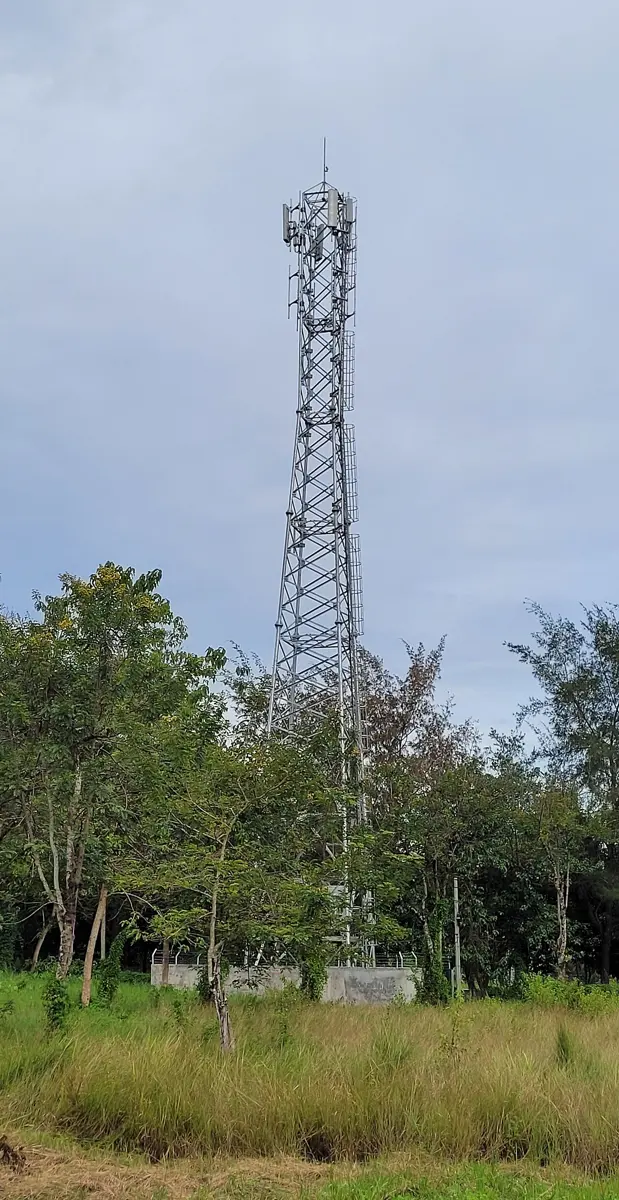
The power spreads out as it travels. At twice the distance, it is spread over four times the area, so each square meter gets a quarter as much: the inverse square law. Exposure is measured as the power arriving on each square meter, the power density, in W/m². ICNIRP’s limit for the public at 900 MHz is 4.5 W/m².
Measurements back this up. Surveys collected by the World Health Organization found that in public places, including schools and hospitals near towers, exposure from towers is between about 0.002% and 2% of the international limits, much like the exposure from radio and TV transmitters.
What the studies say
Physics shows that a phone’s radio waves can’t break molecules, and that the heating they cause is tiny. But could there be some other effect that nobody has thought of? That question can only be answered by studies of people and animals. There have been hundreds. Here is what they have found, as of 2026.
The 2011 classification. In 2011, a panel of 31 scientists from 14 countries at the International Agency for Research on Cancer (IARC), part of the World Health Organization, classified radio waves as “possibly carcinogenic to humans”, its Group 2B. They based this on “limited evidence”: some studies had found slightly more of a kind of brain tumor called glioma among the heaviest phone users, but those studies relied on people with brain tumors remembering how much they had used their phones years before, which can easily give biased results.
IARC’s groups say how sure we are that something can cause cancer, not how much cancer it causes:
| IARC group | Means | Some examples |
|---|---|---|
| Group 1 | carcinogenic: the evidence is strong | tobacco smoke, X-rays and gamma rays, sunlight, alcoholic drinks, processed meat |
| Group 2A | probably carcinogenic | red meat, very hot drinks (above 65 °C) |
| Group 2B | possibly carcinogenic: limited evidence, can’t be ruled out | radio waves, aloe vera leaf extract, traditional Asian pickled vegetables |
Studies of people since then. In 2024, a team working for the World Health Organization combined the results of 63 studies of people, published from 1994 to 2022. They found that using a mobile phone, even for ten years or more and for the most hours, was not linked to brain cancer, and that living near phone towers or radio transmitters was not linked to cancer in children. Another strong piece of evidence: billions of people began using mobile phones in the 1990s and 2000s, yet in countries that have recorded every case for decades, such as Australia and the Nordic countries, brain cancer rates have hardly changed.
Studies of animals. In 2018, the US National Toxicology Program exposed rats to radio waves for 9 hours a day, all their lives, at whole-body SARs of 1.5 to 6 W/kg: up to 75 times the public limit, and enough to warm the rats a little. The exposed male rats had more of a rare tumor of the heart, and slightly more brain tumors. Female rats and mice didn’t, and the exposed male rats lived longer than the unexposed ones. In 2025, a review of animal studies asked for by the World Health Organization concluded, with what it called high certainty, that the exposures had increased these two kinds of tumor in rats. Other experts, such as Germany’s radiation protection office, criticized how that review was done (saying, among other things, that it departed from its own published plan), and the question is still argued over.
Where this leaves us. The World Health Organization’s position, as of 2026, is that no harmful health effect has been shown to be caused by mobile phones at exposures below the international limits. IARC’s advisers have asked it to look at radio waves again between 2025 and 2029; as of 2026 it hasn’t yet. Scientists keep studying them, which is how science should work: no study can prove that something is perfectly safe, only that any risk is too small to find.
IARC put radio waves in Group 2B, along with pickled vegetables. What does this tell you?
Pick an answer to see why.
Mobile phone use grew from almost nobody to almost everybody between 1990 and 2010. If phones caused brain cancer, what would you expect to see in the records of countries that count every case?
Pick an answer to see why.
Judging a claim
Claims about radiation reach you from all sides: in messages, videos, advertisements and the news. Some are careful and true; some are wrong, and some are written to scare you or to sell you something. You met some of the ways to check a website in Grade 9 Grade 9: Is it true? Checking a source. For a claim about radiation and health, ask:
- a.Who is saying it, and do they gain from it? A company selling a “radiation shield” gains from your fear; a company selling phones gains from your calm.
- b.What kind of radiation, and what is each photon’s energy? Below about 3 eV, it can’t damage DNA; below visible light, it can only heat.
- c.How much? Is the exposure near the limits, or thousands of times below them? Is it at the antenna, or far away?
- d.What is the evidence? Large studies of people, or one study, a story, or a lab result in cells? Does it show cause, or only that two things happen together?
- e.What do the expert bodies say, the ones that review all the studies (WHO, IARC, ICNIRP, national health agencies)?
- f.Are the words used carefully? “Possibly”, “may”, “linked to” and “radiation” are often stretched in headlines.
The opposite mistake is to fear something that the physics shows can’t do the harm claimed. In 2020, during the COVID-19 pandemic, messages spread on social media claiming that 5G phone towers spread the virus or weakened people’s bodies against it. In Britain, 159 phone masts were attacked that year, many by fire, and many of them didn’t even carry 5G. Radio waves can’t carry a virus, which spreads from person to person, and the virus spread just as fast in places with no 5G at all. The damaged masts carried emergency calls too.
Questions
Which of these is ionizing radiation?
Pick an answer to see why.
Two lamps shine the same power, 1 W, onto your skin: one red (700 nm), one ultraviolet (300 nm). Which statement is right?
Pick an answer to see why.
Explain why a 50 kW radio transmitter can’t break a single molecule of DNA in your body, while a little ultraviolet light can.
Answer
Radiation is absorbed one photon at a time, and each photon gives its energy to one molecule. A photon’s energy depends only on its frequency (E = hf). A radio photon of 100 MHz carries about 4 × 10⁻⁷ eV, ten million times less than the roughly 4 eV needed to break a bond in DNA. A more powerful transmitter sends more photons each second, but each one still has far too little energy, and they can’t add their energies together. So a radio transmitter can only warm the body (and only very close to it). An ultraviolet photon of 300 nm carries about 4.1 eV, enough on its own to break or rearrange a bond in DNA, so even a little ultraviolet can damage it.
A phone company wants to put a tower on the roof of a school. The parents are worried. Using what you have learned, write what you would tell them: what the physics says, what the studies say, and what is still uncertain.
Answer
A full answer covers:
- The physics. Phone towers send radio waves of about 10⁹ Hz. Each photon has about 4 × 10⁻⁶ eV, a millionth of what is needed to break a bond in DNA, so the waves are non-ionizing: the only established effect is heating.
- The amount. Tower antennas send their beams almost level, slightly downwards, so the classrooms directly underneath are below the beam. Surveys collected by the WHO found exposures in public places, including schools near towers, of about 0.002% to 2% of the international limits, and the limits themselves are 50 times below the level that warms the body by 1 °C. The pupils’ own phones, held to their heads, give them far more exposure than the tower.
- The studies. IARC classed radio waves as “possibly carcinogenic” in 2011 on limited evidence. A WHO-commissioned review of studies of people (2024) found no link between phone use and brain cancer, and none between living near towers or transmitters and cancer in children; brain cancer rates have stayed flat as phone use grew.
- What is uncertain. Some animal studies at exposures far above the limits found tumors in male rats, which experts still debate, and IARC plans to look again before 2029. Science can’t prove anything perfectly safe, but any risk at these exposures is too small to have been found.
- Fair advice: check that the installation was measured against the limits, and that the area right in front of the antennas is fenced off.
A medical X-ray photon has an energy of 60,000 eV. a. What is its frequency? b. About how many ions could it make in air, where each ion takes about 34 eV? c. Why is one such photon more dangerous than a million phone photons?
Answer
- a.E = 60,000 × 1.60 × 10⁻¹⁹ = 9.6 × 10⁻¹⁵ J. f = E ÷ h = 9.6 × 10⁻¹⁵ ÷ 6.63 × 10⁻³⁴ = 1.4 × 10¹⁹ Hz.
- b.60,000 ÷ 34 ≈ 1,800 ions.
- c.A million phone photons together carry about 10⁶ × 4 × 10⁻⁶ = 4 eV, but spread over a million separate molecules, each getting about 4 × 10⁻⁶ eV, which only makes them jiggle a tiny bit more. The X-ray photon puts all its 60,000 eV into one electron, which then knocks out about 1,800 more, breaking molecules and making free radicals that can damage DNA. What matters is the energy each photon delivers to one place.
A student asks 100 classmates how many hours a day they use their phones, and how often they get headaches. She finds that those who use their phones most also get the most headaches, and concludes that phone radiation causes headaches. (The survey is made up for this question.) a. Give two other explanations for her result. b. How could a study test whether the radio waves themselves cause headaches?
Answer
- a.Any two of: long screen use strains the eyes and the neck, which can cause headaches, with or without radio waves; students on their phones late at night sleep less, and lack of sleep causes headaches; stress or exam worry could lead to both more phone use and more headaches; people who believe phones cause headaches may notice and report them more (the nocebo effect). Finding two things together (a correlation) doesn’t show that one causes the other.
- b.A double-blind test: people sit with a phone or antenna that is switched to transmit or not, at random, with neither the volunteer nor the person running the test knowing which, and record their symptoms. If radio waves caused the headaches, they would come more often when it was transmitting. (Such tests have been done many times, and found no difference.)
For a typical tower antenna, the power density in the middle of its beam, 20 m away, is 0.20 W/m². a. What is it at 40 m and at 80 m? b. What share of the 4.5 W/m² limit is it at 80 m? c. Why is the power density on the ground directly beneath the tower usually lower still?
Answer
- a.Twice the distance gives a quarter: 0.050 W/m² at 40 m, and a quarter of that, 0.0125 W/m², at 80 m.
- b.0.0125 ÷ 4.5 = 0.0028, about 0.3% of the limit.
- c.The antenna sends its main beam out almost level, tilted down only a few degrees, so it reaches the ground hundreds of meters away. Directly beneath, you are below the beam, where the antenna sends only weak side-beams.
An advertisement says: “Our phone case blocks 99% of the harmful radiation from your phone. Scientifically proven!” Evaluate this claim, using at least three of the questions for judging a claim.
Answer
- Who gains? The seller, who makes money if you are afraid of your phone. “Scientifically proven” is given with no study named.
- What kind of radiation? A phone’s radio waves are non-ionizing, with photons a millionth of the energy needed to damage DNA; at the phone’s power, their only known effect is a tiny warming. So “harmful” is not supported to begin with.
- Does it make physical sense? A phone works by sending and receiving radio waves. If a case really blocked 99% of them, the phone would lose its signal, or turn its power up to get through, which is the opposite of what the advert promises. (Wrap a phone in foil and it can’t be called at all.)
- Evidence and experts: in 2002 the US Federal Trade Commission took sellers of such “radiation shields” to court for false claims that they had been tested and proven. No expert body recommends them.
The claim is not supported.
Trekkers at 5,000 m in the Himalaya are told to wear sunglasses and sunscreen, even on cold days. Explain why, using photon energy, and say whether this advice is well supported.
Answer
The danger is the ultraviolet in sunlight, whose photons (about 3 to 4.3 eV) can damage DNA in the skin and burn the eyes; cold air doesn’t stop them. At high altitude there is less air above to absorb ultraviolet, so it is stronger (by roughly 10% for every 1,000 m), and snow reflects much of it back up. Sunburn, snow blindness and skin cancer from ultraviolet are well established, and sunglasses and sunscreen are recommended by health agencies everywhere: the advice is well supported.
Where to go next
- Is Light a Wave or a Stream of Particles? Where photons come from: the photoelectric effect, and how light behaves both as a wave and as particles. Is Light a Wave or a Stream of Particles?
- What Happens Inside a Nucleus When It Decays? Where gamma rays, the most energetic photons of all, come from, along with alpha and beta particles. What Happens Inside a Nucleus When It Decays?
- What Are Stars Made Of? Atoms take in and give out photons of exact energies, and that tells us what the stars are made of. What Are Stars Made Of?