
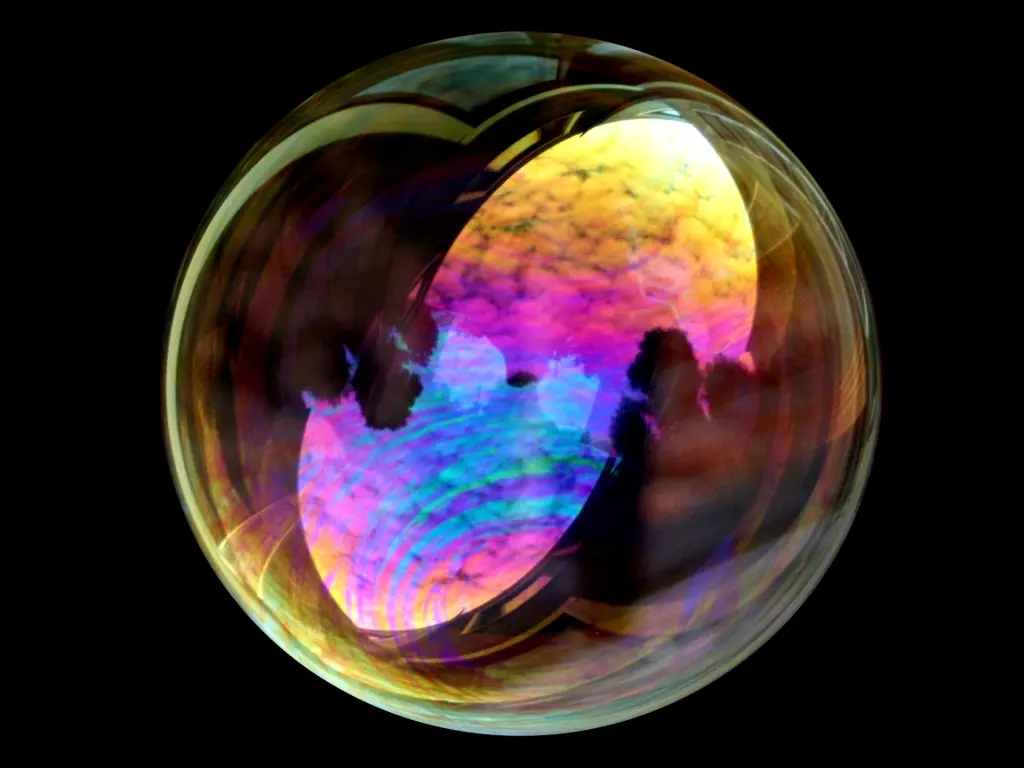
Tilt an old CD under a tube light and its surface flashes with rainbow colors. Look closely at a soap bubble and you see swirls of pink, green and gold, although soapy water has no color at all. Those colors are made by light waves adding up in some places and canceling out in others.
Now look up at the solar panels on the rooftops of Bhaktapur. They work because light knocks electrons loose from the silicon. And that only makes sense if light arrives as a hail of tiny separate packets, like particles.
So which is light: a wave, or a stream of particles? For three hundred years, some of the greatest scientists argued about it. Each side had evidence, and each time new evidence came in, the answer changed. This topic follows the evidence, and lets you judge it.
Two ideas about light
You know from Grade 9 that light is an electromagnetic wave, and that visible light is a small part of a much bigger spectrum Grade 9: Electromagnetic spectrum. But how do we know it is a wave? Nobody can see light waving. Scientists know it from what light does, and that took a long time to work out.
In the late 1600s two ideas were in play. Each was a model: a picture of something we can’t see, used to explain what we can see and to predict what we haven’t seen yet.
- The particle model. Isaac Newton thought light was a stream of tiny, fast particles shot out by a lamp or the Sun. That explains why light travels in straight lines and casts sharp shadows, and why it bounces off a mirror the way a ball bounces off a wall.
- The wave model. The Dutch scientist Christiaan Huygens thought light was a wave, spreading out like the ripples when you drop a stone into a pond. In his Treatise on Light (1690) he showed that waves explain reflection and refraction too.
Both models explained what was known. So scientists looked for a case where they predict different things, and tested it. One was refraction. You know from Grade 10 that light bends towards the normal when it goes from air into water Grade 10: Refraction of light. In Newton’s model, that happens because the water pulls the particles in, so light should go faster in water than in air. In Huygens’s model, the waves bend because they slow down, so light should go slower in water.
For 150 years nobody could measure the speed of light in water. Newton was so famous that most scientists sided with him. Then, in 1850, the French physicist Léon Foucault compared its speed in water and in air with a fast-spinning mirror: light is slower in water. (Today we know by how much: in water it goes about three-quarters of its speed in air.) Score one to the waves. But by 1850 the waves had already won on other evidence, as you will see.
Two models of light both explain why light reflects from a mirror. What is the best way to decide between them?
Pick an answer to see why.
Waves that cancel
Drop two stones into a still pond, side by side. Each makes its own rings of ripples, and where the rings cross, something odd happens. In some places the water heaves up and down twice as much. In other places it hardly moves at all, even though ripples from both stones arrive there.
Waves can do something particles can’t. When two waves meet, they add up:
- Where a crest meets a crest (or a trough meets a trough), they make a bigger wave. This is constructive interference.
- Where a crest meets a trough, one pushes up while the other pulls down, and they cancel. This is destructive interference.
The adding up and canceling of waves that overlap is called interference. Two streams of particles can’t do this: two balls arriving at the same place never cancel each other out to make no ball.
What decides which happens? The path difference: how much farther one wave has traveled than the other.
- If one path is longer by 0, 1, 2, 3… whole wavelengths, the waves arrive in step, crest with crest: they add up.
- If one path is longer by ½, 1½, 2½… wavelengths, they arrive out of step, crest with trough: they cancel.
You can hear interference too. Noise-canceling headphones have a small microphone that listens to the noise outside, and a speaker that plays the same sound turned upside down, a trough wherever the noise has a crest. The two cancel, and the drone of a bus engine goes quiet.
Two waves of wavelength 2 cm reach a point. One has traveled 13 cm and the other 16 cm. What happens there?
Pick an answer to see why.
Young’s two slits
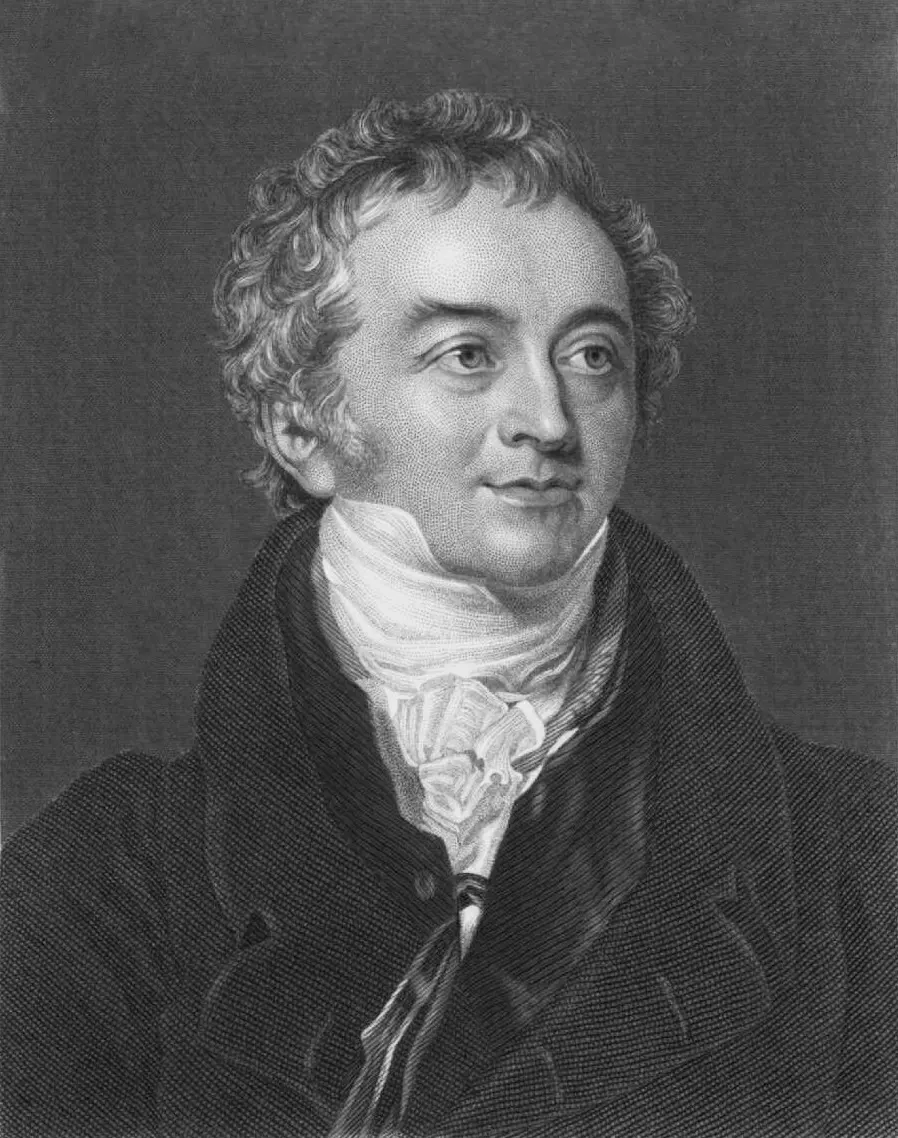
If light is a wave, two beams of light should be able to cancel each other and make darkness. In 1803 the English doctor and physicist Thomas Young showed that they do.
Young let a thin beam of sunlight into a dark room through a small hole, and split it in two with the edge of a thin card. Where the two halves overlapped on the wall, he saw stripes: bright bands with dark bands between them. Take the card away, and the stripes vanished. The dark bands were places where light from one side of the card canceled light from the other. In his lectures of 1807 he described the experiment in the form now named after him: light falls on two very narrow slits close together, and on a screen beyond them the light makes a row of bright and dark bands, called interference fringes.
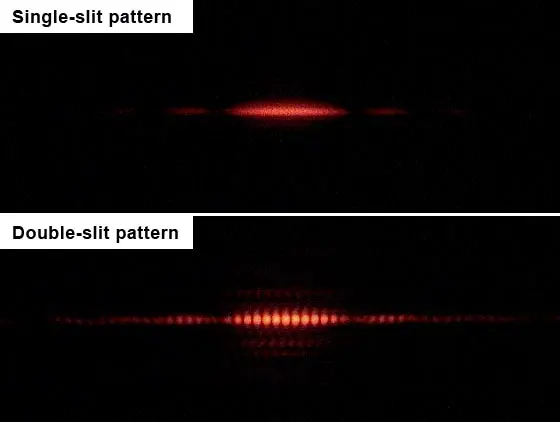
How far apart are the bands?
Go to the middle of the screen: there both paths are equally long, so there is a bright band. Step sideways and one path gets longer than the other. When the difference reaches half a wavelength, the screen is dark; at a whole wavelength, it is bright again. So the bands are farther apart when:
- the wavelength is longer (red light): you must go farther to the side to make one path a whole wavelength longer;
- the slits are closer together: the two paths stay nearly equal for longer;
- the screen is farther away: the pattern spreads out, like the beam of a torch.
For a screen much farther away than the slits are apart (it always is: about a meter, against a fraction of a millimeter), the spacing y between neighboring bright bands is
where λ is the wavelength, L the distance from the slits to the screen, and d the distance between the slits (center to center). Measure y, L and d, and you can work out the wavelength of light. Young used his fringes, and the colored rings Newton had measured, to work out the wavelengths of the colors, and measurements like these are how we know that visible light’s wavelengths are 400 to 700 nanometers (1 nm = 10⁻⁹ m).
Light bends round edges
Your friend can hear you shout from around the corner of a building, but can’t see you. Sound bends round corners, and light seems not to. Newton thought that was strong evidence against waves.
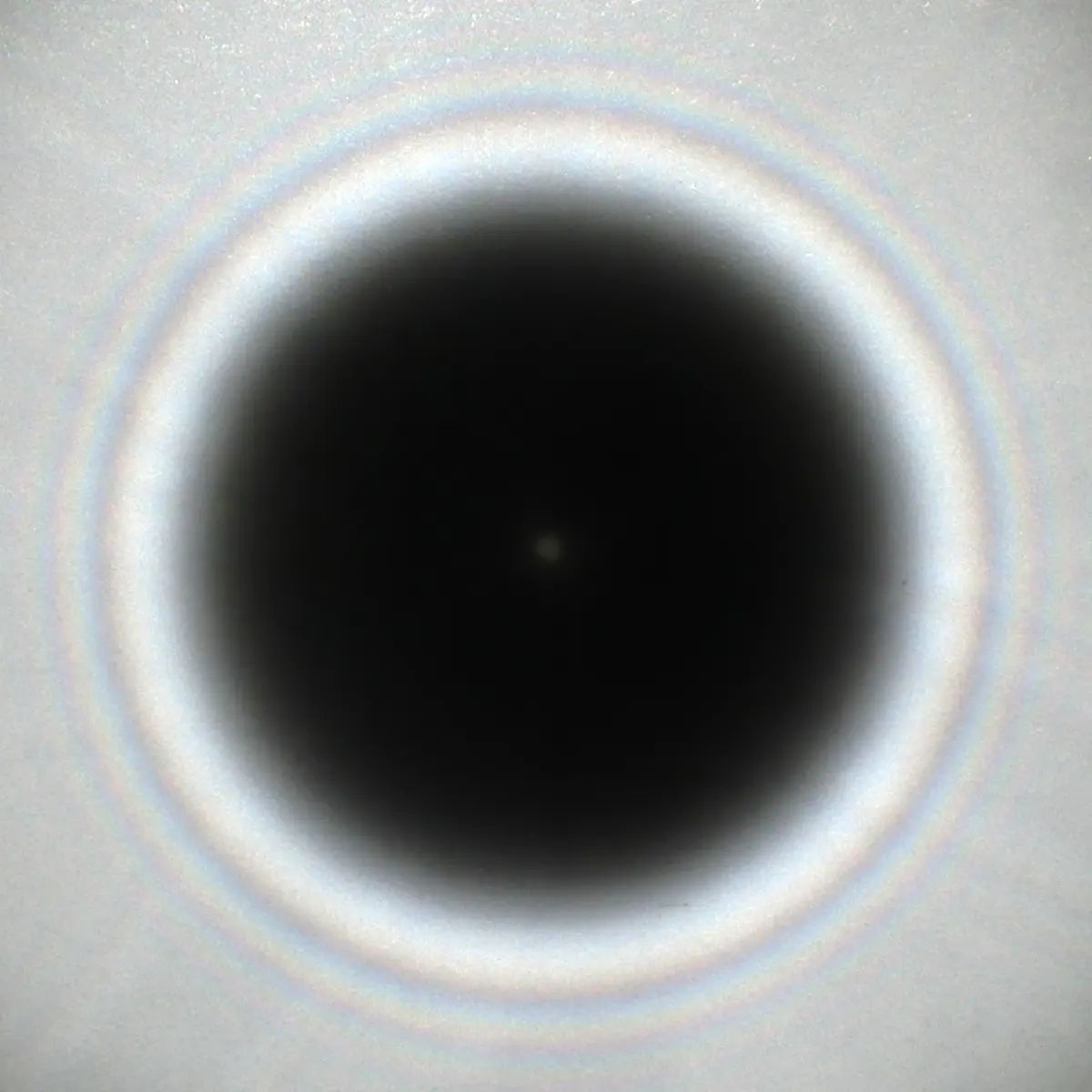
But all waves spread out when they pass through a gap or past an edge. This is diffraction. How much they spread depends on the size of the gap compared with the wavelength:
- If the gap is much wider than the wavelength, the wave goes straight through, and hardly spreads.
- If the gap is about as wide as the wavelength, or narrower, the wave spreads out widely.
A sound you can hear has a wavelength from about 2 cm to 17 m; a person’s voice, one to a few meters. A doorway is about a meter wide, so sound spreads round it. Light’s wavelength is about half a micrometer, two million times shorter. So light passes a doorway in a straight line, and the shadow looks sharp. Look very closely at the edge of a shadow with a narrow beam, though, and you find faint bands: light does bend round edges, just very little. Its waves are simply very small.
The spreading out after each of Young’s slits is diffraction too: each slit is so narrow that light spreads from it in all directions, and that is why the light from the two slits overlaps at all.
Why can you hear someone talking around a corner, but not see them?
Pick an answer to see why.
Light is an electromagnetic wave
By the 1830s, interference and diffraction had convinced most scientists that light was a wave. But a wave of what? Water waves are water moving; sound is air being squeezed. Light crosses empty space from the Sun.
In 1865 the Scottish physicist James Clerk Maxwell found the answer in the mathematics of electricity and magnetism. A changing electric field makes a magnetic field, and a changing magnetic field makes an electric field. Together they can pass themselves along through empty space as a wave. Maxwell worked out how fast such a wave would travel from measurements of electricity and magnets, and got about 3 × 10⁸ m/s: the speed of light. Light, he concluded, is an electromagnetic wave.
Maxwell predicted other electromagnetic waves, of other wavelengths. In 1887 the German physicist Heinrich Hertz made some with an electric spark and detected them across his laboratory: the first radio waves. They reflected, refracted and interfered just as light does. The whole electromagnetic spectrum you met in Grade 9, from radio waves to gamma rays, is the same kind of wave.
The wave model explains how your radio picks out one station from all the others. The aerial is struck by waves from every station at once. Inside the radio, a tuning circuit has a natural frequency at which it vibrates most easily, like a child on a swing. When you tune to Radio Nepal’s 100 MHz, you set the circuit’s natural frequency to 100 MHz, and only the waves of that frequency, pushing in step with it, build up a big current. This is resonance. It works because radio waves, like all waves, have a frequency: pushes that arrive in step, again and again, build up a big swing.
By 1900 the wave model of light seemed finished. It explained reflection, refraction, interference, diffraction and the whole electromagnetic spectrum. And in the same experiments in which Hertz made his radio waves, he had noticed a small, odd thing that would end up changing it.
The photoelectric effect
In 1887 Hertz noticed that the sparks in his detector jumped more easily when ultraviolet light from another spark shone on it. Put a sheet of glass in between, which blocks ultraviolet, and the sparks grew weaker. Light was somehow helping electric charge to escape from metal.
A year later the German physicist Wilhelm Hallwachs made it clear. He put a clean zinc plate on a gold-leaf electroscope and charged it negative, so that its two thin leaves pushed each other apart. When he shone ultraviolet light on the plate, the leaves slowly fell together: the plate was losing its negative charge. In 1897 J. J. Thomson discovered the electron, and it became clear what was happening: light was knocking electrons out of the metal. This is the photoelectric effect, and the electrons that come out are called photoelectrons.
So far, no problem: light is a wave carrying energy, and the metal’s electrons soak up the energy until some have enough to escape. But then came the details. Experiments by Philipp Lenard in 1902, and by others after him, found three facts that the wave model could not explain:
| What the wave model predicts | What experiments found |
|---|---|
| Any color should free electrons if it is bright enough, or shines long enough: a bright wave carries plenty of energy. | Below a certain frequency, the threshold frequency, no electrons come out at all, however bright the light. For zinc, all visible light is below it. |
| Brighter light should give the electrons more energy, so they fly out faster. | Brighter light frees more electrons, but not faster ones. The fastest electrons’ energy depends only on the frequency of the light. |
| In dim light an electron needs time to soak up enough energy: by one calculation, minutes or longer. | Electrons come out at once, even in very dim light, as soon as the light is switched on. |
A zinc plate is lit by very bright red light for an hour and gives out no electrons. What happens if the light is made ten times brighter?
Pick an answer to see why.
Einstein’s packets of light
In 1905 a 26-year-old clerk at the patent office in Bern, Switzerland, Albert Einstein, suggested an answer. Light, he said, carries its energy in separate packets, each with an energy of
where f is the light’s frequency and h is Planck’s constant, 6.63 × 10⁻³⁴ J s. Max Planck had used this rule in 1900 for the light given out by hot objects, thinking of it as a mathematical trick. Einstein took it seriously: light is made of packets. Today they are called photons. (You met E = hf = hc/λ in What Are Stars Made Of?, where it explains the colors atoms give out.)
The photoelectric effect is then simple:
- An electron is freed by one photon, which gives it all its energy at once. Electrons can’t save up energy from several photons.
- The metal holds on to its electrons. To pull one out takes at least a certain energy, the metal’s work function, φ (the Greek letter phi). Each metal has its own.
- If the photon brings less energy than φ, the electron can’t get out, and the photon’s energy just warms the metal. A brighter light only sends more of these too-small photons. So there is a threshold: the frequency f₀ at which hf₀ = φ.
- If the photon brings more than φ, the electron escapes, and what is left over becomes its kinetic energy:
This is Einstein’s photoelectric equation. It is the largest kinetic energy, for an electron right at the surface; electrons from deeper in lose some energy on the way out, so they come out slower.
- Brighter light, at the same frequency, means more photons each second, so more electrons, but each photon has the same energy, so the electrons are no faster.
- There is no waiting: as soon as one photon arrives, it can free one electron.
All three puzzles solved. Physicists measure these small energies in electronvolts (eV): 1 eV = 1.60 × 10⁻¹⁹ J.
| Metal | Work function φ (roughly) | Threshold wavelength | Light that frees electrons |
|---|---|---|---|
| cesium | 2.0 eV | 620 nm | orange, yellow, green, blue, violet, ultraviolet |
| potassium | 2.3 eV | 540 nm | green, blue, violet, ultraviolet |
| zinc | 4.3 eV | 290 nm | ultraviolet only |
(The work function changes with how clean the metal’s surface is, so measured values vary; these are rounded from the CRC Handbook of Chemistry and Physics.)
Testing Einstein’s equation
Einstein’s equation makes a sharp prediction. Plot the fastest electrons’ kinetic energy against the light’s frequency, and every metal should give a straight line, starting at its own threshold frequency, and all the lines should have the same slope: h, Planck’s constant, the same number Planck had found from hot objects.
In a photoelectric experiment, the light is made dimmer but kept the same color. What happens?
Pick an answer to see why.
Photons at work
Once you know that light comes in photons, a lot of everyday things make sense.
Solar cells. You learned in Grade 9 that sunlight knocks electrons free in the silicon of a solar cell Grade 9: Solar electricity. It is the same idea as the photoelectric effect, except that the electrons don’t leave the silicon: one photon lifts one electron into a state where it is free to move through the cell, and the cell is built so that those electrons are pushed out to one terminal. Silicon needs at least 1.12 eV per photon. So light shorter than about 1,100 nm works, which is all visible light and some infrared; longer infrared does nothing however strong it is. And the extra energy of a blue photon above 1.12 eV is lost as heat, which is one reason even the best silicon cells turn only about a quarter of the sunlight’s energy into electricity.
Sunburn. You can sit in front of a bright fire for hours and not get sunburnt, but half an hour in the midday Sun in the hills burns your skin. The fire gives out mostly infrared, photons of less than 1 eV each. The Sun also sends ultraviolet, whose photons carry about 4 eV each, enough for one photon to damage a molecule of DNA in a skin cell. It is the energy of each photon that matters, not how much light there is in total. That is why ultraviolet, X-rays and gamma rays can damage the molecules of living cells, one photon at a time, while radio waves and visible light can’t, however strong. (Very strong light or radio waves can still harm you by heating, as a magnifying glass or a microwave oven does.)
Photography and your phone’s camera. Black-and-white photographic paper can be handled under a dim red lamp in a darkroom without spoiling it: red photons have too little energy to change the silver compounds in it. Your phone’s camera has millions of tiny light sensors, each one counting the electrons freed by the photons that land on it.
Wave or particle?
So is light a wave or a stream of particles? Interference and diffraction say wave. The photoelectric effect says particles. What happens if you do an interference experiment with light so faint that only one photon goes through at a time?
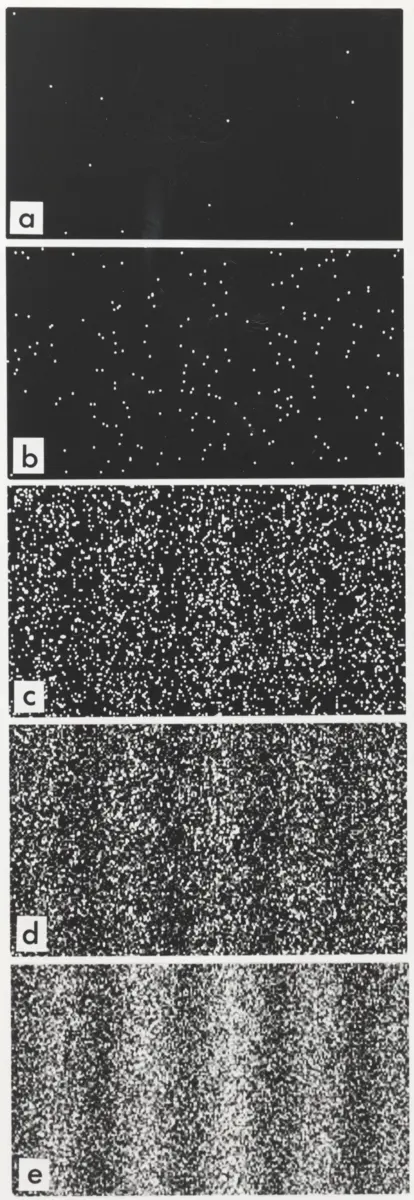
In 1909 the young English physicist G. I. Taylor tried it. He photographed the shadow of a needle in light so dim that, as was worked out later, there was hardly ever more than one photon in the apparatus at a time; his faintest picture needed an exposure of about three months. The stripes at the edge of the shadow came out exactly the same as in bright light. Today, cameras that record every single photon as it arrives show what happens.
Each photon arrives at one place, like a particle: one dot on the screen, never a smeared-out wave. Where any one photon lands can’t be predicted. But after thousands of them, the dots build up the interference pattern, bright and dark bands, exactly as the wave model says. And if one slit is covered, the stripes disappear. A single photon, passing through on its own, still lands in a way that depends on both slits being open.
The same thing happens with electrons, which everyone had thought of as particles. In 1989 a team at Hitachi in Japan led by Akira Tonomura sent electrons one at a time through an electron biprism, a thin charged wire that splits each electron’s path in two, like two slits, and filmed the dots building up into stripes.
Which model when?
Physicists today don’t say that light is “really” a wave or “really” a particle. Light is light. It behaves in a way that nothing in your everyday life does, so no everyday picture fits it perfectly. Instead we have two models, and each is right in the situations it was made for:
| Use the wave model for | Use the particle (photon) model for |
|---|---|
| interference: Young’s slits, soap bubbles, the colors of a CD | the photoelectric effect and solar cells |
| diffraction: light spreading through narrow gaps, the Arago spot | why ultraviolet causes sunburn and red light doesn’t, however bright |
| how light travels, reflects and refracts, and how lenses work | the bright and dark lines of atoms (What Are Stars Made Of?) |
| resonance: tuning a radio to one station | cameras and eyes counting single photons |
A good rule: the wave model describes how light travels; the particle model describes how light gives or takes energy when it meets matter, one photon at a time. When there are huge numbers of photons, as in nearly all the light around you, the lumps can’t be noticed and the wave model works perfectly.
Questions
Which of these is evidence that light behaves as a wave?
Pick an answer to see why.
Light of a certain color frees electrons from a metal. The light is changed to a higher frequency, with the same brightness. What happens to the fastest electrons?
Pick an answer to see why.
Explain how Young’s two-slit experiment supports the wave model of light, and why the particle model, as Newton imagined it, cannot explain it.
Answer
With two slits, the screen shows bright and dark bands. At a dark band, light arrives from both slits, but the path from one slit is half a wavelength (or 1½, 2½…) longer than from the other, so the waves arrive crest to trough and cancel. At a bright band the path difference is a whole number of wavelengths, and they add. Covering one slit removes the dark bands, so they are made by the two beams together. Particles shot through two slits would simply add up: two streams of particles landing in the same place can only make it brighter, never darker. Only waves can add to give darkness, so the pattern is evidence for waves.
In a two-slit experiment with slits 0.30 mm apart and a screen 1.20 m away, the bright bands are 2.4 mm apart. a. What is the wavelength of the light? b. What color is it? c. What would the spacing be with slits 0.15 mm apart?
Answer
- a.λ = yd ÷ L = (2.4 × 10⁻³ m × 0.30 × 10⁻³ m) ÷ 1.20 m = 6.0 × 10⁻⁷ m = 600 nm.
- b.600 nm is orange.
- c.y is inversely proportional to d: halving d doubles the spacing, to 4.8 mm.
State three results of photoelectric experiments that the wave model of light could not explain, and explain how Einstein’s photon model explains each one.
Answer
- a.Threshold frequency. Below a certain frequency no electrons come out, however bright the light. Photon model: an electron is freed by one photon, which must bring at least the work function φ. Below f₀ = φ ÷ h, every photon is too small, and brighter light only means more of them.
- b.Brightness doesn’t change the electrons’ energy. Brighter light gives more electrons, not faster ones. Photon model: brighter light of the same frequency means more photons, each of the same energy hf; each frees one electron with at most hf − φ.
- c.No delay. Electrons come out at once, even in dim light. Photon model: the energy arrives in whole packets; the first photon to arrive can free an electron straight away, with no need to soak up energy over time.
Light of wavelength 400 nm falls on a cesium surface (work function 2.0 eV). Calculate a. the energy of one photon, in eV; b. the largest kinetic energy of the electrons, in eV and in joules. c. The light is made twice as bright. What changes, and what doesn’t?
Answer
- a.E = hc ÷ λ = (6.63 × 10⁻³⁴ × 3.00 × 10⁸) ÷ (400 × 10⁻⁹) = 4.97 × 10⁻¹⁹ J; ÷ 1.60 × 10⁻¹⁹ = 3.11 eV.
- b.KE_max = 3.11 − 2.0 = 1.1 eV = 1.1 × 1.60 × 10⁻¹⁹ = 1.8 × 10⁻¹⁹ J.
- c.Twice as bright means twice as many photons each second, so about twice as many electrons each second (twice the current). Each photon still has 3.11 eV, so the fastest electrons still have 1.1 eV.
A student says: “Einstein proved that light is made of particles, so Young was wrong.” Evaluate this claim, using evidence.
Answer
The claim is wrong in an important way. Young’s evidence is still true: two slits still make interference bands, and the wave model still predicts their spacing (y = λL/d) exactly. Einstein’s photon model explained new evidence, the photoelectric effect (threshold frequency, energy depending on frequency not brightness, no delay), that the wave model couldn’t. Neither set of evidence cancels the other. Experiments with single photons show both at once: each photon lands at one spot, like a particle, yet thousands of them build up Young’s interference bands, and only when both slits are open. So light is described by both models: a wave for how it travels, photons for how it gives up energy. Young was right about interference; Einstein added to the model rather than overturning it.
Why is a solar panel’s output almost the same whether the sunlight falling on it is mostly red or mostly blue, as long as the same number of photons arrive? What happens to the extra energy of the blue photons?
Hint
How many electrons can one photon free?
Answer
Each photon with more than silicon’s 1.12 eV frees one electron, whatever its color: red (about 1.8 eV) and blue (about 2.8 eV) photons each free one. So the same number of photons gives about the same number of electrons, and about the same current. A blue photon’s energy above 1.12 eV doesn’t go into the electricity: it is lost as heat in the cell. (This is one of the reasons even the best silicon cells turn only about a quarter of sunlight’s energy into electricity.)
The particle model and the wave model of light each explain some things better. Give one situation where each model is the more useful, and say why.
Answer
Wave model: working out the colors of a soap bubble or the bands from two slits. These depend on light from two paths adding or canceling, which needs wavelengths and path differences; photons alone give no reason for a dark band.
Particle model: explaining why ultraviolet causes sunburn but much brighter visible light doesn’t. The damage is done by one photon changing one molecule of DNA, so what matters is the energy of each photon (E = hf), not the total energy of the light; a wave model, where energy builds up smoothly, gives no reason for a threshold.
(Other good answers: waves for diffraction, radio tuning or lenses; photons for the photoelectric effect, solar cells, or the lines in atoms’ spectra.)
Where to go next
- What Are Stars Made Of? The same photons, E = hf, are given out and taken in by atoms in exact amounts, making the bright and dark lines that tell us what the stars are made of. What Are Stars Made Of?
- Is Phone Radiation Dangerous? The energy of each photon decides what light and radio waves can do to the cells of your body.
- Which Energy Should Nepal Use? Solar panels turn photons into electricity. How do they compare with Nepal’s rivers, and its imported fuel?