
Light as particles, and a ruler for color
Nobel Prize in Physics, 2005: Roy J. Glauber, John L. Hall, and Theodor W. Hänsch
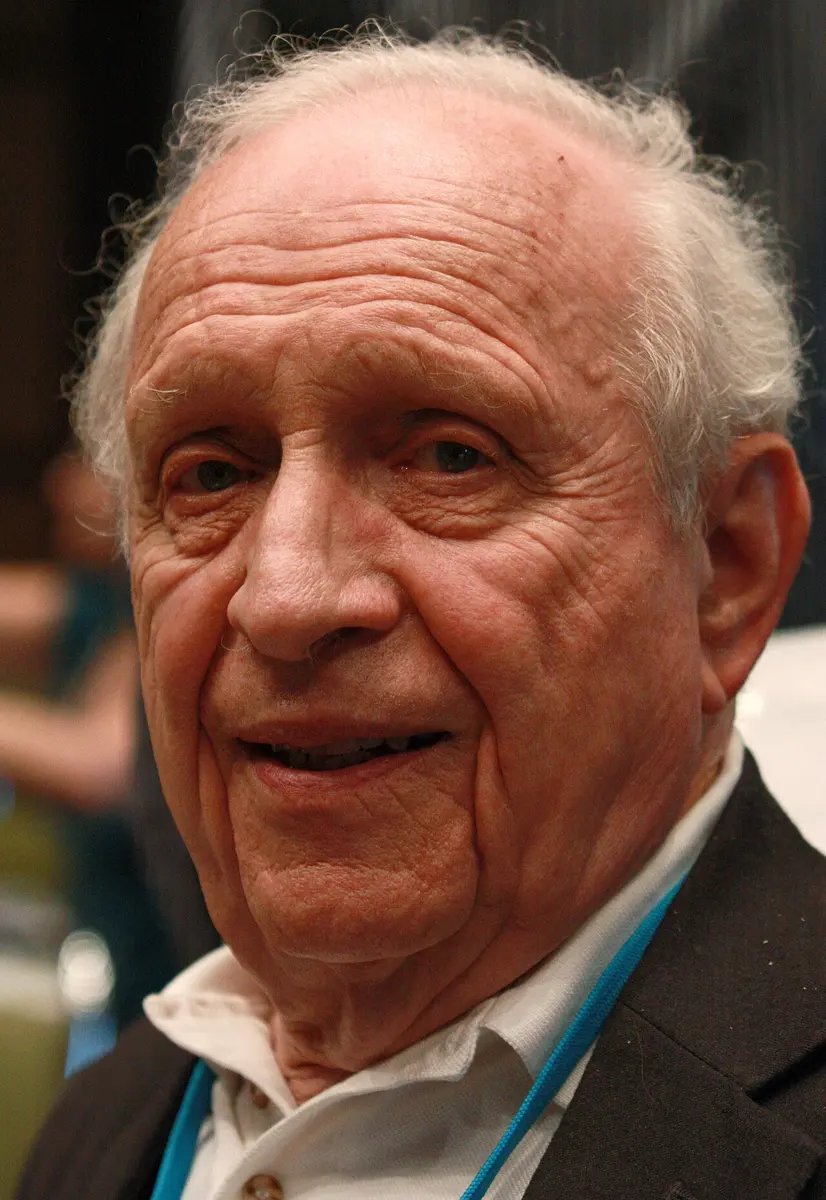
Roy J. Glauber
1925–2018, born in New York, USA
At 18 he was one of the youngest scientists at Los Alamos during the Second World War. He spent most of his life at Harvard, working out what light really is.
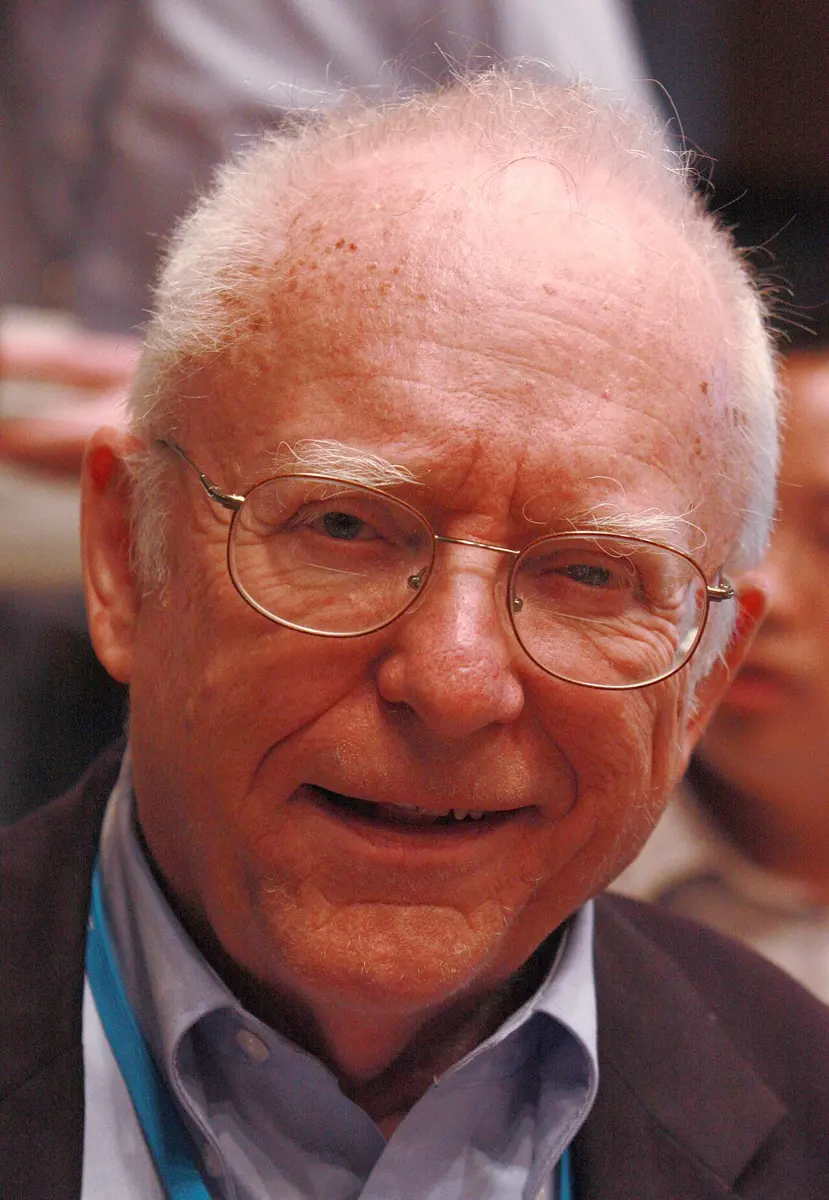
John L. Hall
born 1934 in Denver, USA
Known as Jan. As a boy he built radios and black-powder rockets; he spent his working life in Boulder, Colorado, making the steadiest lasers in the world.
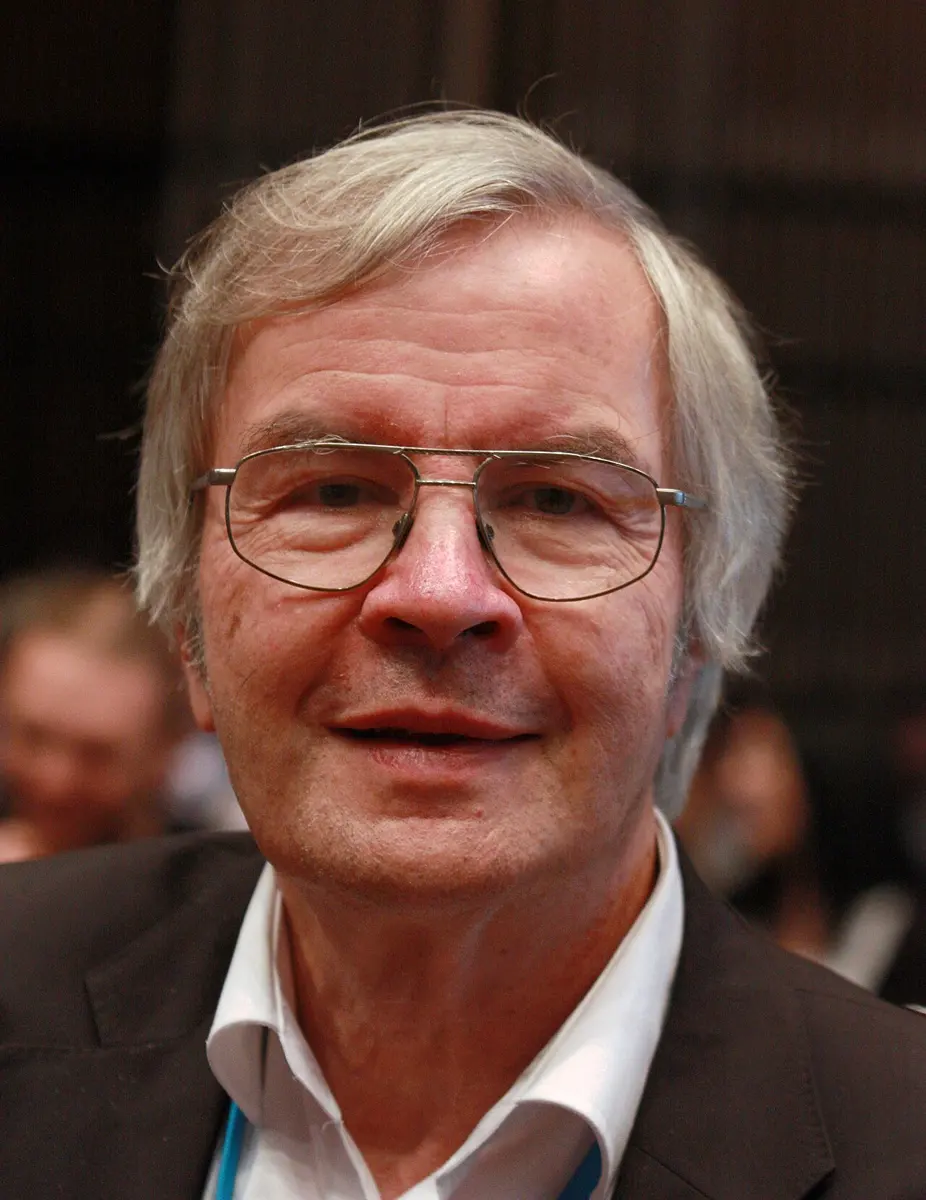
Theodor W. Hänsch
born 1941 in Heidelberg, Germany
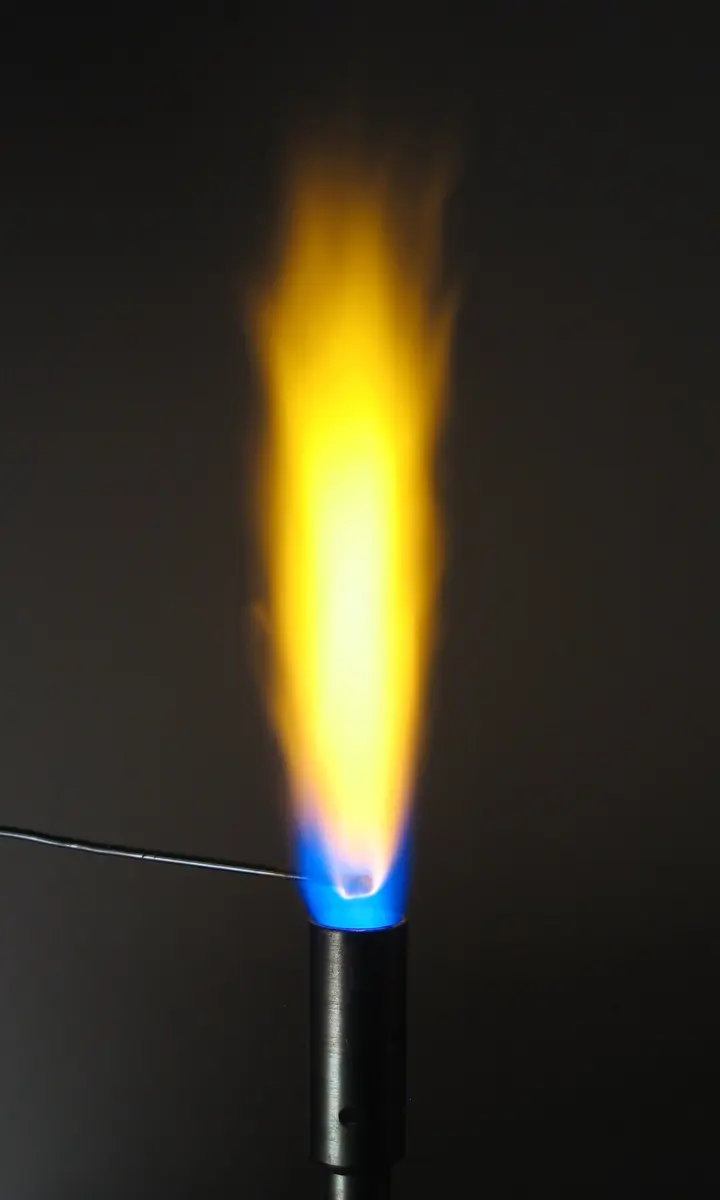
He grew up in the house where the chemist Robert Bunsen had lived, and was given a Bunsen burner at the age of six.
Your phone always knows the exact time, and GPS can find your place on a map to within a few meters. Both depend on atomic clocks, clocks that keep time by counting the steady vibrations of atoms. Today the best clocks in the world are clocks of light, so exact that they would not be wrong by a second in billions of years.
To build them, scientists first had to understand light much better, and then learn to measure its color more exactly than ever before. In 2005 the Nobel Prize in Physics went to three scientists who did this. Half went to Roy Glauber, for explaining light in terms of its particles. The other half was shared by John Hall and Theodor Hänsch, for building a “ruler” for light called the frequency comb.
The problem: what is light, and what color is it exactly?
Waves and packets
You know that light is a wave, an electromagnetic wave, like radio waves and X-rays Grade 9: Electromagnetic spectrum. Every wave has a wavelength (the distance from one crest to the next) and a frequency (how many crests pass a point each second, measured in hertz, Hz). For any wave, speed = frequency × wavelength Grade 9: Words used for waves.
For light, the color is set by the frequency. Red light has a frequency of about 450 million million Hz (4.5 × 10¹⁴ Hz): that many crests pass your eye every second. Violet light is about 750 million million Hz.
But light is also a stream of tiny packets of energy, called photons. In 1905 Albert Einstein showed that when light falls on a metal, each photon knocks out at most one electron (Einstein’s packets of light). Almost every light detector works this way, including the camera in your phone: it counts electrons, and so it counts photons.
So light is both a wave and a stream of particles. For most of the 20th century that did not matter much in optics. Lenses, mirrors and rainbows can all be explained by treating light as waves.
Two questions nobody could fully answer
- How is light from a bulb different from light from a laser? A laser, invented in 1960, gives light of one pure color, with all its waves in step. A bulb or the Sun gives a jumble of colors and waves out of step. Scientists described both as waves with some random flicker. But what does the difference mean for the photons themselves?
- How can you measure the color of light exactly? Every element gives out its own exact colors, as sharp as a barcode (Why each element has its own lines). Measuring them very precisely tests our deepest ideas about atoms. But light waves go up and down hundreds of millions of millions of times a second, far too fast for any electronic counter.
The color of light is decided by its…
Pick an answer to see why.
Glauber: counting photons
The puzzle of the bunched photons
In 1956 two British scientists, Robert Hanbury Brown and Richard Twiss, were testing a new way to measure the size of stars. They pointed two light detectors at the bright star Sirius and compared the flickering of the two signals. Before that, in the laboratory, they had done the same with the light of a mercury lamp.
They found something strange. The photons from the lamp did not arrive at random. They tended to come in bunches: if one detector caught a photon, the other was a little more likely than usual to catch one at the same moment. Many physicists did not believe it. How could separate particles, sent out by separate atoms, know about each other?
Glauber’s answer (1963)
Roy Glauber, at Harvard University, was a theoretical physicist: someone who works out with mathematics how nature behaves. The laser had just been invented, and he wanted to describe light properly, photon by photon. In 1963 he published a new theory of how a detector counts photons, using quantum theory, the physics of the very small.
His theory explained the puzzle and much more:
- Light from a bulb or a star comes from huge numbers of atoms giving out light at random moments. Its brightness flickers very fast. Photons are more likely to be caught when the light is momentarily brighter, so they arrive in bunches. This is what Hanbury Brown and Twiss had seen.
- Ideal laser light is perfectly steady. Its photons arrive completely at random, with no bunching at all.
- Some light can only be explained with photons. Glauber’s theory showed that light could exist whose photons come out more evenly spaced than random, never two at once. No wave picture can explain such light. In 1977 an experiment in the USA saw exactly this, in the light of single atoms: a single atom must take a moment to “reload” before it can give out its next photon.
So two beams of light can have the same color and the same brightness and still be different kinds of light. You find the difference by counting how the photons arrive.
Glauber’s work started a new field of physics, quantum optics: the study of light photon by photon. It is the base of many of today’s experiments with single photons, including ways of sending secret messages that cannot be read without the sender noticing.
Hanbury Brown and Twiss found that photons from a lamp tend to arrive…
Pick an answer to see why.
Hall and Hänsch: a ruler for light
Why measuring light was so hard
To measure time, the world uses the cesium atomic clock. Since 1967 one second has been defined as exactly 9,192,631,770 vibrations of a particular kind of microwave given out by cesium atoms. Electronics can count microwaves like that.
Visible light vibrates about 100,000 times faster. No electronic circuit can count that. Before 1999, the only way to compare the frequency of light with a cesium clock was a long frequency chain: a series of many lasers and microwave sources, each one locked to the next, step by step, from the microwave up to the light. A chain took years to build, needed a team of scientists to run, and could measure only one color.
John Hall spent his working life in Boulder, Colorado, at the US national laboratory for measurement (now called NIST) and the institute JILA. From the 1960s on, he made lasers whose color was steadier than anyone else’s, by locking each one to the sharp colors of certain molecules. In the early 1970s such lasers helped measure the speed of light more exactly than ever before. Then, in 1983, the world agreed that the speed of light would be exactly 299,792,458 m/s, and that a meter would be the distance light travels in 1/299,792,458 of a second. After that, measuring a length exactly also meant measuring the frequency of light exactly.
Theodor Hänsch, in Germany, spent decades measuring the colors of the simplest atom, hydrogen, more and more exactly. By the late 1980s, his measurements were held back by the frequency chains. He needed a better ruler.
The comb: a laser that flashes
The idea of the comb comes from a special kind of laser, a pulsed laser, which gives out its light not steadily but as a train of extremely short flashes, called pulses. Each pulse lasts only a few femtoseconds (a femtosecond is a millionth of a billionth of a second), and the flashes come at a perfectly steady rate, for example a hundred million times a second.
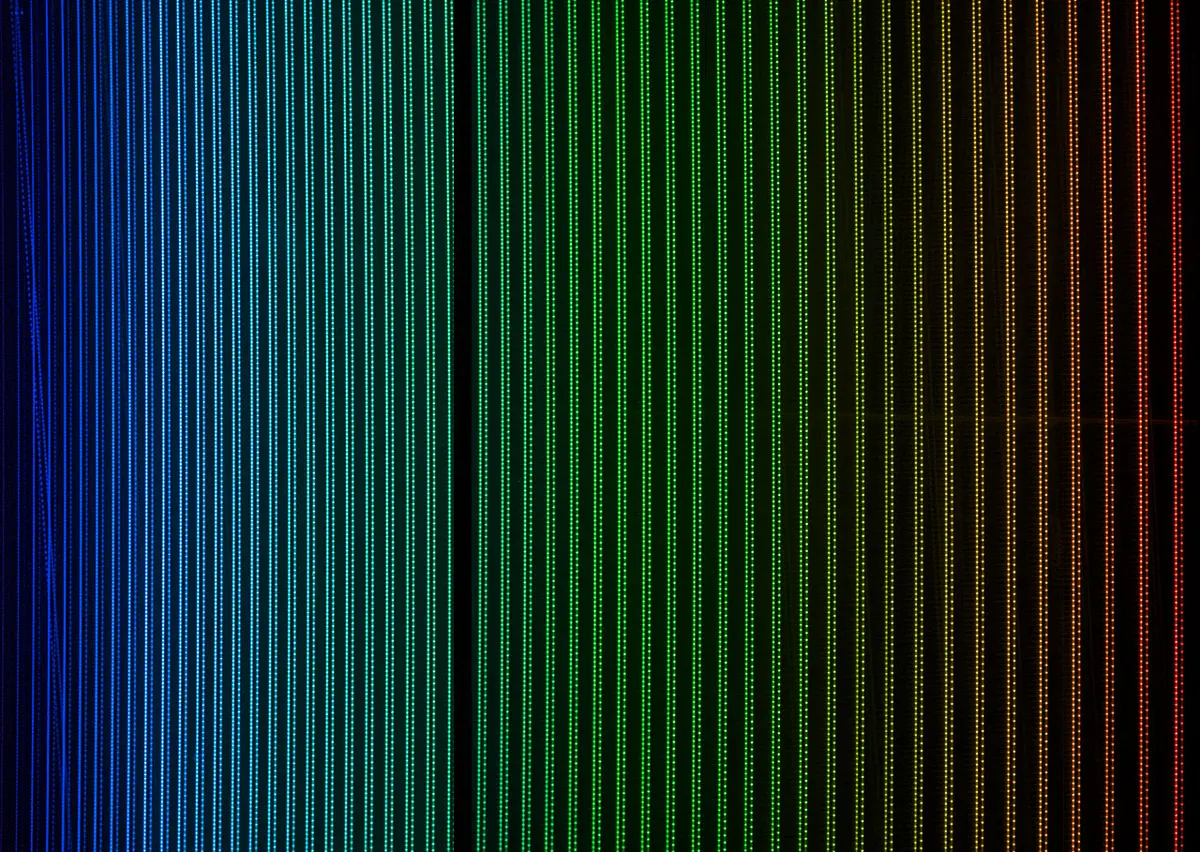
Here is the surprising part. A light that flashes very regularly does not contain just one color, nor a smooth mixture of all of them. It contains a huge number of sharp colors, evenly spaced, like the teeth of a comb or the marks on a ruler. And the spacing between the teeth is exactly the flash rate. If the laser flashes 100 million times a second, the teeth are exactly 100 million Hz apart.
That is the key. The flash rate is slow enough for electronics to count and to lock to a cesium clock. So every tooth of the comb is a known frequency of light, and together they make a ruler that reaches across the visible colors in one step.
What they did, step by step
- Late 1970s. At Stanford University in the USA, Hänsch and his student showed that the flashes of a pulsed laser could be used as evenly spaced colors, in the same way. The lasers of the time could not make a broad enough comb.
- 1998. In Garching, near Munich, Hänsch’s team used a new kind of pulsed laser, sold commercially, with pulses only a few femtoseconds long. They showed that its teeth really were evenly spaced, to extreme precision, and used it to compare the frequency of a laser directly with a cesium clock.
- June 1999. With a portable cesium clock brought from Paris, they measured a color of hydrogen to 14 digits.
- One problem remained. The teeth are evenly spaced, but the whole comb is shifted by an unknown amount, the offset, as if the ruler’s zero mark were missing. You can find it if the comb is so broad that its highest frequencies are more than twice its lowest (an “octave”, like the eight notes from one Sa to the next in music). Then you double the frequency of a tooth at the low end and compare it with the tooth at the high end. The two should match exactly; the small mismatch is the offset.
- Late 1999 to 2000. A new kind of glass fiber, full of tiny air channels, had just been made at Bell Labs in the USA. Laser pulses sent through it spread into a rainbow covering more than an octave. In Boulder, Hall’s team and their colleagues used it to find and lock the offset in a simple way, and Hänsch’s team in Garching did the same. Now one laser and a short fiber could do the work of a whole frequency chain, for any color.
- 2001. Two of Hänsch’s students started a company, Menlo Systems, to make frequency combs for sale. Today laboratories all over the world have them.
How a frequency comb measures light
Suppose you have a laser of unknown color, for example a laser locked to a color of hydrogen. You shine it together with the comb onto a fast light detector.
The unknown laser falls between two teeth of the comb, close to one of them. Two waves of slightly different frequency beat: together they get louder and softer, again and again, at a rate equal to the difference of their frequencies. You may have heard this when two strings of a guitar or a sarangi are almost, but not quite, in tune: a slow “wah-wah-wah”. The beat between the laser and the nearest tooth is only a few million Hz, slow enough for electronics to count.
So the laser’s frequency is: the number of the tooth × the spacing + the offset + the beat. Each of these is either a whole number or a frequency that electronics can count. The press release of the Nobel Prize said that Hall and Hänsch had made it possible to measure frequencies with an accuracy of fifteen digits.
Why can’t an ordinary electronic counter measure the frequency of visible light directly?
Pick an answer to see why.
In your life today
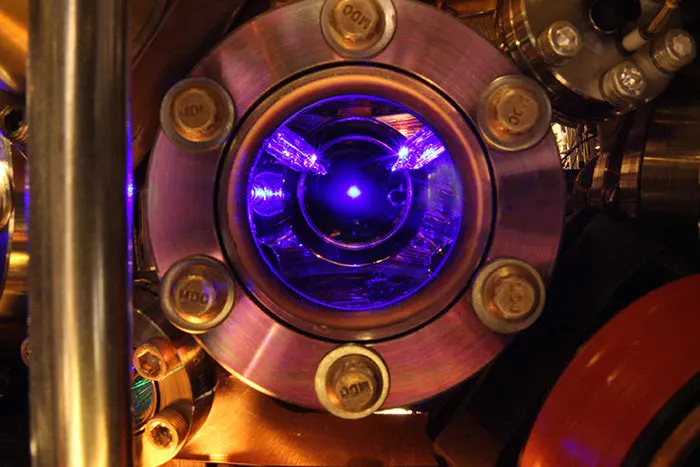
- Clocks. With a frequency comb, a clock can tick at the frequency of light instead of microwaves. Such optical clocks, using atoms of strontium, ytterbium or aluminium, are now more than a hundred times more exact than the best cesium clocks. The comb is their “gearwork”: it turns the ticking of light into a signal electronics can use.
- GPS and the time on your phone. GPS satellites carry atomic clocks, and your phone finds its place from how long their signals take to arrive Grade 9: Global Positioning System. Light travels 30 cm in a billionth of a second, so better clocks mean better positions.
- Finding planets. Astronomers use frequency combs to measure the colors in starlight very exactly. A star with a planet wobbles slightly, and its colors shift a tiny amount (The barcode in sunlight). A comb makes the shift measurable.
- Sniffing the air. Every gas absorbs its own exact colors. Combs are used to detect gases such as methane leaking from gas fields, from a distance.
What came next
- A new second. The best optical clocks would not be wrong by a second in about the age of the universe. Scientists plan to change the definition of the second, from cesium to an optical clock, perhaps around 2030.
- Clocks that feel gravity. Einstein predicted that time runs more slowly lower down, nearer the Earth. Optical clocks are now so exact that they can measure this when one clock is raised by less than a centimeter. They could one day be used to measure the shape of the Earth’s gravity, and differences in height between places.
- Do the laws of nature change? By measuring the colors of atoms year after year, scientists test whether the basic constants of nature, such as the strength of the forces between charges, are slowly changing. So far, no change has been found. Hänsch’s team also hopes to compare hydrogen with antihydrogen, its antimatter twin, to see whether they have exactly the same colors. Nobody yet knows why the universe is made of matter and not antimatter.
In your science books
- Grade 9: electromagnetic waves, the electromagnetic spectrum, frequency, wavelength and wave speed, scientific measurement and scientific notation, and GPS.
- Grade 10: dispersion of light, white light as a mixture of colors.
- Going Further: Is light a wave or a stream of particles? and What stars are made of, the sharp colors of each element.
Learn more
- The Nobel Prize’s own explanation: Popular information: the 2005 Nobel Prize in Physics (nobelprize.org).
- The three laureates’ Nobel lectures: Glauber, Hall and Hänsch.
The official reason
The prize was given “for his contribution to the quantum theory of optical coherence.”
The prize was given “for their contributions to the development of laser-based precision spectroscopy, including the optical frequency comb technique.”