
Atomic clocks and traps for single atoms
Nobel Prize in Physics, 1989: Norman F. Ramsey, Hans G. Dehmelt, and Wolfgang Paul
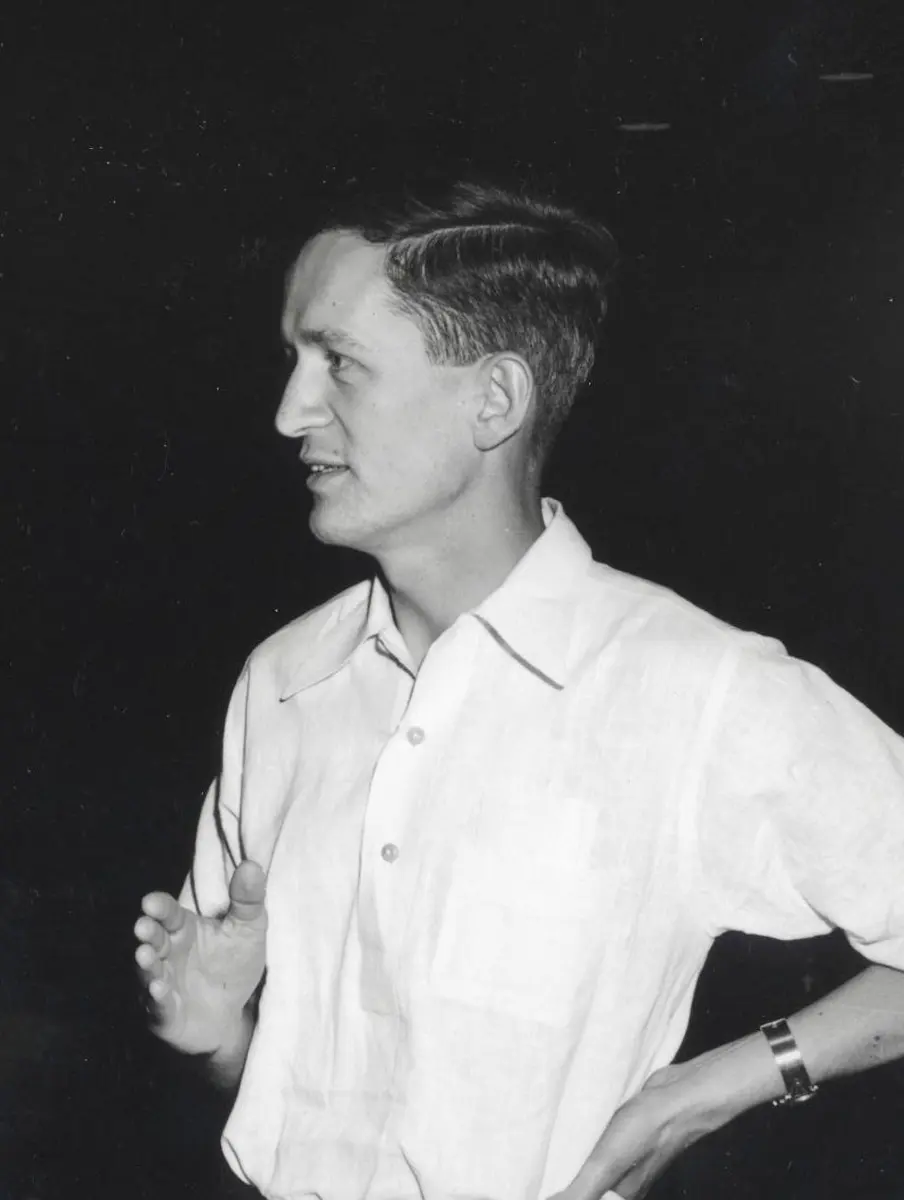
Norman F. Ramsey
1915–2011, born in Washington, D.C., USA
He finished school at 15. When he couldn’t get magnets good enough for his experiment, he invented a method that didn’t need them.
Photo: US Department of Energy, Public domain
-
Hans G. Dehmelt
1922–2017, born in Görlitz, Germany
A soldier in the Second World War and then a prisoner of war, he went on to keep a single electron in a trap for months, and gave his favorite trapped atom a name: Astrid.
-
Wolfgang Paul
1913–1993, born in Lorenzkirch, Germany
He built traps for charged atoms out of electric fields that keep changing, and brought a spinning saddle and a steel ball to Stockholm to show how they work.
Open a map on a phone in Kathmandu, and a blue dot shows where you are, often to within a few meters. The phone works this out from radio signals sent by satellites 20,000 km above the Earth. Each signal says exactly when it was sent. Radio waves travel at the speed of light, about 300,000 km per second, so an error of just one millionth of a second in a satellite’s clock would put the dot about 300 meters in the wrong place.
So every navigation satellite carries atomic clocks: clocks that count the ticks of atoms. Half of the 1989 Nobel Prize in Physics went to Norman Ramsey, who invented the method that makes the most important atomic clocks so precise. The other half went to Wolfgang Paul and Hans Dehmelt, who found ways to trap single charged atoms, and even a single electron, and hold them still to study them.
The problem: what is a second?
For thousands of years, time was measured by the sky. A day was one turn of the Earth, and a second was one 86,400th of a day. But the Earth is not a perfect clock. Tides, winds and the movement of molten rock inside it make it spin a tiny bit faster or slower from year to year. Compared with an atomic clock, said the Nobel presentation speech, “the Earth behaves like a bobbing duck”.
People built better and better clocks: pendulum clocks, then quartz clocks. The watch on your wrist or the clock in a phone contains a tiny piece of quartz crystal that vibrates 32,768 times a second; the clock counts the vibrations. But no two quartz crystals are exactly alike, and they change with temperature and age.
Atoms are different. Every cesium atom in the universe is exactly the same as every other. If you could use an atom as a pendulum, every clock in the world could tick at exactly the same rate.
How an atom keeps time
The electrons in an atom can only have certain fixed amounts of energy, called energy levels, like the steps of a staircase Grade 9: Shells and their energy. An atom can jump from one level to another by taking in or giving out an electromagnetic wave. The wave’s frequency, the number of waves per second Grade 9: Words used for waves, must match the size of the step exactly. This is why each element gives out its own colors of light (Why each element has its own lines).
The cesium atom has two levels very close together. To flip an atom from one to the other takes microwaves Grade 9: Microwaves of one exact frequency: 9,192,631,770 waves per second. So an atomic clock works like this: make microwaves, shine them on cesium atoms, and adjust the frequency until the most atoms flip. Then the microwaves are at exactly the right frequency, and counting 9,192,631,770 of their waves measures one second.
Since 1967 this has been the official definition of the second, all over the world.
Why is a cesium atom a better “pendulum” than a quartz crystal?
Pick an answer to see why.
Why it was hard
- Atoms fly past. In these instruments the atoms travel as a thin beam through a vacuum, at hundreds of meters per second. Each atom spends only a short time in the microwaves. And a short look gives only a rough answer: atoms flip over a broad range of frequencies, so the “right” frequency is blurred.
- A long look needs a perfect magnet. To make the look longer, you could make the microwave region longer. But the atoms’ levels are shifted by any magnetic field around them, and nobody could make a field that was the same everywhere along a long region.
- Atoms won’t stay still. The best measurement of all would be on one atom, held still for a long time. But atoms fly about, and a charged atom, an ion Grade 9: Ion, can’t be held in place by fixed electric charges around it. It always slips out one way or another, like a marble placed on a horse’s saddle: it may sit still along one direction, but it rolls off down the sides.
What they did, step by step
Ramsey: two short looks instead of one long one
Norman Ramsey learned to work with beams of atoms as a student of Isidor Rabi in New York. In 1937 Rabi invented the method of flipping atoms in a beam with radio waves (Rabi won the Nobel Prize in 1944).
- 1949, a failure that led to an invention. At Harvard University, Ramsey wanted to measure atoms more accurately than Rabi’s method allowed, but he couldn’t get magnetic fields uniform enough along a long region. So he gave the atoms two short kicks of radio waves instead of one long one: one where they enter the region, and one where they leave it. What happens to the atoms in between depends only on the average field along the way, so it doesn’t need to be perfect. This is the separated oscillatory fields method.
- Why it is sharper. The first kick starts each atom “ticking” in step with the waves. The second kick checks whether the atom is still in step after its long flight between them. If the frequency is even slightly wrong, the atom and the waves drift out of step on the way, and fewer atoms flip. The longer the flight, the smaller the error that can be spotted. It is like checking your watch against the radio’s time signal once in the morning and once at night: you can spot a much smaller error than by watching it for a minute.
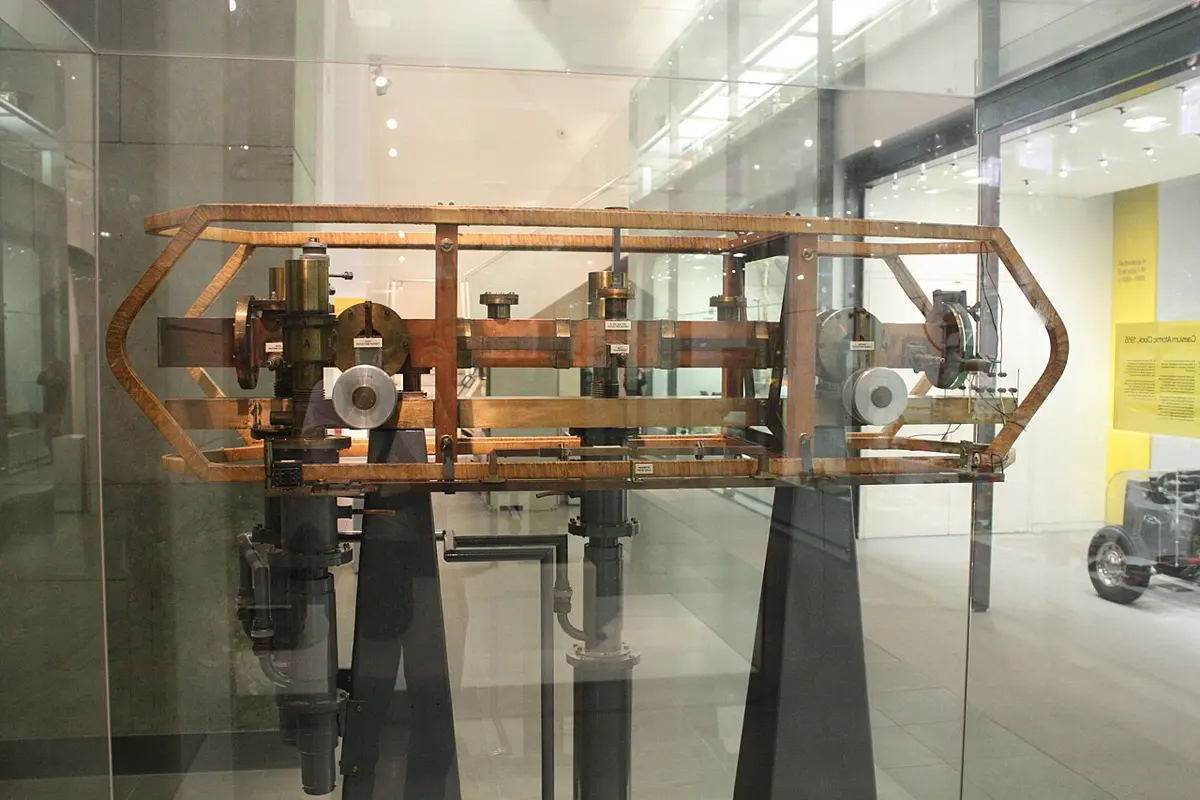
- 1950s–1967, the cesium clock. The first cesium clock was built in England in 1955, and cesium clocks use Ramsey’s method. In 1967 the second was defined by cesium.
- 1960, the hydrogen maser. With his student Daniel Kleppner, Ramsey built a different instrument, the hydrogen maser, in which hydrogen atoms are stored for about a second in a bottle coated inside with Teflon (the coating of non-stick pans), bouncing about and giving out microwaves. Over hours and days it is even steadier than a cesium clock.
Paul: a trap made of changing electric fields
Wolfgang Paul grew up in Munich, Germany, and became professor of physics at the University of Bonn in 1952.
- 1953, a filter for ions. With Helmut Steinwedel, Paul made a filter out of four metal rods. An electric voltage on the rods keeps changing, alternating many times a second, like the current in your home’s wiring but much faster Grade 10: Alternating current. Ions fly along between the rods. Only ions of one particular mass travel straight through; heavier or lighter ones wobble more and more and crash into the rods. This quadrupole mass filter is now one of the most common tools in chemistry laboratories.
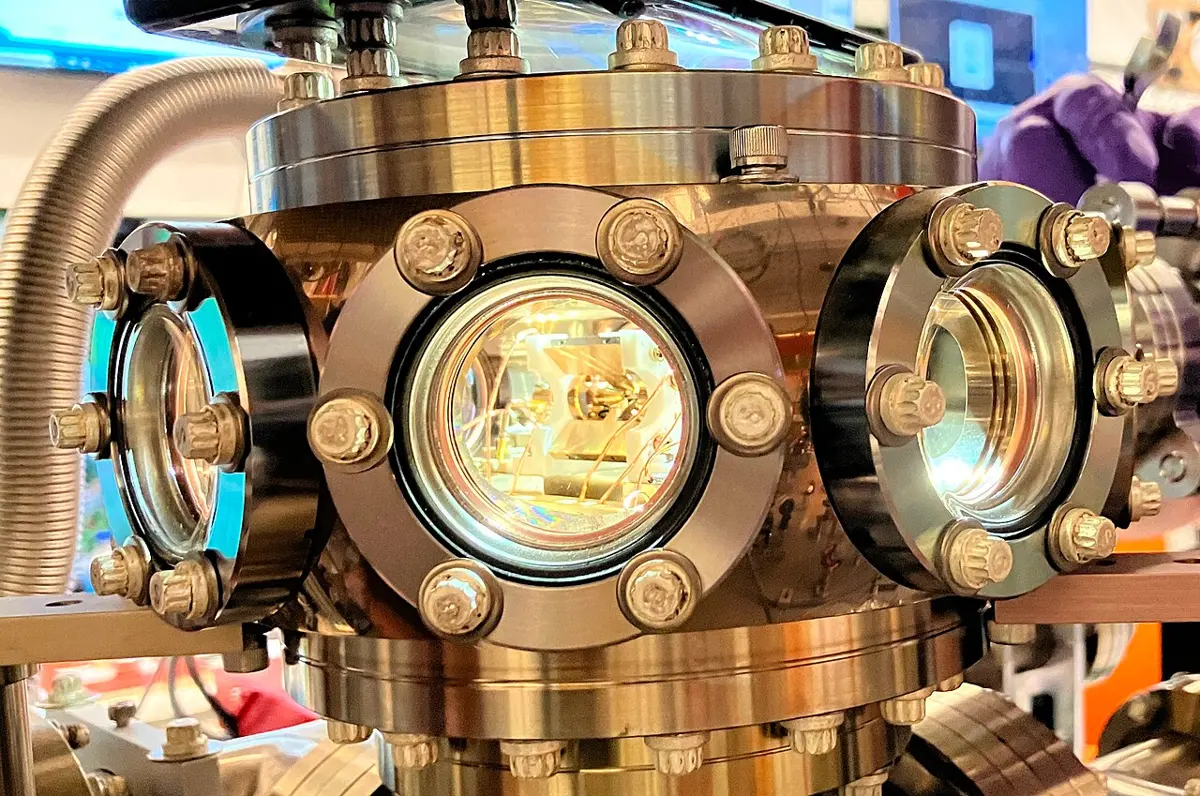
- 1950s, the trap. Paul’s group bent the same idea into a closed shape: a ring with a cap above and below. The changing voltage traps an ion in the middle. This is the Paul trap.
- The saddle. Remember the marble on a saddle, which always rolls off? Now spin the saddle. Just as the marble starts to roll down one side, that side turns up and pushes it back. At the right speed, the marble stays near the middle. Paul had such a saddle machined from Plexiglas, and he brought it to Stockholm for his Nobel lecture, with a steel ball to show it.
Why does the voltage on a Paul trap have to keep changing?
Pick an answer to see why.
Dehmelt: one electron, one atom
Hans Dehmelt was born in Germany in 1922. As a young soldier in the Second World War his unit only just escaped being trapped at Stalingrad; later he was captured and spent a year in a prisoner-of-war camp. After the war he studied physics, and in 1955 he moved to the University of Washington in Seattle, in the United States.
- The Penning trap. Dehmelt developed another kind of trap, which holds a charged particle with a fixed electric field and a strong magnetic field together. It is called the Penning trap, after the Dutch physicist Frans Penning, whose instrument gave Dehmelt the idea. (A Penning trap was also built in Paul’s laboratory at the same time.)
- 1973, one electron. With his co-workers, Dehmelt trapped a single electron and kept it for weeks and months. He called the electron in its trap an “atom”, geonium, since it is held not by a nucleus but by the trap, and the trap by the Earth.
- Measuring the electron. Watching that one electron, his team measured how strong a magnet the electron is to about 12 digits. A theory of electrons and light, quantum electrodynamics, predicts the same number, and the two agree. It is one of the most precise tests of any theory in science.
- About 1980, one atom you could see. With Peter Toschek in Heidelberg, Germany, Dehmelt trapped a single barium ion in a tiny Paul trap. Lit by a laser, it glowed blue, bright enough to be photographed in natural color as a single dot of light. Dehmelt called it Astrid. The lasers also slowed the ion down, which is the same as cooling it, so it sat almost still.
How an atomic clock works now
An atomic clock is a loop. A quartz oscillator makes a steady signal, which is turned into microwaves. Cesium atoms fly through the microwaves, using Ramsey’s two kicks. A detector at the end counts how many atoms flipped. If the number drops, the microwaves have drifted off the right frequency, and the electronics nudge the quartz back. The quartz does the ticking; the cesium atoms keep it honest.
Today’s best cesium clocks throw a ball of cooled atoms gently upwards through the microwaves and let it fall back, a cesium fountain: the two kicks are the ball going up and coming down, nearly a second apart. Better still are optical clocks, which use a single trapped ion, as Dehmelt hoped, or atoms held by laser light, and which tick with light instead of microwaves, hundreds of thousands of billions of times a second. The best would lose less than a second in the age of the universe. Scientists plan to redefine the second using such a clock, perhaps around 2030.
In your life today
- Your position. GPS satellites, and the European, Russian, Chinese and Indian navigation satellites, all carry atomic clocks Grade 9: GPS. Every map on a phone, every delivery or ride app, every airplane, depends on them.
- Your time. World time, UTC, is kept by about 450 atomic clocks in about 85 laboratories around the world (as of 2023). Nepal Standard Time is UTC plus 5 hours 45 minutes. Mobile networks, the internet and banks use atomic time to keep their computers in step.
- The moving Himalaya. Atomic clocks in radio telescopes on different continents measure how fast the continents drift, by timing signals from distant galaxies, and GPS stations in Nepal measure how fast India pushes into Asia and lifts the Himalaya, a few centimeters a year (India meets Asia).
- Testing food and medicines. Paul’s four-rod mass filter is inside many machines that find tiny traces of pesticides in vegetables, check medicines, or catch athletes who take banned drugs.
- Quantum computers. Some of today’s experimental quantum computers store their information in a row of single ions held in Paul traps.
What came next
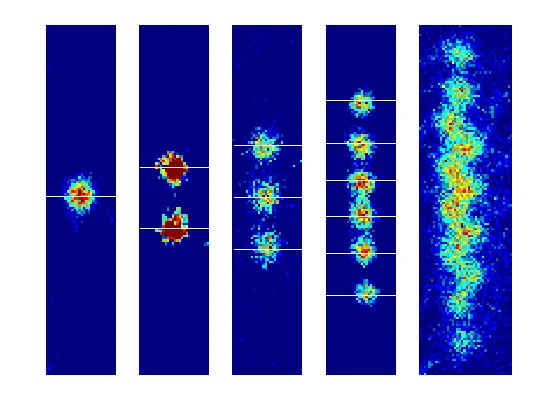
- More Nobel Prizes. Cooling and trapping atoms with laser light won the Nobel Prize in 1997; making a gas of atoms so cold that they act as one, in 2001; measuring light’s frequency precisely, in 2005; and controlling single trapped ions, in 2012, for David Wineland, who had worked with Dehmelt on the single electron.
- Clocks that feel gravity. Optical clocks are now so precise that two of them show a difference in the rate of time if one is lifted by a few centimeters. Such clocks could one day measure the shape of the Earth and the height of mountains from the way time passes.
- An open question. Are the laws of nature exactly the same everywhere and always? If a number such as the strength of electric forces were changing, even very slowly, clocks built on different atoms would slowly drift apart. So far they haven’t. Physicists keep comparing them, more precisely every year.
In your science books
- Grade 9: shells and their energy, ions, words used for waves, the electromagnetic spectrum and microwaves, navigation satellites and GPS.
- Grade 10: alternating current.
- Going Further: why each element has its own lines, how fast a satellite must go, and India meets Asia.
Learn more
- The Royal Swedish Academy’s press release and the presentation speech (nobelprize.org).
- The Nobel lectures: Ramsey, Dehmelt (with the photograph of Astrid) and Paul (with his spinning saddle).
The official reason
The prize was given “for the invention of the separated oscillatory fields method and its use in the hydrogen maser and other atomic clocks.”
The prize was given “for the development of the ion trap technique.”