
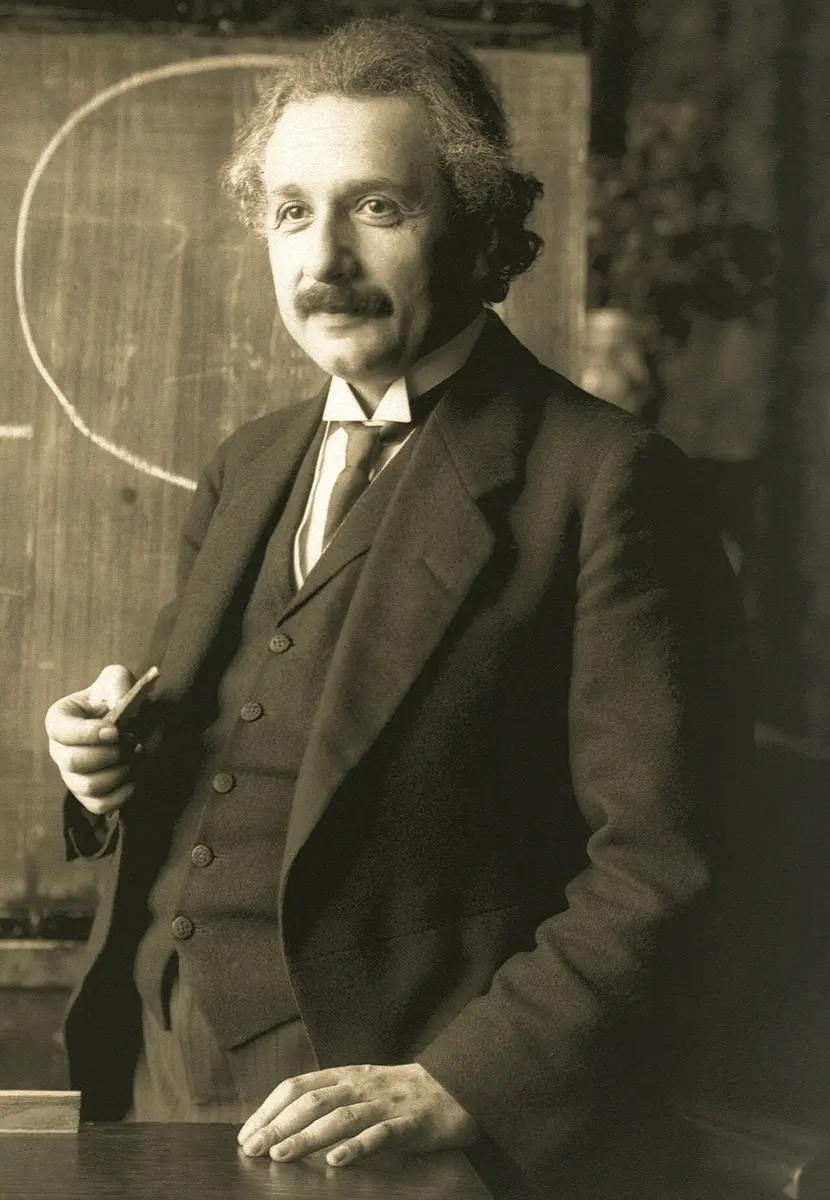
Albert Einstein
1879–1955, born in Germany
Best known for relativity, but his Nobel Prize was for an idea about light he had at 26, while working in a patent office.
Photo: Ferdinand Schmutzer / Adam Cuerden, Public domain
Stand in front of a fire on a winter evening and you can warm yourself for hours without getting burnt. Spend half an hour in the midday Sun high in the hills, and your skin can burn. Why should sunlight do something that a hot fire can’t?
The answer comes from an idea Albert Einstein had in 1905: light carries its energy in tiny separate packets. Most scientists thought the idea was wrong for years. It won him the Nobel Prize in Physics for 1921, and today it is at work in every solar panel and every phone camera.
The problem: light as a wave
By 1900 scientists were sure they knew what light is: a wave. Experiments showed light spreading and overlapping like ripples on a pond, and the physicist James Clerk Maxwell had shown that light is an electromagnetic wave, the same kind of wave as radio waves and X-rays, only with a different wavelength Grade 9: Electromagnetic spectrum.
Colors of light differ in their wavelength and frequency. Red light has the longest wavelength we can see and the lowest frequency; violet has the shortest wavelength and the highest frequency. Beyond violet is ultraviolet (UV), which we can’t see.
A wave carries energy spread out smoothly over its whole front, like a wave on the sea hitting the whole beach at once. A brighter light is a bigger wave, carrying more energy. That seemed simple enough. Then came a strange result.
The puzzle: light that knocks out electrons
In 1887 the German physicist Heinrich Hertz noticed that an electric spark jumped more easily when ultraviolet light shone on the metal. A year later Wilhelm Hallwachs showed it clearly with a gold-leaf electroscope: an instrument with two thin leaves of metal that push each other apart when it is charged.
He put a clean zinc plate on top and gave it a negative charge, so the leaves spread apart. When he shone ultraviolet light on the plate, the leaves slowly fell: the plate was losing its negative charge. In 1897 the electron was discovered, and the reason became clear. The light was knocking electrons out of the metal. This is the photoelectric effect (“photo” means light).
That much the wave idea could explain: the wave shakes the electrons until some get enough energy to escape. But around 1900, Philipp Lenard and others measured the effect carefully and found three things that made no sense for a wave.
- Color matters, brightness doesn’t. Below a certain frequency, no electrons come out at all, however bright the light. For zinc, even the brightest red or yellow light frees nothing. Only ultraviolet works.
- Brighter light gives more electrons, not faster ones. Make the ultraviolet brighter and more electrons come out, but each comes out with the same top speed. Higher-frequency light gives faster electrons.
- There is no waiting. Even with very dim light, the first electrons come out the moment the light is switched on. A spread-out wave should take time to give one tiny electron enough energy.
A clean zinc plate is lit by a very bright red lamp for an hour. No electrons come out. What will happen if the lamp is made ten times brighter?
Pick an answer to see why.
Why it was so hard to believe
The experiments had been done. What was hard was the idea needed to explain them.
- Light really does behave like a wave. A hundred years of experiments showed light spreading round corners and making patterns of bright and dark bands, which only waves do. Saying light is made of lumps seemed to throw all of that away.
- Even the man who started it didn’t believe it. In 1900 Max Planck had found that the light given out by hot objects only made sense if energy was given out in small fixed amounts, which he called quanta. But Planck thought of this as a trick in his mathematics, not as something light really does.
- Einstein was an outsider. In 1905 he was not a professor. He was 26, worked six days a week checking inventions at the patent office in Bern, Switzerland, and did his physics in his spare time.
What Einstein did, step by step
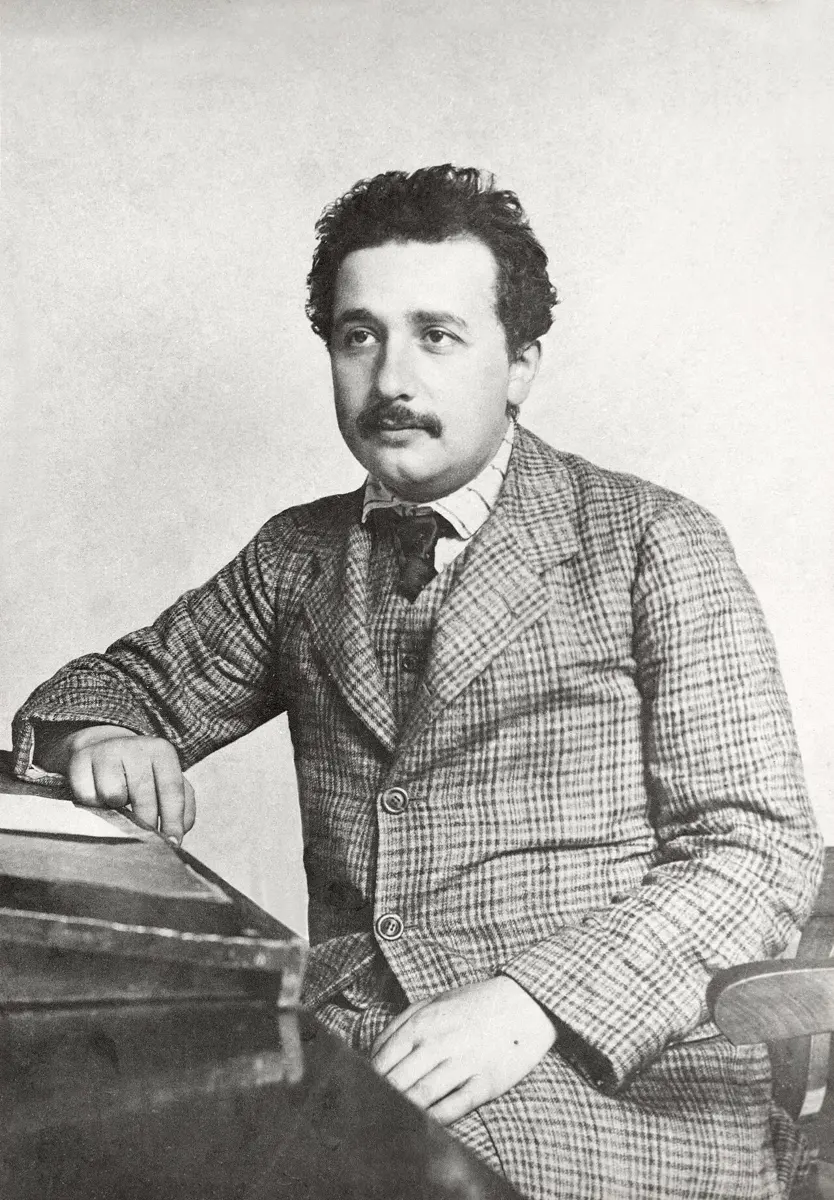
A clerk at the patent office (1905)
Einstein was born in 1879 in Ulm, in Germany, and grew up in Munich. He studied physics in Zurich, Switzerland, but couldn’t find a teaching job, and took one at the Swiss patent office.
- He took Planck’s quanta seriously (1905). Einstein said that light itself is made of packets of energy. Today we call them photons (the name came in 1926).
- Each packet has a fixed energy, set by the color. The higher the frequency, the bigger the packet. A photon of ultraviolet carries more than twice the energy of a photon of red light. In symbols, the energy of one photon is E = hf, where f is the frequency and h is a very small number, Planck’s constant.
- One photon frees one electron. An electron can’t collect energy from several photons; it gets one whole photon or none.
- The metal holds on to its electrons. To get out, an electron needs at least a certain amount of energy, different for each metal. If one photon brings less than that, the electron stays, however many photons arrive.
With these four ideas, all three puzzles disappear. Red light’s packets are too small for zinc: a brighter red lamp only sends more small packets, and none is big enough. Brighter ultraviolet sends more photons, so more electrons come out, but each photon is the same size, so they aren’t faster. And there is no waiting, because the very first photon to arrive can free an electron.
Einstein’s idea also made a prediction that could be tested: the energy of the fastest electrons should rise in a straight line with the frequency of the light, by the same amount for every metal.
In Einstein’s idea, what decides whether one photon can knock an electron out of a metal?
Pick an answer to see why.
The man who tried to prove him wrong (1905–1916)
Almost nobody believed in Einstein’s light packets. Even in 1913, when Planck and other leading physicists recommended Einstein for a top post in Berlin, they wrote that he “may sometimes have missed the target in his speculations, as, for example, in his hypothesis of light quanta”.
In the United States, Robert Millikan set out to test Einstein’s prediction, expecting to show it was wrong. The experiment was very difficult: the metal surfaces had to be perfectly clean, so he worked inside a glass vessel with the air pumped out, shaving fresh surfaces off blocks of metal with a knife worked from outside. For about ten years he measured the energy of the electrons from each metal, with light of one frequency after another.
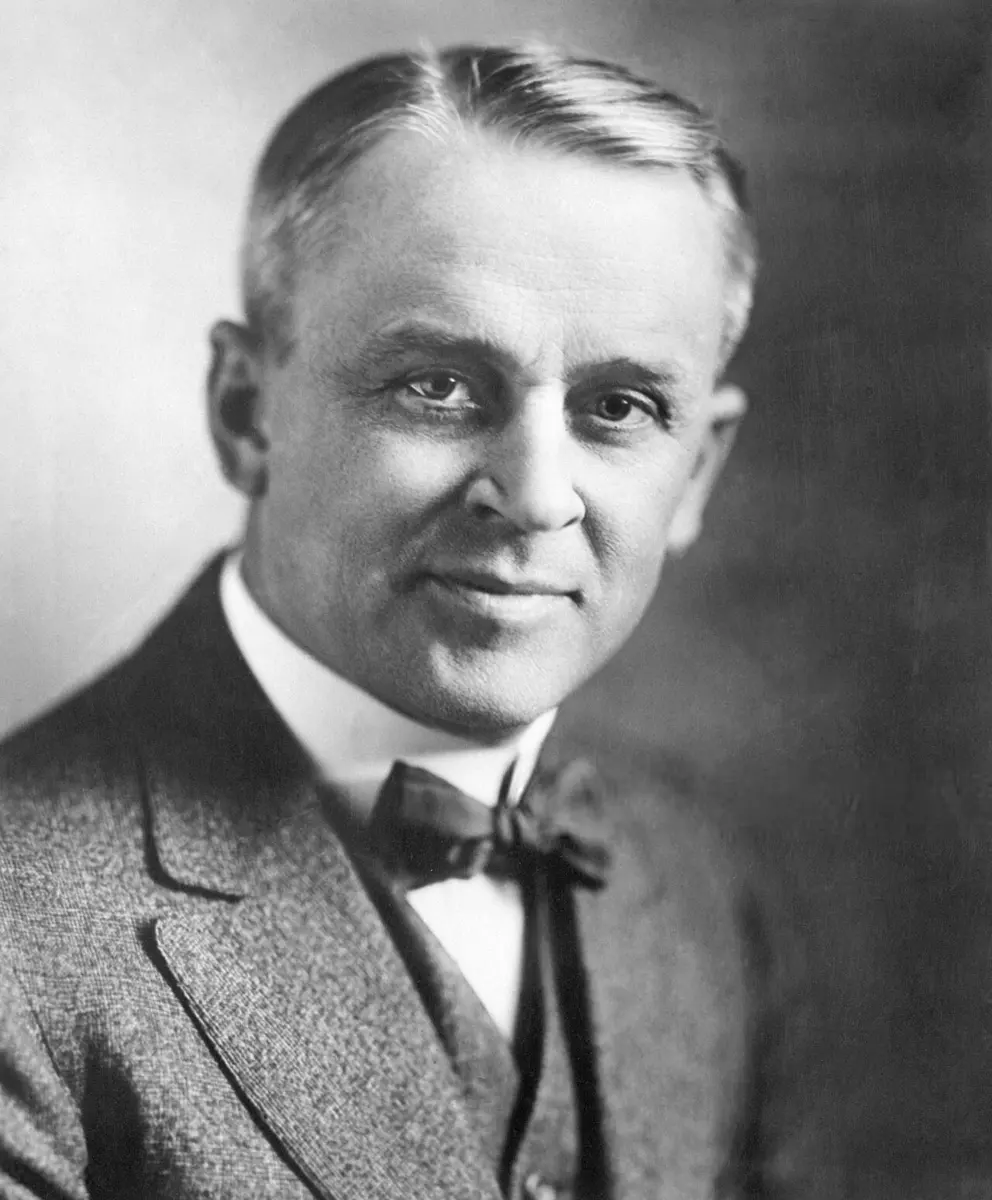
In 1916 he published his results. Every metal gave a straight line, and every line had the same slope, just as Einstein had predicted. From the slope he worked out Planck’s constant. Einstein’s law was right, though Millikan still found the idea behind it hard to accept. Millikan won the Nobel Prize himself in 1923.
A prize for light, not relativity (1922)
By then Einstein was world-famous for his theory of relativity, his ideas about space, time and gravity. Year after year he was nominated for the Nobel Prize, but the committee hesitated: some of its members doubted relativity, or thought it was not yet proven by experiment.
In 1921 the committee couldn’t agree, and the prize for that year was held over. In 1922 a new member, Carl Wilhelm Oseen, suggested giving it for something experiments had already proved beyond doubt: the law of the photoelectric effect. On 9 November 1922 Einstein was awarded the 1921 prize “for his services to Theoretical Physics, and especially for his discovery of the law of the photoelectric effect”. (Historians still argue about how much the committee was simply unwilling to reward relativity.)
Einstein wasn’t there to receive it: he was traveling to Japan. When he finally gave his Nobel lecture, in Sweden in July 1923, he spoke about relativity.
How it works: packets of energy
Here are the photons of different colors, side by side, with the energy needed to free an electron from two metals. Physicists measure such tiny energies in electronvolts (eV).
When a photon does free an electron, its energy is shared out like this: part of it is used up getting out of the metal, and whatever is left over becomes the electron’s kinetic energy, its energy of movement.
Try it yourself: choose a metal, change the color and the brightness, and find the color at which electrons start to come out.
In your life today
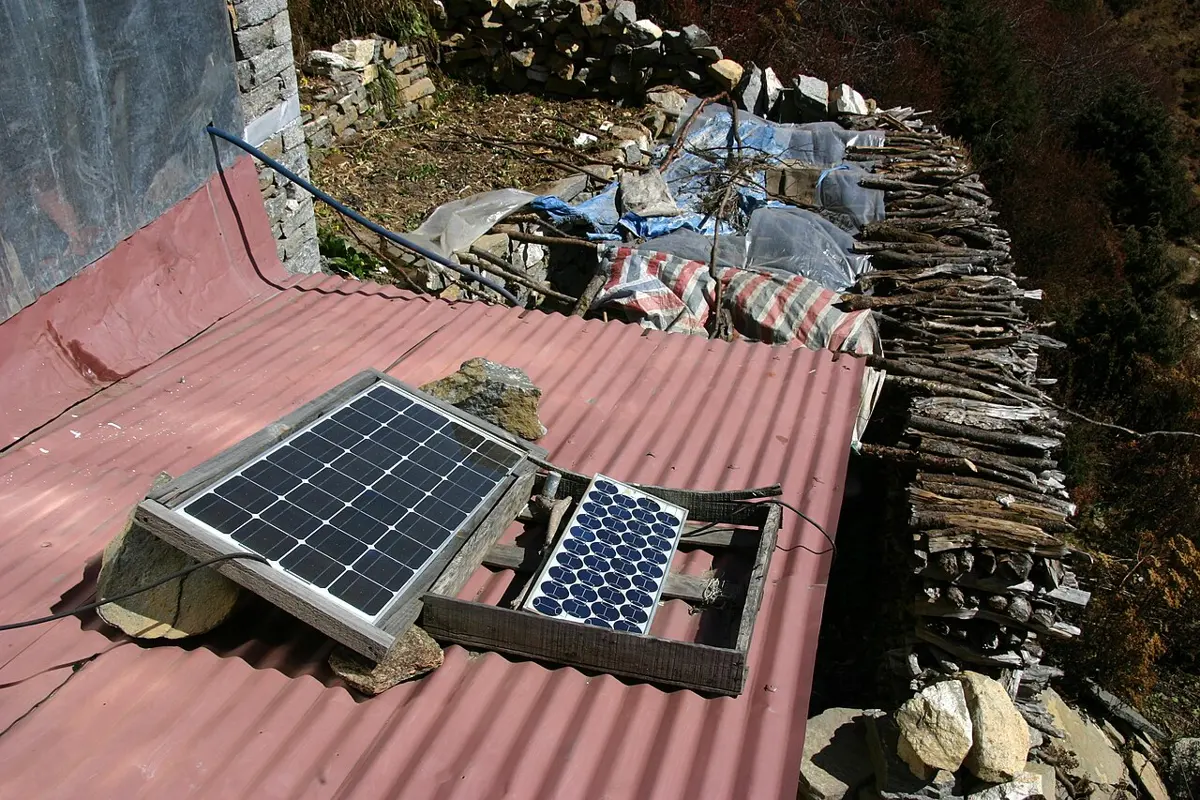
- Solar panels. In a solar cell, each photon of sunlight that is big enough frees one electron inside the silicon, and the cell is built so those electrons flow out as an electric current Grade 9: Solar electricity. The electrons don’t leave the material, but the rule is Einstein’s: one photon, one electron, and only if the photon brings enough energy. Across Nepal, from rooftops in the cities to lodges high in the Himalaya and the solar street lamps in many towns, sunlight is turned into electricity this way.
- Phone cameras. The camera in a phone has millions of tiny light sensors. Each one counts the electrons freed by the photons landing on it, and that count becomes the brightness of one dot of the picture.
- Sunburn. A fire gives out mostly infrared light, whose photons are too small to harm the molecules in your skin. Sunlight also contains ultraviolet, whose photons are big enough to damage a molecule of DNA in a skin cell, one photon at a time. It is the size of each packet that matters, not the total amount of light Grade 9: Ultraviolet rays.
What came next
- Light is both. Einstein didn’t throw out the wave. Light spreads like a wave, but it gives and takes energy in packets. In 1923 Arthur Compton showed that photons also carry momentum, like tiny particles hitting electrons. Physicists had to accept that light behaves as a wave in some experiments and as a stream of particles in others (Wave or particle?).
- Quantum physics. The idea spread to everything. If waves of light act like particles, perhaps particles act like waves; and electrons do. From this grew quantum physics, the physics of atoms, which explains chemistry, lasers and every computer chip.
- The open question. Physicists can predict exactly what light will do in any experiment, but they still argue about what light is when nobody is measuring it. Einstein himself said, near the end of his life, that fifty years of thinking had not brought him any closer to the answer.
In your science books
- Grade 9: the electromagnetic spectrum, ultraviolet rays and solar electricity.
- Going further: Is light a wave or a stream of particles?, with the photoelectric effect and Einstein’s equation worked out with numbers, and Is phone radiation dangerous?, on why one photon’s energy matters.
Learn more
- The prize at nobelprize.org: The Nobel Prize in Physics 1921, with the presentation speech that explains the photoelectric law.
- Einstein’s Nobel lecture, given in 1923, which is about relativity.
The official reason
The prize was given “for his services to Theoretical Physics, and especially for his discovery of the law of the photoelectric effect.”