
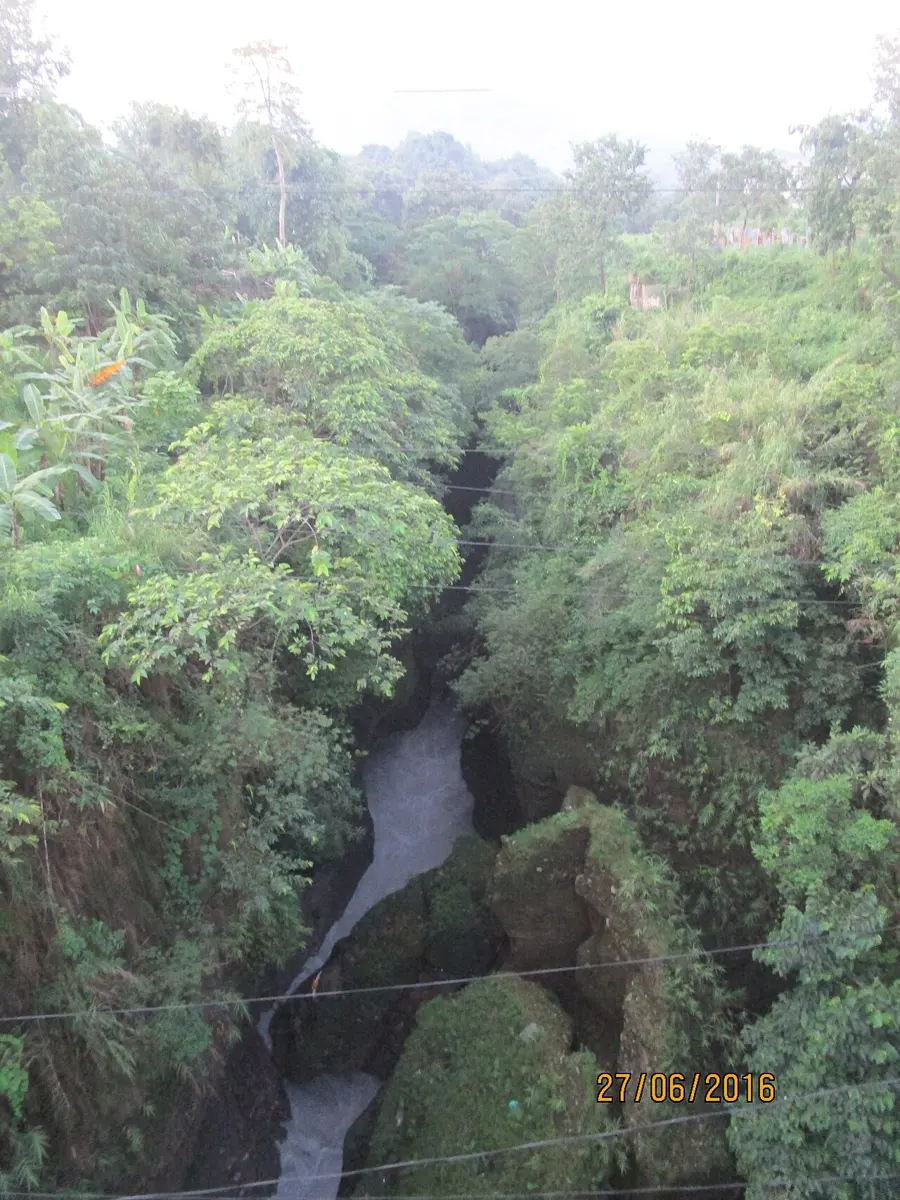
Walk down the steps into Gupteshwor Mahadev Cave in Pokhara and you hear the water of Devi’s Fall roaring somewhere in the dark rock beside you. On the other side of the city, in Mahendra Cave, the walls are coated in pale, rippled stone that grew there drop by drop. Between them, the Seti River runs milky white through a gorge so narrow that in places you can hardly see the water from the bridges. And since November 2013, in Armala, just north of the city, more than a hundred holes have opened in farmers’ fields, some of them 15 m across, as the ground sank into hollows below.
All of it is the work of water. Rock seems the hardest, most lasting thing there is, and water the softest. Yet water splits rock, dissolves it, carries it away and lays it down somewhere else, and deep in the Earth it even helps rock melt. This topic is about how: which properties of water let it do each of these things, how fast, and how you can investigate it yourself.
Water, an unusual liquid
Water has a handful of properties that most liquids don’t, and each one lets it attack rock in a different way. You have met some of them already.
| Property of water | What it does to rock |
|---|---|
| It expands by about 9% when it freezes Grade 10: Grade 10: Anomalous expansion of water. | Ice forming in a crack pushes the rock apart. |
| It dissolves more substances than almost any other liquid, and picks up carbon dioxide to become a weak acid. | It dissolves minerals out of rock, slowly for most rocks, quickly for limestone. |
| It wets rock and soaks into tiny cracks and pores. | It takes the ice and the acid deep inside the rock. |
| It flows downhill, and drags on what it flows past. | Rivers pick up broken rock, carry it and drop it somewhere else. |
| It dissolves into very hot rock. | It lowers the temperature at which rock melts. |
Almost all of this is powered by the Sun. Sunlight evaporates water from the sea, the wind carries the vapor over the land, and it falls as rain and snow on the hills, high above the sea it came from. Everything water does to rock on its way back down to the sea, it does with energy the Sun gave it.
The first job, breaking rock into pieces without changing what it is made of, is called physical weathering (or mechanical weathering). Changing the minerals themselves, by dissolving them or turning them into new ones, is chemical weathering. Carrying the pieces away is erosion, and dropping them somewhere else is deposition.
Ice as a wedge
You know from Grade 10 that a bottle full of water cracks in the freezer, because water expands as it freezes. Ice (917 kg/m³) is less dense than water (1000 kg/m³), so the same mass of water takes up about 9% more room as ice.
Now think of a crack in a rock high in the Himalaya. By day, the sun melts snow and the water runs into the crack. At night, the air falls below 0 °C. The water at the top of the crack freezes first, because it touches the cold air, and makes a plug of ice that seals the crack. Then the water below freezes too. It has nowhere to go, so as it turns to ice it pushes hard on the walls. Next day the ice melts, water runs a little deeper into the crack, and at night it freezes again. Night after night, the crack is pushed a little wider and grows a little deeper, until a piece breaks off. This is frost wedging (also called freeze–thaw weathering).
How hard can ice push? If water is sealed in and can’t escape as it freezes, the pressure rises until the ice stops forming. At −5 °C that is at about 60 MPa (60 million pascals, 600 times the pressure of the air), and at −22 °C over 200 MPa. Most rocks split when they are pulled apart by about 5 to 20 MPa. So ice in a sealed crack is easily strong enough to break rock.
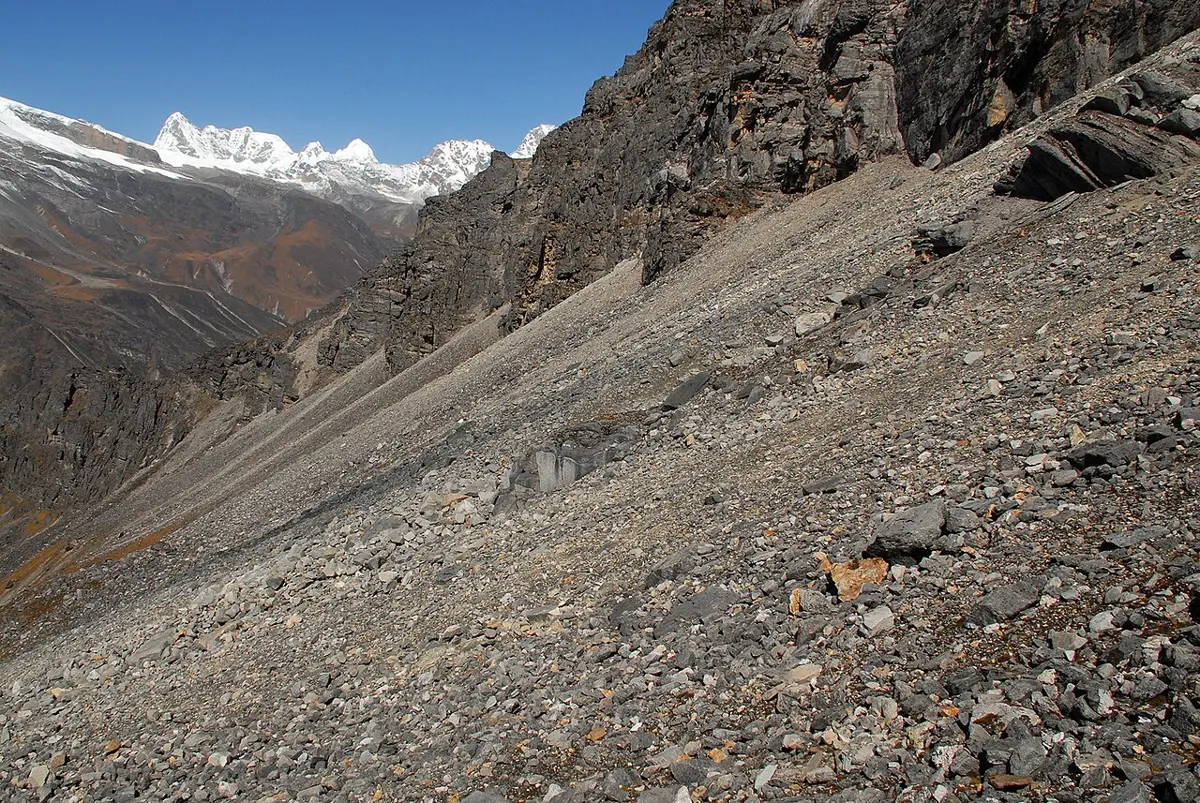
So frost wedging works best where cracks are full of water when it freezes: under melting snow, or after rain, and where the temperature falls below 0 °C at night and rises above it by day, again and again. Much of the high Himalaya is like that for months of the year. The slopes of broken rock below its cliffs, called scree or talus, are made largely of pieces that frost has split off.
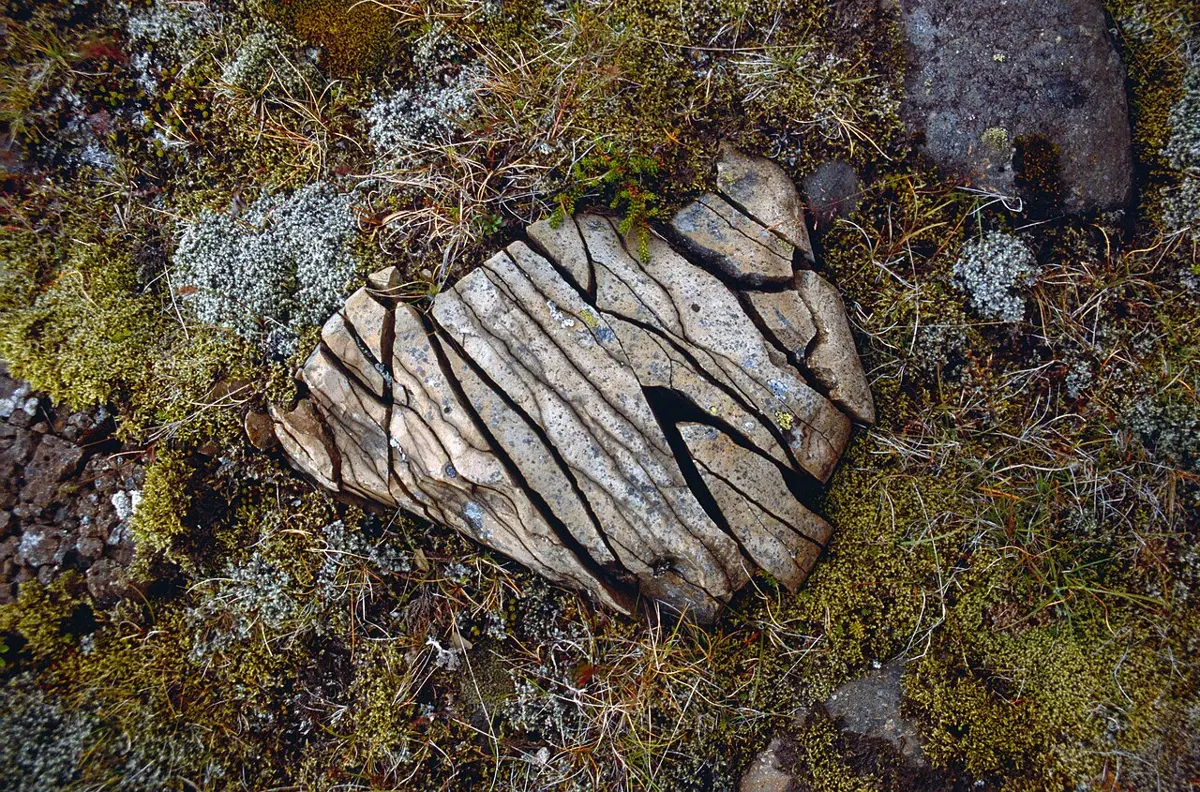
Two cracks in the same rock freeze on the same night. Crack A is full to the top with water; crack B is half full. Which is more likely to be widened?
Pick an answer to see why.
Water that dissolves rock
A weak acid from the air and the soil
Put a spoon of salt in a glass of water and it disappears in seconds. Put a piece of limestone in, and nothing seems to happen at all. Yet water dissolves whole mountains of limestone. How?
You saw in Grade 10 that carbon dioxide dissolves in water to make a weak acid, carbonic acid, and that carbon dioxide bubbled through lime water first makes it milky with calcium carbonate, then clears it again as the calcium carbonate dissolves Grade 10: Grade 10: Tests for carbon dioxide. That second step is how water dissolves limestone (calcium carbonate):
The dissolved calcium and hydrogencarbonate ions are what make water hard Grade 8: Grade 8: Hardness of water. That is why water from wells and springs in limestone country is hard, and why kettles there fill with scale: boiling drives out the carbon dioxide, the reaction runs backwards, and the calcium carbonate comes out again. The double arrow, ⇌, means the reaction can go either way. The more carbon dioxide there is in the water, the more limestone it can dissolve; take carbon dioxide away, and limestone comes out of the water again.
How much carbon dioxide does the water get? Rain gets a little from the air, which is only about 0.04% carbon dioxide (as of 2026). But when rain soaks into the ground, it passes through the soil air, which has far more: roots and the soil’s microbes breathe out carbon dioxide, and in soil it builds up to around 1–5%, sometimes 10%, tens or hundreds of times as much as in the open air. So water that has soaked through soil is a stronger acid, and it is this water that dissolves most limestone.
| What dissolves | Most that 1 liter of water can dissolve (20 °C) |
|---|---|
| table salt | 360 g |
| gypsum (calcium sulphate, a soft rock) | about 2.4 g |
| limestone, in water with no carbon dioxide | about 0.014 g (14 mg) |
| limestone, in rain (air with 0.04% CO₂) | about 0.06 g (60 mg) |
| limestone, in soil water (soil air with 3% CO₂) | about 0.26 g (260 mg) |
| quartz, the commonest mineral in sand and granite | less than 0.01 g |
A quarter of a gram in a liter doesn’t sound like much. But rivers carry trillions of liters, every year, for millions of years.
Caves, sinkholes and springs
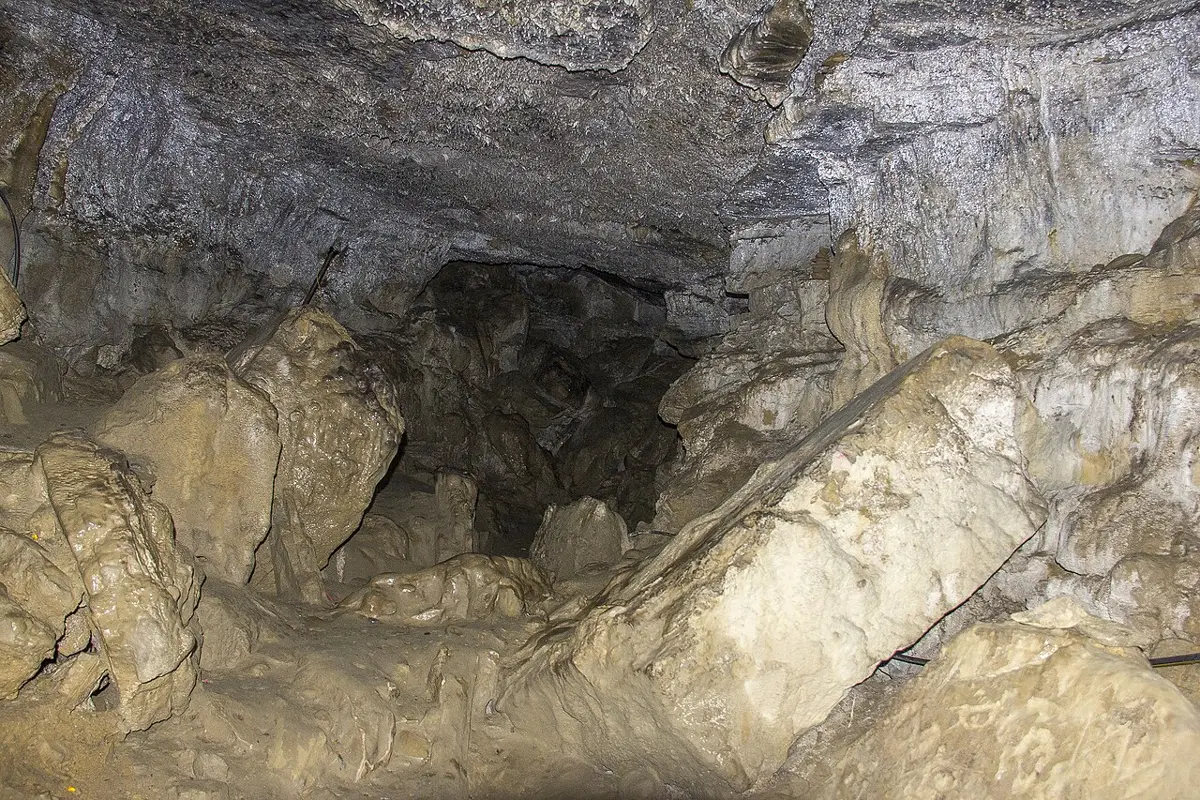
Limestone is full of cracks: the layers it was laid down in, and joints that cross them. Water soaking down from the soil runs along these cracks and dissolves their walls, so they grow wider. The wider a crack, the more water flows through it, and the faster it grows. Over thousands of years a few lucky cracks become pipes, and the pipes become caves, joined into passages that carry whole underground streams. The water comes out again where a valley cuts down to the cave’s level, as a spring.
Where the ground above a cave or a widened crack gives way, or the soil is washed down into it, a hollow opens at the surface: a sinkhole. A landscape like this, with caves, sinkholes, springs and streams that vanish underground, is called karst, after a limestone region in Slovenia.
Stalactites and stalagmites
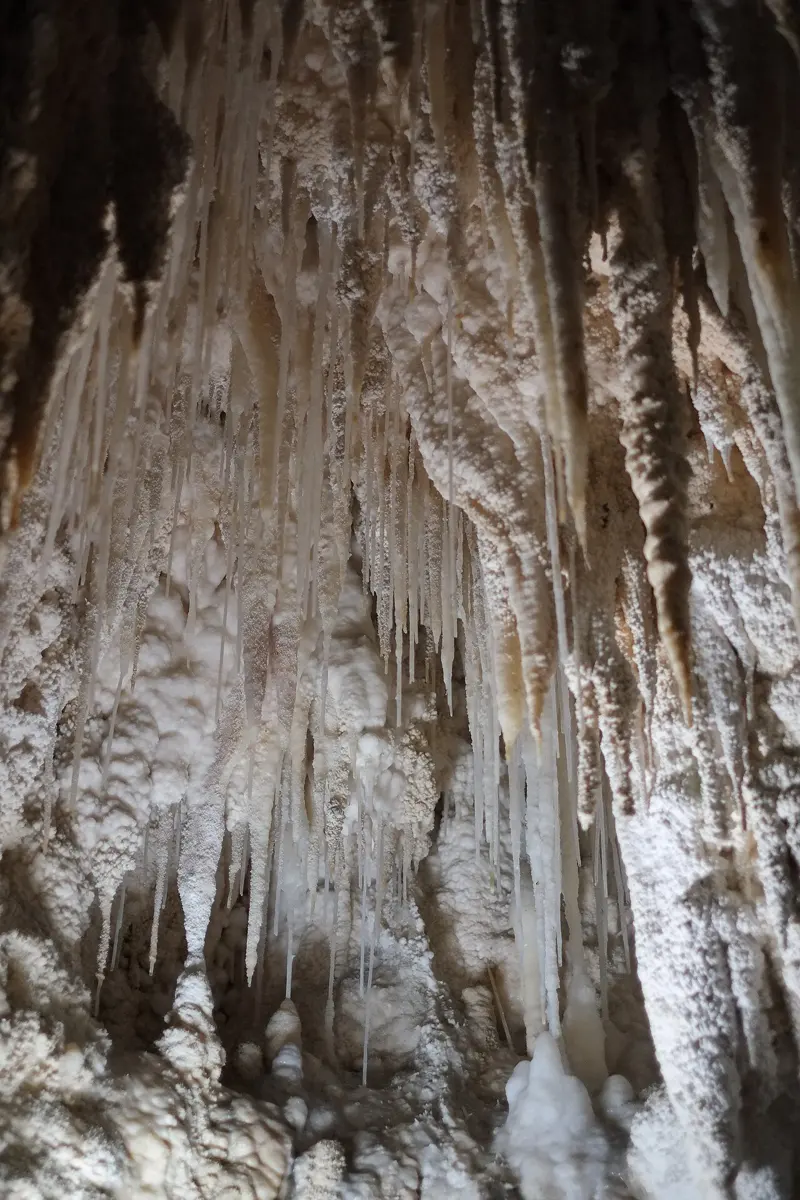
When a drop of that water seeps out of a crack into a cave, it meets the cave’s air, which usually has less carbon dioxide than the soil the water came through (around 0.1–1%). Some carbon dioxide leaves the drop, the reaction runs backwards, and a tiny ring of calcium carbonate is left on the roof, as the mineral calcite. Drop after drop, the rings build a hollow straw, then an icicle of stone: a stalactite (from the roof). Where the drops land, they lose more carbon dioxide and build a stalagmite up from the floor. Water running over the walls leaves sheets of flowstone. A stalactite and the stalagmite below it may meet in a column.
They grow slowly: often around a tenth of a millimeter a year, so a stalactite a meter long can be ten thousand years old. A broken stalactite never grows back in a lifetime. Please never touch them: the grease from a single finger can stop new calcite from sticking there.
A stalactite grows in a cave because…
Pick an answer to see why.
Rivers that carry rock
Grinding, carrying and dropping
You learned in Grade 6 that rivers roll stones along until they grind them into sand and mud, and that soil shaken up in a jar of water settles in layers, the biggest grains at the bottom. That is the story of every river: it picks up broken rock (erosion), carries it, and drops it somewhere else (deposition).
A river carries rock in three ways:
- dissolved, as ions in the water, which you can’t see (the limestone from the last section);
- suspended: fine grains of clay, silt and sand kept up in the water by its swirling, which make a river cloudy or milky;
- along the bed: sand, gravel and stones that roll, slide and hop along the bottom, too heavy to be held up.
What decides which grains a river can move is how fast it flows. Moving water pushes on a stone with a drag force that grows with the square of the speed. A bigger stone has a bigger face to push on, but much more weight to hold it down. Put these together, and the answer is surprising: the weight of the biggest stone a river can roll grows with the sixth power of its speed. Double the speed, and the river can roll stones 2⁶ = 64 times heavier. This rough rule was first written down in 1753.
Notice three things in the widget. A fast river sorts its load: as it slows, it drops the biggest grains first, then smaller and smaller ones. Silt and clay need very little speed to stay up once they are in the water, so the river stays cloudy long after it has dropped its stones and sand. And clay settles out only where the water is almost still, in a lake or a reservoir.
How fast do grains sink?
When the water slows, a grain sinks at a steady speed set by its size. For grains smaller than fine sand, this speed is given by Stokes’ law:
where ρₛ is the density of the grain (2650 kg/m³ for quartz), ρw the density of water (1000 kg/m³), g = 9.8 m/s², d the grain’s diameter and η the viscosity of water, how sticky it is (1.0 × 10⁻³ Pa s at 20 °C). The speed goes with the square of the diameter: a grain ten times smaller sinks a hundred times more slowly.
Where the rock ends up
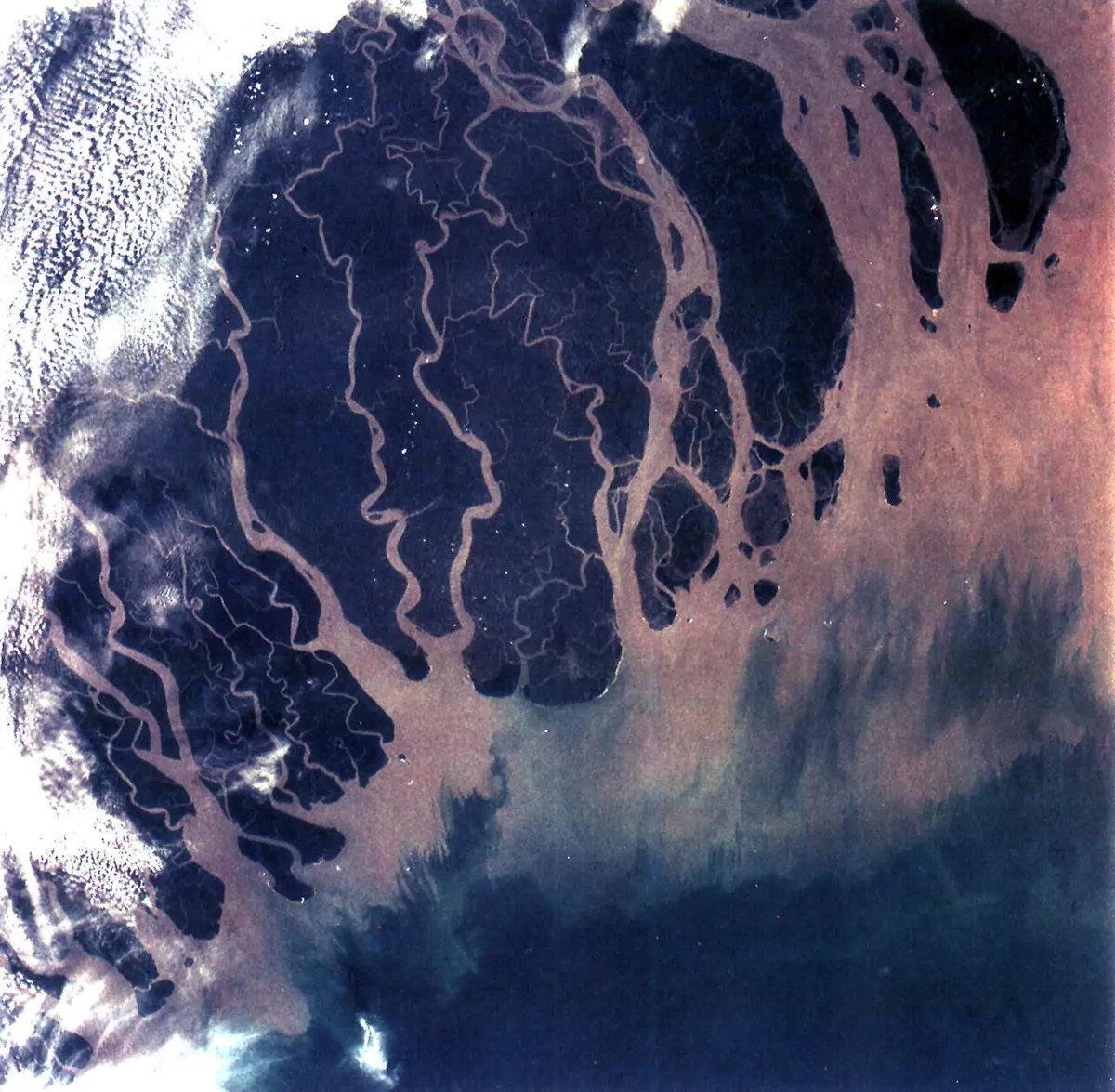
Where a river leaves the mountains, its slope suddenly flattens and it slows down. It drops its gravel first, building a broad, gently sloping fan: most of the Terai is built of the fans of the rivers coming out of the Himalaya, gravel near the hills, sand and silt farther south. Where the river finally meets the sea, it drops the rest, and builds a delta. The Ganga and the Brahmaputra together carry about a billion tonnes of sediment a year, much of it from the Himalaya, and they have built the biggest delta on Earth, in Bangladesh and West Bengal.
A river carries sand, silt and pebbles out of the hills onto a plain, where it slows down. What does it drop first?
Pick an answer to see why.
Water helps rock melt
Salt on ice
If you have ever made kulfi the old way, you have used a trick from chemistry. The molds are packed in ice mixed with salt, and the mixture gets far colder than ice alone, as low as about −20 °C. Salt dissolves in the thin film of water on the ice and lowers its melting point, so the ice melts, and as it melts it takes in heat from everything around it, the kulfi included. Almost any substance dissolved in a liquid lowers the temperature at which it freezes, or, which is the same thing, the temperature at which the solid melts.
Rock does the same with water in it. Deep in the Earth, hot rock under great pressure can take water into itself. The water breaks some of the strong links between silicon and oxygen atoms that hold the rock’s minerals together, and the rock starts to melt at a much lower temperature: for mantle rock about 100 km down, at roughly 800–1,000 °C instead of nearly 1,500 °C.
Volcanoes above sinking plates
You saw in Why Is Everest Still Rising? that where a plate of sea floor meets another plate, it sinks into the mantle (Where plates meet). That sea floor has spent millions of years under the ocean, and water has soaked into it and become part of its minerals: clays, serpentine and others that hold water in their crystals.
As the plate sinks, it is squeezed and heated, and at about 100 km down, these minerals break down and give their water up. The water rises into the hot mantle rock above the plate. That rock is at about 1,300 °C: too cool to melt while it is dry, but hot enough once the water reaches it. It partly melts, and the melt, lighter than the rock around it, rises through the crust and erupts. So above every sinking plate there is a line of volcanoes, standing roughly where the plate below is about 100 km deep: the Andes, Japan, Indonesia, the Aleutians, the Cascades.
Mantle rock 100 km down under a line of volcanoes is at about 1,300 °C. Dry, it would melt at about 1,480 °C. Why does it melt?
Pick an answer to see why.
Water and the rock cycle
Put it all together, and water is part of every stage of the rock cycle:
- Powered by the Sun, water rises from the sea and falls on the land.
- Frost splits the rock; carbonic acid dissolves it and turns other minerals into clay.
- Rivers carry the pieces and the dissolved minerals downhill, sorting them as they go, and drop them on fans, plains and deltas, and on the sea floor.
- Buried and squeezed, the layers of sand and mud harden into new rock (sandstone, mudstone), and the dissolved calcium becomes the shells of sea creatures and, in the end, new limestone.
- Sea floor carried down into the mantle takes water with it, which helps rock melt, and new rock erupts from volcanoes, to be worn down by water again.
Limestone that formed on the floor of an ancient sea now stands on the summit of Everest, and its pieces are washing back down the Dudh Koshi towards the sea today.
Questions
Which of these is chemical weathering?
Pick an answer to see why.
In which place would you expect frost wedging to break rock fastest?
Pick an answer to see why.
Explain why ice can split a rock, although ice is much weaker than rock.
Answer
Ice doesn’t split the rock by being strong, but by needing more room. Water expands by about 9% when it freezes. In a crack full of water and sealed at the top by ice, the freezing water has nowhere to go, so it pushes on the walls; the pressure can rise to about 60 MPa at −5 °C. Most rocks break when pulled apart by 5–20 MPa, so the crack is forced open. Each freeze widens and deepens it a little, and repeated freezing and thawing splits the rock.
Rain falling through the air dissolves about 60 mg of limestone per liter, but the water that has soaked through soil can dissolve over 250 mg. Explain the difference.
Answer
Limestone dissolves because carbon dioxide in the water makes it a weak acid (CaCO₃ + H₂O + CO₂ ⇌ Ca²⁺ + 2HCO₃⁻). The more carbon dioxide, the more limestone it dissolves. The air has only about 0.04% carbon dioxide, but soil air has around 1–5%, because plant roots and the soil’s microbes breathe it out. Water soaking through soil takes up much more carbon dioxide, becomes a stronger acid, and dissolves several times more limestone.
A cave guide says, “This stalagmite is 2 m tall. It grew about 0.1 mm a year.” How old is it? Why is it important not to break stalactites and stalagmites?
Answer
2 m = 2000 mm. Time = 2000 mm ÷ 0.1 mm a year = 20,000 years. A broken stalactite or stalagmite takes thousands of years to grow again, so in human terms the damage is permanent. They also record the past: their layers can be dated, and they show how the rainfall and temperature changed while they grew.
The Narayani enters the Terai at about 3 m/s in a monsoon flood, and slows to about 0.5 m/s across the plains. Describe what happens to its load of boulders, gravel, sand and silt as it slows, and where you would find each kind of grain.
Answer
At 3 m/s the river can roll pebbles and cobbles along its bed, and carries sand and silt up in the water. As it slows, it can no longer move the biggest stones, so boulders and cobbles are dropped first, near where the river leaves the hills; then gravel; then, as it slows to about 0.5 m/s, coarse sand. Silt and clay sink so slowly that they stay in the water and are carried far out onto the plains, laid down on the fields in floods, or carried to the sea. So the grains are sorted: stony near the hills, sandy farther out, silty and muddy farthest away.
A grain of fine sand 0.1 mm across falls through still water. Use Stokes’ law to find its speed. How much faster is that than a grain of silt 0.02 mm across?
Answer
v = (2650 − 1000) × 9.8 × (1 × 10⁻⁴)² ÷ (18 × 1.0 × 10⁻³) = 1650 × 9.8 × 10⁻⁸ ÷ 0.018 = 9.0 × 10⁻³ m/s, about 9 mm a second.
The sand grain is 5 times wider, so it falls 5² = 25 times faster than the silt grain (3.6 × 10⁻⁴ m/s). (At this size Stokes’ law is just starting to overestimate the speed a little; for bigger grains it doesn’t hold.)
Plan an investigation to find out whether frost breaks a soaked rock faster than a dry one. Say what you would change, what you would measure, what you would keep the same, and how you would show your results.
Answer
Independent variable: whether the blocks are soaked or dry. Dependent variable: the mass lost (or the number of cracks) after a number of freeze–thaw cycles. Controlled variables: the material and size of the blocks (for example, plaster of Paris blocks from the same mold), the freezer temperature, the length of each freeze and each thaw, the number of cycles, and the way the crumbs are brushed off before weighing. Use several blocks of each kind (say five) and take the average, to allow for differences between blocks. Weigh each block before starting and after every two cycles. Show the results as a line graph of percentage mass lost against the number of cycles, one line for soaked and one for dry blocks. If the soaked blocks lose mass and the dry ones don’t, water is what does the damage.
Explain why there is a line of volcanoes about 100 km above a sinking plate, and why the Himalaya, where two plates also meet, have none.
Answer
The sinking plate is old sea floor whose minerals hold water. About 100 km down, heat and pressure break these minerals down and drive the water out. It rises into the hot mantle rock above (about 1,300 °C), which can’t melt while dry (it would need about 1,480 °C) but melts once water lowers its melting point to about 800–1,000 °C. The melt is less dense than the solid rock, so it rises and erupts, in a line above where the plate reaches about 100 km. In the Himalaya, India is a continent, not sea floor: it carries little water and is too light to sink deep into the mantle, so no water is released into hot mantle rock, and no magma forms to feed volcanoes.
Where to go next
- Why Is Everest Still Rising? The other side of the contest: the heat inside the Earth that pushes up the mountains water wears down.
- Where Does the Carbon Go? Weathering rock takes carbon dioxide out of the air, and limestone stores it for millions of years.
- Why Has the Climate Changed Before? Ice ages, and how the record left in rocks, ice and cave stalagmites shows it.