
Nobody at a rice shop in Asan counts the grains. You ask for two kilos, the shopkeeper scoops rice onto the scale, and you go home with about 100,000 grains, though nobody counted one. A grain of rice weighs about 0.02 g, so a kilo holds about 50,000 of them. Weighing is counting, once you know what one weighs.
Chemists have the same problem, much worse. A sip of water, 18 g of it, holds about 600,000,000,000,000,000,000,000 molecules: 6 × 10²³. Nobody could count them, and you can’t even see one. Yet when chemists make a medicine, a fertilizer or a cement, they need to know how many of each kind of atom they are putting in, because atoms join in fixed numbers: two hydrogen atoms to one oxygen atom, every time.
So chemists count atoms the way the shopkeeper counts rice: they weigh them. This topic shows how, and how the same idea lets you work out, before you start, how many grams a reaction will make.
Counting by weighing
You learned in Grade 9 that every atom has a mass, measured in atomic mass units (amu): hydrogen 1, carbon 12, oxygen 16, and so on Grade 9: Atomic mass. You also added them up to get a molecule’s molecular mass: water, H₂O, is 2 × 1 + 16 = 18 amu Grade 9: Molecular mass. These numbers tell you how heavy atoms are compared with each other: a carbon atom is 12 times as heavy as a hydrogen atom, and an oxygen atom 16 times.
That is all you need to count by weighing. Think of a hardware shop in Bhaktapur that sells nails and bolts by the kilo. Suppose one bolt weighs exactly 12 times as much as one nail. Then:
- 1 kg of nails and 12 kg of bolts hold the same number of things;
- 10 g of nails and 120 g of bolts hold the same number;
- in fact, any mass of nails and 12 times that mass of bolts hold the same number, whatever one nail weighs.
Atoms work the same way. A carbon atom is 12 times as heavy as a hydrogen atom, so 1 g of hydrogen atoms and 12 g of carbon atoms hold the same number of atoms. So do 16 g of oxygen atoms, 23 g of sodium atoms and 56 g of iron atoms. Take each element’s atomic mass, in grams, and you always get the same number of atoms. What is that number?
An oxygen atom is 16 times as heavy as a hydrogen atom. Which holds the same number of atoms as 2 g of hydrogen?
Pick an answer to see why.
The mole
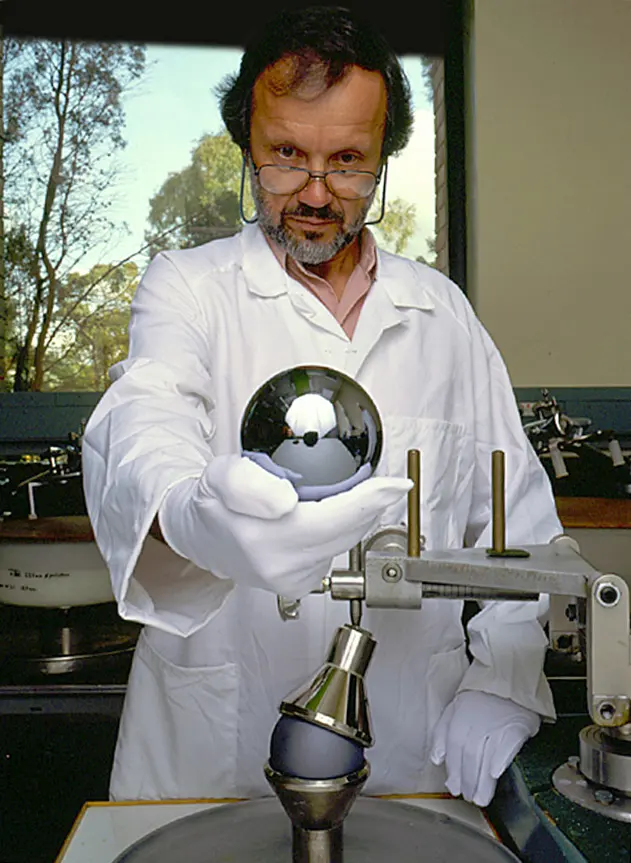
People count things in useful batches. You buy bananas by the dozen (12), and paper by the ream (500 sheets). Chemists count particles in a batch of 6.02 × 10²³, called a mole (symbol mol).
One mole of anything is 6.02 × 10²³ of it: 6.02 × 10²³ atoms, or molecules, or ions. This number is the Avogadro constant, written :
The mole is one of the seven base units of the SI, alongside the meter, the kilogram and the second (you met it in Grade 10’s table of SI units, Fundamental units). It is the chemist’s unit for an amount of substance: “how many”, not “how heavy”.
The number was picked so that the masses come out easy. One mole of atoms of an element has a mass, in grams, equal to its atomic mass: 1 mol of carbon atoms is 12 g, 1 mol of oxygen atoms is 16 g. The same goes for molecules: one mole of water is 18 g, the molecular mass in grams. That is the bridge from atoms, which you can’t see, to grams, which you can weigh.
Molar mass
The mass of one mole of a substance is its molar mass, M, in grams per mole (g/mol). It is the same number as the atomic mass (for an element) or the molecular mass (for a compound), with the unit changed from amu to g/mol:
| Substance | Formula | Molecular mass (amu) | Molar mass (g/mol) |
|---|---|---|---|
| hydrogen gas | H₂ | 2 × 1 = 2 | 2 |
| oxygen gas | O₂ | 2 × 16 = 32 | 32 |
| water | H₂O | 2 × 1 + 16 = 18 | 18 |
| carbon dioxide | CO₂ | 12 + 2 × 16 = 44 | 44 |
| methane | CH₄ | 12 + 4 × 1 = 16 | 16 |
| common salt | NaCl | 23 + 35.5 = 58.5 | 58.5 |
| calcium carbonate (limestone) | CaCO₃ | 40 + 12 + 3 × 16 = 100 | 100 |
A mole of each of these holds exactly the same number of particles, 6.02 × 10²³, but they weigh different amounts and take up different amounts of room, because their particles are different.
Grams, moles and particles
Three numbers describe a sample: its mass (what a balance shows), the number of moles, and the number of particles. You move between them with the molar mass and the Avogadro constant:
where n is the number of moles, m the mass in grams, M the molar mass in g/mol, and N the number of particles.
Which of these holds the most molecules?
Pick an answer to see why.
Atoms are conserved, so mass is conserved
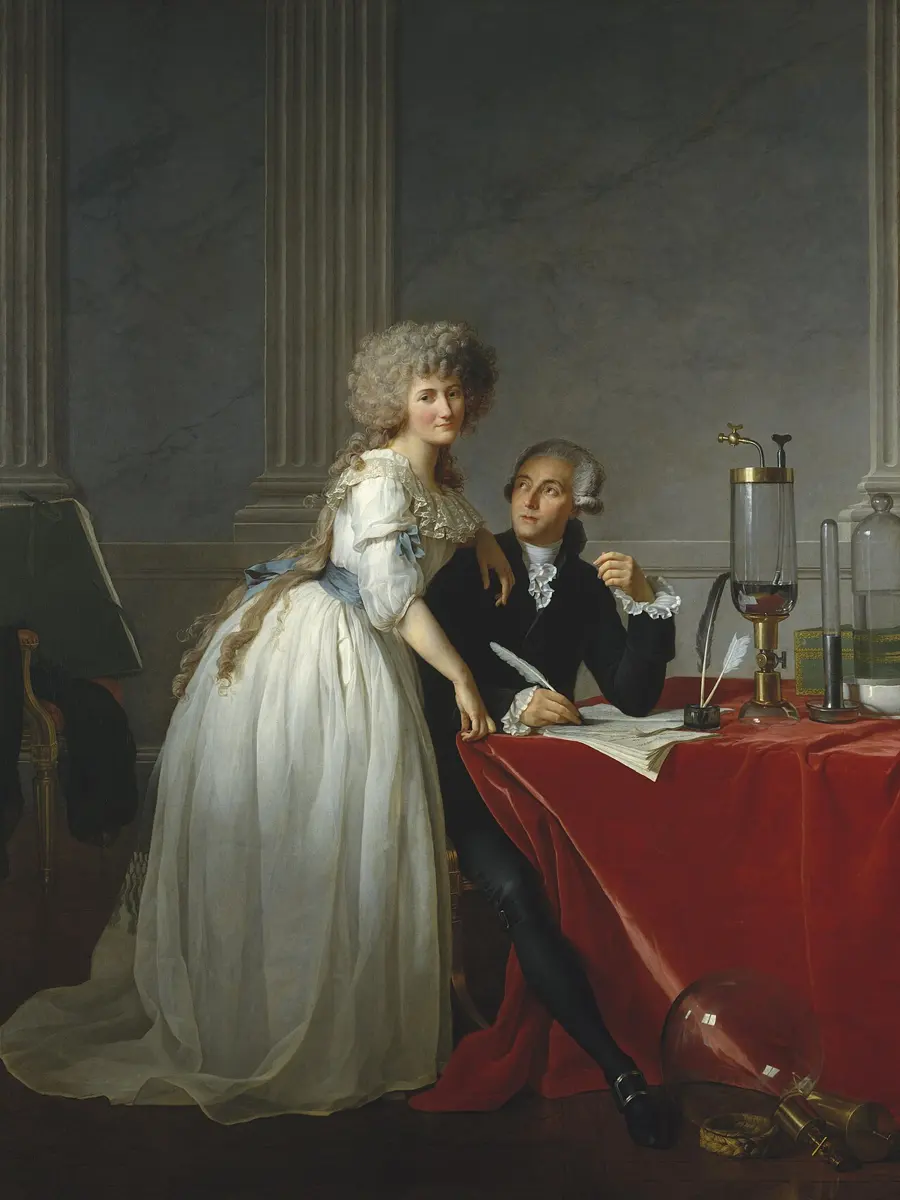
You learned in Grade 9 that in a chemical reaction the total mass of the products equals the total mass of the reactants: the law of conservation of mass, which is why an equation must be balanced Grade 9: How to balance a chemical equation. Now you can see why it is true, and show it with numbers.
In a reaction, atoms are not made, destroyed or turned into atoms of another element. They only change partners: the bonds between them break and new bonds form. Every atom keeps its own mass. So if the same atoms are there before and after, the total mass before and after must be the same.
A balanced equation lets you check this with arithmetic. Take methane burning in a biogas stove:
| Reactants | Products | |
|---|---|---|
| carbon atoms | 1 | 1 |
| hydrogen atoms | 4 | 2 × 2 = 4 |
| oxygen atoms | 2 × 2 = 4 | 2 + 2 × 1 = 4 |
| mass (amu) | 16 + 2 × 32 = 80 | 44 + 2 × 18 = 80 |
The same atoms, so the same mass: 80 amu before and 80 amu after. Multiply every particle by 6.02 × 10²³ and it is 80 g before and 80 g after. The numbers are bigger, but the balance holds at every scale, because each atom brings its mass with it.
When the balance seems to say otherwise
If mass is conserved, why does a log get lighter as it burns, while a nail gets heavier as it rusts? Because gases come and go, and you can’t see them. When wood burns, most of its atoms leave as carbon dioxide and water vapor, up the chimney. When iron rusts, it takes oxygen in from the air. Weigh only the solid and the mass seems to change. Weigh everything, gases included, and it doesn’t.
Magnesium ribbon is burned in an open crucible. The white ash weighs more than the ribbon did. Why?
Pick an answer to see why.
From atoms to grams: what a reaction makes
A balanced equation is a recipe in particles. Grade 9 showed you that it tells you the ratio of the masses that react Grade 9: Information from a balanced chemical equation. The mole turns that into a recipe in grams. Take carbon (charcoal) burning:
The numbers in front of the formulae, the coefficients, count particles, so they also count moles. 2H₂ + O₂ → 2H₂O says that 2 molecules of hydrogen react with 1 of oxygen, so 2 moles of hydrogen react with 1 mole of oxygen, to make 2 moles of water. The ratio of the coefficients is the mole ratio.
So to work out the mass of a product from the mass of a reactant, you always take the same four steps:
- Write the balanced equation.
- Change the mass you know into moles ().
- Use the mole ratio from the equation to find the moles of the substance you want.
- Change those moles into grams ().
In C + O₂ → CO₂, how much carbon dioxide do 24 g of carbon make, with plenty of oxygen?
Pick an answer to see why.
When one reactant runs out
In a real reaction you seldom have the exact amounts the equation asks for. A cook with 12 eggs and 1 kg of flour, and a recipe that needs 2 eggs for every 200 g of flour, can make only five batches, not six: then the flour is gone, and 2 eggs are left over. The flour is what limits the cooking.
Reactions are the same. The reactant that is used up first is the limiting reactant: it decides how much product is made. The other is in excess, and some of it is left over. To find which is which, change both masses to moles and compare them with the equation’s mole ratio.
Evidence from the laboratory
The mole also works backwards: from masses you have weighed, you can find how many atoms of each kind have joined, and so a formula nobody has seen. This is how chemists first found the formulae of compounds, and it is a test of the whole idea.
In a common school experiment, each group weighs a coiled strip of magnesium ribbon in a crucible, heats it strongly until it has all turned to white ash, and weighs the ash. Here are results of the kind a class gets (made up for this page, but typical of real ones):
| Group | Magnesium (g) | Ash (g) | Oxygen gained (g) |
|---|---|---|---|
| 1 | 0.12 | 0.19 | 0.07 |
| 2 | 0.18 | 0.30 | 0.12 |
| 3 | 0.24 | 0.39 | 0.15 |
| 4 | 0.30 | 0.49 | 0.19 |
| 5 | 0.36 | 0.59 | 0.23 |
| 6 | 0.48 | 0.79 | 0.31 |
If the ash were Mg₂O, MgO or MgO₂, how much oxygen should each gram of magnesium pick up? Each makes a different prediction. Test them against the class’s results.
Why is the class’s oxygen a little low? The white smoke you see when magnesium burns is magnesium oxide escaping, so some is lost; and a little magnesium reacts with the nitrogen of the air instead, making magnesium nitride, Mg₃N₂, which gains less mass than the oxide would. Real data always has errors like these. The point is that the results fall close to one straight line through zero, so the mass of oxygen gained is in proportion to the mass of magnesium (twice the magnesium, twice the oxygen), and the line’s slope matches the one formula whose atoms are in a 1 : 1 ratio.
Questions
How many atoms are there in 0.5 mol of aluminium?
Pick an answer to see why.
A student burns some steel wool on a balance, in an open dish. What happens to the reading?
Pick an answer to see why.
In N₂ + 3H₂ → 2NH₃, 2 mol of nitrogen reacts with 3 mol of hydrogen. Which is the limiting reactant?
Pick an answer to see why.
How many water molecules are there in a 250 mL glass of water (250 g)?
Answer
Moles: mol.
Molecules: 8.4 × 10²⁴.
Magnesium burns in oxygen: 2Mg + O₂ → 2MgO. Use the atomic masses (Mg = 24, O = 16) to show that the number of atoms of each element and the total mass are the same before and after.
Answer
| Before | After | |
|---|---|---|
| magnesium atoms | 2 | 2 |
| oxygen atoms | 2 | 2 |
| mass (amu) | 2 × 24 + 32 = 80 | 2 × (24 + 16) = 80 |
The atoms are only rearranged, from Mg atoms and O₂ molecules into MgO, and each atom keeps its mass, so the total mass is 80 amu on both sides. For a mole of the equation (6.02 × 10²³ times as much), it is 80 g on both sides: 48 g of magnesium and 32 g of oxygen make 80 g of magnesium oxide.
Lime (calcium oxide) is made by heating limestone in a kiln, and Nepal’s cement factories heat limestone in the same way: CaCO₃ → CaO + CO₂. How much lime, and how much carbon dioxide, does 1 tonne (1,000 kg) of limestone give? (Ca = 40, C = 12, O = 16)
Answer
Molar masses: CaCO₃ 100, CaO 56, CO₂ 44 g/mol.
1,000 kg = 1,000,000 g of CaCO₃ = 10,000 mol.
The mole ratio is 1 : 1 : 1, so 10,000 mol of each product:
CaO: 10,000 × 56 = 560,000 g = 560 kg.
CO₂: 10,000 × 44 = 440,000 g = 440 kg.
Check: 560 + 440 = 1,000 kg. Nearly half of the limestone’s mass goes into the air as carbon dioxide, which is one reason cement making gives out so much of it.
Railway tracks are welded with the thermite reaction, which makes white-hot liquid iron: Fe₂O₃ + 2Al → Al₂O₃ + 2Fe. What mass of aluminium is needed for 320 g of iron(III) oxide, and how much iron is made? (Fe = 56, Al = 27, O = 16)
Answer
Molar mass of Fe₂O₃ = 2 × 56 + 3 × 16 = 160 g/mol, so 320 g is 2 mol.
Aluminium: mole ratio Fe₂O₃ : Al = 1 : 2, so 4 mol, 4 × 27 = 108 g.
Iron: mole ratio Fe₂O₃ : Fe = 1 : 2, so 4 mol, 4 × 56 = 224 g.
(Aluminium oxide made: 2 mol × 102 g/mol = 204 g. Check: 320 + 108 = 428 g = 204 + 224 g.)
A student says: “When paper burns, only a little ash is left. So mass is destroyed in burning.” Explain what is wrong, and describe an experiment that would test the claim properly.
Answer
The paper’s atoms are not destroyed. Paper is made mostly of carbon, hydrogen and oxygen; when it burns, they join oxygen from the air to make carbon dioxide and water vapor, which are gases and drift away. Only the minerals in the paper stay behind as ash. The products, gases included, weigh more than the paper did, because they also contain the oxygen taken from the air.
To test it, burn the paper in a closed container that holds enough air, such as a large sealed glass jar (with an adult; set it alight with a lens and sunlight, or a hot wire, so nothing has to be opened). Weigh the whole sealed jar before and after: the reading stays the same. Opening it afterwards and weighing only the ash would repeat Boyle’s mistake.
- a.8 g of methane is burned with 16 g of oxygen: CH₄ + 2O₂ → CO₂ + 2H₂O. Which is the limiting reactant?
- b.What masses of carbon dioxide and water are made, and what is left over?
- c.Show that the total mass is conserved.
Answer
- a.Moles: CH₄ = 8 ÷ 16 = 0.5 mol; O₂ = 16 ÷ 32 = 0.5 mol. 0.5 mol of methane would need 1 mol of oxygen, but there is only 0.5 mol, so oxygen is limiting.
- b.0.5 mol of O₂ burns 0.25 mol of CH₄, making 0.25 mol of CO₂ (0.25 × 44 = 11 g) and 0.5 mol of H₂O (0.5 × 18 = 9 g). Left over: 0.25 mol of methane, 0.25 × 16 = 4 g.
- c.Before: 8 + 16 = 24 g. After: 11 + 9 + 4 = 24 g.
(In a real flame without enough oxygen, some carbon would be left as soot or carbon monoxide instead; that is why a gas stove needs a good air supply.)
A balanced equation is sometimes described as “a statement that atoms are conserved”. Using 2KClO₃ → 2KCl + 3O₂ and the atomic masses K = 39, Cl = 35.5, O = 16, explain how the numbers support the claim that mass is conserved because atoms are.
Answer
Count each kind of atom: potassium 2 and 2; chlorine 2 and 2; oxygen 2 × 3 = 6 and 3 × 2 = 6. The same atoms are present before and after, only joined differently.
Each atom has a fixed mass, so the total masses must agree: before, 2 × (39 + 35.5 + 48) = 2 × 122.5 = 245 amu; after, 2 × (39 + 35.5) + 3 × 32 = 149 + 96 = 245 amu.
Because a mole of anything is the same number of particles, multiplying every particle by 6.02 × 10²³ turns this into grams: 245 g of potassium chlorate gives 149 g of potassium chloride and 96 g of oxygen. The mass is conserved at every scale, because it is the atoms, each with its own mass, that are conserved.
Where to go next
- Why Do Some Reactions Get Hot? Now that you can count bonds by the mole, find out why breaking and making them gives out or takes in heat, in kilojoules per mole.
- What Makes a Reaction Go Faster? A balanced equation tells you how much a reaction makes, but not how fast. Molecules have to collide hard enough.
- Why Do Some Reactions Stop Halfway? Not every reaction makes all the product the masses here predict: some run both ways and settle at a balance.