
MOFs: crystals full of tiny rooms
Nobel Prize in Chemistry, 2025: Susumu Kitagawa, Richard Robson, and Omar M. Yaghi
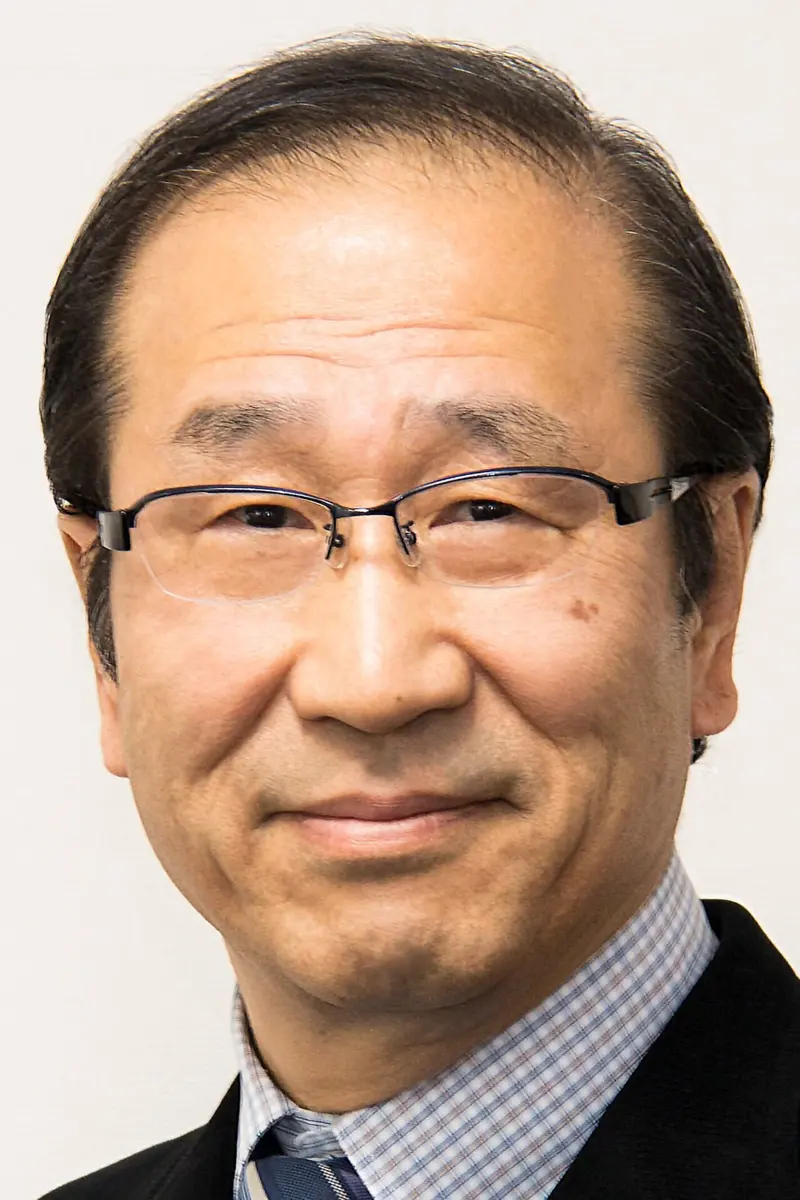
Susumu Kitagawa
born 1951 in Japan
A chemist in Kyoto who kept building “useless” crystals when nobody would pay for them, and showed they can breathe gases in and out.
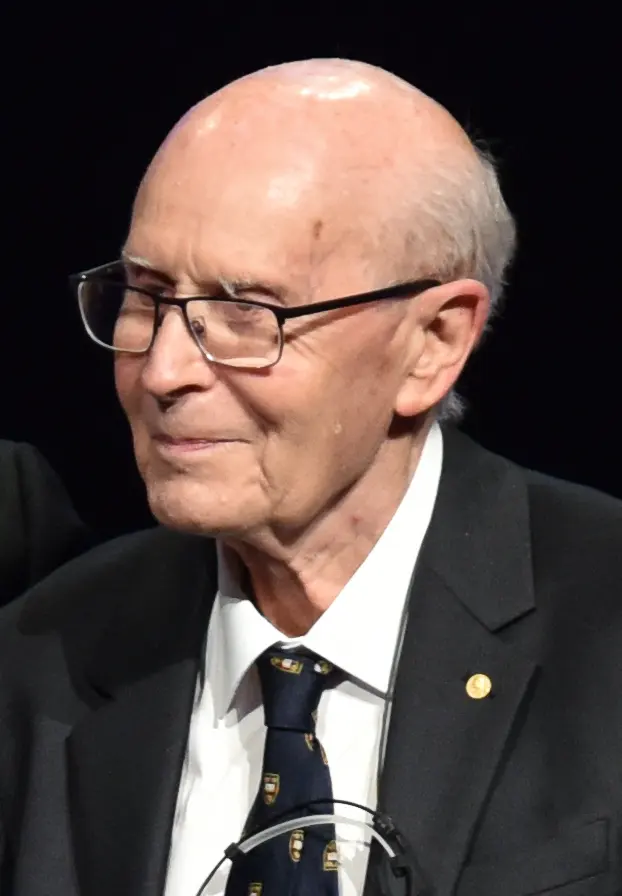
Richard Robson
born 1937 in the United Kingdom
A teacher in Melbourne whose idea came while he was making wooden models of molecules for his students.
Photo: Karen Zhou, CC BY-SA 4.0
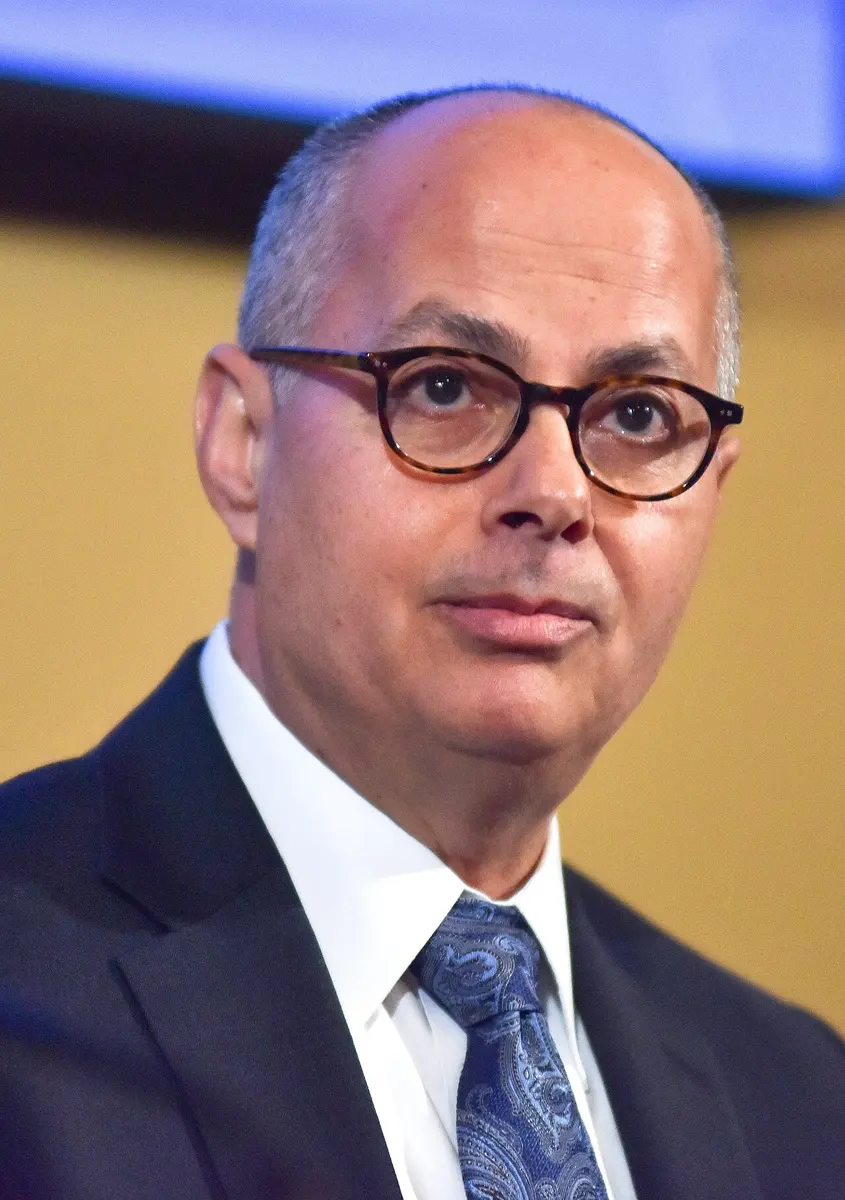
Omar M. Yaghi
born 1965 in Jordan
He grew up in one room with no electricity or running water, and fell in love with chemistry through a book in a locked school library.
Photo: Karen Zhou, CC BY-SA 4.0
A sponge is mostly holes. That is why it can soak up so much water. A spoonful of charcoal is full of holes too, so tiny that you can’t see them, which is why charcoal in a water filter can trap bad smells and tastes.
But the holes in a sponge or in charcoal are a jumble: all sizes, all shapes, scattered anywhere. What if you could build a solid whose holes were all exactly the same, arranged in perfect rows, each one a little room of a size you chose, made to hold one kind of molecule?
That is what three chemists did. Their crystals are called metal–organic frameworks, or MOFs. A few grams of one can hold, on the walls of its tiny rooms, an area as big as a football ground. In 2025 the Nobel Prize in Chemistry went to Susumu Kitagawa, Richard Robson and Omar Yaghi.
The problem: chemists couldn’t design a solid
Chemists are very good at building molecules: they can join atoms in almost any order they want. But building a solid, a crystal with a planned pattern of empty spaces inside, was much harder.
Usually, to make a new material, chemists mix substances in a container and heat it. The atoms join up however they like. Often the result is a messy lump, not the structure you hoped for.
There was one family of solids already used for their holes: the zeolites. These are minerals made of silicon, aluminium and oxygen, full of tiny channels. Zeolites are used in some washing powders to soften water and in oil refineries to speed up reactions. But zeolites are hard and rigid, their holes are small, and there are only a limited number of kinds.
Atoms have hands
To see how MOFs are built, start with something you may have done in a science class: building a model of a molecule from balls and sticks (Build your own models).
Each kind of atom forms a fixed number of bonds, pointing in fixed directions. A carbon atom has four bonds, pointing to the four corners of a tiny pyramid. In diamond, every carbon atom is joined to four others in exactly this way, and the pattern repeats in every direction, over and over, to make a hard, tightly packed crystal Grade 9: Diamond, graphite and fullerene.
The holes in a model ball decide the shape of everything you build. You can’t make a wrong shape, because the holes only let the sticks go in certain directions. That simple fact gave Richard Robson his idea.
What they did, step by step
Robson: a diamond with rooms in it (1974–1990)
- 1974, wooden balls. Richard Robson, teaching chemistry at the University of Melbourne in Australia, had to make wooden ball-and-stick models for his students. He marked where the university workshop should drill the holes, so that each “atom” had its bonds in the right directions. Building molecules with them, he noticed how much information was in the holes: the models took the right shape all by themselves.
- The idea. What if, instead of single atoms, you joined together whole molecules, chosen so that their “hands” fitted together only in certain ways? Could you design a crystal the way you design a building?
- 1989, the first one. For the corners he used copper ions (Cu⁺: copper atoms that have lost one electron, so they are positive Grade 9: Ion), which, like carbon, like to have four neighbors around them. For the links he used a molecule with four long arms, each ending in a group that sticks to copper ions. He mixed them. Most chemists would have expected a tangled mess. Instead, the ions and molecules arranged themselves into a crystal with the same pattern as diamond, but stretched out, with huge empty spaces inside.
- 1990, things move in and out. He showed that the spaces could be filled, and that ions in them could be swapped for other ions from a liquid. He suggested that such crystals could one day be designed for particular jobs.
But Robson’s crystals were wobbly. Take out what filled the spaces, and they fell apart. Many chemists thought they were useless.
Robson’s crystal had the same pattern as diamond. Why was it full of empty space when diamond isn’t?
Pick an answer to see why.
Kitagawa: the usefulness of the useless (1992–1998)
Susumu Kitagawa, working at Kindai University in Japan, liked a saying of the ancient Chinese thinker Zhuangzi, which he had read about as a student: we should question what we believe to be useful, because something with no use today may turn out valuable.
- 1992, a start. His first framework was flat, with small spaces where molecules of acetone (the liquid in nail-polish remover) could sit. It had no real use. When he asked for money to go on, many of his requests were turned down.
- 1997, it holds gas. His team built three-dimensional frameworks from cobalt, nickel or zinc ions joined by a rod-shaped molecule. Dried out, they stayed standing, and their channels could take in methane, nitrogen and oxygen gas and let them out again, without the crystal changing.
- 1998, soft crystals. Funders asked: why bother, when zeolites already hold gases? Kitagawa answered that MOFs could do something zeolites can’t. Because they are built from bendable molecules, a MOF can be flexible. Later, he and others made MOFs that change shape as they fill and empty, breathing gases in and out like a lung.
Yaghi: building like Lego (1995–2003)
Omar Yaghi grew up in Amman, Jordan, with his many brothers and sisters in a single room. At ten, he slipped into the school library, which was usually kept locked, opened a book at random and saw pictures of molecules. He didn’t understand them, but he never forgot them. At fifteen he moved to the United States to study.
As a chemist, he disliked the usual way of making materials, mixing and heating and hoping. He wanted to build crystals by design, fitting pieces together like Lego.
- 1995, a name. At Arizona State University his team made frameworks of copper or cobalt joined by organic molecules. One stayed whole even when heated to 350 °C. In his paper he called these materials metal–organic frameworks.
- 1999, MOF-5. His most famous one has clusters of zinc and oxygen at the corners, joined by a flat molecule called terephthalate, the same building block used to make the plastic of soft-drink bottles (PET). The pieces join into a framework of cube-shaped rooms. Even empty, MOF-5 stays standing up to 300 °C. A couple of grams of it has an inside surface as big as a football ground.
- 2002, a whole family. Yaghi showed that you can swap the linking molecule for a longer or shorter one and keep the same pattern. His team made 16 versions of MOF-5, with rooms of different sizes. One stored large amounts of methane, the fuel gas.
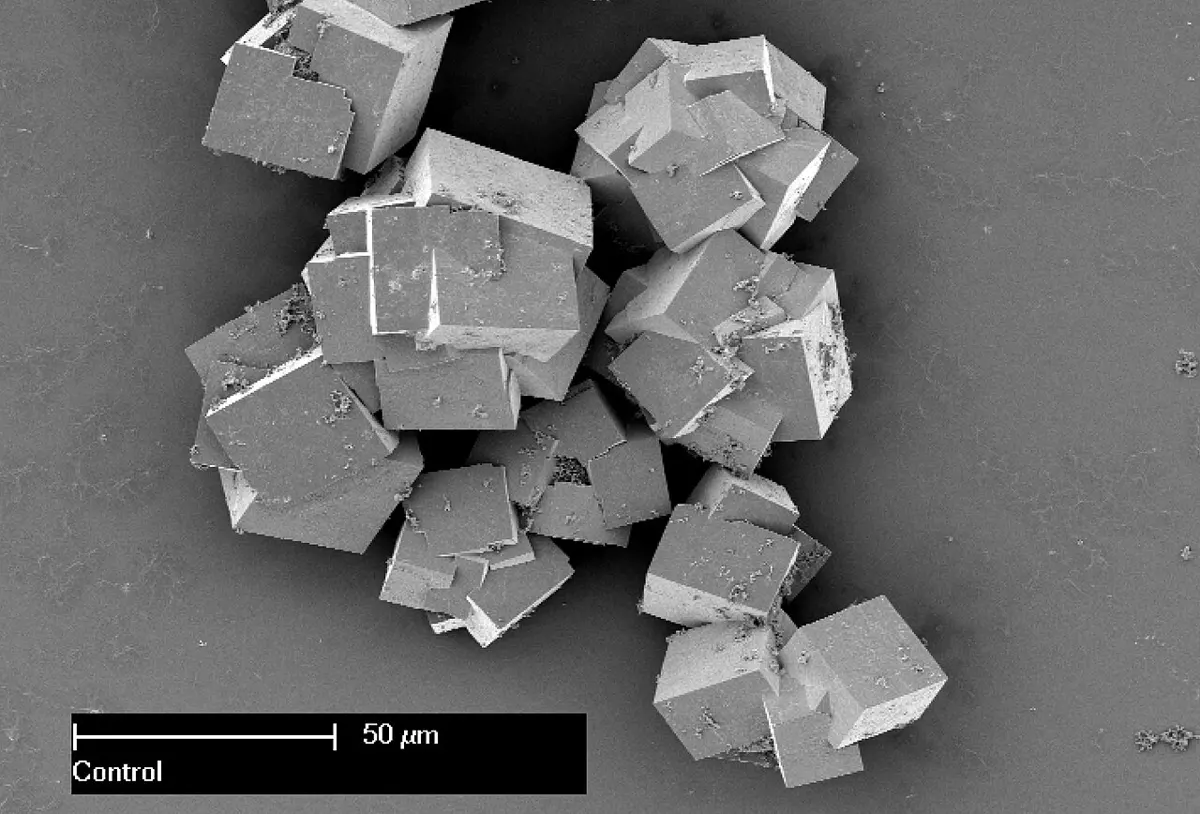
Yaghi made 16 versions of MOF-5 with rooms of different sizes. What did he change?
Pick an answer to see why.
How MOFs are used now
Since 2003, chemists have made tens of thousands of different MOFs, by choosing different metals and linkers, more and more often with the help of computers.
- Water from desert air. Yaghi’s team made a MOF (called MOF-303, with aluminium corners) whose rooms take in water vapor from the air at night, even in a dry desert. In the morning, the sun warms it and the water comes out, to be collected as drinking water. They tested it in the Arizona desert.
- Catching carbon dioxide. Burning coal, oil and gas puts carbon dioxide into the air, which strengthens the greenhouse effect Grade 10: Greenhouse effect. Some MOFs grab carbon dioxide from a mix of gases. One, called CALF-20, is being tested at a factory in Canada to catch it from the chimney before it escapes.
- Clean water. Some MOFs pull out PFAS (“forever chemicals” that don’t break down in nature) from water, or help break down traces of medicines in waste water.
- Dangerous gases. Factories that make computer chips use some very poisonous gases. MOFs now store some of them safely in their rooms, at low pressure.
- Hydrogen. Hydrogen burns cleanly, giving only water, but it is very hard to store safely Grade 9: Hydrogen gas. MOFs that soak it up could hold it without enormous pressure.
In your life today
As of October 2026, MOFs are only beginning to leave the laboratory. Most of the uses above are still small or in trials, and many companies are now working out how to make MOFs cheaply by the tonne. Whether they will do in factories what they do in the laboratory is still being tested.
In a country like Nepal, two of the hopes matter especially. Many hill villages are short of clean water in the dry season, and a device that pulls water from the air with sunlight alone could help where there is no tap. And Nepal already feels a warming climate, with melting glaciers and glacial lakes that can burst Grade 10: Climate change, so better ways to catch carbon dioxide matter here too, even though Nepal itself puts out very little of it.
What came next
- Designed by computer. With tens of thousands of possible metals and linkers, chemists now use computers and artificial intelligence to predict which MOF will do a job best, before making it.
- Cheaper, by the tonne. Many MOFs need expensive ingredients or solvents. Making them cheaply, from water instead of solvents and in huge amounts, is the main problem being worked on now.
- Will they last? Some MOFs fall apart in damp air or after many fill-and-empty cycles. Can chemists build ones that last for years in real factories and in hot, humid climates? Nobody knows yet how many of the hopes will come true.
In your science books
- Grade 9: ions, the charged corners of a MOF; diamond, graphite and fullerene, the pattern Robson copied; hydrogen gas.
- Grade 10: carbon dioxide and the greenhouse effect; climate change.
- Going further: molecules have shapes, networks of atoms and building your own models.
Learn more
- The Nobel Prize’s own explanation: They have created new rooms for chemistry (nobelprize.org), with the press release.
- The laureates’ Nobel lectures: Kitagawa, Robson and Yaghi.
The official reason
The prize was given “for the development of metal–organic frameworks.”