
RNA that works like an enzyme
Nobel Prize in Chemistry, 1989: Sidney Altman and Thomas R. Cech
-
Sidney Altman
1939–2022, born in Montreal, Canada
The son of poor immigrants, he studied physics before he moved to biology. He found an enzyme with RNA inside it and spent years showing that the RNA did the work.
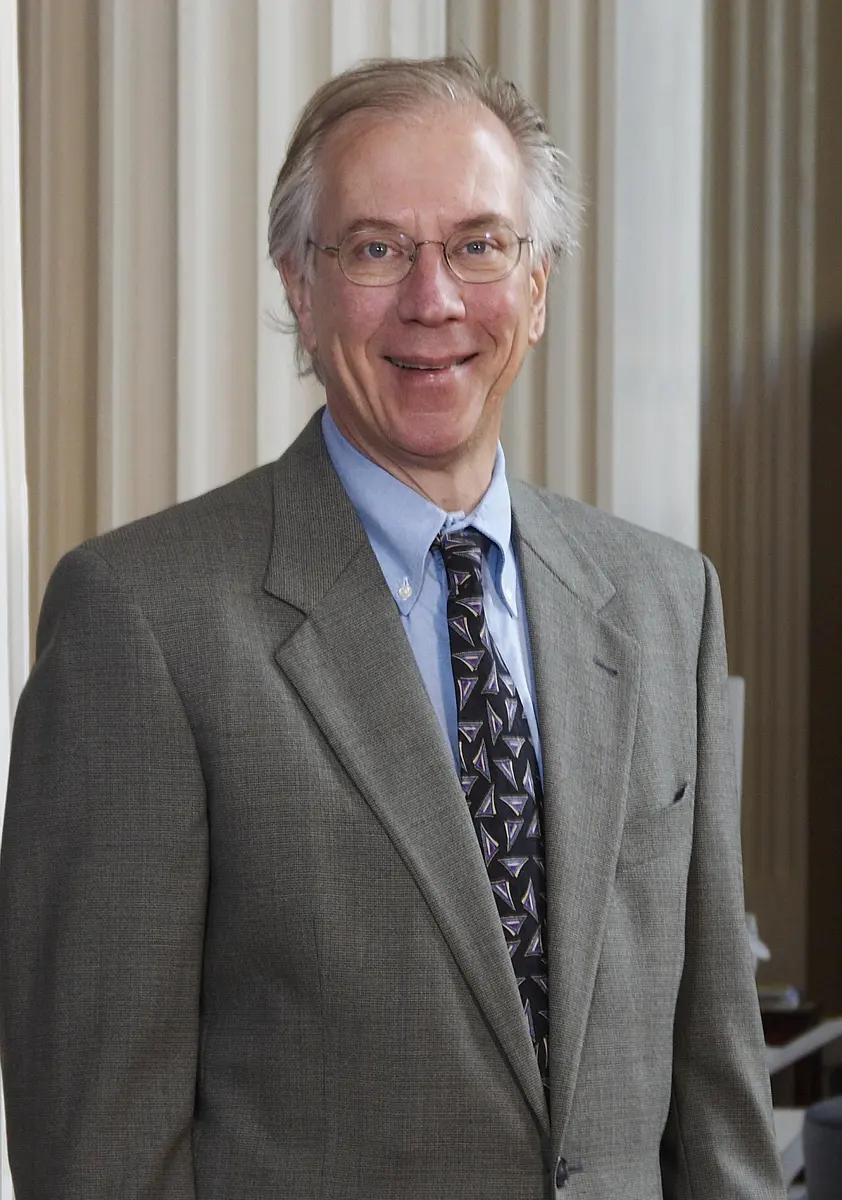
Thomas R. Cech
born 1947 in Chicago, USA
As a schoolboy in Iowa he knocked on geology professors’ doors to ask about crystals and meteorites. He was in his early thirties when a control experiment that “went wrong” changed biology.
Photo: Douglas A. Lockard, CC BY-SA 3.0
Chew a mouthful of plain rice slowly, for a minute or two. It starts to taste sweet. A substance in your saliva is cutting the starch in the rice into sugar. That substance is an enzyme, and your body has thousands of different ones, each speeding up one chemical reaction.
Until the 1980s, every textbook said the same thing: all enzymes are proteins. Then two scientists in the USA, working separately, found enzymes made of something else: RNA, the molecule that carries copies of your genes. For this, Sidney Altman and Thomas Cech shared the 1989 Nobel Prize in Chemistry. The Nobel committee said that “many chapters in our textbooks have to be revised”.
The problem: a puzzle about chickens and eggs
A catalyst is a substance that makes a chemical reaction go faster without being used up itself Grade 10: Catalyst. At the end of the reaction it is unchanged, ready to work again. Catalysts in living things are called enzymes. They can make a reaction go about a million times faster, or more. Without them, the chemistry of a cell would be far too slow for life.
In 1926 the American chemist James Sumner purified an enzyme and showed that it was a protein. Over the next fifty years, hundreds more enzymes were found, and every one was a protein. Scientists came to believe that only proteins could do this job.
Meanwhile, they had worked out how a cell uses its genes Grade 10: DNA:
- DNA stores the recipes, in the nucleus.
- Each recipe is copied into RNA Grade 10: RNA.
- The RNA is read to build a protein, which does the work.
Notice the puzzle. To copy DNA and to read it, a cell needs enzymes, which are proteins. But to make proteins, it needs the recipes in DNA. Neither works without the other. So how could life have started? Which came first, the chicken or the egg?
What makes a substance a catalyst?
Pick an answer to see why.
How RNA can have a shape
DNA is a long double strand, two chains twisted round each other. RNA is usually a single strand, made of four kinds of building blocks, or “letters”: A, U, G and C. As in DNA, the letters pair up: A with U, and G with C.
Because RNA has only one strand, its letters can pair with other letters further along the same strand. The strand folds back on itself, like a long piece of string with sticky patches, and forms loops, hairpins and twisted bundles. Each RNA folds into its own shape, set by the order of its letters.
Proteins work in the same way. A protein enzyme is a long chain that folds into a shape with a little pocket. The pocket holds the molecules that are going to react, in just the right position, and that is how it speeds the reaction up. So, in principle, a folded RNA might do the same. In 1967 and 1968 three scientists, Carl Woese, Francis Crick and Leslie Orgel, guessed that RNA might once have been a catalyst. But nobody had ever seen one.
Why it was hard
- Everybody was looking for proteins. If an RNA seemed to be doing something, the obvious explanation was that a protein enzyme was stuck to it.
- It is hard to prove that something is not there. A tiny trace of protein, too little to see, could still be a powerful enzyme. To prove the RNA worked alone, you had to rule out every last trace.
- Doubts about the word “enzyme”. A true catalyst works again and again. Some critics said the first RNA reaction happened only once, so it didn’t count.
What they did, step by step
Altman: the enzyme with RNA inside
Sidney Altman grew up in Montreal, Canada, and studied physics before he moved to biology.
- 1969–1972, Cambridge, England. Working at a famous molecular biology laboratory, Altman studied transfer RNA (tRNA), the small RNA that carries amino acids to the cell’s protein factory, the ribosome Grade 8: Ribosomes. He found that each tRNA is first made too long, with extra letters at its ends. He also found the enzyme in bacteria that trims the extra piece off the front. It was named ribonuclease P, or RNase P.
- 1978, Yale University, USA. His student Benjamin Stark found something strange: RNase P contained a large piece of RNA, and when the RNA was destroyed, the enzyme stopped working. An enzyme that needed RNA seemed shocking enough. Nobody yet dared to suggest that the RNA did the cutting.
- 1979. The team pulled RNase P apart into its two pieces: an RNA, 377 letters long, and a small protein. Neither piece worked on its own; mixed again, they did.
- 1983, the surprise. Cecilia Guerrier-Takada, in Altman’s laboratory, was testing the pieces in a different salt solution, with more magnesium in it. In a control tube with the RNA and no protein, the precursor tRNA was trimmed perfectly. The RNA alone was the enzyme. It cut one tRNA after another, so it was a true catalyst. In the cell, the protein helps it work faster.
Cech: the RNA that cut itself
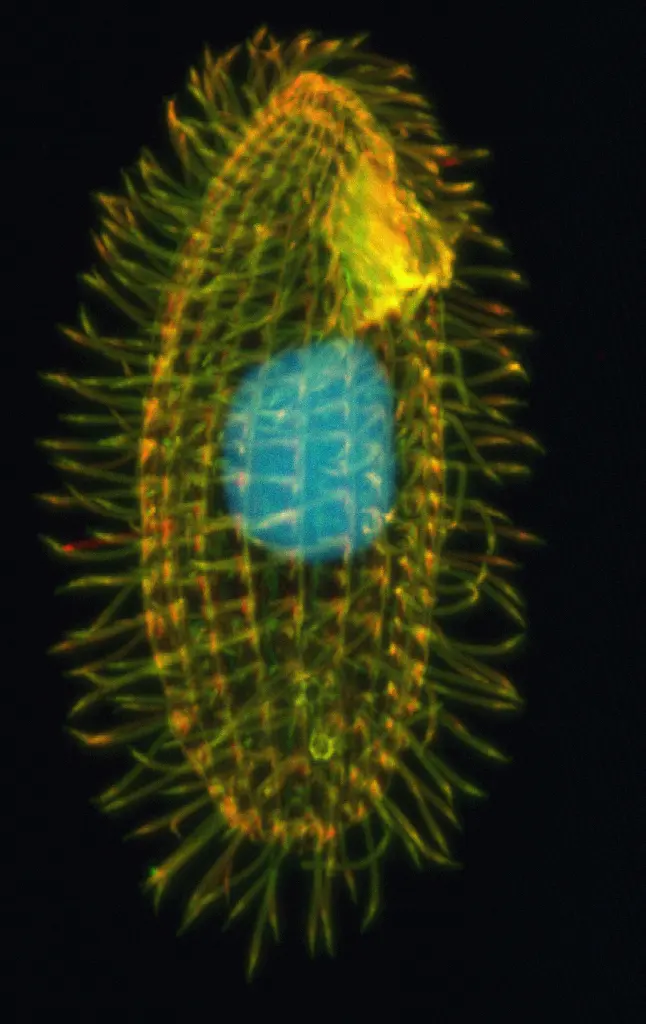
Thomas Cech started his own laboratory at the University of Colorado in Boulder in 1978. He wanted to study how genes are switched on, and chose an unusual animal for it: Tetrahymena, a single-celled creature covered in tiny hairs that lives in ponds and streams. Each cell has about 10,000 copies of the gene for its ribosome’s RNA, so there was plenty to study.
- 1979, a gene in pieces. Cech and Don Rio found that this gene had an intron: a stretch of about 400 letters in the middle that has to be cut out of the RNA copy, and the two ends joined, before the RNA can be used. Cutting out introns is called splicing (Medicine 1993).
- 1980. Arthur Zaug, in Cech’s team, showed that the splicing happens in a test tube, in nuclei taken out of the cells.
- 1981, the control that went wrong. Cech set out to find the splicing enzyme. Zaug mixed the unspliced RNA with juice from cell nuclei, which should contain the enzyme. In a control tube he left the nuclear juice out, so nothing should happen. But in the control tube, the intron was cut out just as well. Cech told him: “Well, Art, this looks very encouraging, except you must have made some mistake making up the control sample.” He hadn’t. The result came out the same, again and again.
- The extra G. The cut-out intron had one extra letter, a G, at its front end, which the gene didn’t have. And the reaction only worked if the tube had GTP (a G building block) and magnesium in it. The intron was taking a G from the liquid and using it to cut itself out.
- Torturing the RNA. They boiled the RNA with detergent and treated it with enzymes that destroy proteins. It still spliced itself.
- Early 1982, the proof. The team made the RNA from scratch, using bacteria’s copying enzyme, so it had never been near a Tetrahymena cell. Mixed with just salt, magnesium and GTP, it still cut out its own intron, at exactly the right place. They celebrated with champagne and made up a word for an RNA that acts as an enzyme: a ribozyme.
- 1986, a true enzyme. A self-splicing RNA works only once. To answer the critics, Zaug removed the first 19 letters of the cut-out intron. The shortened intron could now cut other RNA molecules, one after another, without being used up, as fast as some protein enzymes.
How a ribozyme works
The Tetrahymena intron folds into a compact shape with a pocket. The pocket grips a G building block from the surrounding liquid and holds it next to the place where the intron begins. Magnesium ions help hold the shape together and help the bonds break and form. Then splicing happens in two steps.
Each step breaks one bond in the RNA’s backbone and makes a new one, so no energy is needed from outside. That is why the RNA can do it in a test tube with nothing but salt, magnesium and G.
Altman’s RNase P is different. It cuts other RNA molecules, not itself, and a single molecule of it trims tRNA after tRNA. A bacterium makes about 60 kinds of tRNA precursor, and RNase P trims them all.
Cech’s team saw the intron cut out in a tube with no nuclear juice. Why didn’t that alone prove that RNA was the enzyme?
Pick an answer to see why.
In your life today
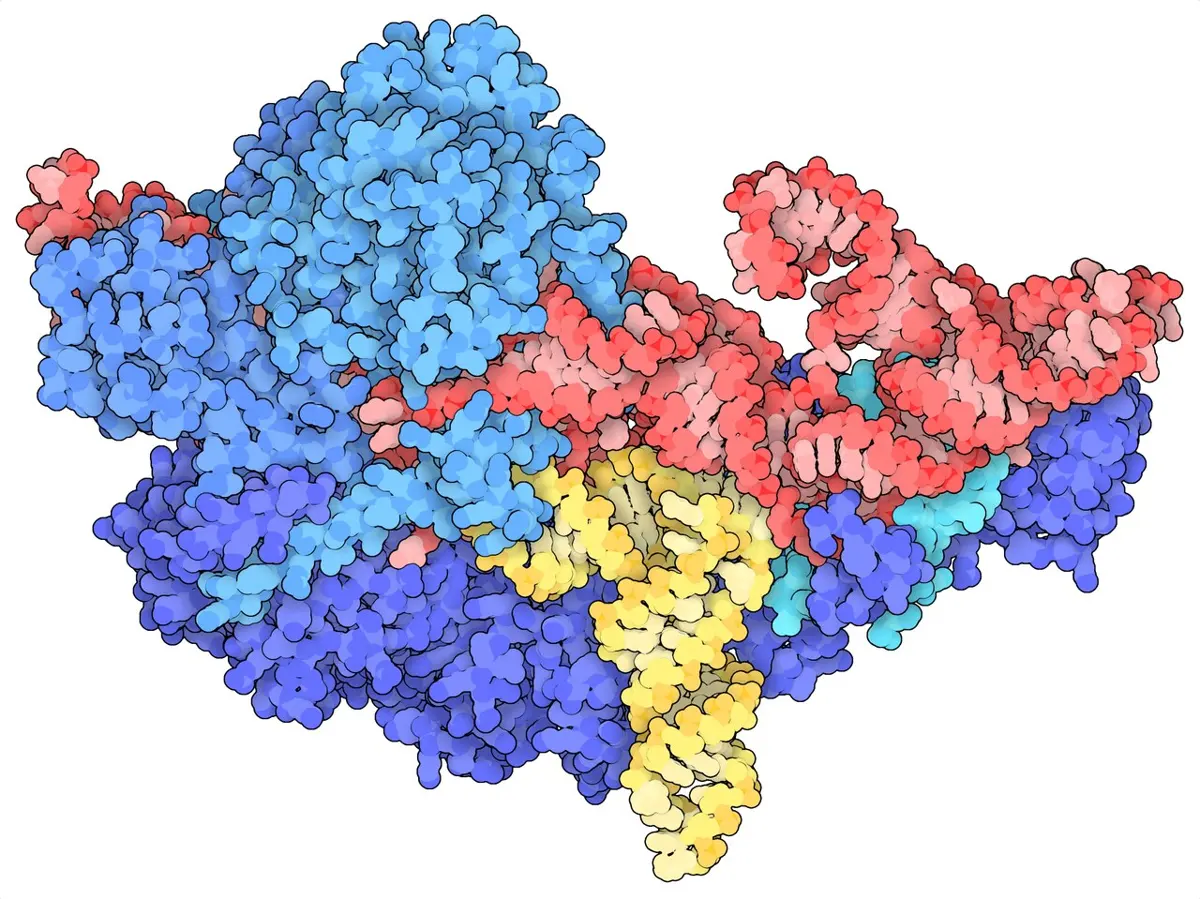
- Every protein in your body is made by a ribozyme. A ribosome is a huge machine of RNA and proteins. In 2000, when scientists saw its shape atom by atom, they found that the spot where amino acids are joined into a protein is made only of RNA (Chemistry 2009). The keratin in your hair and the hemoglobin in your blood were joined together by RNA.
- RNase P in you. Your cells have their own RNase P. It has many more proteins than the bacteria’s, but at its heart is still a folded RNA.
- A new kind of medicine. The Nobel committee hoped that ribozymes could be designed as “gene shears”, to cut up the RNA of viruses. That worked well in the laboratory but has not become an everyday medicine. Other ways of using RNA came after, built on the same new respect for it: RNA that silences genes (Medicine 2006), the RNA that guides the gene-editing scissors CRISPR (Chemistry 2020), and the mRNA vaccines against COVID-19 (Medicine 2023).
What came next
- The RNA world. In 1986 the American scientist Walter Gilbert gave a name to an old idea: the RNA world. RNA can carry recipes, like DNA, and it can be a catalyst, like a protein. So perhaps the earliest life, about four billion years ago, used RNA for both jobs, and DNA and proteins came later Grade 8: History of life on Earth. The ribosome, which still uses RNA to make proteins in every living thing, looks like a leftover from that time. This is the Nobel committee’s answer to the chicken and the egg.
- Ribozymes made in the laboratory. Scientists now “evolve” new ribozymes in test tubes, picking the best from billions of random RNAs, round after round. Some can join RNA letters into chains longer than themselves.
- An open question. For the RNA world to work, some RNA must once have copied itself, again and again, with few mistakes. No one has yet made an RNA that does this well enough. Whether life really began with RNA is still being tested.
In your science books
- Grade 8: the cell’s parts, including ribosomes and the nucleus; the history of life on Earth.
- Grade 9: an introduction to evolution.
- Grade 10: DNA, RNA, and catalysts.
- Going further: how a gene makes a protein, including copying a gene into RNA, and how catalysts lower the hill.
Learn more
- The Swedish Academy’s press release and the presentation speech (nobelprize.org).
- The Nobel lectures: Altman on RNase P, and Cech, who tells the story of the control tube and the extra G.
The official reason
The prize was given “for their discovery of catalytic properties of RNA.”